January 28th 1920

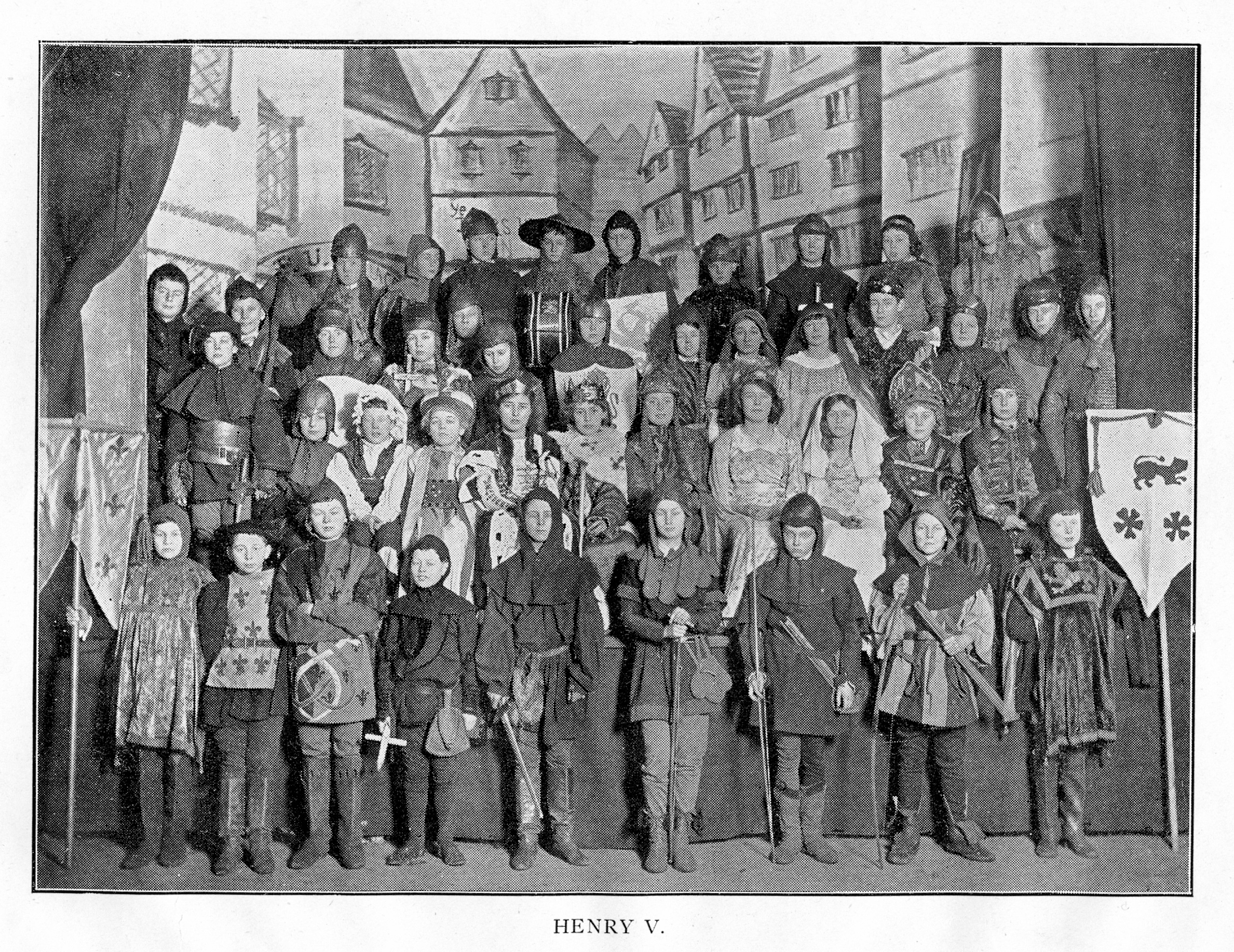
The Easter Term has got off to its usual start – with our annual Shakespeare production, this time of ‘Henry V.’ We put on three performances: one on Friday evening for 330 boys, girls and teachers from various local elementary and secondary schools, and two on Saturday for OPS parents and friends.

We were delighted to welcome back Jack Gamlen, late of the Ox & Bucks Light Infantry,  to his old job of writing a review. It may be remembered that back in 1917, when he was unable to attend our production of ‘A Midsummer Night’s Dream,’ he sent a most witty poem to the cast.

Whilst the ‘Oxford Times’ was impressed (The whole performance was of a very high standard), Jack was far harder to please:

“Let me begin by saying that I enjoyed the play very much indeed, and that it was a rich reward for the actors themselves for hours of honest work. This reward to the actors is far more important than anything that concerns the audience, but, even so, my recollection of twenty earlier school plays forbids me to put this latest one among the very best.

There was never a Class III at the OPS, and if this ‘Henry V’ comes into Class II it is only because there was, by chance, not quite enough first-rate material to lift it higher. I judge by a fearfully high standard: how can I do otherwise?”

Jack was critical of a number of performances, including that of John Betjemann, whom the Oxford Times described as “the cleverest actor of all… he played the mad old King of France in such a way that, instead of being completely minor, it became one of the most impressive parts in the whole play. There was remarkable genius in this performance.” John played two minor roles, the other being that of the Duke of Cambridge.

Jack’s assessment of this role was more critical:

“Betjemann was the best of the conspirators… but he over-acted… I am sorry to find fault, because Betjemann showed a good deal of promise which will come out, another time, if he allows himself to be natural.”  

The truth about young Betjemann is, Jack should understand, to him, being “natural” is to over-act!
 

January 23rd 1920

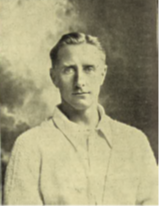
This week, the University magazine ‘Isis’ has featured our colleague and esteemed editor of the ‘Draconian‘ magazine, GC (‘Cheese’) Vassall, who has been helping get sport going again in the undergraduate world with the same verve and enthusiasm with which he conducts himself at the OPS.

Mr Gilbert Vassall

I S I S   I D O L  N o. 4 9 5

MR GILBERT CLAUDE VASSALL

(Hon. Treasurer, Oxford University's Athletics Club, 
 Rugby Union Football Club and Association Football Club; 
 Hon. Sec. of the Blues Committee)

As some people in Oxford may still be unfamiliar with his 
appearance, perhaps I had better describe him: it would be a 
pity if he were not recognised, for he is playing a big part 
now in the re-ordering of the undergraduate life of Oxford.

He is a well-set-up fellow, aged about 43. He is clean-shaved, 
has lightish hair and nice pink cheeks. He has an expansive 
smile and does not smoke. He often wears an 'Authentic' tie, 
but, in other respects, he is careless about his dress. I am 
not even sure that he has a tailor; he certainly has no hatter. 
So, if you see a man in the Parks, or on the running track, or 
on the Iffley Road Football ground, looking like this, you will 
know that it is 'V.'

He won countless athletic trophies. He appeared many times for 
the Old Carthusians and was 'capped' for England, but preferred 
to captain Oxford against Cambridge on the day of the match. He 
played football in France, Canada and America, and in such 
forlorn and dangerous places as Liepsic, Prague, Vienna and 
Buda-Pesth.

For many years before the War he acted as judge in the inter-
Varsity sports. As a cricketer he was never in the running for 
a Blue, but he was thought good enough, after he went down, to 
appear for Somerset..

Of his characteristics as a football player I cannot speak, for 
the finer points of the Association game are a mystery to me, 
but I know he has broken a cross-bar and a goal-post. On the 
field I only met him once, and he struck me as being a 
particularly brutal player...

He understands how things should be done, and he will give his 
opinion with a directness which may be disconcerting, but which 
will certainly command respect. For his opinion will be based 
upon principles which do not admit of pettiness or brag or 
insincerity. He will help Oxford to take her rightful place again 
as leader in all that is best and most untainted by false ideals.


January 16th 1920

Lieut.-Col. George Stack (Royal Engineers)

We are very sorry to learn, rather belatedly, of the death on active service of George Stack on September 16th 1919. He had served in France, Kut and Palestine during the war and was mentioned in despatches four times as well as being awarded the DSO in 1916.

Of his part in the battles of Neuve Chapelle and Ypres (1915) he wrote, in his letter to us in December of that year, “The sappers, of course, have been hard at it all the time. The work involved in maintaining old trenches, making new ones, wire entanglements, redoubts, defence of houses and villages etc., has been heavy and continuous. My own job has been to assist in this as far as possible…”

After being in France from the beginning, he went out with the Kut Relief Expedition in 1916, and was with the 3rd Lahore Division on General Maude’s entry into Bagdad.

Gen. Maude enters Baghdad, March 11th 1917.

In March 1918 the Division was sent to Palestine and was serving all through that campaign under General Allenby. During the 1916-17 campaign on the Tigris, the 3rd Sappers and Miners were often up to their waists in water for five or six nights, fighting the floods.

A farewell order to the Sappers and Miners, 3rd Division RE, given by Major HD Keary, is the best evidence for George’s wonderful work:

“Later on in India and Mesopotamia, when others fell sick, he carried on single-handed until at last he was in charge of an area extending from (but not including) Kontara up to and including Damascus, and from the sea to the Mecca railway, an enormous tract of country…  

Early in August 1919, the Chief Engineer had to go on leave, and George Stack had to take on the duties of Chief Engineer as well as those of Commander Royal Engineers, so his area stretched right up to the Taurus…”

Even he was not proof against the effects of wounds, five or six years’ fighting with little or no leave, exposure and overwork, and he now lies buried in the little British military cemetery between the villages of Ramleh and Ludd, on the slope of a hill which looks east to Jerusalem.

As his General has written:

His life was given for his Country just as much as if he had been killed in the trenches.”

January 9th 1920

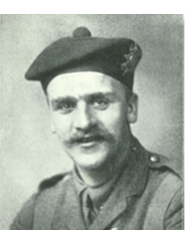
Jack Haldane, having been Junior Librarian of the Union on return from the War, is now to be an Oxford Don – strangely, to lecture for Science Schools, which he himself has never taken!

The University magazine, ‘Isis,’ has recently featured Jack as their ‘Idol’ for the week, and his time at the OPS is mentioned:

“Like many other little boys, he went to a preparatory school, in his case to Mr Lynam’s in Oxford, whence he proceeded to Eton with a scholarship. Whilst still a ‘Dragon,’ the Gods, Frankenstein-like, became frightened of the monster they had created, for they tried to translate him to other spheres of action, by causing him to undergo a compound fracture of the base of the skull. In direct contradiction of all the ordinary laws, our Idol survived, a magnificent example of the Darwinian theory, which he used to discuss with his nurse – the survival of the fittest…”

Also recalled are some of Jack’s wartime experiences (which he claims to have enjoyed):

“At the beginning of the War our Idol received a commission in the 3rd Battalion of the Black Watch, served in France and in Mesopotamia with the 1st and 2nd Battalions of that Regiment, and was twice wounded. Whilst he was in France, he was one of the first persons on whom they experimented with Chlorine Gas in the funny crude old gas-mask devices, a piece of unshowy and cold-blooded gallantry which commands everyone’s admiration.”

There is one story that particularly raises an eyebrow…

“In Simla, one night, at the Club, he is reported to have mixed (internally) every cocktail in the place, and to have run all the way home at a perfectly incredible speed; during that run he is supposed to have experienced and understood for the first and only time what the Fourth Dimension really is.”

The article ends with a fitting tribute:

“There are some who considered our pre-war Haldane to have been a little farouche; whether that be so or not, our present Idol is a wonderfully kind and tolerant friend to many. We have hope we have said enough to make it quite clear that he is a great, great man, in whom there is not once trace of intellectual snobbery which characterises so many of the little great men.

Should our readers wish to know anything further about him, to conclude let us say that he takes a hat size seven and five-eighths, and has had mumps three times.”


December 22nd 1919

Notes for the Term

With the term now over, the next edition of the ‘Draconian’ magazine is being prepared.  Under this heading are included a number of points of interest that have emerged during the term:

I have received from West Coker Rectory a number of essays written by the children attending the Church School. They show that essay writing is carefully taught; and though in originality of treatment and in expression they naturally fall short of our boys and girls of the same age, I must say that, in writing and spelling, on the average they beat us. I am much pleased to see how good they are.

* * * * * *

The competitors for Mr. Fitch’s Speech Prize were A Carling, P Mallalieu, Betjemann, Chadwick, B Burton. Carling received 10 votes and Mallalieu and Betjemann 2 each.

* * * * * *

The boys subscribed £20 to help the Barnado Home and £5 for the crippled children’s ward at the Headington Orthopaedic Hospital.

* * * * * *

Garner (Lynam)’s valuable 15 inch brass cartridge case from the Hohenzollern Redoubt has been hung up as a school gong. It awaits an inscription.

* * * * * *

During the past term, Dr FG Hobson, working under Professor G Dreyer of the Department of Pathology, has made observations upon a number of boys in the school. These observations have consisted of measurement of standing height, sitting height and chest circumference, and in addition the weight and lung capacity of each boy has been taken.

The observations were taken at the beginning and end of term and it is hoped to follow the same boys through succeeding terms.

The work is being done under the auspices of the Medical Research Committee and forms part of a general investigation, which is now proceeding, upon the questions of Standards of Physique and Physical Fitness. When sufficiently extensive observations have been made, a report will be sent in giving the results of the enquiry as far as it may be of interest and value to the school.

* * * * * *

As Hum (Lynam) reports below, we have had a reasonably healthy term, and have taken measures to combat any influenza:

“Acting on the advice of the local doctors, we had all but half a dozen of the boarders inoculated (by two injections at an interval of a week) against Influenza. There was no case of indisposition resulting from the inoculation, and we hope it may be as successful here as at a friendly rival establishment where, they assure us, they have never had a cold since it was done, eight months ago.

During the last three weeks of term we had a few cases of ‘impetigo contagiosa’ – better known as scrum-pox; and also of chicken pox. The latter seems hardly worthy of the name of disease, and is usually much less serious than a severe cold.”

* * * * * *

Next term starts on Tuesday 20th January 1920.

December 15th 1919

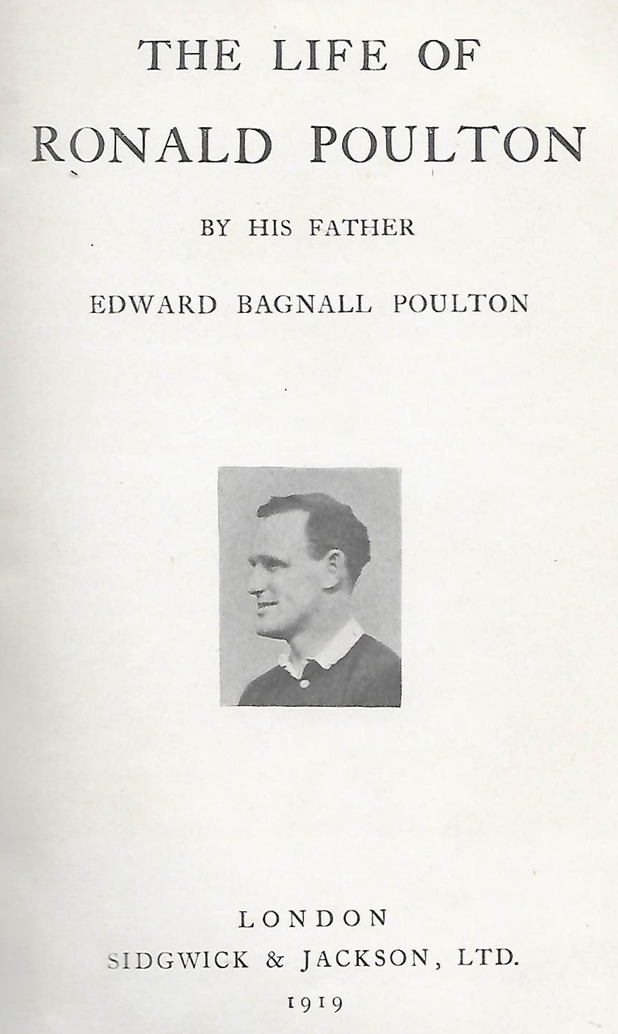
The revival of the Varsity Rugger Match, on 9th December 1919, saw the publication of ‘The Life of Ronald Poulton.’ The book is the loving and devoted work of his father.

To all people he was known as a great football player, perhaps the finest, certainly the most electrifying, three-quarter of any age…

But, as the pages of his life make clear to those who did not know, football occupied a very small part of his time and thoughts.  He regarded it as a great and glorious pastime, and nothing more. He could never regard it as an occupation worthy of a man’s whole devotion. Even on the night before an international match he would be more interested in wandering about the worst slums of Notting Dale than of thinking of what lay before him on the morrow…

It was too much to hope that the war would spare him. He went to France counting the cost, knowing that he had little chance of returning. He loved life, and hated the whole ghastly business of war, but he felt that it was his duty to go, that England might be somehow a better place for those who came after. And then – a stray bullet – and all was over.

Ronald Poulton went out to fight, to make England a better place. Will it be? It will be either better or much worse; if worse, then all the sacrifice will have been in vain…

What he would have done had he lived it is impossible to say… Though his views were still unsettled, they were taking shape. He was gravely dissatisfied with the relations of Capital and Labour; he was aghast at the social conditions of our big cities, horrified by the misery, crime, disease, waste. What an ugly contrast it all made with the New Jerusalem, with its happiness and spacious buildings and shining streets!

He would not have rested without trying with all his strength to do something, and others would have followed him…

It is because he had this rare and splendid gift for loving and for inspiring love, this magnetic influence and power of attraction, that his death has been no ordinary calamity.

But at least we can thank God that he lived and that he was what he was, bringing joy and sunshine and happiness to all who knew him. And if we keep his memory before us, as this book will help us to do, we shall be able to do our work with a stouter heart and a deeper vision, and to face the future with a brighter hope.

December 4th 1919

We have received news of the death of Maharaj Kumar Shivaji Rao (Shivajirao Gaekwad) who attended the school before the War.

Shivaji Rao, as we then knew him, was the son of Sir Sayajirao Gaekwad III, Maharaja of Baroda in India since 1863.

The Maharaja of Baroda and his family

The Maharaja came to England in 1900, bringing with him a party of 27 (seven family members and a staff of 20, including a secretary, two tutors, companions, maids, valets and a cook).

Shivaji first appeared at the OPS in the Summer Term of 1900, as was recorded in the ‘Draconian’:

“Also we have had this term two of the sons of perhaps our best friend and ally amongst the native princes of India, the Maharaja of Baroda, who is at present an honoured guest in England. His boys, Jey Singh Rao and Shivaji Rao have made themselves quite at home with our English boys and are deservedly quite popular – and should become good cricketers.”

Shivaji returned to the OPS for the Summer Term of 1902, when we saw more of his cricketing ability. He was awarded a cricket bat for an innings of 94 against Cot Hill School. Mr Vassall’s comment on him at the end of term was most complimentary: “A good bat; clever catch at the wicket; played one magnificent innings and never failed in an emergency.”

Indeed he became a cricketer of note, playing first-class games – the first of which was for the Hindus against the Parsees at Bombay Gymkana in 1909; in 1910 he played for the Gentlemen of England v Oxford University.

Shivaji returned to Oxford to study at Christ Church, making four appearances for the Oxford University XI.

Wisden’s Cricketers’ Annual 1913 recorded that “Early in the season the Gaekwad of Baroda batted in such good style that he seemed almost certain of a ‘blue,’ but a serious accident – sustained away from the field – cut short his cricket.” It transpired that, after the University match against the Australians, he had become involved in a ‘rag’ in which he suffered a serious head injury. It was said that the ‘rag’ invaded the privacy of the dons and whilst the others managed to escape, he was left to face the consequences. He was ‘sent down’ and thereafter returned to Baroda.


The Maharajah, currently on another trip to this country, received the news of his son’s death by way of a cable on November 25th. It is understood that Shivaji died on pneumonia in Baroda on November 20th, aged 29. He leaves a wife and three children.


November 25th 1919

I n   G e r m a n y   ( 1 9 1 4 – 1 8 )

123456789 – 1011 Part 12

Cyril King took a two year break from journal writing between October 1915 and 1917, by which time Ruhleben had grown most impressively:

28/10/17. “Two more years have rolled [by] since I wrote last. There have been no great changes in our life and we have almost forgotten the world outside. The only new institution is the Horticultural Society and it is perhaps the greatest of all and certainly works most smoothly. It has succeeded in acquiring a lease for the other half of the inside of the racecourse, and after tremendous struggles with the soil in which most of the camp joined, has turned it into a model market garden! In the summer we were able to buy lettuces, cucumbers, tomatoes, radishes and a few melons at almost nominal prices, while all over the camp there were bowers, borders and beds filled with every kind of garden flower. It makes all the difference in the world.

The school has greatly increased in size, filling a whole stone barrack and several sheds around it. It has from 1000 to 1500 pupils and about 100 teachers, several small class-rooms, a big reading-room, an office, two big lecture rooms, an arts and crafts department where people bind marvellous books, while others work in leather or hammer silver; a big science research laboratory where, as we hear, new ‘elements’ are discovered every day; a ‘wool and worsted’ shed, where they dye clothes in many colours and where someone has invented and constructed an apparently epoch-making weaving loom; an engineering shed; and a real live motor car, which is daily taken to pieces and put together again.

The theatre has seen over a hundred plays in five languages, including five by Shakespeare, two by Ibsen, one by Chekhov, two by Rostand, several by Maeterlinck, Synge, Lady Gregory, Yeats, Shaw and Galsworthy, five Gilbert and Sullivan Operas, two pantomimes, a German musical comedy, variety shows and numerable French and English farces, melodramas and other plays – nearly all completely successful and I think really awfully well done. The fortnightly chamber orchestral and choral concerts, and the weekly debates and lectures, have been continued unbrokenly, and in the summer we have had open air concerts on the promenade des Anglais.”

November 19th 1919

I n   G e r m a n y   ( 1 9 1 4 – 1 8 )

123456789 10 – Part 11

This is the final section from Cyril King‘s journal of October 28th 1915, in which he continues his description of life in the Ruhleben camp for civilian prisoners of war:

“Societies, circles and committees have sprung up, and though there are constant quarrels and heated resignations, a very great amount of work has already been done. The stage in the grandstand has been enlarged and most extraordinarily fitted with footlights, scenery, battens, costumes, make-up, furniture and so on, and we have weekly debates, fortnightly concerts of every kind of music, fortnightly lectures and five performances of a different play almost every week, ‘variety shows’, revues, French, German, Irish and English ‘classics’, melodramas and farces – paying their way by tickets costing from one mark to twenty pfennigs each. French, German and Italian circles have been formed for debates, lectures and discussions in those languages, and the school has already about 800 pupils and almost as many teachers!

We have been able to rent the inside of the oval-shaped racecourse, and football was played on it… and cricket, on coconut matting, during the summer. There is enough space for one full-sized ground and two small ones – one of which is now used for hockey and rugger and the other two for soccer. In August and September we played tennis on a part of the racecourse itself, where by dint of constant laborious rolling and watering, eight courts have been made and kept in very good condition on the sand…

It is wonderful to be so free of money cares, and many of the conventions which seem necessarily to accompany them – the greatest plutocrats living on 20 marks a week and there being almost no distinction in dress; and it is wonderful too to know so many people so thoroughly and to be able to make all kinds of interesting acquaintances whom one would never see outside; but one longs for privacy and to be forced to work hard, instead of being always observed by someone and having more leisure than one knows how to spend.”

November 13th 1919

DINNER FOR OXFORD OLD DRAGONS

November 8th 1919

A delightful evening was spent at the School House, when Oxford ODs came to dinner. We were even invaded by two naval stalwarts from Cambridge, and by one representative of the Army of Occupation.

Amongst those present were: CA Pittar, O Sturt, ALF Smith, JBS Haldane, SBL Jacks, CP Duff, WT Collier, NS Norway, ML Jacks, PJ Campbell, V Alford.

* * * * * *

After abeyance during the War, the mid-term holiday has been revived; and Admiral Tyrwhitt’s whole holiday, in celebration of the surrender of the German Fleet, was added to it.

Hum Lynam has provided the following account:

“Boarders who went home, or to stay with friends or other boys, left on Friday 7th November and returned on the evening of Monday Nov. 10th, in time for fireworks.

This revival seemed generally popular with boys and parents, though there were one or two protests. The increased cost of travelling, and some increase in the possibilities of incurring infection, as well as the considerable trouble of getting so many boys away and back again, incline us to the view that a trip to the country would be the better way for most, while some would have parents down to see them.

Those who did not go away had a trip by charabanc on the Saturday, and after a walk by the river at Henley, we ate our lunch in the headquarters of the Ancient Order of Oddfellows, amid strange appurtenances, which were put to stranger use. Then up the steep side of the Chilterns to Peppard Common, where we were royally entertained by Mr & Dr Carling at the Sanatorium. We just caught the last of the glories of autumn colouring, which seemed to surpass themselves this year, and are surely nowhere more striking than among those Berkshire beeches.

We got back to Oxford in time for ‘progressive games’ organised by Miss Field.

A bicycle and caravan expedition on the Sunday was marred by rain.”