November 11th 1917

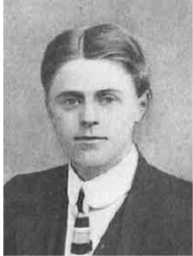
2nd Lieut. Pat Campbell, having returned to the Ypres front following four days’ leave in Paris, has found himself back in the thick of this seemingly never-ending battle at Ypres, which has been going on since July 31st.

23/10/17 “The veterans of the brigade say – at least some of them do – that in all the long years they have been out here they have never seen such a country of absolute desolation, or such mud, and that they have never had the breeze up so badly as they have in the last few days…”

Pat was involved in an attack on October 22nd. As the Forward Observation Officer for his Brigade, he had to make his way forward with four signallers to a pill box close to the front line. Carrying heavy equipment and in bad conditions, this took them 3 hours.

His job was to keep in touch with the advance and send back information to the artillery. This was easier said than done, it seems:

“It is very difficult to tell what has happened in the early stages of a battle; some of the walking wounded who come dancing down the line are so pleased with themselves that they tell you that everything is going top hole, though they were probably hit before the thing began, while others who are rather worse and have lost some of their friends are equally despondent.”

He and another officer took turns to go forward:

“We went out alternately to various HQ and other less official sources to find out what news we could get and whether the infantry wanted any particular artillery support. On one of these little trips I got rather a nasty shock, which made me decide that I was not going out any more.

Usually you can hear a shell coming for at least a second or two and one learns to act promptly, but on this occasion it was a light velocity shell, which came right alongside us without any warning at all.”

This seems a strange point at which to leave this incident, but Pat does, so there it is. The Campbells deserve their luck. Pat’s brother Percy Campbell was killed in the first battle at Ypres almost three years ago to the day in 1914.

In his letter Pat asks, “I am wondering what the papers said about yesterday’s battle. It seems to have been a pretty decent show…”

This is a view shared at least by the Daily Telegraph:
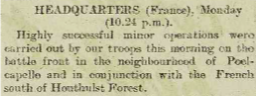
Given the conditions Pat describes, it is difficult to imagine how a battle can be fought:

“It was very tiring walking about because at every step you lifted pounds of thick Belgian mud. I don’t think you could find a single square yard in that area that was not part of a shell hole, but even so, you can’t have any idea of what it looks like. It is simply indescribable.”

It is not that often that an artillery officer finds himself in the front line and Pat is quick to acknowledge the role of the infantry, who are there all the time:

“The more you see of them, the greater respect you have for them all, and I think the subalterns in particular. Such things as trenches have practically ceased to exist now, and they just live in shell holes and going forward to attack over ground like this, I really can’t understand how they do it. “

And so say all of us.
November 6th 1917

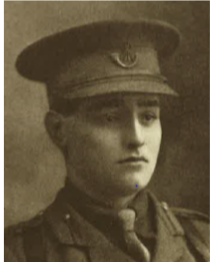
2nd Lieut. Gifford Turrell (OBLI)

This is the most distressing news that I have had to pass on during the course of this dreadful conflict. Indeed, the details are almost too painful for words, and I wondered if I should spare you them. However, I have come to the conclusion that I should not shy away from sharing what are the grim realities of war for our gallant Old Boys.

Yesterday Gifford Turrell was laid to rest in Oxford’s Holywell Cemetery, aged a mere 19 years.

He was severely wounded in the head in the attack made by the Ox & Bucks Light Infantry on August 22nd near St. Julien, the same engagement in which Lieut. Will Scott was killed and Walter Moberly won the DSO.

Gifford was brought back to St Thomas’ Hospital in London, where an operation was performed to remove fragments from the wound, leading to hope that he might make a recovery.

During his time in hospital however, Gifford was barely conscious and on Nov 1st he was assessed by a Medical Board. It noted that the brain had swollen to such an extent that it protruded through his skull and had become infected.

The report concluded: “He appears to be totally blind, and consciousness is very feeble. Pupils dilated & inactive, no motor paralysis. Sensation cannot be determined. In the last two days, there has been fever & meningitis has set in with a fit. Recovery is improbable & he is failing rapidly.”

Gifford died the following day – 72 days after he had been wounded. One can only hope that he was in such a state as to have been spared any pain. His passing must be seen as a merciful release for him and his family.

His body was brought back to Oxford so that his funeral could be at his old college (Queen’s).

May he finally rest in peace.


November 1st 1917

Lieut. Gustavus Hume-Gore (Argyll & Sutherland Highlanders)

News from German East Africa takes time to reach our shores and only recently have we heard of the death of Lieut. Gus Hume-Gore, who since December has been attached to the King’s African Rifles.

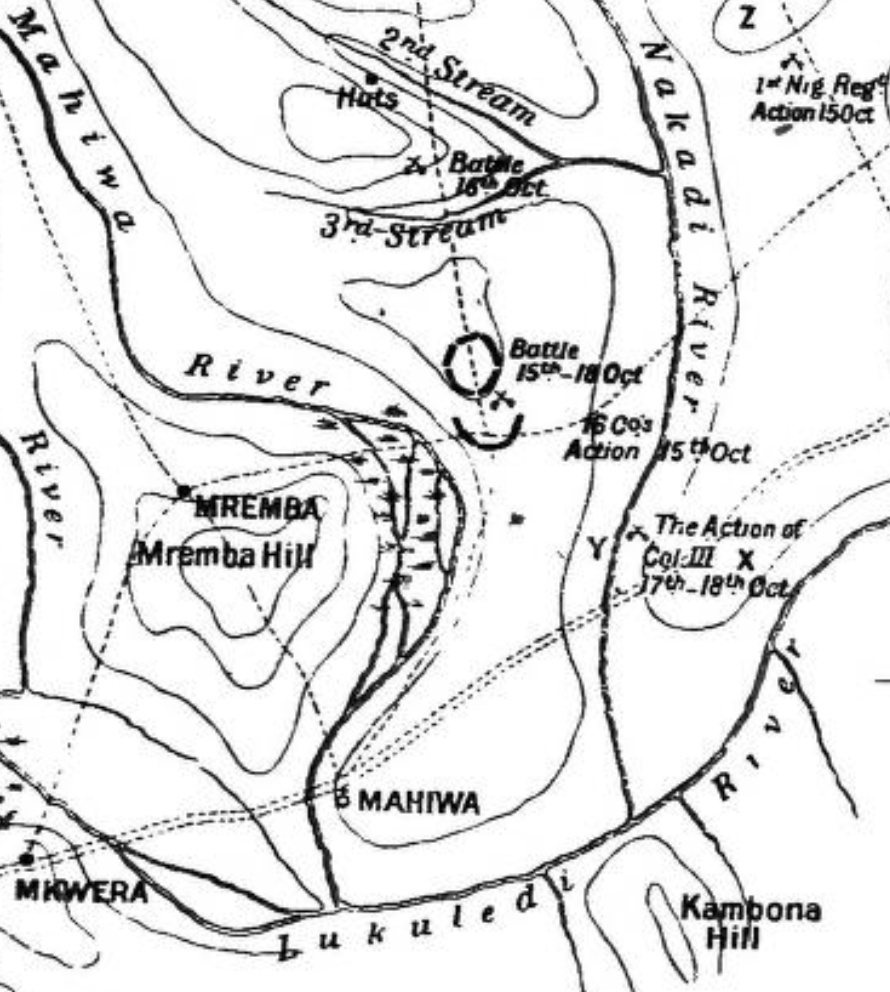
The bare facts are that he was killed in a battle fought at Nakadi River, 28 miles from Lindi on October 17th.

He was involved in an attack on German troops near Mahiwa, driving them back over what was a dry river bed. However, the exact manner in which Gus met his death is unknown.

We were most grateful to Gus for his descriptions of the conditions faced by our troops in East Africa, written within a week of his death. Illness was rife, but it was noted that in his time with the Battalion he had never been taken sick, and was one of only three in the Battalion not to require hospital treatment.

October 22nd 1917

Friday’s newspaper published the latest lists from London Gazette and in it is the excellent news that 2nd Lieut. Walter Moberly (Ox & Bucks Light Infantry) has been awarded the DSO:

“In an advance against enemy positions three companies reached their objectives and consolidated. The commanders of all three companies were killed, and he thereupon assumed command of the front line. The position was extremely difficult, as the troops on both flanks had failed to reach their objectives, and the enemy were consequently holding positions at and slightly behind his flanks.

Communication with battalion headquarters failed, as runners were unable to get through the machine-gun and snipers’ fire from the front and flanks. In these circumstances this officer determined to hold on to the advanced line at all costs.

He took steps to defend his flanks, and organized an effective resistance to counter attacks. By his prompt and decisive action and complete disregard of danger he inspired his men with confidence; and if it had not been for this plucky decision and courageous determination on his part, the whole of the objectives gained would have had to be abandoned.”

It was in this attack – on August 22nd – that Will Scott, who had been with D Company, was killed and Gifford Turrell severely wounded. (Gifford is, we hear,  still at St Thomas’ Hospital in London).

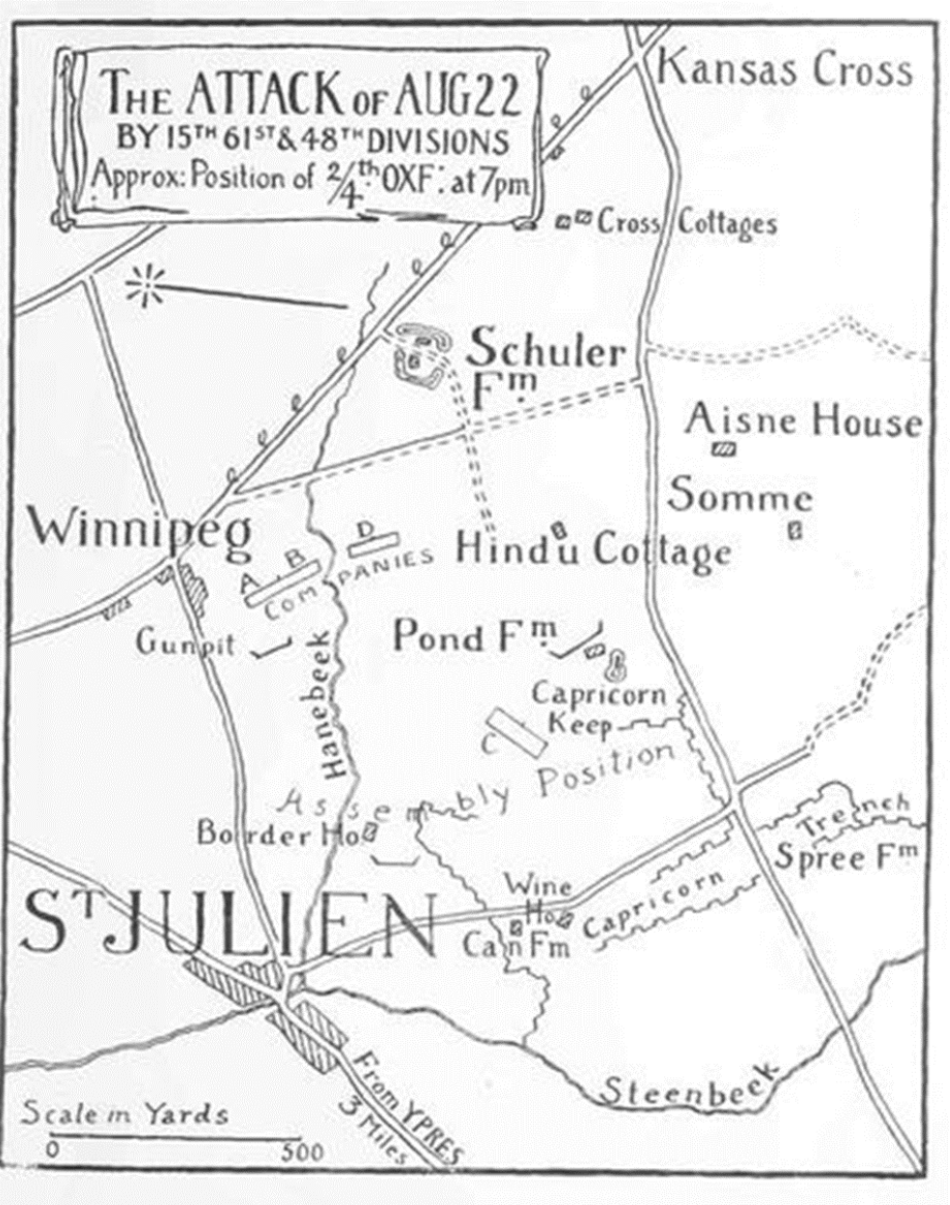
The attack was witnessed by Capt. Geoffrey Rose, who has kindly provided this map:

The companies Walter took command of are shown as A, B and D Companies. They were fired on from both Schuler Farm and the gunpit to their rear.

C Company, in which Gifford Turrell was fighting, is shown as having been held up by enemy forces at Pond Farm.

The sadness of this is that, although the citation makes it clear that without Walter’s determination “the whole of the objectives gained would have had to be abandoned,”  Geoffrey Rose tells us that “what had been gained by it (the Ox & Bucks) with heavy loss was in fact given up by its successors almost at once.”


October 18th 1917

A second letter has been received from Lieut. Gus Hume-Gore (Argyll & Sutherland Highlanders), who is with the King’s African Rifles and the British East Africa Expeditionary Force.

In addition to the extreme heat he complained about last time, he now catalogues a number of other difficulties the British soldier faces:

11/10/17 “Tinned rations that are mostly full of sand before you have finished eating them (aided by the worst kind of flies), the water in your bottle a bit more than lukewarm, and not the best of water very often at that; bottles have been filled from a stream and then dead bodies have been discovered roosting against a rock up-stream; sun that burns the eyes out of you; sun that makes you sick, that goes clean through your backbone and out the other side; sun that makes everything made of metal red-hot, so hot that it will blister your fingers if you give it a chance – and miles and miles of the ‘road’ that never seems to grow less and is harder and harder the farther you get.

When the rains come in about three weeks and then slack off for a bit, I gather that everything I have tried to picture may be multiplied by about ten.”

October 15th 1917

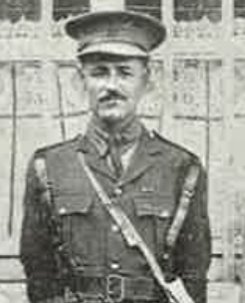
2nd Lieut. Walter Moberly (Ox & Bucks Light Infantry), has felt moved to contribute a piece in memory of Hugh Sidgwick, his contemporary at the OPS:

2nd Lt. W Moberly

“When my generation entered VIa in September 1894, we found him, though a year younger than the rest of us, already there, the only survivor of the previous year, amongst whom he had been the first…

With Hum (Lynam) to teach us and Sidgwick to set us a standard we had a most stimulating time; and I remember nothing to compare with it until I reached Senior Sixth Book at Winchester under Dr. Fearon…

I have never known any other case of a boy being so completely on a pinnacle by himself, though I have been told that ten years later Jack Haldane approached something of the same position…

In those days, Mr Lang of Magdalen, now Archbishop of York, used to teach us Divinity. I remember his describing to us one day the characteristics of the Pharisees and of the Sadducees respectively, and his asking us each in turn which we thought we should have been. Sidgwick, who was of course at the top, led off with proclaiming himself a Sadducee. The future Archbishop told him he had judged rightly, and so he certainly had…”

Walter further recalls Hugh speaking at an Old Dragon Dinner:

“He (Hugh) went on to ask what the distinctive character of the School and its training is. He found it in the Skipper’s refusal to force his boys into one or other of two or three conventional moulds, in his positive encouragement of originality, in the opportunity given to boys to discover their own peculiar interests and gifts; so that, if you were to collect a number of Old Boys in after-life and to ask what was the common stamp that the School had set on them, you would be able to point to no single machine-made quality, but you might observe that every one was very much himself.”

I have never believed that our boys are clay to be shaped as potters will, all much in the same way, and our way. To have tried to mould a Hugh Sidgwick was unthinkable. What if the chisel had slipped, what irretrievable damage might have been done?

Finally, few concerned with the School would disagree with Walter’s conclusion:

“If I were asked to illustrate the contribution of the OPS to English life, and now to England’s sacrifice, I should be content to couple his name to that of Ronald Poulton and let the OPS be judged by them.”

Capt. Hugh Sidgwick (RGA)


October 11th 1917

Lieut. Gus Hume-Gore (Argyll & Sutherland Highlanders) was seconded to the King’s African Rifles with the British East Africa Expeditionary Force last December. Whereas many an Old Dragon is complaining of the mud so prevalent on the Western Front, Gus has very different but equally trying conditions with which to contend:

4/10/17 “I have just had my first wash and shave for seven days and feel quite respectable again.

We have just done a great push and advanced about 8 miles with some heavy fighting. The positions the Germans take up are terrible. They get well dug-in and then stick trees and spikes etc well round them, so that attacking over the open with a lot of machine guns firing at you is a nasty job.

The heat is overwhelming and makes even breathing difficult. My arms and knees are the colour of bronze…

We are simply eaten alive with mosquitoes, bugs etc., as we can’t put up a net when we are on the move. There is a lot of swampy ground around here.

I am trying to improve my German by reading German letters and books which are lying about all over the place.” 

One can forget that this war is being fought across the world, so we are grateful to Gus for reminding us of this.


October 6th 1917

The ‘Oxford Magazine’ has published an appreciation of the life of Capt. Hugh Sidgwick (RGA), who died of his wounds on September 17th:

“Another of the veriest sons of Oxford, and of the Morning, gone! And one of the brightest and best… he had such obvious qualities for true friendship – intelligence far above the average, wit and humour and a capacity for deep affection, and endless interests in many directions, the open road, or even more the open hills, music, mathematics, history, scholarship, education, social service and what not.

After a brilliant course at Winchester and Balliol – his was a case of double First Class Honours in Mathematics and Classics, something of a rarity nowadays with rising and specialist standards…

During his life he returned to the College the greater proportion of his stipend as Fellow to be applied to the support of necessitous students, and by his will he directed that the whole balance should be repaid to the Master and Fellows, leaving them free to allocate it in the same way, or in any manner they may approve…

Hugh has also left the OPS £100 in his will, which will aid our Leaving Exhibition Fund. This fund has, since 1908, been allowing me to give leaving exhibitions to help boys whose parents are not very well off to go to a good public school. (The first such award I gave to a young Jack Smyth, later to win the VC).


September 30th 1917

Sergeant Robert Pratt (Military Labour Bureau)

We have received news from Robert’s family that he died of the spotted fever at Iringa in Eastern Africa on September 9th.

In 1914, soon after arriving in Johannesburg, where he had gone to join the National Bank of South Africa, he was taken seriously ill, but recovered and with the opening of the East African campaign he passed riding and shooting tests and joined that fine body of men, Van de Venter’s Scouts.

In a short time 70% of them lost their lives and in 1917 Robert was drafted into the Military Labour Bureau.

He was a bright, merry, conscientious boy all the time he was with us; anxious to reach the high standard he had set himself both in and out of school.

I met him a few years later by chance in Stoke-on-Trent. He told me he meant to come and see his old school again after he had done something creditable.

His is the 51st name to be added to our Roll of Honour.


September 24th 1917

Much as one would like to have enjoyed the celebration of the school’s 40th anniversary this past week, all possible pleasure has been overwhelmed by the sadness we are all feeling at the loss of Hugh Sidgwick. I have no hesitation in saying that he was the ablest boy that ever came to the school, and withal one of the most lovable.

The circumstances of his death (which it pains me greatly to write about) are that on September 16th, Hugh was getting into a car to go to HQ when a German aeroplane dropped a bomb, wounding him and several others.

He was taken straight to the Casualty Clearing Station and underwent an operation. However, there was internal bleeding and he lost consciousness and died in the early hours of the 17th. We are reassured to hear that he was in no pain and slipped away quietly.

By the time his mother received this telegram notifying them that Hugh had been wounded, he was in fact already dead.

Regret to inform you that No 46 Casualty Clearing Station reports September sixteenth Captain AH Sidgwick RGA 157 Siege Btty with bomb wound buttock and right knee. Condition dangerous…    Regret permission to visit cannot be granted.

By the time they received a second telegram the following day telling them of his death, he had been buried in the Mendinghem British Cemetery.

All so quick. One moment he is the vibrant human being we have all loved so much, the next…  all this.