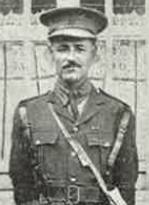
February 3rd 1918

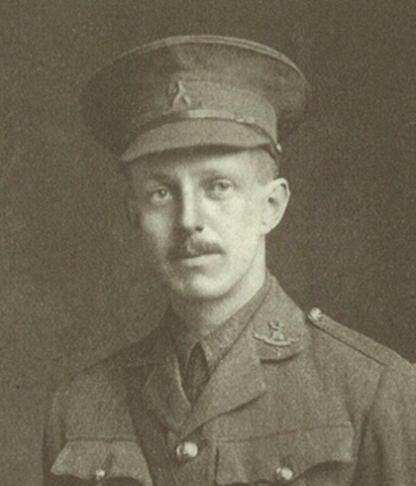
I am grateful to Lieut. Spencer Leeson (RNVR) for this appreciation of the life of Martin Collier, who has become the 58th of our old boys to have laid down his life for the country:
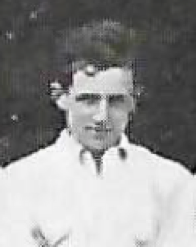
Spencer Leeson

“Memories of Martin must be vivid and clear-cut in the minds of all his friends. He was one of those men who, as it were, hit you straight between the eyes the first minute you saw him. You were conscious at once of a personality, and at the mention of his name afterwards many scenes came crowding into memory with the figure of Martin in high relief, saying or doing some characteristic thing.

Many will remember even how he used to arrive at school in the morning – hands in pockets, a battered old cap a little to the back of his head, passing jauntily through the gate leading to the asphalt, and on frosty mornings, rushing to the top of the slide to take his place in the queue.

On the rugger ground, of course, he was in his glory…
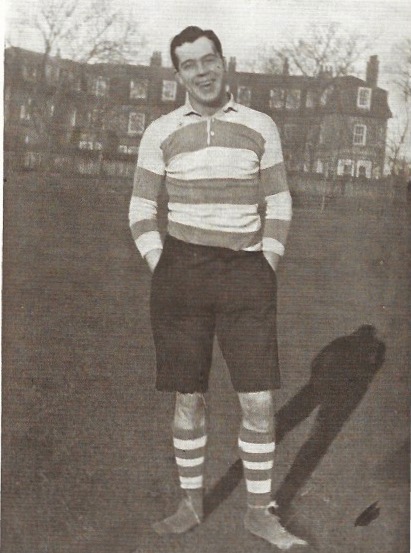
Martin Collier outside School House

The ordinary school matches never roused in him the stern ardour with which he entered upon a Dayboy and Boarder match… He always played a great game on these days, as I have particular reason to know, for he generally marked me out of touch. He would speak of these games with great enthusiasm when he was well on the way to his International Cap, and of all the matches he played, I do not believe he enjoyed any more than those at the School for the OD side.

One game particularly will be remembered – surely the greatest the ODs ever played – when GC (Mr Vassall) collected an OD side which Lindsay Wallace took down in December 1913 to meet the Osborne officers and staff. Martin led the pack in tremendous style, and our victory was largely due to his and Lindsay’s play.

Whenever I met him afterwards, Martin would speak rapturously of that game, and declare that when the OD scrum got well together, no side on earth could beat them.”

We did so hope that Martin would have lived to fulfil his ambition to play for England, and his last letters to the school – one on some rather robust rugger tactics and the other in support of a War Memorial, will be treasured.

There was more to Martin than sporting prowess, however, and Spencer is right to remember this:

“He carried his taste for literature with him into the service, and would relate afterwards how hard he found it to get time for reading, and how his Philistine colleagues used to enquire what earthly good there was in Tennyson or Browning.

In one of the last letters I had from him, he told me how he was enjoying a volume of Plutarch, which he could read, he said, in his submarine, during his off-time, ‘not a hundred miles from the coast of Germany.’

His memory will be enshrined among us, as long as any are alive who knew him.”


January 17th 1918

E A S T E R   T E R M   1 9 1 8

Yesterday saw the start of a new term. The School Roll numbers 141, of which 84 are boarders. Our Junior Department has a further 26 – the majority being 7 and 8 yr. olds.

Let us hope for a healthy term, free of illness. It will no doubt become even more difficult to keep everyone well fed. Yesterday’s announcement in the newspapers of compulsory rationing of butter and margarine (with other items undoubtedly to follow), allows us only 4 oz per person per week. Meat continues to be in short supply, although the importation of Argentinian beef is helping make up the difference.

* * * * * * *

It was a great pleasure to be able to share with our returning pupils the news of honours recently won in the war – particularly that of the DSO by one of their former teachers.

One of the more prestigious orders of chivalry is the Order of the Bath – founded by King George I in 1725. In the honours list announced in the New Year, Captain. WW Fisher (RN) and Temp. Brigadier-Gen. BG Price (Royal Fusiliers) were made Companions (CB).

The Distinguished Service Order (DSO) has been awarded to Temp. Major LD Luard (ASC), Acting Maj. JAA Pickard (RE, Special Reserve) and, although not an Old Dragon but a much admired member of the Dragon staff before the war, Temp. Capt. WRG Bye (Royal West Surreys & General List).

No fewer than six have been awarded the Military Cross (MC): Acting Capt. FS Low (RFA), Acting Major VLS Cowley (Irish Rifles, attached to MGC), Temp. Captain WT Collier (RAMC), Capt. EH Evans (RWF), Temp. Lieut. GH Moberly (MGC), Captain. GF Thuillier (Devons).

* * * * * * *

Readers of The Times of 14/1/18 may have noticed this article on Capt. William Fisher (RN). For those who read other newspapers, here it is:

Director of Anti-Submarine Division

“Capt. WW Fisher commanded a battleship at Jutland, and was commended for his services in that action. He has received a CB. He had held several Staff appointments before the war, having served as flag commander to the Commander-in-Chief  of the Home Fleet at Devonport, while in the summer of 1912 he was selected to act as Assistant Umpire for the Grand Naval Manoeuvres.

He is a gunnery specialist and a French interpreter, and was commander of the ‘Indomitable‘ when that vessel made her record run across the Atlantic with King George, then Prince of Wales, on board in 1908.

He has been for some months the Director of the anti-Submarine Division of the Naval Staff.”

January 12th 1918

Lieut. Arthur Huson (RGA) has sent in this heart-felt appreciation of his, and our great friend, Bill Sheepshanks, whose death was confirmed recently.

2nd Lieut. William Sheepshanks (KRRC)

“Well, Sheepers, they have given me a difficult job this time, old thing, to try to do justice to your memory, but I should be a poor sort of pal if I did not make the attempt.

I remember you first when I arrived at the School House, very small and very frightened,  long time ago now, and you helped to make an easy path for me, a new boy in a new world.

It did not take long to grow to like you, and not long for that liking to develop into something deeper, for there have been few things in your short life that we have not done together…

It was always you that led the way and I never knew you chuck your hand in over any single thing you tried, and you wouldn’t let me do it either. The very thought of giving in never seemed to occur to you…

Do you remember the joys of the Varsity rugger, or the Eights, or lunch in a punt on the Cher on Sundays? We tried and shared them all. And how we crept out of our beds and waited together to get seats for the Mikado, for how we blessed Josias Conybeare and his car for taking us to an ‘International’ in Town?

And how faithful you were to the Skipper and his School. Not that it was a hard job, but ask GC (Mr GC Vassall, esteemed editor of the ‘Draconian‘) how many dinners or cricket matches you missed at the OPS. How we looked forward to those games. They were the only ones you were allowed to keep wicket or I to bowl, and with what joy we encompassed the fall of Pug Wallace – when we did.

Well those days are over, Sheepers, except in memory, and I don’t think I realised it properly until that Winchester meeting at Amiens the other day when you were not sitting next to me to talk about old times, as you surely would have been.

But your end was true to your life, old thing, and you have left behind you a memory as clean and happy as the life that bred it. Here’s luck to you on the other side, Sheepers. God knows you need no wishes of mine, but you shall have them nonetheless, for a cleaner, straighter, truer pal man never had.”

January 1st 1918

As we move into a New Year, I look back with a mixture of pride and extreme sadness at the achievements and sacrifice made by so many in 1917.

Since July, 13 Old Boys have been wounded, one has received the DSO, three the Military Cross, one a special promotion, one a Croix de Guerre, one an Egyptian distinction, one a Belgian, one an Italian and one a Royal Red Cross award. There have been 13 ‘Mentions in Despatches’ (Bat Price for the 5th, Tyrrell Brooks the 4th and Jocelyn Pickard the 3rd time).

The Roll of Old Boys that have fallen includes some of my best, and best-loved, friends. Their lives cannot and must not have been given in vain: and the thought that has come down the ages, that the souls of the brave and righteous still live on, cannot lie.

None do we mourn more greatly than Hugh Sidgwick. His family has passed to me this tribute from his old employer, Sir Amherst Selby-Bigge, Permanent Secretary to the Board of Education, reflecting on Hugh’s abilities:

“He was not only a perfect Private Secretary, but a very dear friend who could be trusted with anything. His loyalty, sincerity and candour were perfect and I never found in him the slightest touch of vanity or self-seeking…

His mind was singularly cool and well balanced and his exposition of intricate problems admirably clear and logical. His knowledge of Mathematics and power of handling figures were invaluable…

He had the gift of writing straight ahead in good proportion and with clear expression and articulation of argument, almost as quickly as another man could dictate…

When he was in doubt about coherence and lucidity of an important paper for publication he used to test it by turning it into Greek, and I have in my possession an admirable Greek version of a letter addressed by the President of the Board (HAL Fisher) to teachers, concerning their duties in regard to military service…”

Hugh was one of 18 Old Dragons to perish in 1917, 9 of whom were involved with the third and grimmest of struggles at Ypres. The fates of Edmund Gay,  John Dowson and Hunter Herbertson remain unknown.

          Capt. E Gay            Capt. OJ Dowson     Lieut. H Herbertson

Is it too much to expect, or even suggest, that 1918 might see the end of this terrible conflict?


December 30th 1917

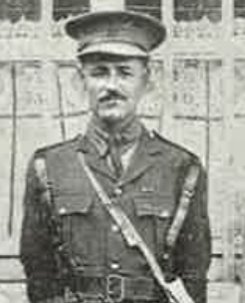
Capt. GK Rose – Capt. WH Moberly – Capt. CSW Marcon

Three Old Dragons of the 2/4th Ox & Bucks have kindly sent their picture, just in time to be included in the December edition of our magazine.

Capt. Geoffrey Rose tells us that the 2/4th Ox & Bucks near Arras were involved in a raid to draw the attention of the Germans away from Cambrai, just before the attack was launched there on November 20th. Capt. Walter Moberly and his company were chosen to carry out this diversionary attack, which was made on November 19th.

The attack was preceded by a gas attack using a mixture of lethal and non-lethal gas, which were “intermingled both by the Germans and ourselves with high explosive shells; the effect of each assisted the effect of the other. If one began to sneeze from the effect of non-lethal gas, one could not wear a gas helmet to resist the lethal; the high explosive shells disguised both types…

It was planned to fire lethal gas against the enemy for several nights. On the night of the raid and during it, non-lethal only would be used. The two gases smelt alike and the presumption was that on the night of the raid the enemy would wear gas-helmets…

B Company, though they missed the gap through the enemy’s wire, entered the trenches without opposition and captured a machine-gun which was pointing directly at their approach but never fired…

As often, there was difficulty in finding the way back to our lines; in fact, Moberly… after some wandering in No-Man’s-Land, entered the trenches of a Scotch division upon our right. His appearance and comparative inability to speak their language made him a suspicious visitor to our kilted neighbours. Moberly rejoined his countrymen under escort.”

Much has been written of the great attack made at Cambrai on November 20th, involving over 400 tanks.

Drawing by Geoffrey Rose


December 27th 1917

2nd Lieut. William Sheepshanks (KRRC)

It has been some five months since Bill was reported as “missing.” Just before Christmas, the family received from the Red Cross what they take to be confirmation that Bill died of his wounds on July 10th. The information came from KRRC men now in German prisoner of war camps.

Letter from the International Red Cross

19/12/17. “We beg to enclose, as a result of our enquiries in different camps in Germany, the statements of Capt. Hugh Ward, interned at Freiburg and 2nd Lieut. Rowland Madeley of the same unit, prisoner at Clausthal, Germany.”

Captain Ward’s statement accompanying this was, “I saw him carried out of the German dressing station in a moribund condition on the evening… He could not have lived more than half-an-hour. He was unconscious.”


The family have also heard this from Bill’s servant:

“… I was your son’s servant from the time he joined the battalion until the time he was taken prisoner along with the other officers, NCOs and men who were lucky enough to be spared on that most memorable day, July 10th, when the KRRC and the Northants made a great stand at Nieuport, Belgium.

The Germans started their terrible bombardment at 8 o’clock in the morning, and your son was very badly wounded at 9.30 a.m. and the Captain and two stretcher-bearers tried to get him to the dressing station, but owing to the heavy shell-fire it was impossible to get to him and a few of his platoon. At 7.30 in the evening the Germans attacked and took our positions, as we were surrounded and cut off…

On the morning of 11th July, I was told he had died at the German Field Dressing Station.”

The letter from the Red Cross concludes, “We deeply regret it should be our duty to convey such sad news to you, but we want to draw your attention to the fact that this statement is unofficial and cannot in any way be considered as an absolute certainty…”

It seems rather cruel to suggest there is a chance Bill could be still alive in the face of this evidence. Surely it will be enough to convince the Army Council to authorise publication of Bill’s name on the official casualty lists?


There are few boys who have captured our hearts so entirely as Bill Sheepshanks did. There was an individuality about him, a fearless independence, and at the same time a most fascinating and chivalrous courtesy which impressed us all. A powerful and active brain, coupled with a calm and always cheerful demeanour and a winning smile, were rare gifts which would have carried him far.

November 11th 1917

2nd Lieut. Pat Campbell, having returned to the Ypres front following four days’ leave in Paris, has found himself back in the thick of this seemingly never-ending battle at Ypres, which has been going on since July 31st.

23/10/17 “The veterans of the brigade say – at least some of them do – that in all the long years they have been out here they have never seen such a country of absolute desolation, or such mud, and that they have never had the breeze up so badly as they have in the last few days…”

Pat was involved in an attack on October 22nd. As the Forward Observation Officer for his Brigade, he had to make his way forward with four signallers to a pill box close to the front line. Carrying heavy equipment and in bad conditions, this took them 3 hours.

His job was to keep in touch with the advance and send back information to the artillery. This was easier said than done, it seems:

“It is very difficult to tell what has happened in the early stages of a battle; some of the walking wounded who come dancing down the line are so pleased with themselves that they tell you that everything is going top hole, though they were probably hit before the thing began, while others who are rather worse and have lost some of their friends are equally despondent.”

He and another officer took turns to go forward:

“We went out alternately to various HQ and other less official sources to find out what news we could get and whether the infantry wanted any particular artillery support. On one of these little trips I got rather a nasty shock, which made me decide that I was not going out any more.

Usually you can hear a shell coming for at least a second or two and one learns to act promptly, but on this occasion it was a light velocity shell, which came right alongside us without any warning at all.”

This seems a strange point at which to leave this incident, but Pat does, so there it is. The Campbells deserve their luck. Pat’s brother Percy Campbell was killed in the first battle at Ypres almost three years ago to the day in 1914.

In his letter Pat asks, “I am wondering what the papers said about yesterday’s battle. It seems to have been a pretty decent show…”

This is a view shared at least by the Daily Telegraph:

Given the conditions Pat describes, it is difficult to imagine how a battle can be fought:

“It was very tiring walking about because at every step you lifted pounds of thick Belgian mud. I don’t think you could find a single square yard in that area that was not part of a shell hole, but even so, you can’t have any idea of what it looks like. It is simply indescribable.”

It is not that often that an artillery officer finds himself in the front line and Pat is quick to acknowledge the role of the infantry, who are there all the time:

“The more you see of them, the greater respect you have for them all, and I think the subalterns in particular. Such things as trenches have practically ceased to exist now, and they just live in shell holes and going forward to attack over ground like this, I really can’t understand how they do it. “

And so say all of us.

October 22nd 1917

Friday’s newspaper published the latest lists from London Gazette and in it is the excellent news that 2nd Lieut. Walter Moberly (Ox & Bucks Light Infantry) has been awarded the DSO:

“In an advance against enemy positions three companies reached their objectives and consolidated. The commanders of all three companies were killed, and he thereupon assumed command of the front line. The position was extremely difficult, as the troops on both flanks had failed to reach their objectives, and the enemy were consequently holding positions at and slightly behind his flanks.

Communication with battalion headquarters failed, as runners were unable to get through the machine-gun and snipers’ fire from the front and flanks. In these circumstances this officer determined to hold on to the advanced line at all costs.

He took steps to defend his flanks, and organized an effective resistance to counter attacks. By his prompt and decisive action and complete disregard of danger he inspired his men with confidence; and if it had not been for this plucky decision and courageous determination on his part, the whole of the objectives gained would have had to be abandoned.”

It was in this attack – on August 22nd – that Will Scott, who had been with D Company, was killed and Gifford Turrell severely wounded. (Gifford is, we hear,  still at St Thomas’ Hospital in London).

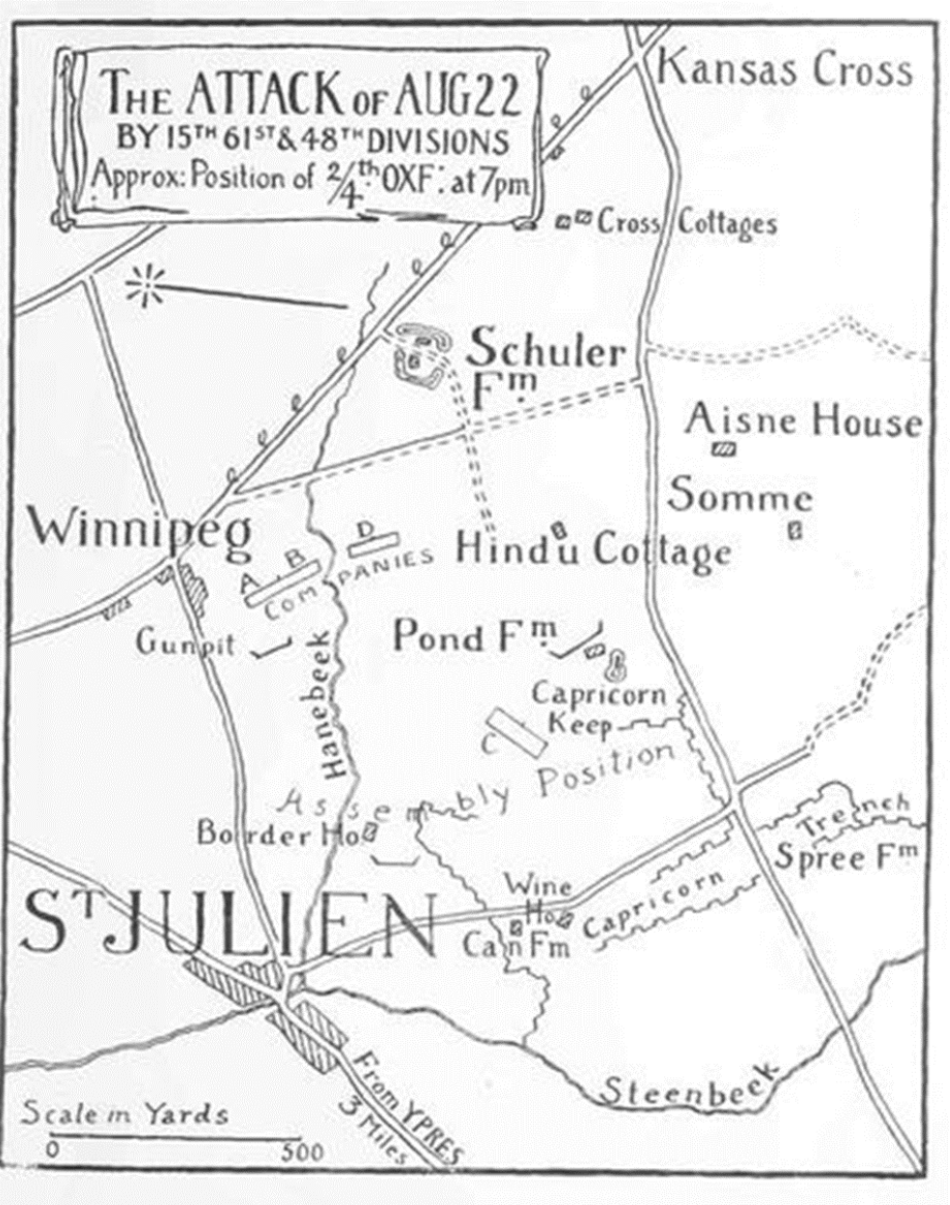
The attack was witnessed by Capt. Geoffrey Rose, who has kindly provided this map:

The companies Walter took command of are shown as A, B and D Companies. They were fired on from both Schuler Farm and the gunpit to their rear.

C Company, in which Gifford Turrell was fighting, is shown as having been held up by enemy forces at Pond Farm.

The sadness of this is that, although the citation makes it clear that without Walter’s determination “the whole of the objectives gained would have had to be abandoned,”  Geoffrey Rose tells us that “what had been gained by it (the Ox & Bucks) with heavy loss was in fact given up by its successors almost at once.”


October 15th 1917

2nd Lieut. Walter Moberly (Ox & Bucks Light Infantry), has felt moved to contribute a piece in memory of Hugh Sidgwick, his contemporary at the OPS:

2nd Lt. W Moberly

“When my generation entered VIa in September 1894, we found him, though a year younger than the rest of us, already there, the only survivor of the previous year, amongst whom he had been the first…

With Hum (Lynam) to teach us and Sidgwick to set us a standard we had a most stimulating time; and I remember nothing to compare with it until I reached Senior Sixth Book at Winchester under Dr. Fearon…

I have never known any other case of a boy being so completely on a pinnacle by himself, though I have been told that ten years later Jack Haldane approached something of the same position…

In those days, Mr Lang of Magdalen, now Archbishop of York, used to teach us Divinity. I remember his describing to us one day the characteristics of the Pharisees and of the Sadducees respectively, and his asking us each in turn which we thought we should have been. Sidgwick, who was of course at the top, led off with proclaiming himself a Sadducee. The future Archbishop told him he had judged rightly, and so he certainly had…”

Walter further recalls Hugh speaking at an Old Dragon Dinner:

“He (Hugh) went on to ask what the distinctive character of the School and its training is. He found it in the Skipper’s refusal to force his boys into one or other of two or three conventional moulds, in his positive encouragement of originality, in the opportunity given to boys to discover their own peculiar interests and gifts; so that, if you were to collect a number of Old Boys in after-life and to ask what was the common stamp that the School had set on them, you would be able to point to no single machine-made quality, but you might observe that every one was very much himself.”

I have never believed that our boys are clay to be shaped as potters will, all much in the same way, and our way. To have tried to mould a Hugh Sidgwick was unthinkable. What if the chisel had slipped, what irretrievable damage might have been done?

Finally, few concerned with the School would disagree with Walter’s conclusion:

“If I were asked to illustrate the contribution of the OPS to English life, and now to England’s sacrifice, I should be content to couple his name to that of Ronald Poulton and let the OPS be judged by them.”

Capt. Hugh Sidgwick (RGA)


October 6th 1917

The ‘Oxford Magazine’ has published an appreciation of the life of Capt. Hugh Sidgwick (RGA), who died of his wounds on September 17th:

“Another of the veriest sons of Oxford, and of the Morning, gone! And one of the brightest and best… he had such obvious qualities for true friendship – intelligence far above the average, wit and humour and a capacity for deep affection, and endless interests in many directions, the open road, or even more the open hills, music, mathematics, history, scholarship, education, social service and what not.

After a brilliant course at Winchester and Balliol – his was a case of double First Class Honours in Mathematics and Classics, something of a rarity nowadays with rising and specialist standards…

During his life he returned to the College the greater proportion of his stipend as Fellow to be applied to the support of necessitous students, and by his will he directed that the whole balance should be repaid to the Master and Fellows, leaving them free to allocate it in the same way, or in any manner they may approve…

Hugh has also left the OPS £100 in his will, which will aid our Leaving Exhibition Fund. This fund has, since 1908, been allowing me to give leaving exhibitions to help boys whose parents are not very well off to go to a good public school. (The first such award I gave to a young Jack Smyth, later to win the VC).