October 29th 1914

Whilst the German advances through Belgium and France have now been arrested, attempts to outflank the German forces seem to have failed.   Tyrrell Brooks (Duke of Cornwall’s Light Infantry) does not think we can now hope for a quick victory.

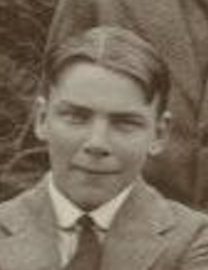
JBBrooks

23/10/14 “We have been in this place for eight days and there is a sort of state of siege – each side digging in – so one hardly ever gets on a horse and consequently they are all eating their heads off. I have three extraordinarily good horses, all of which would make real good hunters.

This war is going to be a very slow one, and a decisive victory seems hard to realise or rather imagine, owing to the length of the line and the various ups and downs which occur in it. There is one thing I am sure of and that is the Germans are as tired and cold as we are, perhaps more so, as I doubt if their Commissariat is as good as ours. The RAMC have done splendid work out here and the removal of the sick has been quickly and splendidly carried out.”

* * * * * * *

Roderick Haigh (Royal West Surrey Regiment) has been wounded in the battle going on at Ypres, although thankfully not badly:

Roderick HaighSt Crispin’s Day (25/10/14). “This has been no St Crispin, but a quiet, peaceful Sunday in Reserve after a week’s very heavy fighting.

On Tuesday last I was wounded by a shrapnel bullet in my thumb. These bullets are about 1/3 to ½ inch in diameter. The bullet was ¾ covered. I at once bit the bullet out, and Capt. Weeding put on my ‘First Field Dressing.’ It is a very slight wound indeed, and is healing up well. I am remaining with my unit, and can even write orders, although, as it is my right hand, I cannot write as fast as usual.

I cannot tell you how much I enjoy it all. There is something so noble and something so grand about the whole show, which places it on a far higher plane than any other scene in which one has acted in this life.”

October 19th 1914

You may have read that the city of Antwerp surrendered on October 10th. The Germans gave notice that they were going to bombard the city on October 6th. The Belgian government left and general evacuation took place the following day.

It had been thought that the British Marines were coming to the rescue and  confidence had risen, particularly when on October 4th Winston Churchill, the First Lord of the Admiralty, was observed taking lunch in the Hotel St. AntoineHenry Souttar commented:

“Surely nothing can inspire such confidence as the sight of an Englishman eating… and certainly on this occasion I found the sight more convincing than a political speech.”

Sadly, it turned out that this confidence was misplaced and the Marines were unable to get to them in time. We understand that Henry’s patients were evacuated by bus! They struggled to get everyone on the four buses provided. Nonetheless, they made their escape to Ghent,

“…utterly tired out, though personally I had slept a sort of nightmare sleep on the top of a bus which boldly announced its destination as Hendon.”


Henry is now in France. He has set up another Field Hospital, this time in Furnes, 15 miles east of Dunkirk. He has been visited by Nobel Prize winner Marie Curie, the discoverer of two elements (polonium and radium).

Mme Curie (right) with her daughter

“One of our most distinguished and most welcome visitors was Madame Curie, the discoverer of radium. She brought her large X-ray equipment to Furnes for work amongst the wounded, and we persuaded her to stay for a week.

One of our storerooms was rapidly fitted up as an impromptu radiographic department, the windows painted over and covered with thick paper, a stove introduced and a dark-room contrived with the aid of a cupboard and two curtains. Electric current was obtained from a dynamo bolted on to the step of a twenty-horse-power-car, and driven by a belt from the flywheel of the engine. The car stood in the courtyard and snorted away, whilst we worked in the storeroom alongside…

Madame Curie was an indefatigable worker, and in a very short time had taken radiographs of all the cases which we could place at her disposal…

Mademoiselle Curie developed the plates and produced photographs of the greatest utility to us.”

Marie Curie is determined to bring X-ray facilities to as many hospitals as possible. At her own expense she has converted a number of vans (nicknamed ‘Petites Curies’) and trained radiographers to operate them. Whilst not all hospitals have not taken advantage of her expertise,  Henry has welcomed her with open arms.


Curie van

A ‘Petit Curie’ Renault van


Now it is possible for surgeons to see more of the shrapnel, bullets and other materials that need removal in the operating theatre. Prior to this it was often necessary to open up a patient a number of times, when infections revealed the existence of further foreign bodies.


October 12th 1914

Roderick Haigh’s sister has kindly shared with us a letter she has received from him. Roderick’s father is a Fellow and Tutor of Corpus Christi College Oxford and Roderick won an Exhibition to Winchester from the OPS before going up to his father’s college. He took up a commission in the Queen’s Royal West Surrey Regiment in 1911 and is now serving with the BEF.

Roderick Haigh  “I am extremely fit, and thoroughly enjoying myself. We are all inspired with the justice of our cause, and by the fact that we are fighting for the cause of honour and liberty throughout the world. The question at stake is whether liberty and justice or military despotism and tyranny are to prevail. It is a great privilege to fight in such a struggle.

I look forward to seeing you all again one day in England. But if I do not return, remember that it is the highest honour to which a man can attain – an honour which is open to officers and men alike, a higher honour than all the honour that can be showered on those who survive – to die for one’s country.”

 *  *  *  *  *  *

Under Mr. Wallace’s superintendence a really good rifle range has been made with 12 feet high butts, and firing sheds at 25 and 50 yards. It is parallel with the Cherwell at the east end of the field. Colonel Henry has most kindly taken batches of boys to the Oxford Rifle Range whilst ours was being made and had taught them the beginnings of shooting. Some of them are very promising and we hope to have regular competitions next term. We have six BSA miniature rifles with .22 ‘long’ cartridges and the Staff and visiting Old Boys have lively competitions.

The field is being used considerably by Oxford recruits as a drilling ground. The recruits have been drilled by Sholto Marcon, Billy Smyth, Alasdair Macdonell and other Old Boys. I shall be very glad to let the range be used for practice under responsible officers during the holidays.

Cyril Pouncey, in my top form, has written a capital poem, which we shall put in the next edition of ‘The Draconian’.

Oh! Kaiser William, I today
Do condescend to write to you
And ask you, if indeed I may,
If what men say is really true?

Some people say you are the cause
Of all this grief and useless strife,
Of breaking treaties, starting wars,
And cutting short the Belgian life.

They say you slaughter many a child,
And pound with shells each ancient town;
And use as shields the women mild,
And turn cathedrals upside down.

They say your soldiers, at your will,
Do rob and plunder just for you;
And often poor civilians kill.
Oh! Kaiser, is this really true?


October 5th 1914

One of the first Old Dragons to cross over to Belgium was not in fact a soldier, but a surgeon: Henry Souttar. He has been appointed Surgeon-in-chief at a Belgian field hospital at Antwerp. Here he has had to deal with the casualties of war for the first time. Many have been wounded by shrapnel.

“The balls are small and round, and if they go straight through soft tissues they do not do much damage, If, however, they strike a bone, they are so soft that their shape becomes irregular, and the injury they can produce in their further course is almost without limit. On the whole, they do not as a rule produce great damage, for in many cases they are nearly spent when they reach their mark…”  

Henry Souttar is also dealing with the problems of wounds caused by bullets, where infection has been a major problem for him and his team.

“…In most cases the wounds were anything but clean-cut; with very few exceptions, they were never surgically clean… When we say, then, that every wound with which we had to deal was infected with bacteria, it will be realised how different were the problems which we had to face compared with those of work at home…

Now there is one way in which all such infections may be defeated – by plenty of fresh air, or, better still, by oxygen. We had some very striking proofs of this, for in several cases the wounds were so horribly foul that it was impossible to tolerate their presence in the wards; and in these cases we made it a practice to put the patient in the open air, of course suitably protected, and to leave the wound exposed to the winds of heaven, with only a thin piece of gauze to protect it. The results were almost magical, for in two or three days the wounds lost their odour and began to look clean, whilst the patients lost all signs of the poisoning which had been so marked before.”

Bullet wounds are of course very common. Surprisingly, Henry does not appear always to be in favour of removing bullets from the body.

“If a bullet is doing any harm, pressing on some nerve, interfering with a joint, or in any way causing pain or inconvenience, by all means let it be removed…. But the mere presence of a bullet inside the body will of itself do no harm at all. The old idea that it will cause infection died long ago. It may have brought infection with it; but the removal of the bullet will not remove the infection, but rather in most cases make it fire up.

We now know that, provided they are clean, we can introduce steel plates, silver wires, silver nets, into the body without causing any trouble at all, and a bullet is no worse than any of these…. It may be a mark of a Scotch ancestry, but if I ever get a bullet in my own anatomy, I shall keep it.”

The greatest advance for the surgeon and of course the patients, compared with previous generations, is the availability of anaesthetics. Sometimes a soldier can be operated on whilst still conscious and yet feel no pain.

“With the injection of a minute quantity of fluid into the spine all sensation disappears up to the level of the arms, and, provided he cannot see what is going on, any operation below that level can be carried out without the patient knowing anything about it at all. It is rather uncanny at first to see a patient lying smoking a cigarette and reading the paper whilst on the other side of the screen a big operation is in progress.”

However, in many cases chloroform is needed for a general anaesthetic. This seems to suit the Belgians better than the British.

“The Belgians are an abstemious race, and they took it beautifully. I am afraid they were a striking contrast to their brothers on this side of the water. Chloroform does not mix well with alcohol in the human body, and the British working man is rather fond of demonstrating the fact.”


September 28th 1914

Our Old Dragon correspondent at Winchester has reported that Cyril King, who was due to be a House Prefect this term “is at present unavoidably detained in Germany.”

At the end of July 1914 Cyril was at Schluchsee in the Black Forest with his mother, four sisters and a tutor from New College, Coote. Although there were rumours of war, they were confident that if anything came of it, they would be able to return to England. Instead on August 7th they were arrested. We await further news.

*  *  *  *  *  *

We have received news from Rupert Lee, a Lieutenant in the 3rd Battalion of the Worcestershire Regiment.  In good OPS tradition, he is keeping a diary, although rather different in content to the usual Dragon offerings at the end of the summer holidays.

“This diary must be read and criticised very leniently, being rather a disjointed sort of narrative. Pieces of it were written in strange postures and places, in varying frames of mind, sometimes left for weeks without an entry and then written up to date… It does not profess to be a connected narrative but merely a conglomeration of statements of happenings as they appeared to me at the moment…”

He writes of a very narrow escape he had during the retreat from Mons:

“Just as I got about twenty yards away from a wood a shell came crashing through the tops of the trees and burst quite close to me. My horse got it badly in the stomach. I got off and shot him to put him out of his agony… I then stood up and looking round saw, just at the end of the ride, two Germans. I bolted for the wood and as it happened it was extraordinarily fortunate that I did so. For they both dismounted and came down the ride  looking into the other side to that on which I was hidden. Just as they got opposite me the leading man put his gun up sharply. I shot him and bolted, as did his companion in the opposite direction.

I went about twenty yards and lay down behind a bush. Nothing happened, so after about twenty minutes I went back very quietly, took his shoulder strap off him and walked away.”

*  *  *  *  *  *

JBBrooks

Capt. W.T. Brooks

Tyrrell Brooks (recently promoted to Captain in the Duke of Cornwall’s Light Infantry and ADC to General Morland) writes:

September 14th.

“We are having a VERY hard time and now the weather has changed to rain it is cold and greatly adds to the discomforts which we are undergoing. Our Infantry has been brilliant and have more than kept up their high traditions, their marching having been really good and their fighting power at the end of the trek has been unimpaired.

We have now started a great forward movement which, though costing many lives, will undoubtedly test our enemy to the utmost and they are, I think, in rather a tight hole from which it will take them all their skill to extricate themselves. However, they are splendid tacticians, but I doubt if they have the material which is worthy of their well planned tactics.

How long this war will last I know not, but one thing is certain and that is it will leave all concerned crippled with regard to fighting material and armaments. Our casualties have been large but the German ones must have been larger.”

*  *  *  *  *  *

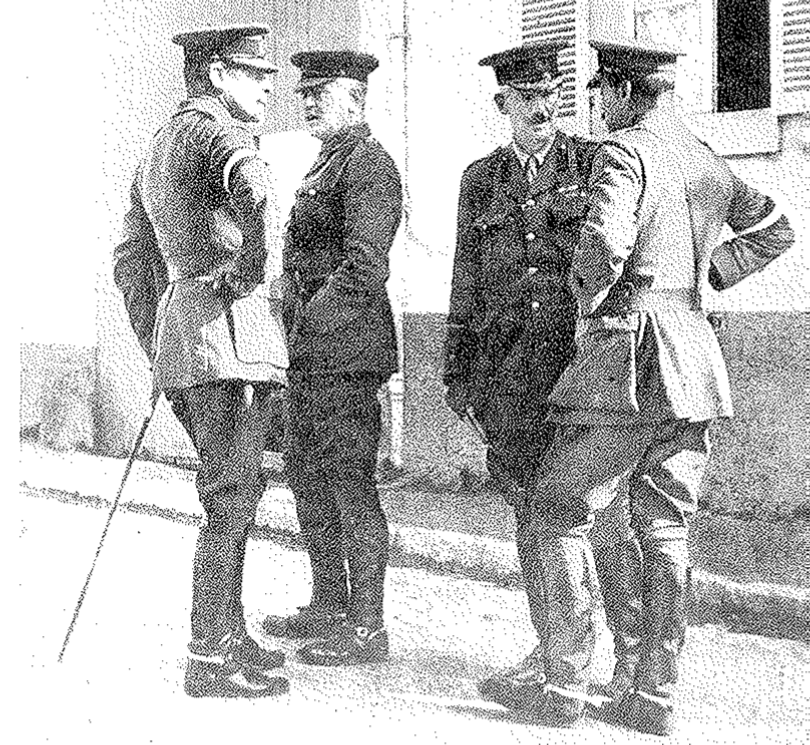
Readers of the “Illustrated London News” may have noticed the photograph below, probably taken during the retreat from Mons, which shows our old boy, Arthur Percival, with a number of notable figures. Arthur, a veteran of the Boer War and the first Old Dragon to have won a DSO, is serving as a General Staff Officer to Major-General Monro.

Percival & Generals

(Left to Right): Gen. Sir Douglas Haig, Maj-Gen Monro, Lt Col AJB Percival DSO and another.


September 23rd 1914

Skipper cropped Dragons. Welcome back to the OPS for the Christmas Term.

At a time when our country’s needs are greater than ours, a number of your masters have answered the call of duty and are now serving in His Majesty’s forces. Of the staff, all of military age have enlisted or received commissions straight off, taking it for granted that whatever views the Board of Education might have, their first duty was to their country.

Mr. Eastwood has joined the King’s Own Royal Lancaster Regiment,

Mr. Watson, the Queen’s Own Dorset Yeomanry,

Mr. Higginson, the Shropshire Light Infantry

and Mr. Bye the U.P.S. Royal Fusiliers.

There are many Old Boys and Masters who have not yet gone to the front; these have been undergoing strenuous and trying training, and their time will come. While they are still in England we are delighted to see them. Nurse Wilkinson has also left us to work at the Base Hospital, where she has been in charge of some very trying cases, chiefly the dreaded tetanus. Her place in the boarding house has been taken by an old friend, Nurse Todhunter.

Two boys who were holidaying in Austria when war broke out have yet to return. We must all help out as best we can and we are welcoming into the school several American boys, whose parents ordinarily would have been travelling on the continent;  but owing to the war have come for a short time to reside in Oxford., and one boy who is a Belgian refugee. His father is a Professor at Louvain. We are also offering to take on, as a boarder entirely free of charge, the son of a British officer killed in the war.

We start the school year with 119 boys in the school in 8 classes, with another 20 in the Junior Department (aged 5-8 yrs).


*  *  *  *  *  *

We have further news from Lieut. Victor Cowley (Royal Irish Rifles). The retreat from Mons finally came to an end on the River Marne, with the British then supporting a French counter-attack on the Germans.
V Cowley“On 5th September we found ourselves south of the forest of Crecy, having enticed the Germans far enough. From then onwards began our advance on their heels, capturing prisoners and transport every day. Plenty of fighting, especially crossing the Marne, but we were advancing, so what did it matter to us? …

It was here we made a big haul of prisoners, all of whom were only too glad to be captured. On being questioned they said they had been marched off their legs and been given no food. They had certainly had enough drink as one was able to trace where they had been the night before by the hundreds of bottles they left empty. The first remark one of them made on being captured was ‘Thank God, at last I am amongst friends.’ On being questioned as to the reason of this thankfulness he told us that he was a waiter at the Criterion, having lived at Bethnal Green till he was called upon to serve his country. He had been bullied about by his officers, given no food, and altogether was ‘fed up’ with it, and was delighted when he got the opportunity of being made a prisoner…

The 13th September saw us at Braisne waiting for the Sappers to throw a pontoon bridge across the Aisne to enable us to cross and turn the enemy out of the heights commanding the approaches to the river. They had destroyed all the bridges and most completely and their guns shelled every attempt to build temporary ones. During the night they put the pontoons in the river and some planks across on the debris of the railway bridge, over which we started to cross in single file. Only a few had got over when they opened a terrific fire on us which literally churned up the water all around us, and we were lucky in not having many hit. After crossing the river we had to cover 400 yards of open (ground) which was ploughed up by shells, there being a regular canopy of them overhead; a fragment of one of them got me on the arm but did no more damage than cut it a little. 

Next morning I went down to the temporary dressing stations, but as these seemed the butt for every shell, I thought the trenches we had dug on the heights were safer. I returned there to find we had suffered terribly in capturing one of their trenches, two officers being killed and seven wounded. The Germans were entrenched 500 yards away and a battery of their artillery 1200 yards. They kept up an incessant bombardment all day and it was a perfect inferno. Their ‘John Willies’ used to sing overhead, followed by the most awful explosion which very seldom did much damage except churning up the ground. However they affected the men’s nerves a little, which was a good thing as they had got rather callous about other shells and it made them keep under cover more. 

We were allowed to light no fires at all and no matches at night, and as it rained in deluges most part of the first few days, making everything into a quagmire, it was not at all comfortable, especially as we were on short rations of bully beef and biscuits.

The postman managed to get up to us one day, which made us forget all the attendant discomforts of shells and rain. One’s letters were very precious possessions as they whiled away many a weary hour in the trenches.

The worst day was the 19th September, as they had the range to an inch and we cringed in our trenches while the shells shrieked and burst around us, in the parapet, knocking down trees in the wood just behind us, trying to frighten us into submission, but so well had we entrenched ourselves that very few got hit. Unfortunately the Colonel and Adjutant were both very badly hit, but that was about all. They kept it up from dawn till about 6.30, when hordes of infantry were launched at us. We were just the reverse side of a slope so could not fire at them till they got within about 50 yards of us. I worked one of my machine-guns and they went down like corn cut by a reaper. I got through 1200 rounds before a bullet picked me off through the neck, a most horrid sensation!

The three days getting to St Mazaire in a cattle truck which was disguised as a hospital train, words fail me to describe, or the horrors of the jolting over side lines. It was heavenly to be carried on board one of the Union Castle boats, the ‘Carisbrooke Castle,’ and so home to England. It was hard to believe that one had been one of the actors in the world’s greatest tragedy, and the whole experience seems like one gigantic nightmare.

Whatever the result may be, what success can recompense one for the loss of those good friends and comrades who fell never to rise again?”


This is what the soldiers refer to as a “blighty one”– a wound serious enough to necessitate evacuation back to England. We are all delighted to hear that Victor has made back to England safely and agree entirely with the sentiments expressed above.


September 19th 1914

In the ‘Times’ today we note the death in action of one of our Old Boys.

R Pringle

Lieut. Robert Pringle (Queen’s Royal West Surrey Regiment).

We regret to announce the death of Robert Pringle. He had been in the Army since 1907 and was one of the first Old Dragons into battle, seeing action at Mons. We understand that he died of wounds suffered in the battle going on near the River Aisne on September 15th.

Robert was a boarder with us for just one year (1895-96) and went on to Winchester via St. Cuthbert’s, Malvern. He was married in April 1913 and leaves a wife and daughter, to whom we send our condolences.

September 14th 1914

Since the outbreak of war on August 4th, a number of Old Dragons have been in action as part of the British Expeditionary Force (BEF) deployed to assist our allies against the German onslaught. We have received this account of the events of last month from Lieut. Victor Cowley, who is serving with the Royal Irish Rifles.          

V Cowley

Victor Cowley

At 1.30 a.m. that night (August 22nd – 23rd) we were sleeping comfortably in billets at Cipley when we got the order to prepare to move in the direction of Bavay. After marching and counter-marching we eventually started to entrench a position in a beetroot field. Hardly had we dug down a foot into the ground when the first shell burst over us, a fragment of it hitting one of the machine-guns and breaking off a piece which struck the sergeant on the head, doing no material damage.

The ground was soft and the earth flew as we burrowed like rabbits to get cover. It was the first time we had been under fire and we were all anxious to know what it felt like. The relief was wonderful when we found that though the air seemed thick with shells, we were still alive. The men began jeering at the shooting and singing ‘It’s a Long Way to Tipperary’; however they were quietened down a little when two shells burst in the trench, one in the parapet and the other knocking the gun back into the trench and nearly taking off the head of No.1, who was working it.

From the first shot being fired till late in the evening it was one incessant bombardment, but of my section of eight they only killed one and wounded another. Several times we were almost buried alive by shells bursting in or near the parapet of the trench. It was most anxious work later in the darkness waiting for them to attack us, but when they did they were met by a fire which cannot have left many unhit. We could not wait till daylight to see the results of our work as we received the order to retire about midnight, and I must own that we were all quite relieved.

We heard that the French on our right hand had retired and that the Germans had started a very powerful enveloping movement round our left flank N.W of Mons, and it was touch and go whether or not they surrounded us.

We had to march night and day fighting a series of rear-guard actions the whole time, but the weight of the pursuit was relieved by the cavalry.

The men suffered terribly from sore feet and want of sleep; so much so that after a temporary halt two miles outside Le Cateau it was found impossible to wake some of the men when the regiment moved on again…  

Between 23rd and 29th August we marched 140 miles and fought two big battles (Mons and Le Cateau). This does not sound as trying as it was, but lack of food and sleep made it a perfect nightmare. The worst was marching at night as it was impossible to keep awake; I used to arrange with someone to lead me while I went to sleep, and in turn led them. It was no use riding my horse as when I went to sleep I used to fall off which woke me up too suddenly…

At every place one halted, excursions were made for eggs, bread and chickens, but one never knew if you would have time to cook them. I became an excellent cook, my forte being ‘aeroplane duck.’ The recipe for this was after having caught, killed and plucked your duck, to truss it with sticks like a man on the rack, then hang it from a tripod over a wood fire, turning it over when the underneath was cooked. The basting was done by filling its inside with bacon fat which melted and oozed through, giving it a delicious flavour…”

OUT OF OFFICE

I am sailing on the ‘Blue Dragon’ off Norway with limited communications. I will post news as best I can until I return in time for the start of the School Term. Skipper.

Term starts on September 23rd 1914.

 Skipper cropped August 3rd. We heard all sorts of horrible rumours about war and mobilising; how much is true, I don’t know; but rumour says the Germans have sunk the Russian fleet and invaded France.

August 4th. We were immediately boarded by the British Consul, who brought us a telegram – ‘English vessels warned not to put into German ports.’ Then a gloomy day ended with the awful news that England had declared war against Germany. We do not know what we shall do, and it is too hideous to contemplate.

August 5th. It seems that the Germans have invaded Belgium and that England sent an ultimatum last night. Everything seems in chaos. That we should go to war with Germany because the Serbians will not apologise for the murder of the Archduke of Austria appear too idiotic, but the fat seems to be in the fire with a vengeance.

August 11th. My crew are heading back to England and I must put off my plans to sail to Bergen till the war is over and the monstrous German terror is a thing of the past.