March 15th 1915

Ruttledge MC

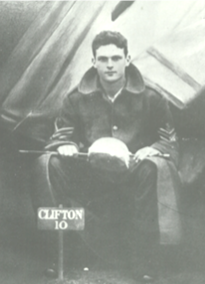
Capt. JF Ruttledge

In this week’s ‘London Gazette’ is the announcement that Jack Ruttledge, now a Captain in the Prince of Wales’s Own (West Yorkshire Regiment), has been honoured with the award of the Military Cross.

The citation reads, ‘For great coolness and gallantry on 19th December 1914, near Neuve Chapelle. When his company were moving over open ground under very heavy fire, many casualties occurred and Lieutenant Ruttledge remained to the last, helping the wounded away to cover.’

 * * * * * * *

An anonymous Old Dragon has written in to give us a glimpse on the sort of life being enjoyed in the trenches at present.

“In the Trenches

La Belle France

March 12th 1915

 The last three days and nights were very noisy and a bit bomby and grenadey. On several occasions we had Brigade orders to open heavy machine gun and rifle fire at the German breastworks backed up by artillery fire at a certain time, and the row usually lasted for about half-an-hour. These unaccustomed bursts of activity were partly to make the Huns as nervy as possible, and partly to prevent them sending reinforcements while attacks were being made between here and * * * * *   (censored).

I was rather lucky in not getting hit the other day. I was working with two men a few yards behind the parados, where one ought, barring accidents, to be pretty safe, when a rifle grenade suddenly dropped and exploded six yards from us. We felt the shock of the explosion and gust of hot air in our faces, but none of us got hurt. We have been sending quite a lot over into their trench (70 yards distant) lately, and they invariably send just the same number back. Some 15” howitzers have arrived at the front, and are apparently found to be a great success. They say that if one of these shells drops in a decent sized factory it absolutely levels the whole place.”

Whereas further south, in the region of the Somme, it is possible to dig deep trenches with underground dug-outs, we understand that in the Ypres area the water table is much higher and such trenches are nigh impossible to build.

“I don’t know if I have explained to you that we aren’t in actual trenches at all, but behind a parapet made of sand bags riveted up with sheets of corrugated iron, hurdles etc., with earth thrown up on the enemy’s side. This parapet varies in height, but I should say the average is between 6 and 7 feet.

This sort of breastwork is of course only of use when we are too near to the enemy to have much fear of artillery fire. The old earth trenches became uninhabitable long ago on account of the mud, but the men still have to dig in where they get shelled, as of course our parapets are no protection against shell-fire.”

Trench pic


March 8th 1915

Lieut. Jack Smyth has sent us an interesting leaflet he came across in the Front Line. It is a translation of an article supposedly written by a Lieut. Colonel Kaden in the March 3rd edition of the  ‘Lille War Gazette’, a German weekly newspaper, which came into English hands when found on a German prisoner captured in recent fighting.

It is printed under the title, ‘A Nation Gone Mad’ and marks the birthday a hundred years ago, on  April 1st, of the German Chancellor, Otto von Bismarck, who famously created modern Germany out of ‘blood and iron.’

Let every German, man or woman, young or old, find in his heart a Bismarck Column, a pillar of fire now in these days of storm and stress. Let this fire, enkindled in every German breast, be a fire of joy, of holiest enthusiasm. But let it be terrible, unfettered, let it carry horror and destruction! Call it HATE! Let no one come to you with ‘Love thine enemy!’ We all have but one enemy, England! How long have we wooed her almost to the point of our own self-abasement. She would have none of us, so leave to her the apostles of peace, the ‘No War’ disciples. The time has passed when we would do homage to everything English – our cousins that were!

‘God punish England!’ ‘May He punish her!’ This is the greeting that now passes when Germans meet. The fire of this righteous hate is all aglow!

You men of Germany, from East and West, forced to shed your blood in the defence of your homeland through England’s infamous envy and hatred of Germany’s progress, feed the flame that burns in your souls. We have but one war-cry ‘GOD PUNISH ENGLAND!’ Hiss this to one another in the trenches, in the charge, hiss as it were the sound of licking flames.

Behold in every dead comrade a sacrifice forced from you by this accursed people. Take ten-fold vengeance for each hero’s death!

You German people at home, feed this fire of hate!

You mothers, engrave this in the heart of the babe at your breast!

You thousands of teachers, to whom millions of German children look up with eyes and hearts, teach HATE! Unquenchable HATE!…

What CARTHAGE was to ROME, ENGLAND is to GERMANY. For ROME as for us it is a question of ‘to be or not to be.’ May our people find a faithful mentor like Cato. His ‘ceterum censeo, Carthaginem esse delendam’ for us Germans means – ‘GOD PUNISH ENGLAND’”

The translator adds, “It is of interest as showing the hatred of Great Britain which is being sedulously cultivated in Germany. This hatred is being encouraged and fostered officially by every possible means.”

March 1st 1915

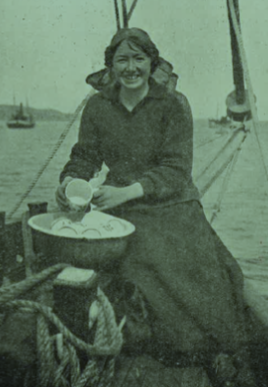
My daughter Kit on ‘Blue Dragon’ in 1912

Amongst all the depressing war news, there has been at least one cause for celebration. My daughter Kit is married. On February 27th we had a whole holiday in honour of her wedding. All who know him agree that Lieut. Marshall, the bridegroom, has only one fault – and that is that he is not an Old Dragon. A wedding under the auspices of about a hundred schoolboys, mostly armed with confetti and old shoes, is an ordeal severe enough in all conscience. But the bride and bridegroom took it all smilingly.

We are not quite sure how they actually took the incident on the first tee of the golf course at Frilford when their golf club bags discharged pounds of confetti in a strong wind, but can well believe that the bridegroom, at all events, was imperturbable. The boys subscribed for a very nice wedding present in the shape of a serviceable suitcase.

* * * * * *

Kit was the first of a number of girls I have admitted to the OPS since 1898.

I have sometimes been, shall I say, criticised for admitting a few very select girls to the School. Personally I have no doubt whatever of the good effects it has on the boys, nor of the benefit that the girls themselves obtain. It is absurd to say that it makes the boys girlish or the girls boyish. The prejudice against the presence of girls at a preparatory school is merely a silly conventional attitude.

By the bye, I have never heard any objections to co-educating!

* * * * * *

We have also noted with great pleasure the announcement of the engagement of Naomi Haldane, rising seventeen, to one of her brother Jack’s best friends, Dick Mitchison. They are not to marry until next year. In the meanwhile Lieut. Mitchison is at the Front.

Naomi, who has been such a prolific contributor to the pages of ‘The Draconian’ over the years,  has submitted a most touching poem for our next edition.

In the grey evening after I come home
I draw the curtains to shut in the light
– One never knows what cruel things may roam
Through the wet cloud-banks in the hostile night –
And when the fire’s lit, and throwing wide
Streamers of flame light, dancing as I look,
And I am reading at the fire-side,
Now and again I glance across the book
To think if you were sitting in that chair
Your eyes and mouth, your forehead, oh my dear,
And the red glow reflected in your hair…
Only you’re out in Flanders, and I am here.


Naomi & Kit 1906

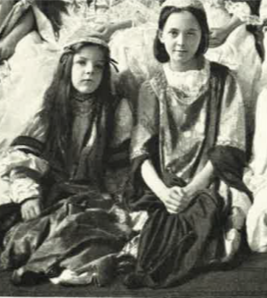
Naomi Haldane & Kit Lynam in ‘Romeo & Juliet’ in 1906.


February 22nd 1915

Only ten years ago, Jack Smyth, aged 12, was recovering from a serious illness. For two years he had blown up like a balloon, whilst getting weaker and weaker. His recovery was almost as sudden as its onset. His nurse, thinking he was dying, decided to offer him whatever he would like to eat and for some reason he chose a steak. Although this surely cannot have been the only reason, it proved a turning point and by the Easter Term 1905 he was able to return to school.

After Repton and Sandhurst, Jack, who did not have the private means to consider a British regiment, joined the Indian Army. The bill for his kit, when he spent a year with the Green Howards in 1912, was beyond what he and his mother could afford, so I and a number of others stepped in to help.

Now he is with the 15th Sikhs, involved in the continuing trench warfare. We received two letters from him last week, dated the 11th and 15th February:

Jack Smyth

Lieut. Jack Smyth

15.2.15. “I am writing this in a German trench and am too filthy and muddy and disreputable for words. As I expect you saw in the papers the Indian Corps captured a German position the other day, and here we are holding on to it for all we are worth. It is more interesting here in a place where the Germans have been for about four months; the place is quite dry, a captured pump tells us the reason why; they did themselves pretty well as all the dug-outs are littered with old bottles of champagne etc., and photos of the Kaiser, and letters and food, etc. Our men rather fancy the German boots and I have one of their haversacks.

There are about 100 of their dead lying just outside my trench where they were discovered creeping up to try and recapture the place and were promptly laid out by a machine gun. 

I haven’t taken off my boots for five days and am a sight for the gods.”

Clearly, his kit is still a matter of concern for Jack!

His earlier letter tells a remarkable tale of good luck enjoyed by a friend of his.

“About five years ago, an old mullah in India gave him a silver charm, which he said would bring him luck and also save his life. He went home on leave the other day and was promptly married (I suppose that was the luck) and yesterday, from a good position behind a big tree, he was having a good look  at the German trenches, when a bullet came through the tree (not bullet proof) and hit the bottom button of his coat, smashing it to bits and winding him, but never penetrated his body. The charm, which he always wore and which was underneath his shirt, was squashed flat, but beyond a very sore tummy, he is none the worse and is now fairly convinced that he will see this show through all right.” 


February 15th 1915


Roderick Haigh

Roderick Haigh

Roderick Haigh’s Will.

The will of Roderick Haigh, who was killed at Ypres in November (see October 12th, 29th and November 16th posts) has just been published. We are immensely grateful to Roderick for remembering us, as no doubt will be all who are benefitting from his generosity:

£2300 to the President and Fellows of Corpus Christi College, Oxford, to found a scholarship or annual prize in memory of Arthur Elam Haigh (his father, a Fellow of the College).

£1000 to the Governing Body of Leeds Grammar School to found a scholarship or annual prize in memory of Arthur Elam Haigh.

£500 to the Headmaster of Winchester College for some purpose as he may determine to assist the Winchester College Mission.

£500 to the Headmaster of the Oxford Preparatory School to supplement the Exhibition Fund, or for any other purpose he may determine.

£30 to the Oxford Women’s Church of England Temperance Society and £20 to the Oxford Surgical Aid Society.

£500 to the officer commanding 2nd Battalion Royal West Surrey Regt., for investment as he may determine and to apply the income in the purchase of instruments, music etc for the drum & fife band, or for any other purposes he may determine.

Roderick also left a number of bequests varying from £50-£10 to warrant officers, non-commissioned officers and men of his regiment ‘as a token of gratitude’ In the event of their being no longer alive, the gifts will go to their next-of-kin.

Part of Roderick Haigh’s bequest to the OPS has been used to pay for the miniature rifle range and the Roderick Haigh Cup will be shot for annually, and will be won by the best individual marksman in a competition between Day-boys and Boarders.

The range has also been very useful to the 4th Territorial Battalion of the OBLI (Ox & Bucks Light Infantry) and to the Oxford Volunteer TC. Officers home on leave from the front and others in training have also used the range for revolver practice. In fact it has been a great success.

The rest of the money may be used to help the sons of Oxford dons attending the School, who, on account of the war, or for other reasons, may need it.

* * * * * * *

Mr Haynes has contributed a handsome addition to the Boarders’ Library in the shape of the following books, which were chosen by a plebiscite of the VIth Form:

W. H. Ainsworth: 	Old St. Paul's 
		 	Windsor Castle
		 	Tower of London
F. Anstey: 		Vice Versa
R. M. Ballantyre: 	Coral Island
Rolf Boldrewood: 	Robbery Under Arms
A. Conan Doyle: 	White Company 
			Rodney Stone
                	Exploits of the Brigadier Gerrard
Quiller Couch: 		Dead Man's Rock
Fitchie: 		Deeds that Won the Empire
W. S. Gilbert: 		The "Bab" Ballads
Rider Haggard: 		King Solomon's Mines 
	       		She
	       		People of the Mist
J. K. Jerome: 		Three Men in a Boat
R. Kipling: 		Just So Stories
	    		Jungle Book 
	    		Second Jungle Book
Lamb's 			Tales from Shakespeare
Capt. Marryat: 		Midshipman Easy
Anna Sewell: 		Black Beauty
Seton Thompson: 	Wild Animals I have known 
			Lives of Hunted
Jules Verne: 		From Earth to Moon 
	     		20,000 Leagues Under the Sea
Stanley  Weyman: 	Gentleman of France
P. G. Woodhouse: 	Mike 
	         	Psmith in the City

February 8th 1915

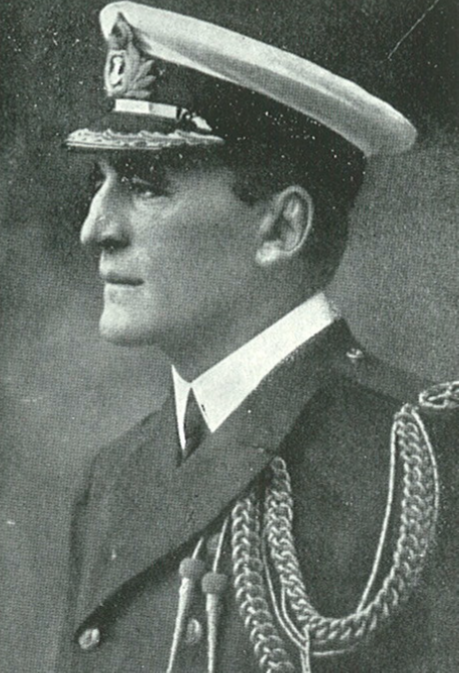
Some of the earliest Old Dragons will remember Regie Tyrwhitt, whose father was vicar of St Mary Magdalen’s here in Oxford. Regie joined the Navy straight from the OPS in 1882, by way of the training ship HMS Britannia. He is now a Commodore in charge of the Harwich Forceon HMS Aruthusa.

HMS Arethusa

Commodore Reginald Tyrwhitt’s ship, HMS Arethusa.

Reginald Tyrwhitt

Last month he was involved in an action off Dogger Bank, about which we have received the following account (from an unknown source) of the sinking of the German battleship ‘Blucher’.

“The ‘Lion’ led the British line and began to pour upon the ‘Blucher’ the deluge of shells which crippled her, but by the time the ‘Blucher’ had ceased steaming, the ‘Lion’ herself had been hit by a chance shot and her speed reduced. At this moment the ‘Arethusa’ was at hand. In spite of the aircraft, submarines and the fire of the big guns she went at full speed towards the damaged ‘Blucher’. When close in, the ‘Arethusa’ swung round. She was greeted with a salvo from the ‘Blucher’ at short range, but every shot went wide. They were the last the ‘Blucher’ fired. Before the smoke had cleared the ‘Arethusa’ discharged two torpedoes and both got home.”

Blucher

The demise of the German battleship ‘Blucher’.

A member of the Arethusa’s crew described the scene on the deck of the ‘Blucher’.

“They drew themselves up on the deck in lines when they knew all was over and then, taking off their caps, gave three cheers.

We steamed in as close as we could and shouted to them to jump, which lots of them did just before she heeled over. We had boats out in no time and picked up 197 altogether. They were mostly black and blue with cold – but all they wanted was some fags.”

Another account noted that “each of the German sailors had been provided with special life-saving apparatus – a cork belt and an inflatable apparatus fastened about the shoulders. The latter was made of rubber and is about 24 ins. long by 10 ins. wide; it can be blown up by the wearer in a moment and is so made that when in use the air-feed pipe comes opposite the mouth. The Germans declared that any sailor who loses this article is liable to a fine of 11 shillings.

As the Germans were helped into the boats a strange scene took place. They took every article of value they were wearing, such as rings, purses and watches and implored our men to accept them as tokens of their gratitude. ‘On land,’ said one, ‘we can beat you, but here, no.’”

February 1st 1915

Percy Campbell

2nd Lieut. Percy Campbell (Wiltshire Reg) 

Last term we were unwilling to mention, as there was still some hope that he might be a prisoner, the death of Percy Campbell in action; but from what has been gathered from eye-witnesses, there seems to be now no doubt that he was killed in the trenches in the neighbourhood of Armentieres in October. His loss is a great grief to us.

He was reported missing about the middle of November, soon after the virtual annihilation of his battalion on October 21-24 had become known through letters from the front. A slowly fading hope that he might be a prisoner in Germany was finally ended by the story of his death, told by a Pte Laws, who was in his platoon.

It appears that, after his battalion had been shelled out of their trenches, Percy Campbell was almost the only officer left unwounded and uncaptured. With a few of his men, he made his way to a place of safety in the rear and then went to report to Headquarters. There is some confusion in the accounts of what followed, but one thing seems clear, viz, that Percy himself, though urged not to, did actually return to seek some wounded of whom he had just heard. It was when on this errand that he was killed.  Pte Laws found Percy’s body – he had been struck in the chest by a shell – and assisted in his burial in the garden of a nearby house.

Though by all his instincts Percy was one who hated war, he had volunteered for the Special Reserve as soon as the war broke out. Gazetted to the Wiltshire Regiment, he went to the front at the beginning of October and was the second of my Old Boys to fall, near Ypres, on 24th October 1914, at the age of 20.

His parents have recently received this communication from the War Office: Campbell telegramTo JE Campbell, Hertford College, Oxford.    O.C Battalion now reports 2nd Lieut. WP Campbell Wiltshire Regiment as missing believed to have been killed 24th Oct   Lord Kitchener expresses his sympathy.                                            

January 25th 1915

At the beginning of last term four most valued members of staff left us to join the armed forces. Mr Higginson, we note, has been promoted to Captain in the 6th Battalion of the King’s Shropshire Light Infantry and has been undergoing training at Aldershot and on Salisbury Plain.

Mr Watson left to join the Queen’s Own Dorset Yeomanry and was by chance in the vicinity of the attack launched by the Germans on the people of Norfolk last week.

 The Zeppelin RaidJanuary 19th 1915.

Blair Watson

Mr Blair Watson

“On the evening of Tuesday 19th January, some of the quiet villages and sea-board towns of Norfolk were roused by the purring drone of motor engines and the crashing of bombs from the sky woke them to the fact that the long-expected Zeppelins had arrived. Yarmouth was subjected to a feverish outpouring of these missiles which destroyed a considerable amount of property and killed two people, a man and a woman, both typical raid victims, poor, inoffensive and old.

The only disappointing feature from the German point of view was that the wild panic supposed to be engendered by these instruments of frightfulness took the form of an inquisitive crowd gazing sky-wards and a few family shot-guns fired into the air by irate old men long after the monsters had disappeared.

From Yarmouth the fleet spread itself over Norfolk, spitting bombs with reckless vehemence and doing the same amount of trivial and unnecessary damage wherever it went. One of the number passed quite close to Sandringham and dropped bombs at Derringham, three miles away from the King’s residence.

King’s Lynn was the object of a heavy bombardment and here whole streets of houses in the working-class and dock quarter were damaged, some of them reduced to ruins, but with the loss of only two lives, the victims being a boy of seventeen and the young widow of a soldier who lost his life at Mons. The raiders then drew off at about 11.15 p.m., having spent less than three hours over English soil and hurried back to spread the tidings of their magnificent exploits.

When one reflects that the total ‘bag’ consisted of four harmless non-militants and a certain amount of damage to private property, one cannot help thinking that the shortage of petrol in Germany is not so acute as some authorities would have us believe.”                                                                                                                                                                                           

These deaths are said to be the first ever suffered in this country due to aerial bombardment.

* * * * * * *

Daily Telegraph.

Henry Souttar (previously featured in this log on October 5th & October 19th) has had a book published in which he recounts his recent experiences. It is called ‘A Surgeon in Belgium’  and in it he tells of a quite astonishing incident concerning the Editor of an English Sporting Journal, who had joined the Belgian Army in the exciting role of machine-gunner in an armoured motor car.

On one occasion, having got out of his car to reconnoitre, some Germans in hiding opened fire and shot him, breaking the bones of both legs. He fell to the ground and an officer in the car by some mistake gave the order to start. But the Sporting Editor had no intention of being left behind. He seized one of the rear springs and held on, while his back and broken legs were bumped along the ground for half a mile at the rate of 25 miles per hour. He is now well and in England.

January 18th 1915

E A S T E R    T E R M    1 9 1 5 .

Hamlet 1915

Having devoted three days to rehearsal, we put on three performances of ‘Hamlet’ over the first weekend of the new term. This was generally reviewed favourably.

From the Oxford Magazine:

“From the melancholy business of arranging half-hearted lectures for skeleton classes, some of us were glad enough to snatch a respite by withdrawing to the OPS in order to witness the performance of no less a play than Shakespeare’s ‘Hamlet’…

As regards diction there was universal excellence; and it is clear that the OPS may rightfully boast of being a school of pure English, where elocution does not rank among the forgotten arts, as happens too often nowadays.”

We were delighted that Rosina Filippi was able to attend our first performance. She is well known as the first dramatist to adapt the works of Jane Austen for the stage. She is also the author of  ‘Hints to Speakers and Players’ and readers my be interested in the first chapter on ‘Diction and Elocution.’ She was rather more critical of the children:

“I think too much was sacrificed to the careful enunciation of words. It was too syllabic. I don’t mean that the sense of the sentences was not there – in many cases it was amazingly clear. It showed great intelligence on the part of the boys that they could deliver lines so accurately as to convey the adult reading in their own delivery; but the poetry as verse was gone; the metre was lost, there was no footing in the line. It was an intelligent reading but not scholarly.”

Finally, this performance was also reviewed by the Oxford Times:

“The boys and girls of Mr. Lynam’s school gave three performances of Shakespeare’s ‘Hamlet.’ The first, on Friday evening was witnessed by nearly 400 boys and girls from the various Oxford elementary and higher grade schools, and with the unfortunate exception of a knot of boys in one corner of the gallery, they all appeared to appreciate and enjoy the performance. The boys referred to did not know how to behave, and to some extent spoiled the evening for the rest.

Hamlet’s part was taken by Terence Greenidge. The boy’s elocution was perfect, and he never hesitated in the enunciation of the seven or eight hundred lines he had to say. His rendering was different from that of the professional Hamlet; he was not so much the ‘melancholy Dane’ as the fiery youth who until the end of the player scene was not sure of the Ghost’s story, but afterwards was ready to carry out his murdered father’s command to avenge and at the same time spare as far as possible his weak mother.”

January 11th 1915

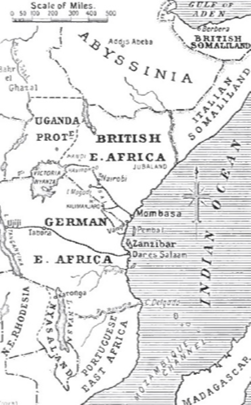
Old Dragons are also involved in fighting the war in other parts of the world. Geoffrey Carpenter (Capt. Uganda Medical Service) is in charge of a field ambulance in British East Africa and has written to tell us of the Battle of Tanga, which took place in early November.

“You will have seen in the papers that there had been some stiff fighting in BEA, mostly on the coast, where an attack on a fortified town (where our men had been told there would be no opposition) was repulsed with considerable slaughter. The Germans had a very large number of maxims, in trees, or firing through holes cut in enormous tree trunks, each one covered by another behind, and with all the ranges carefully marked off. They had also enlisted the services of large numbers of bees – ferociously stinging – which set upon our men and of course considerably aided the rout. Indeed one or two men died of bee stings…B.E.A

We do not have enough troops to do more than maintain a defensive position and have made our line of defence along the north bank of the river Kagera, which flows into the lake at about the middle of its west coast… As it is impassable in most places, owing to dense belts of papyrus along its banks, it makes a most excellent line of defence. The actual political frontier is some miles to the north of the river, so that we hold a strip of territory really part of GEA. I think I may claim to be (at least one of) the first Old Dragons to invade German territory.

I am now (with one other white man) in a fort which we have taken over from the Germans, who retired when we advanced. They had simply erected four walls enclosing a square space. Since we have been here (2½ months) we have taken it in hand and have made no end of a place of it – bomb-proof houses to live in, underground magazine, underground passage leading to an outlying maxim pit, and other dodges so that it seems a very strong place now.

We are about four miles north of the river on a hill top, overlooking a flat plain, with other hills to the east and west. Curiously enough the other white man, who is in charge of the fort and of a section of the line of defence, is Captain Bertram Garratt of the Indian Army, Old Dragon and who was a little senior to me. We both hope the squareheads will attack so that we can have some fun.”

* * * * * *

Meanwhile, we gather Frank Sidgwick is finding training difficult – particularly on the Parade Ground.

“Form Fours”

A Volunteer’s Nightmare.

If you’re a Volunteer Artist or Athlete, or if you defend the Home,

You sacrifice “Ease” for “Attention,” and march like a metronome;

But of all elementary movements you learn in your Volunteer Corps

The one that is really perplexing is known as the Forming of Fours.


Imagine us numbered off from the right: the Sergeant faces the squad,

And says that only the odd files move – I always seem to be odd!

And then his instructions run like this (very simple in black and white) –

“A pace to the rear with the left foot, and one to the right with the right.”


Of course if you don’t think deeply, you do it without a hitch;

You have only to know your right and left, and remember which is which;

But as soon as you try to be careful, you get in the deuce of a plight,

With “a pace to the right with your left foot, and one to the rear with the right!”


Besides, when you’re thoroughly muddled the Sergeant doubles your doubts

By saying that rules reverse themselves as soon as you’re “turned about;”

So round you go on your right heel, and practise until you are deft

At “a pace to the front with the right foot, and one to the left with the left.”


In my dreams the Sergeant, the Kaiser, and Kipling mix my feet,

Saying “East is left, and Right is Might, and never the twain shall meet!”

In my nightmare squad all files are odd, and their Fours are horribly queer,

With “a pace to the left with the front foot, and one to the right with the rear!”


No.5 Balham A.V.F., A Company. Platoon 1 = F.Sidgwick.