April 23rd 1918


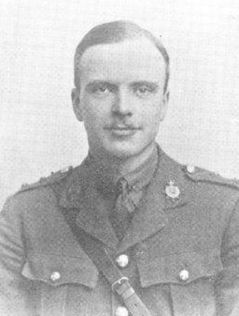
Lieut. Greville Thomas (Gurkha Rifles)

Today, it is my sad duty to report the loss of someone who was not only a much loved Old Boy, but also a member of my own family.

My nephew, Greville Thomas, was killed on April 10th in an attack at El Kefr, near Ramleh, in Palestine.

My sister has forwarded to me a letter from Lieut.-Col. Shaw, commanding 3/3 Gurkha Rifles, with his account of Greville’s final action.

“On April 9th orders came for an advance for the 10th…  

As one of the preliminary moves of the day, we were to take the hill I have marked 6.

Your son’s Company (D Coy) was detailed for the job and, after a preliminary bombardment by our guns, he rushed the hill with practically no casualties…

At about 10 a.m the real advance began…

The General sent me orders to rush the Pimple from the direction of Hill 6 with the company holding that hill. I passed on these orders to your son, and we had a long talk on the telephone, discussing the matter and arranging for artillery co-operation. He was absolutely confident about it, though he knew the attack would involve loss, across the open as it was. His last words on the telephone were a very cheery ‘Very well sir; goodbye’ and I answered ‘Good luck, old boy,’ and we shut down the telephone.

The attack failed completely, though most gallantly made. The Pimple turned out to be the surprise of the day, and was heavily held by the enemy… the attack was simply swept away. The two leading platoons were shot away to a man, and the support platoon practically shared the same fate…

Greville fell while leading this platoon in its dash across the open. He died instantaneously with three machine-gun bullets in his chest.”

Greville’s parents had only recently received a letter from him, written two days before his death:

“Just a short line today as I am very busy. I take my Coy. into the attack tomorrow. It’s not a very big show and mine is the only Company in the Battalion doing it, but one never knows what opposition there will be…”

With so many soldiers having no known graves, it is comforting to hear from Lieut.-Col. Shaw that in Greville’s case at least, his body was recovered:

“The following day I started negotiations under the Red Cross flag with the Germans and Turks with a view to mutual burying of the dead. As a result, his body was buried by our Medical Officer on April 17th. The position of the grave has been registered and marked with a cross of stones alongside.”

Of my three Thomas nephews, only Lynam Thomas remains  – Eric, the middle of the three brothers (and not an Old Boy of the OPS), having been killed in action last December.

Greville’s chief characteristics were an intense love for the home circle, and an unremitting devotion to hard work and duty, with a keen sense of humour. He was a great forward at Rugby football and helped introduce the game at Rossall, to which he won an Open Scholarship in 1910.

					

April 18th 1918

Capt. George Thuillier (Devons)

Following a period when it was thought that George might have been wounded and captured, Mrs Thuillier has received the news that he is now known to have been killed on March 26th.

When the German offensive started, the Devons were thrown in to stem the flow as best they could. At present, the exact circumstances of George’s death are not clear, apart from the testament of a brother officer, who has written:

“He met his death when extricating his company from an exceedingly dangerous position, and that they withdrew in such good order is greatly due to his self-sacrifice.”

His body could not be recovered, owing to the rapid advance of the enemy.

George went to the RMC at Sandhurst when he left Dover College, and left it with a commission in July 1915. He went to the Front in July 1916 with the 2nd Battalion Devons, taking part in the battle of the Somme in September and October 1916.

He was slightly wounded in early 1917, but recovered well to be promoted in command of a Company in February 1917. He received the MC in the New Year’s Honour List this January.

At the OPS, he was famous for his fearless tackling and clever diving, and his bright sunny nature won him friends everywhere.

His pluck and his bright, sunny disposition, and his fondness for, and care of animals, made him a general favourite.


April 16th 1918

Lieut. Ronald Stonehouse (RAF)

After a considerable period of painful waiting, the casualty lists in the papers of those lost in the battles of the end of March are now revealing the scale of our losses – over 1000 notified on the Roll of Honour of officers killed, wounded or missing in the last two days.

Our fliers have also been actively engaged and we have now been informed that one of their casualties was Ronald Stonehouse, on April 1st.

Ronald flew as an observer and his pilot has written to the family to explain the most unfortunate circumstances which led to his death: “He and I were great friends and had been together ever since he joined the Squadron, and had done many trips together over the lines, lived in the same hut or billet and had many pleasant times together…

On the night of March 31st, he and I had made two trips together over the lines.  Just as daylight was breaking, we had landed and were walking together to report to the Major. He turned back to get something he had forgotten. Half a minute later 6 or 7 bombs fell on the aerodrome, and we found him lying under the machine. He was killed instantaneously.”

Ronald took off on the evening of March 31st as a member of the RFC, but landed in the early hours of April 1st a member of the newly formed RAF – becoming, quite possibly, the RAF’s first casualty  (the RFC and the RNAS having been combined to form the RAF on April 1st).

Ronald had first joined the Army Service Corps, as he had injured one of his ankles in his early training and could not march. In August 1917 he joined the RFC and, after his training in aerial gunnery and as an observer, went out to France where he was working on a night-bombing aeroplane with 101st Squadron.

During the short time he was with us at the OPS, his manly, independent nature and his sense of humour endeared him to us all. ‘Public opinion’ meant nothing to him. His was of a most affectionate nature, and he never forgot old friends.

Neither shall we forget him.


April 10th 1918

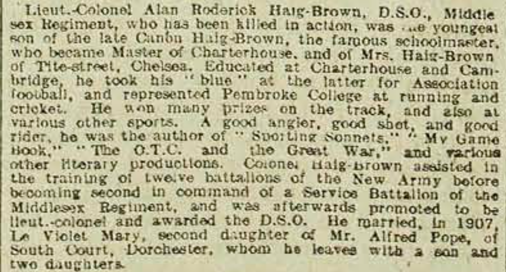
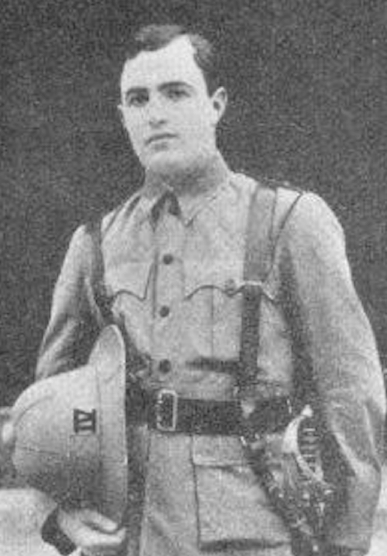
Lieut.-Col. Alan Haig-Brown DSO (Middlesex)

Many families have been more than a little concerned for their young men following the German offensive that started in March 21st. News of their fate has been slow in coming through. Mrs. Haig-Brown had not heard from her husband for two weeks and contacted the War Office for news on April 4th. That same day she received a telegram informing her that Alan had been killed during the retreat, on March 25th.

Alan taught at Lancing College before the war and played a key role in the development of the OTC; he aided in the training of numerous battalions before going out to become the Commanding Officer of the 23rd Service Battalion of the Middlesex Regiment – known as the 2nd Football Battalion.

Alan was well known both for his writing and footballing skills.

The Assistant Chaplain-General has written to say, “From what I hear, he gave his life in seeing that others got clean away, and died, as he had lived, for the men he commanded.”

This notice appeared in yesterday’s ‘Daily Telegraph’:

I have fond memories of Alan as a boy. His love of animals showed itself at a very early age; he was the originator of ‘pets’ at the School, and a goat which trotted about with him was the forerunner of many and various kinds of two, four and even no-legged successors: ducks, hens, kittens, snakes, tortoises, rats, mice, parrots, macaws, cardinals, cut-throats, budgerigars et hoc genus omne, may all claim to owe their appearance among us to Alan.

Some of us may remember his introduction of a huge snake into the drawing-room of 28 Norham Road, and the ensuing hysterics of a parent.


April 8th 1918

Lieut. Greville Thomas (Gurkha Rifles) is in Palestine. Over Christmas he was on the Red Sea and was able to spend a few days in Jerusalem last month.

Greville has from his earliest days been a great letter-writer; his letters are capitally descriptive and expressive of his feelings and ideas, from his letters home from the OPS to some long beautiful letters he has been sending more recently from the East – this before his first experience of action:

26/3/18 “Tomorrow night we go into the real thing and I should like to write you a few lines today, as I may not get the chance to do so again for a week or two… 

We expect pretty stiff opposition now, but we are sure to win through. If I get through all right you’ll know.  I’ll write as often as I can; if I don’t, you’ll know I have done my best from the day I entered the Service and you needn’t worry about anything else…

I’m looking forward to tomorrow night and the following weeks. I shall see my first real fighting then. I’m enjoying every minute of the life now and wouldn’t miss it for anything.”

Greville is the oldest son of my sister Helen – and my own dear nephew. His family were encouraged by his fine words, but understandably anxious to hear that he came through all right.

Fortunately, we did not have to wait long to hear that, for now at least, all is well:

29/3/18. “I write, as it were, in the midst of battle. We captured the ridge we are on the night before last, and we have been fighting to hold it ever since. The hillock I and my Company took was defended by a machine-gun, a Lewis gun and about ten men – all Germans we think…

My only kit now is a blanket and note books and the small photos I have of you all. Well, cheerioh, all of you, and don’t worry about me. I quite enjoy the show. One has got one’s job to do, and I try to do mine to completion, and yet don’t take any unnecessary risks.”


April 5th 1918

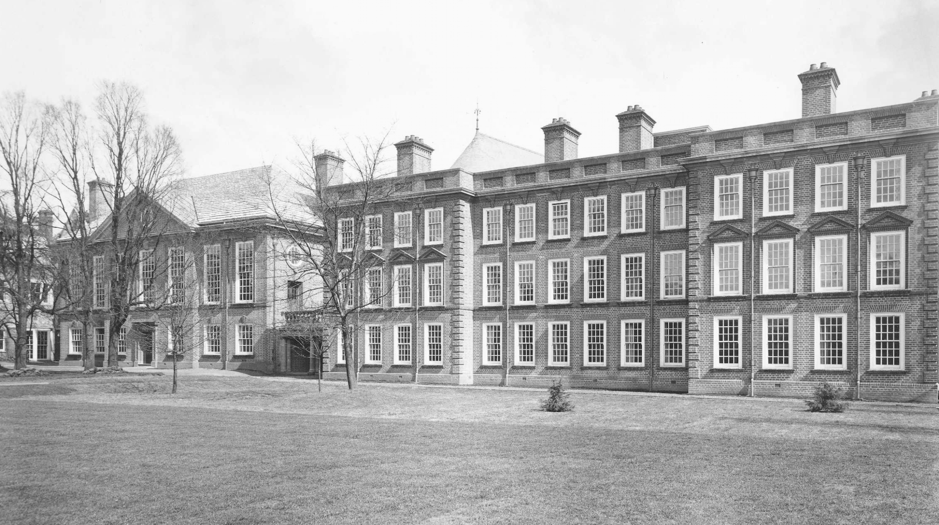
The Maitland Buildings, Somerville College (1913)

The death of Edmund Fisher, following that of his brother Charles at Jutland, is a terrible blow for the Fisher family as well as his many friends.

Some small consolation may be gained from the fact that he does leave a considerable legacy in the form of the buildings he has designed, the most impressive of which are to be found in the shape of the Maitland Buildings at Somerville College on Woodstock Road.

In April 1915, these buildings were requisitioned by War Office as a military hospital for wounded officers, and the Hall was used for a time as a medical ward, before being converted to its current use as an Officers’ Mess.

At the OPS we will remember Edmund for the Museum, which he designed.

Edmund can rest assured that the Museum is well used. This last term it was open to the whole school. A large number of boys have used it and studied the different collections. In addition there have been informal meetings on Natural History subjects several Saturday evenings.

We hope next term to have on show from time to time any interesting flowers or other Natural History objects found by the boys or other friends of the School. We hope also that we shall be able to get out into the country pretty often to look for specimens, but there is one form of collection – birds’ eggs – which ought to be discouraged this year entirely.

It is quite easy and interesting to look at and perhaps photograph nests without disturbing them, and the small insect-eating birds are so scarce, owing to the cold winter when we all enjoyed the skating, that no one ought to risk making them scarcer.

The butterflies and hawk moths have been rearranged and make a very good show. We have got a shell cabinet, but the arranging will have to stand over till next winter.

We are grateful for these recent gifts to the Museum: An African Tom-Tom (J Sanderson), tortoise’s and horse’s skulls (B Schuster), tiger’s skull (C Edwards) and African war stamps (Capt. GDH Carpenter).

The Museum was built to commemorate the death of my old sailing friend Maurice Church. He was a boy at the School (1884-86) and returned to join the staff (1898-1900). He enlisted as a Trooper in the Oxfordshire Yeomanry, going off to fight in the South African War. He was killed at Hartbeestfontein in February 1901.


April 2nd 1918

2nd Lieut. Edmund Fisher (RFA)

Just over two months after he was struck down by appendicitis in France, Edmund Fisher has died, on Easter Sunday, leaving a widow with five sons and two daughters.

In 1915, being well over military age and ineligible for active service, he went out as an orderly to the Hôpital Temporaire d’Arc-en-Barrois, organized by Miss Bromley-Martin and her sisters for French soldiers, and was there through the summer, mainly helping with X-ray work.

Later he succeeded in being accepted for active service, and having completed his training for the RFA, crossed to France on June 5th 1917. He took part in the fighting in the Ypres salient and again in the battle of Cambrai.

He was generally employed to look after camps of mules and horses and to send and often accompany ammunition to the batteries.

The Museum

Edmund had been an architect before the war. He designed our own Museum and carpenter’s shop – the Maurice Church Memorial – and was also responsible for the Maitland Building at Somerville College, now being used by wounded officers. His brother, The Rt. Hon. HAL Fisher, currently President of the Board of Education, was at the time President of the Somerville College Council.

Edmund was a good rider to hounds and at one time master of a pack of beagles. Indeed, no form of country sport was alien to him.

In conversation he was pithy and humorous, in judgement always independent, in observation alert.

The war has claimed no gentler or more spirited victim.


March 28th 1918

With the Easter holidays starting yesterday, it is time to take stock and reflect on the term past.

Since the last edition of the ‘Draconian,’ we have lost two very dear Old Boys: Martin Collier and Cyril Emmett. Three have been wounded, 2 have been made CB, 3 have got the DSO, 3 have had bars to the MC, 6 have won the MC, 1 OBE, 3 special promotions, 2 have been given the Croix de Guerre, 18 Mons Stars have been won and 12 have been mentioned in Despatches.

Capt. Reggie Carr-White (Indian Army) had the honour of introducing to the King two from the parties of Indian officers who visited England from the Western Front. At this investiture were Capt. Geoffrey Rose (OBLI) receiving a bar to his MC and Lieut. Stopford Jacks (RFA) his MC.

* * * * * * * *

I had great pleasure in handing to Miss Bagguley and Miss Williams each a cheque for £100, and a considerable sum will be paid later on. Miss Bagguley has been a valued member of staff for nearly 30 years, and we are fortunate enough to continue to retain her services. Miss Williams, owing to her brother’s blindness, has to live in London now, after 17 years at the OPS. She is at present at work at the Food Control Office, and made a pretty little speech, promising to do her best for our meat supply!

* * * * * * * *

I am sorry to say that war economy has compelled me to part with my dear macaws. Their cheerful bray and quaint ‘Form Fours’ and ‘Goodbye’ will no longer drown the voices of Mr Vassall and Miss Beevor, when conducting their attentive classes. I often long to go to Liverpool and buy them back! Polly and Joey I still happily retain to delight my little Lodge tea-parties.

* * * * * * * *

The Matron tells me that Miss Field has collected from the School more eggs than all the other contributors put together. The total for the last two terms is 1,813, and the grand total 6,749 since Mr Fletcher spoke to us in December 1916.

Colonel Hoare talked to the boys about the War Savings Association, and a sum of about £40 was collected from the boys for “Destroyer Week.”

* * * * * * * *

The health of our boarders is an important concern for any housemaster and my brother,  Hum Lynam, is providing some interesting “House Notes” for the ‘Draconian’:

“On the whole we have been exceedingly fortunate in the matter of health, though early in the term we had cases of ‘flu’, and soon after half-term we started measles. The latter was limited to seven cases, all quite normal in character, and the epidemic ceased before the end of term…

If the weighing machine is a good judge of health, it appears that the substitution of cereals and vegetables for a considerable percentage of meat food is all to the good. All boys, except three, increased in weight, some to an extraordinary degree; and several of these had lost weight in the Christmas holidays. The combination of magnificent weather, a short term and the ‘new’ feeding have kept the sick rooms practically empty, except for a few epidemic cases.”

* * * * * * * *

I fear that the events on the Western Front will over-shadow our holiday. It is clear now that the German Advance has been a significant one; indeed it seems we have now been driven back to where we were before the Battle of the Somme in 1916. Along with their families, I will be pleased to hear that our Old Boys have come through unscathed.


The Summer Term will start on Tuesday 30th April.

March 24th 1918

Sous-Lieut. Noel Sergent (French Artillery) has been enjoying an interesting job as an ‘officier d’antenne’, receiving messages from aeroplanes and then transmitting them on to his Battery for action. He has written to tell of us of his first experience of flying:

13.3.18.  6th Groupe, Secteur 21. “While they were preparing, a young observer came up and offered me his warm things, which are a kind of combinagger which you put over your boots and bags and coat and everything, and button up down the front. It is fur-lined and is guaranteed to keep you warm at any temperature. Then he gave me his gloves and a fur-lined foot-bag, which I declined as it wasn’t cold, and a woolly cap, then an aviator’s helmet over the top and goggles. I felt like a diver with all that on, and climbing in was a bit of a job.

The young hero [the pilot] got in first in front between between two hefty great motors, and I climbed in behind and sat on a kind of piano stool which slides backwards and forwards…

Then he set the motor working and we manoeuvred into position with a mechanic hanging on to each wing, taking gigantic hops like a couple of fleas. Once in position, we stopped dead and the pilot told me to strap myself in and put on my goggles… He then set the two motors going full split and we got going fast (about 90 or 100 miles an hour) and before I knew where I was, I looked down and there was a map underneath.

I had told the fellow I wanted to fly over the 6th Groupe so he did and came right down over the groupe and they all came out and waved their hands at me, and I dropped a message of good will saying that I was tired of war on earth and was migrating to the moon!

Then we made for the lines and went up to about 600 metres and I observed our batteries until we got over the Yser, which is no man’s land – or rather water… We flew up and down the Yser for a bit and then my friend suddenly swooped down to 300 metres. The Germans didn’t like this, but we got away before their machine-guns got going properly… 

My word, you should have seen the houses of La Panne flying past. After that, as soon as we crossed the French frontier we went up again, then down to the Kennel. It was all great fun and the pilot was a very clever fellow…

But the end of the story is that his Squadron Commander was at La Panne and saw us playing monkey tricks, so my friend got 18 days ‘arrêt de riguer.'”

From what Noel says, it appears that he is stationed near the French/Belgian border  – La Penne being on the coast not far from Dunkirk. The letter was written before the Germans launched their offensive on March 21st, and things may be less relaxed now, even if the main area of fighting is further south.

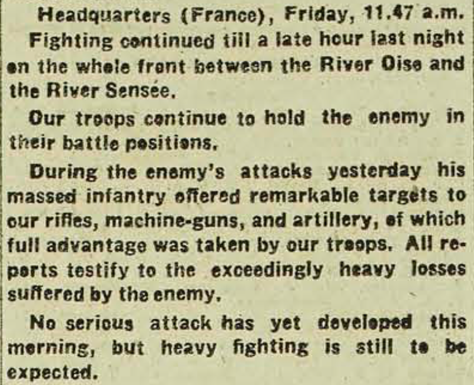
The newspapers suggest that the German attacks are being resisted successfully. Sir Douglas Haig’s communiqué of Friday 22nd is reassuring of that:

March 20th 1918

Flight Sub-Lieut. Cyril Emmett (RNAS)

Although there has been a lull in the fighting on the ground, the war in the air goes on unabated. It is with considerable regret that I have to inform you of the death of Cyril Emmett – the first of our Old Boys to have become a flying casualty.

Having left Repton School, he joined the RNAS in May 1917 and proceeded with training to be a pilot.  He was posted on January 17th to 12 Squadron at Dunkirk, where, we are told, he proved himself to be a very capable officer and a good pilot.

The Squadron Commander has informed the family that Cyril did not die in aerial combat, but rather that it was a flying accident of the sort we too often read about. Last Friday (March 15th), he was taking off from the aerodrome when he experienced difficulties.

“He appears to have choked his engine. He tried to regain the aerodrome, but crashed to the ground from a height of about 200 feet. On examination, the surgeon states skull fractured, that death must have been instantaneous.”

He was buried the following day at the Town Cemetery in Dunkirk, the length of his service having been barely two months. His C.O wrote:

18/3/18 “I, in company with officers and men of his Squadron attended his funeral, which took place last Saturday afternoon, and as an appreciation of his sterling qualities this Squadron sent a large wreath.”

Cyril was always so full of life and pluck that it was a joy to be with him. He was a merry and popular Dragon.