April 20th 1915

Following his rugger match for the South Midland Division against the 4th Division on April 14th, Ronnie Poulton has returned to a tour of duty in the trenches:

Sunday 18th April. “About midday was warned to go up to our new trenches, at present held by the 4th Oxfords,  RWPP profileas we were taking them over tomorrow. I was to go up to see round them. You can enter these by day, so I went up in the afternoon and got a guide from the Oxford headquarters. A short walk along the edge of the wood brought us to the communication trench, and so into the trench well to the right of our line. Moved down this and got to our trench. This is a top-hole one, strong in front, apparently good wire, good parados in parts, not bad dug-outs and apparently never shelled by the enemy…”

And may this continue to be the case!

* * * * * *

BP Price

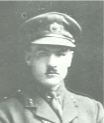
Lieut-Col BG Price DSO Ist Battalion Royal Fusiliers

Having been ‘Mentioned in Despatches’  (17/2/15), Bartholomew Price has now been ‘Promoted for Service in the Field’ and is transferring to take command of the 7th Battalion Warwickshire Regiment.

Bartholomew joined the Royal Fusiliers in 1892 and served in the Boer War, taking part in the Relief of Mafeking. He was awarded the DSO in 1901.

Bartholomew joined the OPS in its second year (1878). He is the son of the late Professor Bartholomew Price, Master of Pembroke College, one of the group of Oxford Resident Fellows who founded our school.

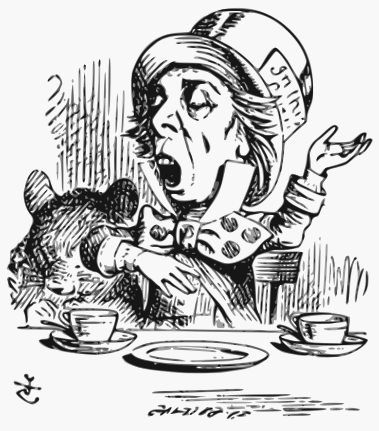
Professor Price is remembered as a teacher of Lewis Carroll (CL Dodgson) when he was an undergraduate studying Mathematics at Christ Church.

379px-MadlHatterByTenniel_svgCarroll referred to his teacher as ‘The Bat’ (‘Twinkle, twinkle Little Bat, How I wonder what you’re at’ as the Mad Hatter sang in ‘Alice’s Adventures in Wonderland’).


February 15th 1915


Roderick Haigh

Roderick Haigh

Roderick Haigh’s Will.

The will of Roderick Haigh, who was killed at Ypres in November (see October 12th, 29th and November 16th posts) has just been published. We are immensely grateful to Roderick for remembering us, as no doubt will be all who are benefitting from his generosity:

£2300 to the President and Fellows of Corpus Christi College, Oxford, to found a scholarship or annual prize in memory of Arthur Elam Haigh (his father, a Fellow of the College).

£1000 to the Governing Body of Leeds Grammar School to found a scholarship or annual prize in memory of Arthur Elam Haigh.

£500 to the Headmaster of Winchester College for some purpose as he may determine to assist the Winchester College Mission.

£500 to the Headmaster of the Oxford Preparatory School to supplement the Exhibition Fund, or for any other purpose he may determine.

£30 to the Oxford Women’s Church of England Temperance Society and £20 to the Oxford Surgical Aid Society.

£500 to the officer commanding 2nd Battalion Royal West Surrey Regt., for investment as he may determine and to apply the income in the purchase of instruments, music etc for the drum & fife band, or for any other purposes he may determine.

Roderick also left a number of bequests varying from £50-£10 to warrant officers, non-commissioned officers and men of his regiment ‘as a token of gratitude’ In the event of their being no longer alive, the gifts will go to their next-of-kin.

Part of Roderick Haigh’s bequest to the OPS has been used to pay for the miniature rifle range and the Roderick Haigh Cup will be shot for annually, and will be won by the best individual marksman in a competition between Day-boys and Boarders.

The range has also been very useful to the 4th Territorial Battalion of the OBLI (Ox & Bucks Light Infantry) and to the Oxford Volunteer TC. Officers home on leave from the front and others in training have also used the range for revolver practice. In fact it has been a great success.

The rest of the money may be used to help the sons of Oxford dons attending the School, who, on account of the war, or for other reasons, may need it.

* * * * * * *

Mr Haynes has contributed a handsome addition to the Boarders’ Library in the shape of the following books, which were chosen by a plebiscite of the VIth Form:

W. H. Ainsworth: 	Old St. Paul's 
		 	Windsor Castle
		 	Tower of London
F. Anstey: 		Vice Versa
R. M. Ballantyre: 	Coral Island
Rolf Boldrewood: 	Robbery Under Arms
A. Conan Doyle: 	White Company 
			Rodney Stone
                	Exploits of the Brigadier Gerrard
Quiller Couch: 		Dead Man's Rock
Fitchie: 		Deeds that Won the Empire
W. S. Gilbert: 		The "Bab" Ballads
Rider Haggard: 		King Solomon's Mines 
	       		She
	       		People of the Mist
J. K. Jerome: 		Three Men in a Boat
R. Kipling: 		Just So Stories
	    		Jungle Book 
	    		Second Jungle Book
Lamb's 			Tales from Shakespeare
Capt. Marryat: 		Midshipman Easy
Anna Sewell: 		Black Beauty
Seton Thompson: 	Wild Animals I have known 
			Lives of Hunted
Jules Verne: 		From Earth to Moon 
	     		20,000 Leagues Under the Sea
Stanley  Weyman: 	Gentleman of France
P. G. Woodhouse: 	Mike 
	         	Psmith in the City

December 28th 1914

We hear that George Fletcher (Royal Welch Fusiliers) is making a name for himself on both sides of the front line. Apparently he taunts the Germans with any news that comes his way of Allied successes, which he chalks up on a board. The Saxons opposite then take pot shots at it, which the Tommy likes to score as if he was on the ranges at Bisley!

George was trying to persuade the Germans to join in a beer, sausage and plum pudding evening on Christmas Day but his C.O was not impressed. Nonetheless, the Germans did provide two barrels of beer and there was general fraternization and exchanging of food and cigarettes.

*  *  *  *  *  *

Greville Drew (Capt. R.E.) was able to enjoy a more relaxed time well behind the front line.

Greville DrewXmas Day.  “We are very glad to be out for Xmas and a few days’ rest. We are in an extremely comfortable billet with a dining room, sitting room, kitchen, and two bedrooms for the four of us that there are now – three officers and an interpreter – or interrupter as the Indians all insist on calling them.

We have decided to have a real day off today and are leaving the men to their own devices for the first time since we have been in the country. Tomorrow we shall start getting them really straightened out. All the same, we are not to be caught napping today. We have orders to stand by in case the enemy should consider Xmas Day a suitable opportunity for a little devilry, so we are all ready to move at a moment’s notice.

The King’s Xmas cards to all ranks have just arrived.

I am glad to see from the ‘Daily Mail’ that they are at last publishing in the papers the fact that all the troops are amply provided with clothing and comforts. Really since we got a mention in despatches, the things sent to us have become a positive nuisance. For instance someone sent us 300 cardigan jackets (for about 150 men we have left in the Company). We don’t know what to do with them, and we have been fully occupied with more important duties than sorting out what we do want and what we don’t, and sending them back again. What is wanted is a central depot in London for each corps, or division, and then when a unit wants something it can write and ask for it.”

December 7th 1914

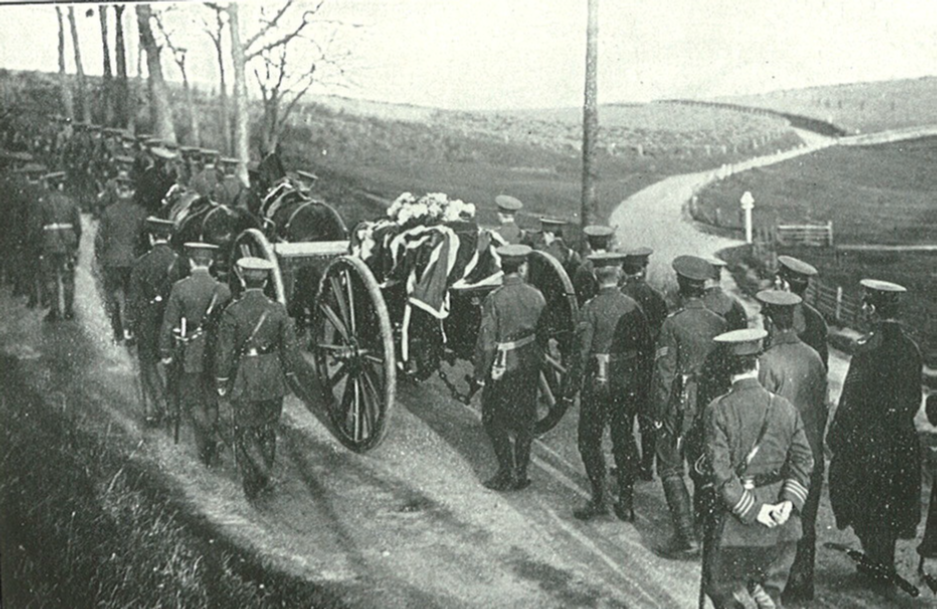
Alan Leggett, one of the three Old Dragons killed on October 31st and whose death was posted on these pages on November 2nd,  was interred with full military honours at St. Martin’s, Cheriton in Kent on Wednesday afternoon. On Monday his body had been brought from Boulogne by his father. The coffin, which was borne from the house to the church on a gun carriage drawn by men of the Northamptonshire Regiment, was draped with the Union Jack. A firing party composed of men of the Northamptonshire Regiment marched in front of the gun carriage.

Cheriton

Lieut. Leggett’s funeral procession.

We are grateful to Col. and Mrs Leggett for sharing with us the contents a postcard Alan wrote to them only a day before he died.

“I am at present in some trenches. I have been here for over 24 hours now, and expect to stay for four or five days before being relieved. We live like rabbits, keeping out of sight and under cover. The German shells have been peppering us a good deal and we get smothered with earth and get buried now and again; however, thank God, I am still fit and sound; the ground regularly trembles when it is struck. It rained a bit last night, so we had an unpleasant time of it. One’s feet get chilled to the bone; however, with all you sent me, I am warm enough otherwise. It will be a mercy when this is over – it is awful. Well no more now, keep cheery, and don’t be anxious. Very best of love, Alan”

*  *  *  *  *  *

Greville Drew (Capt. Royal Engineers) reports better conditions at the front, but hostilities continue, even if there is no major battle.

Greville Drew

Capt. Greville Drew

4/12/14. “All the troops are either in the trenches or comfortably in billets in farm houses, barns etc and they really have to endure very little hardship, as far as the cold is concerned. It is true that some of them got caught during that very cold snap, when it suddenly froze after raining, and I know one regiment had 120 cases of frost-bitten feet. What is going to be the trouble is the wet and not the cold. I have just done six days on end in the trenches, up night and day, and I can assure you there is not much suffering from cold there.

Every man digs out his own little shelter in the firing-line, and roofs it over with material and stuff out of the houses on the road behind. There is a huge brazier burning every few yards and the trenches at night are very nice and comfortable – when it isn’t raining. With my section during my week in the trenches I was lucky enough to have hardly any rain at all, and in any case it would not have affected me much, as my dug-put was quite weather-proof, roofed in with an old ammunition box full of charcoal, burning all the time. I did all my cooking on that.

That is another thing. All our troops are fed absolutely tip-top. We get bacon, fresh or tinned meat, jam, cheese, tea, sugar, every day, with butter and tobacco and matches occasionally. Of course, we buy our own butter, of which there is any amount about. In fact, one of the things that strikes one is how the civil population is staying right up near the firing-line. It seems foolish in a way, as the number of spies and snipers is prodigious.

During an attack on a German sap-head we lost one officer killed, one wounded, and six men killed and wounded, but we accounted for over forty Germans, who were stuck through with bayonets whilst fast asleep in their covey-holes!

By all appearances we are just sitting tight in our trenches until we get all our new troops trained and ready.”

November 30th 1914

The ‘Globe’ Newspaper recently noted a number of “interesting names” of Old Dragons serving. They included the England Rugby Captain, Lieut. Ronald Poulton Palmer; the Oxford stroke, 2nd Lieut. Bob Bourne; a Services Boxing champion, Lieut. Martin Collier; an Oxford Cricket Blue and Fellow & Senior Censor of Christ Church, Charles Fisher; an Oxford Hockey Blue & International, 2nd Lieut. Sholto Marcon; an Oxford Athletics Blue, 2nd Lieut. Aubrey de Selincourt; an Oxford Hockey Blue & International, and tutor to the Prince of Wales, Lieut. Lionel Smith. The list also includes the captain of the Oxford Athletics, a rowing blue who had a picture in last year’s Royal Academy, three first-class men in Greats at Oxford, all this year, many scholars of colleges and 2nd Lieut. CJ ffoulkes, RNVR, who is keeper of the Tower Armouries.

Only three years ago the OPS could indeed claim, amongst the 35 Old Dragons then up at the university, the captains of Rugby (Ronald Poulton Palmer), Hockey (Sholto Marcon) and Rowing (Bob Bourne). Most notable was the University Hockey XI, which that year contained no fewer than five Old Dragons in the team. They are all now members of His Majesty’s Armed Forces.

* * * * * *

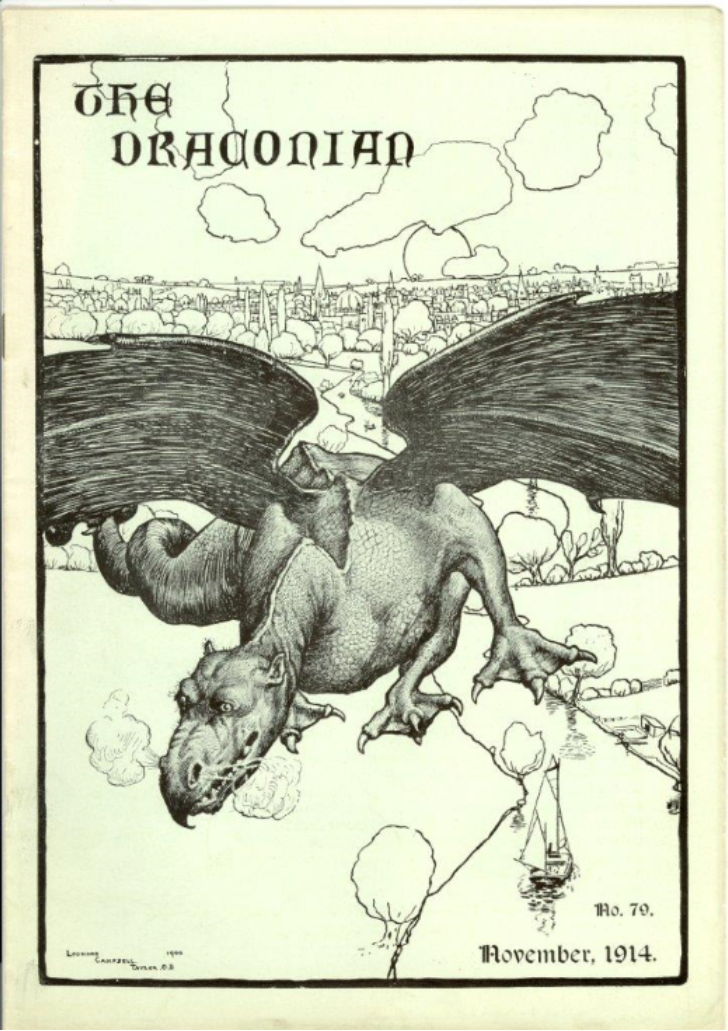
Draconian 79.

With the next edition of the ‘Draconian’ not due until after the end of term, we are issuing a special edition listing all those ODs who have answered the call to arms. It shows some 225 Old Dragons and staff already in uniform and a further 10 at Sandhurst, Keyham or Osborne. (Let it be remembered that when they were at the OPS, we only numbered 90-100 in the school).

We also include a poem by Frank Sidgwick, ‘The People’s Gift,’ which appeared recently in the ‘Saturday Review.’ This is the final verse:

Take the lesson, then, young Englishmen, when the war-cloud lowers black,

Let no man shift his burden of gift on to the next man’s back;

Answer today what part you will play, when your country gives the sign –

What gift will you bring to your country and King – is your blood water or wine?

* * * * * *

Frank’s brother, Hugh Sidgwick has been acting as private secretary to Sir Lewis Selby-Bigge, Permanent Secretary to the Board of Education. His work is deemed too important to allow him to join up. Instead he is doing duty as a Special Constable.

Special Constables – by one

Hugh Sidgwick SC

Hugh Sidgwick

“The Editor has asked for an article on Special Constables, and the motto of the force being obedience I can only comply. But one thing must be made clear at the outset. This nation at present consists of (a) the armed forces of the Crown; and (b) the rest. Special constabling is one of the forms of consolation for (b), who are small beer, and don’t matter much; it stands on a level with knitting socks, and putting on a light green uniform and gesticulating in Hyde Park on Saturday afternoons. It is miles away from the activities of (a), and must not be spoken of in the same breath. Therefore, if this article gets printed, let it be in the smallest of small print, in a corner far away from the ‘res gestae’ of soldiers and sailors. If that is quite clear, I can begin.

Special constables are amateurs who in their spare time assist the police in their lighter duties. They are sworn in for the period of the war – to carry out their duties without favour or affection, malice or ill-will, to preserve the King’s peace and guard the persons and property of his subjects, and so forth. They are provided with an armlet and a truncheon and a note-book and a warrant and a whistle and a badge; (I am going to make a song some day with this refrain). They may also provide themselves with a uniform. In our detachment it is a long blue overcoat and a yachting cap, in which we look like well-intentioned tram-conductors: but I am told that elsewhere there are variations in head-gear. Thus equipped, the special constable goes forth upon his duty.

So far the terror of our name has kept the malefactors away, and we have arrested only a bronze statue and a cat. But the moral effect has been enormous. The criminal classes and the foreign agents stand appalled at the reserves which the Executive has brought into play; they argue, ‘a fortiori’, that if respectable elderly gentlemen take such a lot of trouble about a little thing like that, what will happen if matters get really lively? Further, the ascendancy of the male sex is now re-established. I know of at least one dinner invitation which has been refused on the ground of constabulary duty. The dinner was on Tuesday and the duty on Thursday: but who could know that?”

November 23rd 1914

The arrival of winter weather has put an end, at least for the time being, to the fighting at Ypres. Both sides have suffered most horribly and there have been times when British troops have risked their lives to help the enemy wounded. George Fletcher (Royal Welch Fusiliers) describes an incident in which he was involved.

George Fletcher

“We were fortunate in being able to rescue one wretched man. He was one of the advanced party in the charge, and had seven bullets in him. He stopped for a day in front of us shouting, but we were getting such a peppering from snipers all that day that we were not allowed to fetch him. At night I got two volunteers to come and fetch him, and just as we were getting out such a hail of bullets came that we nipped back.

I kept up a conversation (shouted) with him next day – he told me the Germans had been practically up to him in the night, but had refused to help him. I told him to hang on till night, and we would try and rescue him again. So at dusk I got two volunteers again, and we pulled him in successfully, and doctors say he will live in spite of his seven wounds. Funny thing, war.”

 * * * * * *

Whilst the war takes up the thoughts of us adults, it is important that life at the OPS continues as smoothly as possible for our young Dragons.

rugger

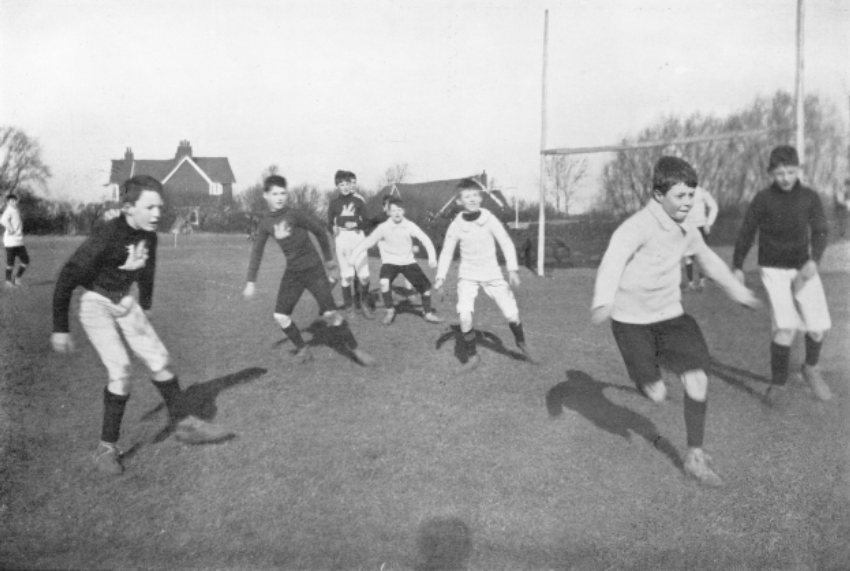
The beautiful weather which held for the first month of term made rugger impossible. In the first match, against Eagle House on November 4th, considering all things, although the team lost 0-22, they made a good show and look as they might develop into a good side.

I am not convinced of the desirability of keeping each boy to play in a particular place practically always. To know the game properly, a boy ought to be prepared to play half or forward or three-quarters as he may happen to be asked.

There seems to me nowadays a sort of prevalent fear of doing the wrong thing, and not enough initiative, not enough determination to get through and to score against the opponents…

I must say I think criticism of an individual’s play, sometimes very emphatic and loud-tongued, should be entirely abolished during the progress of the game; and nothing but encouragement allowed. Personally I know what the effect on myself would be if I were yelled at as a slacker or funk in the middle of a match!

Why, oh why do not Winchester, Charterhouse, Repton and Shrewsbury play rugby instead of the disgraced ‘soccer’? Malvern, Radley and Rossall have abandoned the professional game and joined the Rugger ranks…

 * * * * * *

The boys have sent stamps to the Base Hospital, and indeed have made a very large money collection considering their small incomes! The ‘Blue Dragon’ gramophone with its lovely old records and many new ones has delighted the inmates of Medical Ward V, where it is guarded jealously from the raids of other wards.

Hum Lynam

Hum Lynam

‘Hum’ has been almoner-in-chief and has installed and looked after Belgian refugees at the Lodge and elsewhere. He has also collected and forwarded sweaters, pipes, pencils and writing books, subscribed for by the boys, to various quarters, including HMS Colossus, HMS St. Vincent and HMS Russell.


We have had the following replies:

H.M.S. St Vincent

First Battle Squadron

November 20th 1914.

My Dear Dragons,

Pipes very much appreciated – now smoked by His Majesty’s Jollies.

Pipe 1
Who owned?                         


And the other one that might have been made by Krupp?

Pipe 2


It was a kind thought and entailing some sacrifice I’ve no doubt – parting with old friends – Censor allows no news.

William Fisher (Capt. R.N.)

H.M.S Russell

21/11/14

Dear Dragons,

A line to thank you all for sending us that generous supply of briar pipes. The men are no end pleased, and wish me to thank you for your kind thought for them. I only wish I could come and thank you all personally for them! But I shan’t be able to do that until they become Pipes of Peace.

 Lance Freyberg (Lieut-Commander R.N)

November 16th 1914

We have been notified of the death of another very dear Old Dragon.

 Roderick Haigh 2

Lieut. Roderick Haigh (Queen’s Royal West Surrey Regiment)

Roderick has been killed; his crusade has come to an end. He was in the last charge of the 22nd Battalion at Klein Zillebeke (also known as Hill 60) near Ypres on the night of the 6th– 7th November, when the Brigade, only 700 strong, attacked and carried the German trenches, capturing three machine guns.

A private in his Regiment witnessed his death:

“We had the order to attack some trenches at dawn. I saw our Adjutant (Lieut. Haigh) cheering the men. We had only advanced a few yards when the enemy saw us and fired ‘Rapid Fire’ at us, and then we charged through a terrible hail of bullets, and got the first line of trenches.

Then Mr Haigh gave the order to advance, which we did, quick; and we took another trench, and then were told to get ready again, and we took the last trench; but when we got into it we found it was a running stream. The Adjutant with myself and 14 others got into this ditch only to find that the Germans were only 10 to 15 yards away, strongly entrenched.

We were firing point-blank range at each other, and all the time the Adjutant was standing up in the trench, head and shoulders showing. I actually stopped firing to look at him and admire him. He was using his revolver with great effect, and kept saying to encourage us, ‘That’s another one I hit.’ Oh, he was a cool man.

The Lance-Corporal went back for reinforcements, but couldn’t return. We kept firing for half-an-hour afterwards; then the brave Adjutant was shot through the temple. He died a noble death. I found myself alone, the only one of the fifteen alive, and I made a dash for it, and never got hit, though I had three bullets in my pack close to my neck.”

One of his tutors when at Corpus Christi writes:

“When the war broke out, he was recalled with his battalion from South Africa, and ordered to the front.  I know that he went fully realising the possibility that lay before him, but counting it the highest honour which can befall a soldier, to be allowed to give his life for his country and his king.  For him, therefore, we must not grieve.  Almost ever since I heard of his death, Shakespeare’s glorious words have been beating in my brain:

    ‘Your son, my lord, has paid a soldier’s debt.’…
    ‘Had he his hurts before?’
    ‘Ay, on the front.’
    ‘Why then, God’s soldier he be!
    Had I as many sons as I have hairs,
    I would not wish them to a fairer death.’

May his memory and example long continue to inspire those who knew him.”

Roderick’s sister was notified of his death on November 11th by way of a telegram from the War Office:

Haigh telegram 2

Lieut CR Haigh Queens Reg’t was killed in action 7 November  no further details – Lord Kitchener expresses his sympathy.

*  *  *  *  *  *

Teffrey ThompsonTreffry Thompson is not only an Old Dragon but a sailing companion. Some of you may have read of our voyages together in the ‘Log of the Blue Dragon.’ He is kindly sending us extracts from the diary he is keeping.

Having been a casualty house surgeon at the Radcliffe Infirmary in Oxford, he joined the RAMC. At present he is attached to the headquarters of XV Brigade with the Royal Horse Artillery (RHA). He writes of the battle which has been going on at Ypres since mid October.

“It might interest you to know what sort of things the Germans fling into Ypres. One of the RAMC men was walking outside a large house on the outskirts of the town, which had been taken over for a hospital, when a large shell burst some distance away, and the flat base only of the shell came back and hit him on the foot. This flat base was 16 inches in diameter and weighed 93 lbs., so that the whole shell probably weighed about 800-900 lbs.

These evidently come from large howitzers a very long distance off, as one never hears the bang of the gun, but suddenly a rushing noise, just like that of a train in a tunnel, ending in a mighty crash, which even 3-400 yards away shakes the ground and trees, and when they fall only 50 yards away, as a couple did this morning, they make the whole house rock.

One great advantage here at present is that the ground is very soft; so that the shell buries itself about 12 feet  (down) before it explodes, so that most of the force is spent hurling large sods and chunks of shell into the air; one can be quite close comparatively without real danger. It is anywhere from 100-150 yards away that one may get hit by the fragments.

October 29th 1914

Whilst the German advances through Belgium and France have now been arrested, attempts to outflank the German forces seem to have failed.   Tyrrell Brooks (Duke of Cornwall’s Light Infantry) does not think we can now hope for a quick victory.

JBBrooks

23/10/14 “We have been in this place for eight days and there is a sort of state of siege – each side digging in – so one hardly ever gets on a horse and consequently they are all eating their heads off. I have three extraordinarily good horses, all of which would make real good hunters.

This war is going to be a very slow one, and a decisive victory seems hard to realise or rather imagine, owing to the length of the line and the various ups and downs which occur in it. There is one thing I am sure of and that is the Germans are as tired and cold as we are, perhaps more so, as I doubt if their Commissariat is as good as ours. The RAMC have done splendid work out here and the removal of the sick has been quickly and splendidly carried out.”

* * * * * * *

Roderick Haigh (Royal West Surrey Regiment) has been wounded in the battle going on at Ypres, although thankfully not badly:

Roderick HaighSt Crispin’s Day (25/10/14). “This has been no St Crispin, but a quiet, peaceful Sunday in Reserve after a week’s very heavy fighting.

On Tuesday last I was wounded by a shrapnel bullet in my thumb. These bullets are about 1/3 to ½ inch in diameter. The bullet was ¾ covered. I at once bit the bullet out, and Capt. Weeding put on my ‘First Field Dressing.’ It is a very slight wound indeed, and is healing up well. I am remaining with my unit, and can even write orders, although, as it is my right hand, I cannot write as fast as usual.

I cannot tell you how much I enjoy it all. There is something so noble and something so grand about the whole show, which places it on a far higher plane than any other scene in which one has acted in this life.”

October 12th 1914

Roderick Haigh’s sister has kindly shared with us a letter she has received from him. Roderick’s father is a Fellow and Tutor of Corpus Christi College Oxford and Roderick won an Exhibition to Winchester from the OPS before going up to his father’s college. He took up a commission in the Queen’s Royal West Surrey Regiment in 1911 and is now serving with the BEF.

Roderick Haigh  “I am extremely fit, and thoroughly enjoying myself. We are all inspired with the justice of our cause, and by the fact that we are fighting for the cause of honour and liberty throughout the world. The question at stake is whether liberty and justice or military despotism and tyranny are to prevail. It is a great privilege to fight in such a struggle.
I look forward to seeing you all again one day in England. But if I do not return, remember that it is the highest honour to which a man can attain – an honour which is open to officers and men alike, a higher honour than all the honour that can be showered on those who survive – to die for one’s country.”

 *  *  *  *  *  *

Under Mr. Wallace’s superintendence a really good rifle range has been made with 12 feet high butts, and firing sheds at 25 and 50 yards. It is parallel with the Cherwell at the east end of the field. Colonel Henry has most kindly taken batches of boys to the Oxford Rifle Range whilst ours was being made and had taught them the beginnings of shooting. Some of them are very promising and we hope to have regular competitions next term. We have six BSA miniature rifles with .22 ‘long’ cartridges and the Staff and visiting Old Boys have lively competitions.

The field is being used considerably by Oxford recruits as a drilling ground. The recruits have been drilled by Sholto Marcon, Billy Smyth, Alasdair Macdonell and other Old Boys. I shall be very glad to let the range be used for practice under responsible officers during the holidays.

Cyril Pouncey, in my top form, has written a capital poem, which we shall put in the next edition of ‘The Draconian’.

Oh! Kaiser William, I today
Do condescend to write to you
And ask you, if indeed I may,
If what men say is really true?

Some people say you are the cause
Of all this grief and useless strife,
Of breaking treaties, starting wars,
And cutting short the Belgian life.

They say you slaughter many a child,
And pound with shells each ancient town;
And use as shields the women mild,
And turn cathedrals upside down.

They say your soldiers, at your will,
Do rob and plunder just for you;
And often poor civilians kill.
Oh! Kaiser, is this really true?


September 28th 1914

Our Old Dragon correspondent at Winchester has reported that Cyril King, who was due to be a House Prefect this term “is at present unavoidably detained in Germany.”

At the end of July 1914 Cyril was at Schluchsee in the Black Forest with his mother, four sisters and a tutor from New College, Coote. Although there were rumours of war, they were confident that if anything came of it, they would be able to return to England. Instead on August 7th they were arrested. We await further news.

*  *  *  *  *  *

We have received news from Rupert Lee, a Lieutenant in the 3rd Battalion of the Worcestershire Regiment.  In good OPS tradition, he is keeping a diary, although rather different in content to the usual Dragon offerings at the end of the summer holidays.

“This diary must be read and criticised very leniently, being rather a disjointed sort of narrative. Pieces of it were written in strange postures and places, in varying frames of mind, sometimes left for weeks without an entry and then written up to date… It does not profess to be a connected narrative but merely a conglomeration of statements of happenings as they appeared to me at the moment…”

He writes of a very narrow escape he had during the retreat from Mons:

“Just as I got about twenty yards away from a wood a shell came crashing through the tops of the trees and burst quite close to me. My horse got it badly in the stomach. I got off and shot him to put him out of his agony… I then stood up and looking round saw, just at the end of the ride, two Germans. I bolted for the wood and as it happened it was extraordinarily fortunate that I did so. For they both dismounted and came down the ride  looking into the other side to that on which I was hidden. Just as they got opposite me the leading man put his gun up sharply. I shot him and bolted, as did his companion in the opposite direction.

I went about twenty yards and lay down behind a bush. Nothing happened, so after about twenty minutes I went back very quietly, took his shoulder strap off him and walked away.”

*  *  *  *  *  *

JBBrooks

Capt. W.T. Brooks

Tyrrell Brooks (recently promoted to Captain in the Duke of Cornwall’s Light Infantry and ADC to General Morland) writes:

September 14th.

“We are having a VERY hard time and now the weather has changed to rain it is cold and greatly adds to the discomforts which we are undergoing. Our Infantry has been brilliant and have more than kept up their high traditions, their marching having been really good and their fighting power at the end of the trek has been unimpaired.

We have now started a great forward movement which, though costing many lives, will undoubtedly test our enemy to the utmost and they are, I think, in rather a tight hole from which it will take them all their skill to extricate themselves. However, they are splendid tacticians, but I doubt if they have the material which is worthy of their well planned tactics.

How long this war will last I know not, but one thing is certain and that is it will leave all concerned crippled with regard to fighting material and armaments. Our casualties have been large but the German ones must have been larger.”

*  *  *  *  *  *

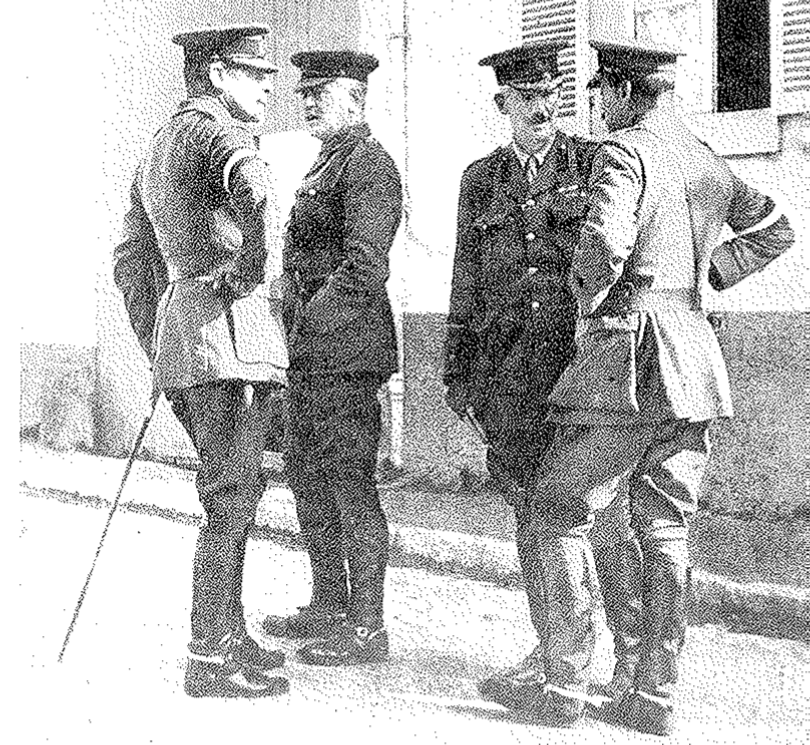
Readers of the “Illustrated London News” may have noticed the photograph below, probably taken during the retreat from Mons, which shows our old boy, Arthur Percival, with a number of notable figures. Arthur, a veteran of the Boer War and the first Old Dragon to have won a DSO, is serving as a General Staff Officer to Major-General Monro.

Percival & Generals

(Left to Right): Gen. Sir Douglas Haig, Maj-Gen Monro, Lt Col AJB Percival DSO and another.