August 16th 1916

CDF at sea croppedYou may have seen the Poet Laureate, Mr Robert Bridges has published a piece entitled ‘The Chivalry of the Sea‘ and the more observant amongst you may have noticed that this is dedicated to our own Charles Fisher, who went down with HMS Invincible at Jutland.

The well-known composer, Sir Hubert Parry, is setting the piece to music.

A friend of Charles Fisher’s, Mr George Lyttelton, has written a capital piece in Charles’ memory. Apparently Charles told him that all he wished to do after the war was to go to bed for five years, only getting up for meals – before adding that this was not to be considered incompatible with an earlier wish to end his days in a Worcestershire vicarage, having helped to settle the date of Deuteronomy.

How I do miss Charles.

June 7th 1916

As far as one can tell, there have been no other casualties amongst the naval Old Dragons at Jutland – for which we are all most thankful.

Charles Fisher‘s brother Captain William Fisher (HMS St Vincent) was also involved in this action, and was lucky enough just prior to the battle to be able to spend some time with Charles.

WW Fisher

William Fisher

“Charles and I were on shore together having the greatest fun when recalled, as we have been recalled dozens of times before.”

Then, by another extraordinary coincidence, he found himself at the scene of his brother’s death very shortly after the event:

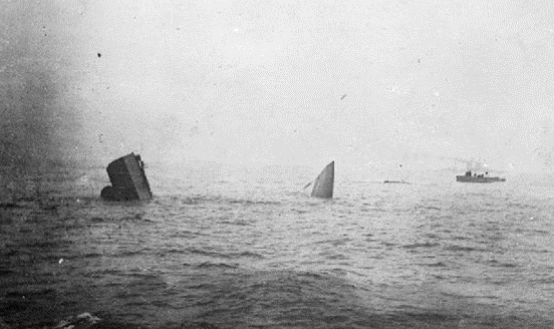
“Exactly twenty-four hours later the ‘St. Vincent’ steamed past the wreck of a ship which we took to be a German. We were, with other ships near us in the line, engaging four German Dreadnaughts at the time, but I looked to see if there was anyone in the water near this ship and saw nothing – not even floating wreckage. All round was still calm water.

The wreck might have been there for weeks – and yet we know now she went down only about a quarter of an hour before our arrival. Her bow was high in the air and so was her stern, the centre having been split in two and apparently resting on the bottom.”

Invincible sunk

The wreck of HMS Invincible

It was not long before someone spotted on the starboard side at the stern, the name: HMS Invincible, and William realised that he had lost his brother.

William writes of Charles:

“I am comforted by the knowledge that he who had seen so much carnage will have steadied everyone near him.

How proud I have been to walk about as Charles’s brother, and prouder, if possible, than ever now…”

These are sentiments we can all share.

* * * * * * * *

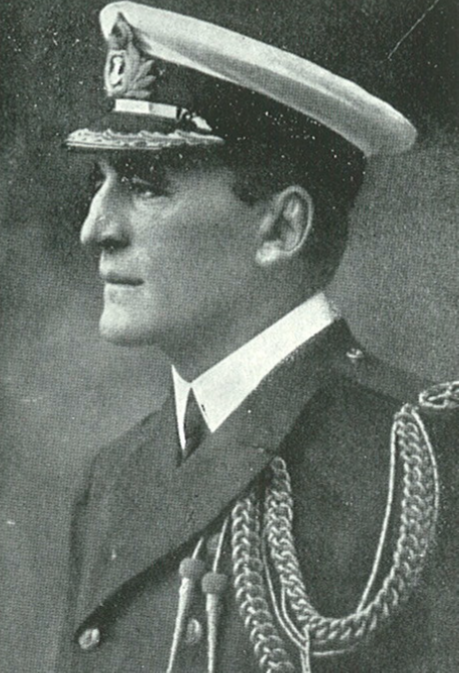
TyrwhittIt is good to read some good news at this time. In today’s Court Circular column it is recorded that Commodore Reginald Tyrwhitt was yesterday invested by the King at Buckingham Palace with the insignia of a Companion of the Distinguished Service Order.

June 6th 1916

HMS Invincible

HMS Invincible

It transpires that there were only six survivors from HMS Invincible and it is by extraordinary luck that one of them, Commander Dannreuther, was at the side of Charles Fisher when the explosion occurred.

HMS Invincible was involved in a gun battle with the German battleship ‘Derfflinger’:

“We hit the Derfflinger with our first salvo and continued to hit her entirely owing to the perfect rate Charles gave us.

It was all over in a few minutes and death came suddenly and painlessly. Everything was going splendidly at the time, and it was entirely due to Charles’ cool head and excellent judgement that our firing was so effective.

I saw him only a few minutes before the end – a smile on his face and his eyes sparkling. He was by my side and in the highest spirits when there was a great explosion and shock, and when I recovered consciousness I found myself in the water.

Ship and crew had disappeared.”

Commander Dannreuther estimates that this great ship went to the bottom in a matter of only 15 seconds.

June 5th 1916

CDF at sea cropped

Lieut. Charles Fisher (RN)

The death of Charles Fisher is confirmed in the papers this morning. He is described as “a well known Oxford tutor… a great cricketer in his day and a man of very remarkable qualities… His death will be deeply felt not only by his comrades, but by many generations of Oxford men.”

Never have truer words been said of our dear friend.

His was a glittering career. He was first in the Westminster Challenge (winning therefore the top scholarship) when he left the OPS in 1889; he won the Slade Exhibition and got a First Westminster Studentship to Christ Church, where he obtained a First Class in Honour Moderations and Second in ‘Greats.’

He was a don at Christ Church from 1901-14. In 1910 he was Junior Censor and then became a member of the Board of Faculty and of Literae Humaniores and finally Senior Censor.

“His authority was based much more on an extraordinary personality than on the powers of his office, though these were great.”

Academically, his special study was Tacitus, on whom he did much work as editor for the Oxford University Press. He was widely read in Modern & Medieval literature, English, French and Italian.

A writer to the Morning Post said, “Charles Fisher towered a very prince among his fellows.  He was of huge stature and splendid in bearing. The formidable shoulders, the active hands, the swinging gait, the characteristic toss of the foot, above all the noble face and head… He loved games and the men who played them, and cricket and cricketers above the rest.”

He achieved his ‘Blue’ at Oxford and played a number of first-class games for Sussex (his highest score being 80 against Worcestershire).

He was present at all our OD dinners from 1908-13 and frequently used to stroll up to the school to encourage and criticise our games. He once told me that he and I had been classed together as the worst dressed men in Oxford – a great honour to me! And he would laugh his glorious laugh and pull out a dirty pipe and tell us some undergraduate story or some anecdote of his many travels; and always a shadow seemed to fall as he strolled away.

That shadow is today a very long one.

June 3rd 1916

“On the afternoon of Wednesday, May 31st, a naval engagement took place off the coast of Jutland…”

Today’s Daily Telegraph  has the news of a major battle at sea and reports the loss of HMS Invincible. This is most distressing and we fear for our old friend Lieut. Charles Fisher. The report states the ship was sunk and we can but wait and hope that Charles might be amongst the survivors – if there are any.

CDF despatch rider

Charles Fisher

When war broke out, Charles was over age, and moreover  found that his varicose veins  disallowed him from active service, according to the medical regulations in force. Inaction, however, was impossible for him, and offering himself for the work which would most quickly bring him to the front, he crossed the Channel in the autumn of 1914 as an orderly in a British Red Cross Motor Convoy.

In 1915 he became Adjutant and was mentioned in despatches. Thereafter he transferred to the RNVR with a lieutenancy. Charles turned his mind from the classics to range-finding, commenting that a ship was a ‘floating laboratory with a foreign language of its own, as difficult as Greek.’ He has become an expert range and rate-finder, and we presume he was directing the fire of HMS Invincible in this battle.

Forty or so Old Dragons are serving in the Royal Navy and it is quite possible a number of them were also involved. I am sure many have been champing at the bit to have their chance to engage the enemy and maybe the stories they have to tell will be of a rather more positive nature than the view given in the newspaper.

We hope that over the next few days we will have news of their safe return to port.


January 31st 1916

It has been brought to our notice that The London Gazette earlier this month listed two more of our Old Boys who have been awarded the DSO: Major George Stack (RE) and Major Frederick St J Tyrwhitt (1st Worcs).

George was mentioned in despatches on January 1st 1916 and has now been awarded the DSO “for consistently good work in the front line during the past six months. This officer has proved himself quite above the average in his powers of organising work and seeing it pushed through. He has been indefatigable in his exertions and never spares himself. All day and every day and most nights he is at work in and behind the front line. He is absolutely fearless. He gets all work entrusted to him done with the minimum of friction to all concerned.”

We were delighted to get a letter from George last month:

GH Stack

Major George Stack

“I never forget that I am an OD… I’m afraid I don’t shine as a scribe and a magazine article would be quite beyond my powers.”

George was only at the OPS for a year, during which time he gained a Scholarship to Westminster School, chiefly for his Mathematics.  Even if an article is beyond him (which I doubt) there is nothing wrong with his letter-writing!

He is now heading for the East:

“We are now about to be transferred to another sphere of activity, though I don’t know for certain which. Everyone here is full of beans and confidence – the nearer you are to the front line trenches, the more cheerful you find everybody.”

We do not as yet know the circumstances in which Major Frederick Tyrwhitt* won his DSO, but we can at least record it as the fifth won thus far, in addition to Jack Smyth‘s VC.

(* brother of Major Nathaniel Tyrwhitt, whose death we reported in December, and a cousin of Commodore Reginald Tyrwhitt)

November 30th 1914

The ‘Globe’ Newspaper recently noted a number of “interesting names” of Old Dragons serving. They included the England Rugby Captain, Lieut. Ronald Poulton Palmer; the Oxford stroke, 2nd Lieut. Bob Bourne; a Services Boxing champion, Lieut. Martin Collier; an Oxford Cricket Blue and Fellow & Senior Censor of Christ Church, Charles Fisher; an Oxford Hockey Blue & International, 2nd Lieut. Sholto Marcon; an Oxford Athletics Blue, 2nd Lieut. Aubrey de Selincourt; an Oxford Hockey Blue & International, and tutor to the Prince of Wales, Lieut. Lionel Smith. The list also includes the captain of the Oxford Athletics, a rowing blue who had a picture in last year’s Royal Academy, three first-class men in Greats at Oxford, all this year, many scholars of colleges and 2nd Lieut. CJ ffoulkes, RNVR, who is keeper of the Tower Armouries.

Only three years ago the OPS could indeed claim, amongst the 35 Old Dragons then up at the university, the captains of Rugby (Ronald Poulton Palmer), Hockey (Sholto Marcon) and Rowing (Bob Bourne). Most notable was the University Hockey XI, which that year contained no fewer than five Old Dragons in the team. They are all now members of His Majesty’s Armed Forces.

* * * * * *

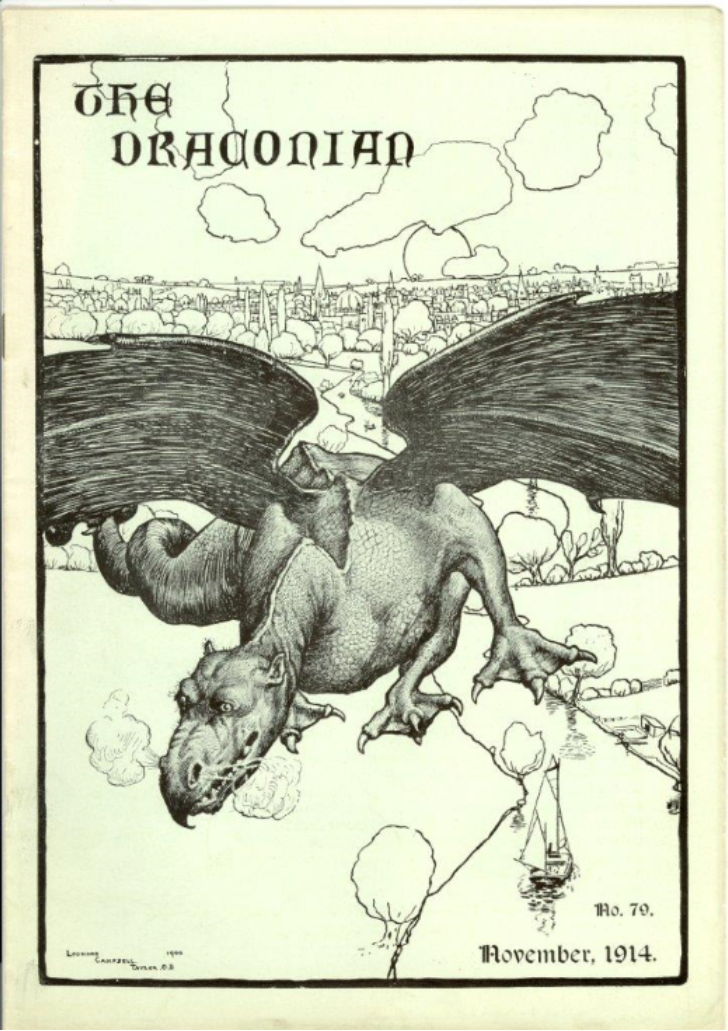
Draconian 79.

With the next edition of the ‘Draconian’ not due until after the end of term, we are issuing a special edition listing all those ODs who have answered the call to arms. It shows some 225 Old Dragons and staff already in uniform and a further 10 at Sandhurst, Keyham or Osborne. (Let it be remembered that when they were at the OPS, we only numbered 90-100 in the school).

We also include a poem by Frank Sidgwick, ‘The People’s Gift,’ which appeared recently in the ‘Saturday Review.’ This is the final verse:

Take the lesson, then, young Englishmen, when the war-cloud lowers black,

Let no man shift his burden of gift on to the next man’s back;

Answer today what part you will play, when your country gives the sign –

What gift will you bring to your country and King – is your blood water or wine?

* * * * * *

Frank’s brother, Hugh Sidgwick has been acting as private secretary to Sir Lewis Selby-Bigge, Permanent Secretary to the Board of Education. His work is deemed too important to allow him to join up. Instead he is doing duty as a Special Constable.

Special Constables – by one

Hugh Sidgwick SC

Hugh Sidgwick

“The Editor has asked for an article on Special Constables, and the motto of the force being obedience I can only comply. But one thing must be made clear at the outset. This nation at present consists of (a) the armed forces of the Crown; and (b) the rest. Special constabling is one of the forms of consolation for (b), who are small beer, and don’t matter much; it stands on a level with knitting socks, and putting on a light green uniform and gesticulating in Hyde Park on Saturday afternoons. It is miles away from the activities of (a), and must not be spoken of in the same breath. Therefore, if this article gets printed, let it be in the smallest of small print, in a corner far away from the ‘res gestae’ of soldiers and sailors. If that is quite clear, I can begin.

Special constables are amateurs who in their spare time assist the police in their lighter duties. They are sworn in for the period of the war – to carry out their duties without favour or affection, malice or ill-will, to preserve the King’s peace and guard the persons and property of his subjects, and so forth. They are provided with an armlet and a truncheon and a note-book and a warrant and a whistle and a badge; (I am going to make a song some day with this refrain). They may also provide themselves with a uniform. In our detachment it is a long blue overcoat and a yachting cap, in which we look like well-intentioned tram-conductors: but I am told that elsewhere there are variations in head-gear. Thus equipped, the special constable goes forth upon his duty.

So far the terror of our name has kept the malefactors away, and we have arrested only a bronze statue and a cat. But the moral effect has been enormous. The criminal classes and the foreign agents stand appalled at the reserves which the Executive has brought into play; they argue, ‘a fortiori’, that if respectable elderly gentlemen take such a lot of trouble about a little thing like that, what will happen if matters get really lively? Further, the ascendancy of the male sex is now re-established. I know of at least one dinner invitation which has been refused on the ground of constabulary duty. The dinner was on Tuesday and the duty on Thursday: but who could know that?”