May 24th 1917

Every day I open the morning newspaper to read on the ‘Roll of Honour’ of large numbers of officers killed and wounded, always in fear that I shall see the name of one of our Old Boys.

I am also confronted by an increasing number of those who are pronounced as ‘Missing’. This gives hope, but the families of these men are condemned to months of uncertainty as to whether their loved ones are dead, wounded or captured. In the case of the family of Capt. Edmund Gay (Norfolk Regiment) it has been nearly two years; he has been missing since August 1915.

Now two more of our Old Dragons have joined this list.
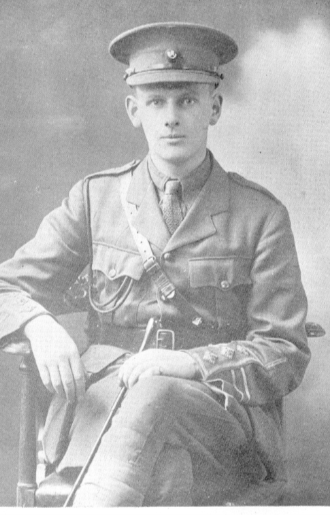
On May 20th, Mr Herbertson received a telegram stating that his grandson, Lieut. Hunter Herbertson (King’s Royal Rifle Corps) was reported as missing, but he understands that this does not necessarily mean that he is either wounded or killed.

On the night of May 16th he went out on a patrol with two others near Cherisy (at the southern end of the Arras battlefield). None of them returned. Enquiries will be made in the hope that he was captured and is a prisoner of war.

Hunter had done two years at Balliol (reading History) when war was declared. He joined up, but whilst training he suffered a double tragedy. His father (Oxford’s first Professor of Geography) died in July 1915, followed two weeks later by his mother. Both are buried in the Holywell Cemetery.


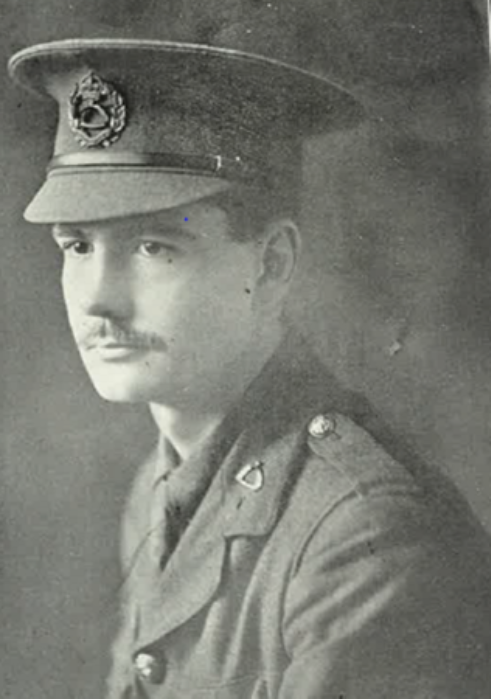
Mr & Mrs Dowson have also been informed that their son, Captain John Dowson (Royal Berkshire Regiment) has been notified as “missing.”

Like Morice Thompson, he was involved in the attacks that took place on May 3rd in the Arras district, but as yet we have no further information as to the circumstances of his disappearance.

John has been a regular visitor to the school in recent times. When home on leave he was always about, ready to take a form or a game.

It is at times like this that you are glad to have a photograph that captures happier times and places to have in front of you. This is John, as the boys will remember him, and hopefully he will return to us in the fullness of time.


Better news was to be found on a list headed ‘Previously reported missing, now reported prisoners of war in German hands.’ Included on it was the name of 2nd Lieut. Peter Warren, whose fate has been unknown these past seven weeks.

His squadron was returning to their base on April 2nd when they were set upon by German squadron. It seems that Peter’s plane was singled one and forced to ditch behind enemy lines.


March 29th 1917

It is now over a year since Lieut. Jack Gamlen (OBLI) last visited us. His witty poem, sent to the boys before their performance of ‘A Midsummer Night’s Dream’ earlier this term was much appreciated, and now he writes to sing the praises of our French allies. He is quite a Francophile!

Here he describes his experience of taking over a section of the trenches from the French:

“I think that none of our party shared my excitement and joy at meeting the French army in the field. In the British area it is difficult to feel that one is in France; even Amiens and Abbeville breathe a mixed (a very mixed) atmosphere. But here, below ground (in a dug-out), we were in France at last. We got to business at once and I began my duties as Brigade Interpreter. The French Brigadier impressed us all very much…

As it was now mid-day, the Colonel suggested that we should have lunch before we came to business. We agreed, and ate one of the best lunches I ever came across. There were five courses, there was red wine, there was champagne, yet everything was simple and the meal was short. At first everyone was shy and I had to do the talking for the English side. But as time went on, both sides thawed, and by the time we had coffee everyone was talking some sort of French.

After lunch we got to business at once. The Colonel was wonderful. He had every detail that we wanted at his finger tips and scarcely ever referred to his Adjutant. After an hour in looking at maps and discussing dispositions, he took us some way forward to an O.P, from which we had a wonderful view of the German front…

The next day I returned with the Brigade Major and again called upon the French Brigadier in order to arrange the final details of the forthcoming relief…

He spoke the most exquisite French and had the most exquisitely simple manners. I am sure that he is descended from one of those French Officers of the old days, who used to call out to their men ‘Messieurs les gendarmes de la maison du Roi, veuillez assurer vos chapeaux. Nous allons avoir l’honneur de charger…’

The French fighting man is a glorious creature and the sight of him should convince any armchair pessimist that nothing can ever kill France, however full her cemeteries may be (and they are terribly full round here)…

Let there be no misunderstanding about what France is. She is, and has been for a thousand years, the most civilized country in the world and her salvation is the first and greatest object of the war, for the presence of a single German soldier on French soil is an obscene thing.

My dear Dragons, educate yourselves to love France. Learn to read and speak French well, NOW, and, after the war, get your parents, whether they can afford it or not, to take you often to France…

There is nothing un-British or decadent in this love of France; and there is something very stupid and ugly in the want of it.  Every civilized being ought to write on his heart the fine old motto, ‘Chacun a deux pays: le sien et La France.’

Clearly we must have more French lessons!

December 27th 1916

Whilst it is to be very much hoped that everyone is enjoying their Christmas holiday, there is one task that the VIth Form must not forget to complete.

As is the tradition, they spent the second half of term getting to know a Shakespeare play – in this case ‘A Midsummer Night’s Dream.’ The parts have been assigned and must be known absolutely pat. Boys should get their sisters etc to improve their acting during these holidays.

Normally, that most faithful of Old Dragons, Lieut. Jack Gamlen (OBLI), would attend a performance to review it, but he has written to say he is otherwise engaged on the Western Front and he tells us that he will instead, “dream mid-winter nights’ dreams” about us all.

The boys will enjoy this witty poem, written for them by Jack, whilst on active service in France:

TO THE CAST OF 'A MIDSUMMER NIGHT'S DREAM.'
Dear Players, take from one who used,
Each year, to be your faithful critic - 
A task he'd never have refused,
Though deaf or blind, or paralytic -

A tribute to your former skill,
Good wishes for your next excursion
In plays which universal Will
Devised for his and your diversion.

I mind the day, in 'ninety-eight,
When I myself appeared as Theseus,
(At two days' notice, let me state,)
Expecting hisses loud as geese use.

And, I can tell you from my heart,
To have such memories to remember,
Helps me to play the harder part
Of fighting Germans in December.

          J.G., France, Dec., 1916

December 5th 1916

Lieut. Jack Gamlen (OBLI) was last in touch back in October, to tell us the story of his regiment’s involvement in the Somme battle in August. He said then that the Somme trenches were “very horrible.” His latest letter tells that, for the time being at least, he has escaped them:

23.11.16. “When you have been wet through for a week, have just come out of the trenches and are standing in the main street of a horrible and historic village, looking through glasses at the German lines, it is pleasant suddenly to have your elbow jogged by your Commanding Officer and to be told that you are to report forthwith at the Brigade Headquarters. Every so often a subaltern is detailed for attachment for instruction in staff duties…

As I approached Brigade Headquarters, I remembered that I had neither washed nor shaved for a week and felt very much ashamed of my appearance…

I was conducted into the presence of the Brigadier, a young and very handsome man with many medals. He was reading the ‘Times’ and told me to sit down and eat.

After a pause he put down his newspaper, looked long at me and in a mild, tired voice said, ‘Soaked through I suppose!’

‘Yes, sir.’

‘And the men?’

‘Soaked through all the time, Sir.’

Then he gave a very refined groan and went on reading the paper.

It was not long before I learnt that this Brigadier was as ready to be soaked through as any of the men, but, at the time, he seemed an exquisite being, remote from war, and mud, and hardship.

I made myself presentable by lunch, when we were joined by the OC Machine Gun Company, no less a person than L Grundy OD. He is my junior by many years and we had never met before. Now we meet nearly every day, but have not yet found time to talk much about the School…

By night I was mostly at Headquarters, but by day I often went out with the Brigadier on his visits to the various Battalion Headquarters. We were frequently shelled and once or twice had quite narrow escapes, but the Brigadier’s personality is such that I think no shell would dare to come too close to him…

My chief job was to write the daily Brigade Intelligence Report, which goes on to the Division. To do so sometimes made me shiver at the cold-bloodedness of my task. It is one thing to put down, ‘The right-half Battalion sent out a patrol between 2 and 4 a.m. which did so and so,’ and a very different thing to go on patrol oneself. The same is true of ration-carrying parties. How well I know them! One must see the game oneself in order to realize how much hardship, danger and often heroism, is compressed into six cold lines of an Intelligence Report.”


October 3rd 1916

No regular reader of the newspapers and their lists of casualties can be in any doubt that the fighting on the Somme continues to be fierce and costly. (How grateful we are that we have suffered no fatalities since August).

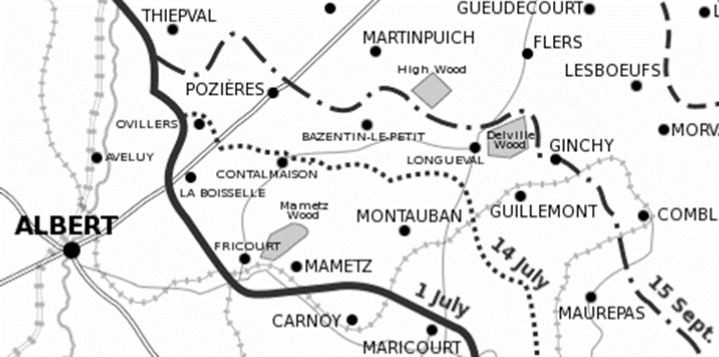
Lieut. Jack Gamlen (OBLI), who joined the Push on August 13th, tells me that he “has no great tale to tell.” I beg to disagree, as his description of the advances made from Ovillers towards Thiepval is most illuminating.

somme-map-2

“We struck north for Ovillers… it was my first sight of the front and I shall never forget it. Less than three hours march had carried us from corn-fields and unruined villages to an obscure desert which looked like nothing but the surface of the moon. We marched through Ovillers, passing streams of wounded and weary men who were returning from the front line.

Then we turned sharp to the left up a narrow, freshly dug, communications trench. In it I felt quite safe, though enemy 5.9 shells began to fall pretty thickly round us. We went on and on very slowly, and with many halts for half-an-hour, and then at last turned into the third line trench, which we were to occupy as company in reserve.”

Here Jack and his men had to endure some fairly heavy shelling, but were pulled back the following day for a brief period.

“We returned three days afterwards, and this time my Company took over the front line. We were heavily shelled from the first. One man in my platoon was killed by a shell, within three yards of me, just as we had taken up our position.”

Again, the shelling was constant but there were no infantry attacks and Jack returned safely.

“A week later we were back again, further to the left, and in full sight of Thiepval, which looks so harmless and so near in the strong sunlight of a hot morning.

In all this part of the line, the trenches were really not trenches at all. They had been blown to bits weeks before and gave scarcely any shelter to my men, several of whom were under fire for the first time.

On the afternoon of our first day up (August 23rd), an attack was to be made by the Bucks battalion on our left against the enemy line some 200 yards in front. I was in charge of a bombing section, with orders to push on to the enemy trench at Point ***  as soon as the Bucks went over, and to join up with them.

From a shell-hole I watched our wonderful preliminary bombardment of the enemy’s lines. It was terrifying, but extraordinarily interesting. I say ‘terrifying,’ because some of our shells burst very close to us; far too close to be pleasant. Then the barrage suddenly stopped, and the Bucks went over, alas, only to come back (what was left of them) in a very few minutes, for they were mown down by machine-gun fire which started the moment our own barrage lifted.

I now sent back for further orders, and was told to push on to Point ***  if I could. So I organised my bombing party, and sent two men up the communicator, where I already held a ‘bomb-stop,’ (a barricade in the trench dividing Br/Ger troops) to see how near the enemy was. They came back at once and reported about 20 of the enemy behind the next traverse but one. I didn’t believe them, so went myself, and found about 10 of them behind the next traverse but two. We looked at each other and I came back quickly. The attitude of the enemy was expectant, but not very menacing.

I waited for about half an hour, in order to allow the Huns to recover from the sight of me, and then advanced with my whole party. We all expected death, but there was no time to think about it.

When we reached the point at which I had sighted the enemy, I found a German, three yards in front of me, who was just about to descend into a dug-out. His head was already out of sight. I had a beautiful revolver shot at him, and his body and legs followed his head. It was a good moment.

Immediately afterwards the enemy woke up, and there was bombing at close quarters. We conjugated the verb “to bomb” in all its moods and tenses, and my party had wonderful escapes and only two slight casualties. The enemy then retired round the corner of the communicator into their own trench, and as I did not feel equal to attacking their whole first line with one section, I ‘consolidated my position,’ and remained where I was until I was relieved…

This is all I will tell you this time. The Somme trenches are very horrible; shells are very horrible; and fighting is tiring beyond anything which can be conceived at home.

What most impresses me is the speed with which one forgets the horrors as soon as one leaves them behind.”


May 13th 1916

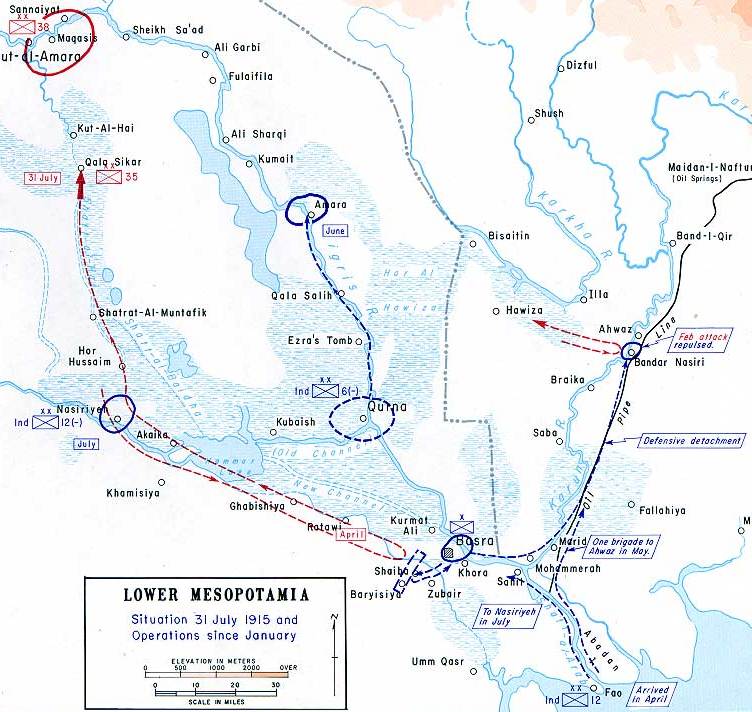
Following the news of the fall of Kut on April 29th we have now heard from 2nd Lieut. Leslie de Selincourt (who, you may recall, transferred from the 7th Hants to the OBLI), who has been wounded. He has written to us from the Club of Western India, Poona.

de Selincourt L27/4/16 “I lent my valuable assistance during the battles of Feb 21st and March 8th, though unfortunately both turned out rather abject fiascos.

On the night of March 16th I was out in front of the parapet of the front line trench burying some bodies, which had lain there too long to make living next door to them enjoyable. The moon appeared from behind a cloud; an ill-mannered Turk saw me and hit me in the arm; annoyed because I didn’t drop down on my stomach and crawl home, he hit me again. Unfortunately in a more disabling place, the bullet entering my shoulder and reappearing out at the small of my back. I dropped like a stone and was unable to rise until three weeks later.

I experienced the usual sensation when hit – ‘never more pained or surprised in my life.’ Some ribs got cracked, but no vital part was touched and I have been the subject of congratulations from every doctor.

Now I am going up to Naini Tal – a very good spot in the Himalayas. Then I suppose I go back to the Gulf.”

* * * * * * *

Lieut. Leslie Murray (RNAS) was also involved in the efforts to relieve Kut and he too is now in hospital:

3/5/16 “I expect you will be sorry to hear I have arrived at the Funk Hole at Buzra, otherwise known as the British General Hospital. I had been feeling pretty rotten since last Thursday (April 27th) and on Friday I discovered I had a temp of 100.3 degree, so I retired to bed altogether. The heat in my tent was almost unbearable, the only breeze was a hot draught.

The next day I was just as bad, so, as our Naval Doctor has gone down with dysentery, I was sent along to one of the Field Hospitals close by. It was very hot there and the biting flies were most irritating, as I had not got the energy to drive them out of my mosquito net.

It was in the afternoon that I got the news of the fall of Kut, which was rather depressing, although most of us were fairly certain that they could not hold out much longer and it seemed fairly obvious that under the present conditions it would not be possible to get through, because we had a very difficult position to attack.

The Turks were very strongly entrenched at Sannaiat, and with marsh on one side and river on the other, it would have required a much larger division than we had got at the time, to get through.

Of course, several attacks were made on the position, but whenever they got through, they were driven back. We expected Kut to surrender any time, as we knew we could not feed them from the air much longer. Neither the machines or the pilots could stand it…

I suppose we prolonged the agony for four or five days… By the way, the things we usually dropped were ‘atta’ (a native flour), sugar and occasionally chocolate. I usually took 200 or 250 lbs and an observer; the food was placed inside two strong sacks, four 50 lbs sacks being placed on a specially devised bomb rack under the engine or between the floats, the fifth bag was put in the observer’s seat to balance the back of the machine and was heaved overboard by him.”


May 7th 1916

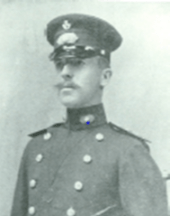
William Esson

Major William Esson (Royal Marines Light Infantry) 

Lance Freyberg

Lieut-Commander Lance Freyberg (RN)

On 27th April 1916, off the port of Malta, HMS Russell struck two mines laid by a German U-boat and sank. 27 Officers and 98 ratings were lost, including two Old Dragons, William Esson and Lance Freyberg.

HMS Russell

HMS Russell

HMS Russell was flying the flag of Admiral Fremantle, who was amongst the 702 saved. He has written from Malta to say of William Esson, “His cabin was immediately over where the mine struck us. We were hit only four miles from the entrance to Malta Harbour. At that time all the officers, except those actually on duty, were in their cabins, and it is for that reason that we lost such a very large proportion of officers. The great majority of the people on the deck below the main deck, including your husband and five lieutenants (this must include Lance Freyburg) were never seen after the explosion, indeed there are now alive only two men who were in that part of the ship… ”

Whilst 24 officers together with the Captain and Admiral were saved, 27 were killed – almost 50%.

The degree of grief currently the lot of the Esson family can only be understood when one remembers that William Esson’s sister Margaret is the wife of Capt. Edmund Gay (Norfolks), who has been “missing” since last August.

Of Lance Freyberg, Captain Bowden-Smith wrote, “He was asleep in his cabin at the time (5.30 a.m). The explosion took place immediately under his cabin and I think he must have been killed instantaneously and did not suffer. I am afraid that all his belongings went down with the ship. Nothing was saved.”

Clearly, William’s and Lance’s cabins were in very close proximity and it is some small comfort that two Old Dragons should be together, comrades in life and death.

HMS Russell was one of the ships for which our boys supplied the crew with pipes in November 1914. Lance wrote a charming letter back to them. It is a great sadness that the pipes have not become pipes of peace, as he had hoped.


March 12th 1916

Whilst so many Old Dragons are wielding the sword, there are some who have not entirely forsaken the pen and endeavour to keep our spirits up in these troubled times.

Some Verse – F.S

(Available for 2/6 from Sidgwick & Jackson)

Frank Sidgwick, the author of many of the verses in the various Logs of the Blue Dragon has in this little volume given us a collection of poems, a few of which have appeared in the Cornhill and other magazines.

One of them has given rise to considerable and learned discussion in the Times Literary Supplement – viz. Narrative Macaronic Verses. The VIth form learned this witty and amusing essai by heart and quote it constantly with enjoyment.

Narrative Macaronic Verses                                      

Charmer virumque I sing, Jack plumigeramque Arabellam.
Costermonger erat Jack Jones, asinumque agitabat;
In Covent Garden holus, sprouts vendidit asparagumque.
Vendidit in Circo to the toffs Arabella the donah,
Qua Piccadilly propinquat to Shaftesbury Avenue, flores.

Jam Whitmonday adest; ex Newington Causeway the costers
Erumpunt multi celebrare their annual beano;
Quisque suum billycock habuere, et donah ferentes,
Impositique rotis, popularia carmina singing,
Happy with ale omnes – exceptis excipiendis.
Gloomily drives Jack Jones, inconsolabilis heros;
No companion habet, solus sine virgine coster.
Per Boro’, per Fleet Street, per Strand, sic itur ad “Empire”;
Illinc Coventry Street peragunt in a merry procession,
Qua Piccadilly propinquat to Shaftesbury Avenue tandem
Gloomily Jack vehitur. Sed amet qui never amavit!

En! Subito fugiunt dark thoughts; Arabella videtur.
Quum subit illius pulcherrima bloomin’ imago,
Corde juvat Jack Jones; exclamat loudly “What oh, there!”
Maiden ait “Deus, ecce deus!” floresque relinquit.
Post asinum sedet illa; petunt Welsh Harp prope Hendon.

O fons Brent Reservoir! Recubans sub tegmine brolli,
Brachia complexus (yum yum!) Jack kissed Arabella;
“Garn” ait illa rubens, et “Garn” reboatur ab Echo;
Prositique tenax Jack “Swelp me lummy, I loves yer.”
Hinc illae lacrimae; “Jest one!” et “Saucy, give over.”

Tempora jam mutantur, et hats; caligine cinctus
Oscula Jones iterat, mokoque immittit habenas.
Concertina manu sixteen discordia vocum
Obloquitur; cantant (ne saevi, magne policeman)
Noctem in Old Kent Road. Sic transit gloria Monday.

February 9th 1916

2nd Lieut. Leslie de Selincourt (OBLI) has reached Ali Garbi but floods, a shortage of mule rations and an uncertainty as to the friendliness of the Arabs in the area make for slow progress.

de Selincourt L

Leslie de Selincourt

“There is a biggish Arab village 1½ miles downstream from which we bought eggs yesterday in large quantities. They charged a lot and they all turned out to be bad, so this morning we strapped on our revolvers, took half a dozen trusty followers with rifles and kit bags and marched straight into the village.

With the aid of an interpreter we interviewed the Sheik, explained our discovery about the eggs and demanded the right number in the right condition. It was about eight dozen. They hummed and hawed in excited tones and then some slunk away and after a considerable delay reappeared with two eggs. We explained that the compensation was inadequate. They merely looked stupid and pretended not to understand. So the word was given and we scattered through the village.

Time was called after sixteen minutes and the bag was as follows: 54 hens, 19 eggs, 2 leaded sticks, a Service Colt (loaded, ancient, but still serviceable), a cartridge belt containing 31 cartridges (also ancient) and a coffee pot. They came off very lightly, and as a hen in this country can be bought for four annas, we didn’t take enough to pay for our loss in eggs. But we didn’t want to make enemies of these people and if they don’t swindle us we are quite willing to trade fairly with them.”

So far Leslie and his troops have marched about 190 miles and they are now 42 miles from the firing line.

January 13th 1916

2nd Lieut. Leslie de Sélincourt has written to say that he has been transferred from the Hampshire Regiment in India to the 1st Battalion of the Ox & Bucks Light Infantry.

The Battalion itself is currently besieged at Kut and he is to join a provisional battalion at Ali Garbi to be part of a relief force.

Leslie is about to set off from Basra for Amara and he is currently doing battle with jackals and flies:

de Selincourt L5/1/16  “We are plagued by jackals who howl in the most dismal fashion round the tent at night. One came in last night and swallowed this morning’s breakfast while we all slept…

We are driven crazy here by flies. In spite of the cold – frost at night – they are as thick as… as…well, as flies. We have an admirable plan for catching them. Just a drop of methylated spirit in a glass which you hold under the fly as he sits on the roof of the tent; fuddled by the fumes, he immediately drops in. I caught 250 in 14 minutes.”