December 23rd 1924

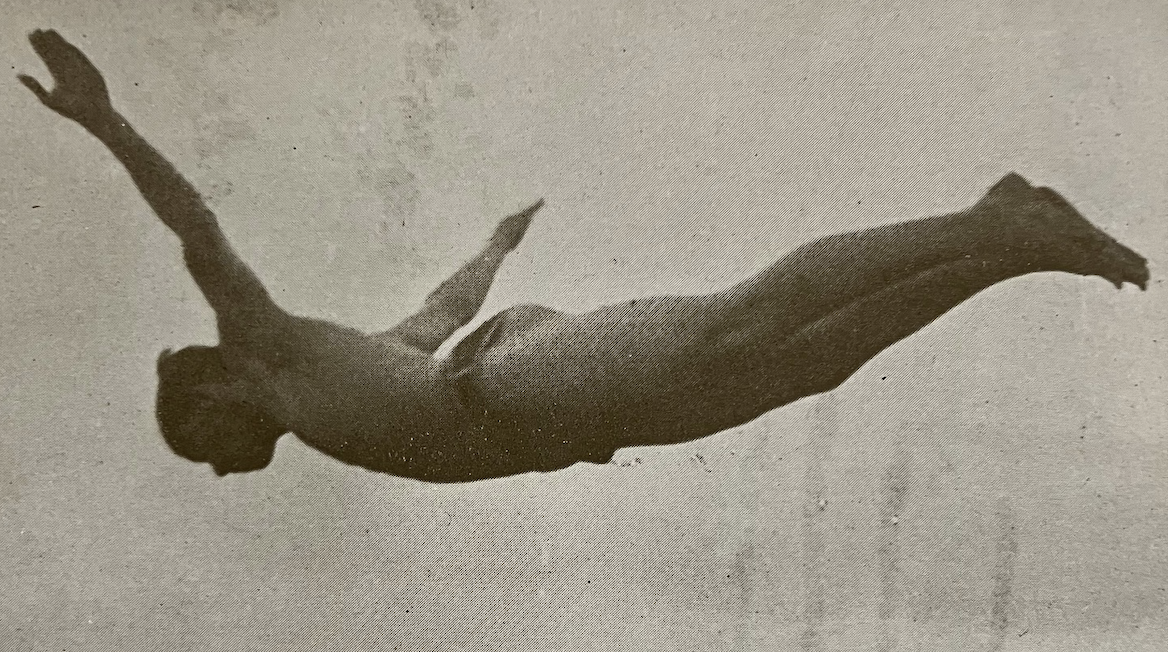
Dick Sergent diving at Repton  

It seems right to celebrate the life of Dick Sergent more fully, particularly as a sportsman of some note. In addition to his prowess as a diver (he won our diving prize every year from 1899-1903), he was a talented player of both rugger and hockey – once captaining our team which contained seven future Half-Blues, of whom two became internationals.

He left Repton after only three years to complete his education at the Lycée Saint-Louis in Paris, so as to be with his brother Victor. Here the two brothers attempted to introduce the Lycée to football, but they were called up before the “Censeur” and told to get rid of the football immediately. “If someone breaks a leg or an arm, the parents will hold us responsible,” said the Censeur!

Nonetheless, Dick went on to become a formidable player of association football. In 1912 he was (along with his brothers) in the winning team of the French Soccer Cup and was selected to play for France at the Olympic Games at Stockholm, in a side which his brother Victor was to have been captain. Unfortunately, the French Committee was unable to send the team, owing to lack of funds.

After leaving the Lycée, Dick entered the Polytechnikum in Zurich where he excelled, captaining the Zurich ice-hockey team and stroking the winning four at the Lucerne regatta. However, it was his proficiency in boxing, together with his craving for adventure, that led him into serious trouble.

In the summer of 1911, one of the items on the programme at the Corso (a large and popular music-hall) consisted in the appearance on the stage of a large number of plump German ‘fraus’ wearing German ‘pickkelhaube‘ and singing one of the popular French songs, which was enough to offend any high-minded Frenchman. Consequently a number of the French students interviewed the manager and asked him to remove that item from the programme.

This the manager refused to do; so the next day the Frenchmen came in force to the performance and drowned the French marching song with hostile shouts and remarks. They were, however, immediately surrounded by a large company of plain-clothes Zurich policemen, who they mistakenly took to be local roughs.

A fierce fight ensued, which was continued in the streets. Dick, who had come as a ‘neutral’, on being hustled, joined forces whole-heartedly with the Frenchmen. Unluckily, they were outnumbered and Dick was ultimately overpowered, but only after he had knocked out five policemen. He was condemned to three weeks in prison and a 1,000 franc fine – which was paid by a subscription among the Frenchmen. The hardships of prison life were alleviated by letters of congratulation from English sportsmen, who had read about it in one of the papers.

This is an early example – three years early – of England and France joining hands against German aggression and misappropriation. As in 1914, it seemed to meet with the approval of the British public!


December 19th 1924


Raoul ‘Dick’ Sergent (1889-1924)

We have to record with sincere grief the death of Dick Sergent, at Lons le Saunier, Jura, France on Thursday 4th December, aged 35.

His death, following within a year of his brother, Victor Sergent, seems particularly sad, as they were fine athletes, both of whom had gone safely through the war, and both have died suddenly so soon after it.

Although half French, Dick was born in England and therefore a British subject. Whilst his brothers joined the French Army, Dick joined the British forces and in 1915 he was sent to Mudros, then Suvla Bay (Dardanelles) and Imbros. He wrote a capital account of his experiences in the final withdrawal from the peninsula in January 1916.

In 1917 he obtained a commission, and was Lieutenant RNVR in the anti-submarine department at the Admiralty, under an Old Dragon, who is now Admiral WW Fisher.

After the war he trained as an electrical engineer, but his various jobs did not work out and when his brother Victor started a motor-bus business in the Jura, Dick joined him as a partner. This was May 1923 and then when Victor caught broncho-pneumonia and died last December, Dick carried on alone. In the course of the year that followed Dick worked himself to the bone; he was enormously strong, but his strength could not last forever. He was persuaded to employ an under-manager.

It is a cruel irony of fate that when the under-manager arrived and Dick was showing him the ropes, he (Dick) collapsed suddenly at his wheel and died. He leaves a widow and two children – a girl of four and a boy of two.

I think Dick’s greatest pleasure in life was to come down to the School in summer and use the bathing-place for some of his wonderful dives. I have seen him many times do a dive off the top board – a run and a leap into the air, legs thrown forward up to the moon, body bent round with a jerk, and finish up in a dive. Another of his stunts was a long-arm balance on the top board, followed by a double somersault into the water. He must have broken himself many times practising these and many other fancy dives, but he was a ‘tough nut.’

Dick had a most unselfish character and generous heart. His death leaves a gap in our hearts which will never be filled.


December 31st 1921

Captain JG Smyth VC MC

The past term’s edition of ‘The Draconian’ (due to be published shortly) includes this colour picture of a painting of Jack Smyth, the work of Old Dragon George Drinkwater, and done specially for our magazine.

George was at the OPS from 1889-94 and went on to Rugby School and then Wadham College, Oxford. When his friend from OPS days, Eric Macfadyen, enlisted as a trooper at the Queen’s Own Oxfordshire Hussars’ headquarters in New Inn Hall Street, he went off and did likewise. They were joined by four other Wadham men and a further two from other colleges and together formed half a troop in the 2nd Service Squadron (the 1st, formed the previous vacation, included OD Maurice Church, who was destined to become a war casualty).

After the Boer War George returned to his studies and the river: he was a noted rower, being in the Oxford eight in the University Boat Races of 1902 and 1903. Since 1906 he has been the rowing correspondent for the ‘Daily Telegraph’.

In the Great War, George gained a commission in the Royal Artillery and went with his battery to France. He was promoted to Staff Captain in 1916 and was then sent to Egypt and Palestine, where his services were recognised by his retention as Brigade Major for a year after the Armistice. He was twice mentioned in dispatches and was awarded the Military Cross in 1918.

In civilian life he has followed the architectural profession of his father, Harry Drinkwater, and has also met with success as a portrait painter, having a picture hung in the Royal Academy in 1913.

We were delighted to see George back for last year’s reunion dinner and he is seen here alongside his old schoolboy chum, Frank Sidgwick:

Frank Sidgwick and George Drinkwater


July 21st 1920

Yesterday was a special day for the Smyth brothers, Jack and Billy:

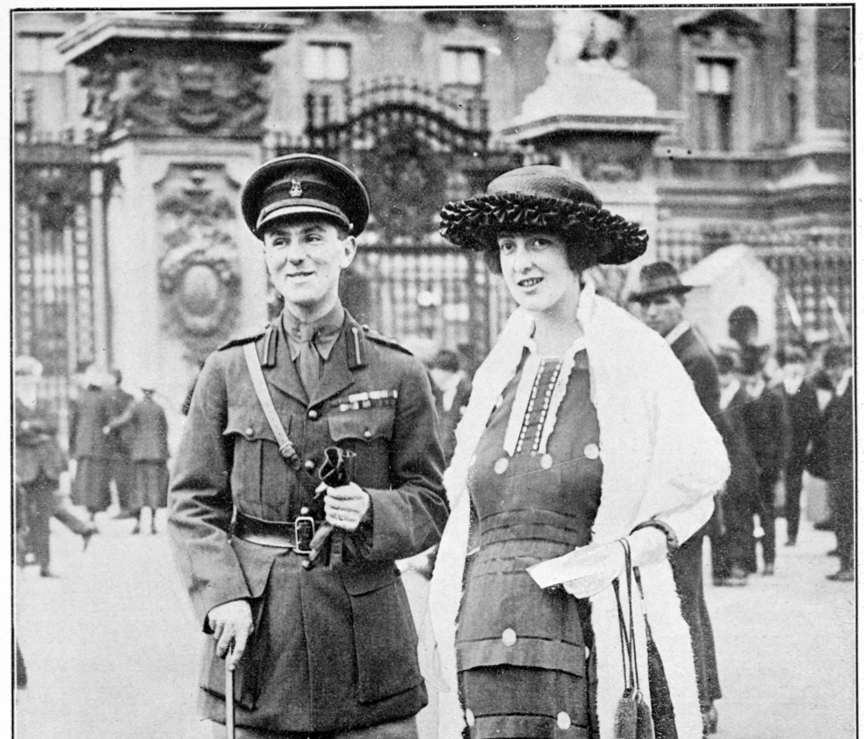
Captain JG Smyth VC, 15th Ludhiana Sikhs, 43rd Infantry Brigade and Lieutenant (Acting Captain) HEF Smyth, 1st Battalion, Ox & Bucks Light Infantry were summoned to Buckingham Palace to receive decorations won in action in Waziristan and Russia (where the 1st Ox and Bucks were part of the Allied force that intervened in the Russian Civil War to assist the ‘White Russians’ in their fight against the Bolsheviks) respectively.

We understand that it was the first occasion on which two brothers had been decorated with the same decoration at the same investiture, and they marched up together to receive Military Crosses from the Duke of York, who was deputising for the first time for the King (who was unwell).

I gather both brothers were rather nervous – as was His Royal Highness, and the citations were never read out. We can at least rectify this here in Jack’s case:

“At Khajuri (Tohei Valley) on October 22nd, 1919, this officer’s gallantry and initiative under fire contributed largely towards the saving of a valuable convoy which was attacked by the enemy. Sent forward from Idak with reinforcements to clear up the situation he most ably appreciated a very critical situation which, but for his so doing, must have resulted in serious disaster. He displayed staff ability of a high order in co-ordination and reporting the situation, rallying personnel who were in a state of apathy, due to the casualties amongst their officers. He was subjected throughout this period to heavy and accurate enemy fire, which in no way deterred him from moving from place to place. His courage was an example to all, and resulted in the convoy being brought safely to Idak.”

Jack Smyth pictured after the ceremony with his fiancée, Miss Dundas.

Today we bring the Summer Term to an end with sports, a concert and prize-giving, and Jack’s busy week continues as he is with us to make the presentations.

May 26th 1920

The most recent issue of ‘The Draconian’ contains no fewer than 26 pages of letters from the Carline brothers, recording their time as war artists gathering material on their grand tour of 1919.  It is now six months since the Imperial War Museum packed them off on this mission and from Mesopotamia, where Sydney Carline‘s last letter was posted, they have moved on to Persia, which they reached at the end of July 1919.

“Kuretu (Persia) July 31st 1919.

If you look on the map you will see that on the borders of Persia and Mespot there are endless successions of mountain ranges. My sketch shows the craggy peaks of the first series as seen from the camp in which we are quartered till tomorrow, when we continue by car to Kirmanshah, Hamadan and Kazvin

We are blessed with a servant in the form of a little Arab boy about 13 to 14. He puts our beds out, fetches water, polishes our boots and so forth. It is very nice to have someone to attend to us on a journey of this sort, as there are no conveniences anywhere, no hot and cold water laid on etc. But already we are faced with a counterbalance of extra worry about what he is to eat, where it is to be got from, where to sleep and so forth…

Though he made my dressing easy by having everything ready, in return it took me most of the morning to arrange for his boiling of his mid-day rice. You see everything has its proper place; one caste of Indians use this fire, another that, and so on, and to find the one where our boy is to boil his is quite a job…

To understand the country one must understand the heat, as it produces problems that are exactly opposite to all the conditions that one is accustomed to and looks upon as proper…

After I have washed in our one and only basin, should Dick want to do so also, what does he do to get rid of my dirty water? Does he call a servant, have it tipped in a bucket and carried in search of a drain down which to pour it..? Oh, dear no. He may chuck it out the window, in which case it may allay the dust on the lane for a brief moment. But water is precious, evaporating water produces a coolness in the air, our room is hot, the brick floor is hot to touch and dusty; taking the basin Dick therefore pours the contents on our bedroom floor. The bricks are porous, they drink up the water; there is a dark patch for a few moments, the room is perhaps slightly cooler, and, as Dick finishes his wash, all is as it was before.”

May 15th 1920

Sydney Carline and his brother Richard have moved on since their last letter from Cairo in May 1919, and this one is from Mesopotamia:

“Mespot, 12th July 1919.

I am sorry I have not written a proper letter, but it is very difficult to find time for writing in this country. The early morning is sacred for work, as the afternoon is silent and universally given up to sleep. One complies with this not from indulgence, but because one’s eyes will not keep open. After tea one can again work and by dinner one is quite exhausted, and by reason of our getting up at sunrise, I, like a boy after the jam in the cupboard, slink off early to bed on the roof-top.

Everyone sleeps on the roof-top in order to get the cool breeze. Towards dusk there is quite a chatter, as all the many wives of each household are busy putting the beds out on their roofs, which are of course flat, and in the better class houses have low walls separating them from the neighbours…

Occasionally the silence of the night is perturbed by a wife who has still some household work to perform for her lord and master, who is probably reclining and smoking on his wooden bed…

It is now 7 and breakfast time. I must get to work on my picture of dropping bread on Kut, after which I have only one more to do to finish my work here.”


May 3rd 1920

The Carlines have moved on into Egypt on their journey and it is the turn of Richard Carline to write, this time from the Hotel Continental in Cairo on May 20th 1919.

“A day was spent in riding along the edge of the desert on camels, from the Gizah Great Pyramids to the old Step Pyramids and the necropolis of Sakkara about ten miles south, and from there on to the site of Memphis, where we saw the colossal statue of Rameses. But all the journeys were so long and took so much time that not much was left for seeing the most interesting things of all, namely, the tombs of Sakkara.  We ended by doing much of the ride in the dark…

We were accompanied by our dragoman, and two small Arab boys ran the whole way with sticks to drive the camels, in order to keep a good speed up and in order to take care of them while we are enjoying ourselves; neither of these boys could have been more than twelve, and we did more than thirty-two miles during the whole of the day – running all the way. I remember my young days, when I walked to Windermere once, a matter of about eighteen miles in all, and I was practically dead at the end of it.”

Richard also includes this delightful little sketch (and explanation):

Picture by Sydney giving an impression as he saw it of our journey to Sakkara. In the distance to left is the Step Pyramid, and all about under the sand are the tombs. The further figure is the dragoman; the nearer is myself.


April 23rd 1920

This is the third of the letters from the Carline brothers on their travels last year and appropriate for today, which is St George’s Day.

Arriving in the Middle East in January 1919, the brothers followed the suggestion of General Salmond (General in Command) to travel round Palestine and Syria by train or car before making flights over the areas of interest. Thus Sydney had made preliminary sketches in February before he wrote this letter from Damascus, dated April 24th 1919.

“Dick has mentioned the picture he is painting of the town from the air, and I am painting another of my aeroplane pictures, depicting the attack on the Turkish Army trying to escape along the pass between the mountains leading from the town along which the famous and beautiful Baroda flows. I have got to take another flight tomorrow if the weather is good in order to finish it…

The only news one ever gets here is of the troubles in Egypt, expecting massacres of Jews in Palestine on account of the Zionist movement, and odd bits about the Peace Conference, so that we are really quite ignorant as to the state of affairs at home or in Europe.

Tomorrow is St. George‘s Day. Curiously he is supposed to be buried at Ludd near Ramleh, where there is a church to him. The story of Perseus and Andromeda is also supposed to have been enacted at Jaffa, in the same neighbourhood, and the rocks out to sea from Jaffa (which I have painted) are supposed to be the dragon turned into stone…

St. George and the dragon was, I believe, a local story that the crusaders brought back with them.”


April 16th 1920

This letter is the second from a series of letters from the Carline brothers on their journeys as war artists working for the Imperial War Museum. This one is from Richard Carline, dated April 22nd 1919.

“We are back at Damascus once more, to fly over the places we are painting in this district. I came by train on Good Friday and Sydney flew over on Easter Sunday…

We have now practically finished our work on this front. I have taken my two flights over Damascus, and Sydney has done a sketch of the Sea of Galilee with the Turkish boats being attacked by our aeroplanes, and is in the midst of his sketches of attacking the Turkish army in the pass of the River Baroda, just outside Damascus…

Damascus makes a very good subject as is to be expected with such a beautiful place situated in such beautiful scenery. I am painting it from rather high. It is in the midst of its green fertile oasis of gardens and orchards, and behind it are the Anti-Lebanon Mountains rising up, and behind them snow-capped Mount Samnin.

I think it about time we left the country and the Headquarters are getting very impatient for us to go…

First we have to go to Cairo and I hope that we shall not be murdered by the natives, as the trouble in Egypt appears to be just as bad as ever… Life in these parts is more like the Cowboy West than anything, it being usual for a man to go about on horseback, with his revolver and ammunition pouch on his belt and his servant riding behind him…”

April 10th 1920

 The Goupil Gallery

The paintings and drawings of Sydney and Richard Carline of Egypt, Palestine, Mesopotamia, Persia, India have been exhibited at the Goupil Gallery in London throughout February and March.

The brothers wrote a series of letters back from their travels, which stretched from January until October 1919, whilst in the employment of the Imperial War Museum as official war artists, and they have kindly allowed us to print them in this term’s edition of the ‘Draconian.’

Their first letter from “near Malta” was written on January 11th, describing their journey from Havre to Marseilles on a troop train. Letters followed form Port Said and Ramleh and then, on February 9th 1919, Sydney wrote from Jerusalem:

“Dick started a water colour here of the Mosque of Omar, the great mosque on the site of Solomon’s temple.

This is a sketch of his picture of the mosque. It is in blue and yellow tiles, making the sides of it a beautiful colour, and having a black dome. Around it is a white marble court, surrounded by grass and paths, and surrounding that again in the distance are the walls of Jerusalem going sheer down for 50 ft.

The space around the mosque is most impressive, especially as the city wall that encloses it here is built on the edge of a ravine some 200 feet deep, on the other side of which are the Mount of Olives, Gethsemane, and the village of Bethany. In this ravine are thousands of tombs covering it on either side, as the Jews believe that the Resurrection will take place in this spot and like to be close handy.”