October 15th 1916

blencowe-oc

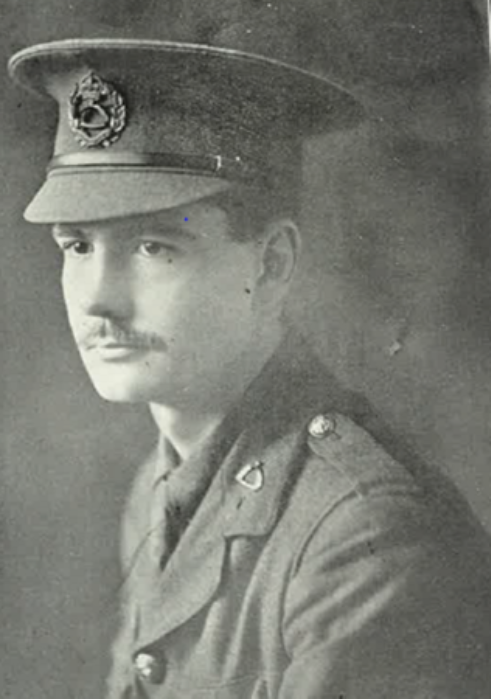
2nd Lieut. Oswald Blencowe (Oxford & Bucks Light Infantry)

An eighth Old Dragon has laid down his life in the battle that has been raging on the Somme since July 1st. Oswald was killed on 7th October 1916 when temporarily attached to the Rifle Brigade.

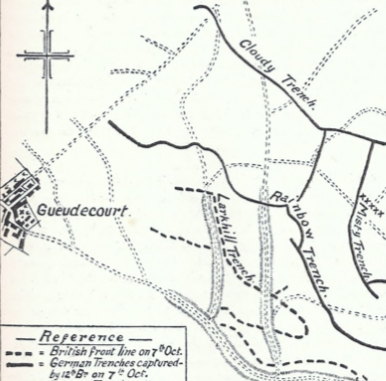
It was the Brigade’s task to capture Rainbow and Cloudy Trenches, near Guedecourt. As soon as our barrage lifted the Riflemen (some of whom had been lying down in the open awaiting this moment) rose bravely to make the attack.  On reaching the crest of a hill about twenty yards from the German line they met with heavy machine-gun fire. All five officers of the two leading companies went down – four (including Oswald) were killed and a fifth severely wounded.

guedecourt-map

It is of some small consolation that the reserve troops coming up behind them were able to take Rainbow Trench.

A brother officer recalls Oswald most fondly:

“In the line he was of immense value to us, and in the most trying hours, when things were as bad as shells and foul weather could make them, he showed that rare kind of cheerfulness which does not offend nor depress by its artificiality. He set a high value on music and poetry. He sang well, and was strongly heard in a dug-out – carols, songs, and choruses, old English songs, and Gilbert and Sullivan. One day he pulled out the books he always carried with him – Omar Khayyam, and two volumes of the hundred best poems and three of us lay awake reading aloud to one another…

He was hit by a shell in the head in front of his men about ten yards from the enemy’s line, but such details are needless and unsatisfying; we know what he was when alive and in what manner and with what spirit he must have died. The circumstantial details are useless trappings.” 

We are thankful for information from the Colonel, confirming Oswald was given a proper burial:

“He had been temporarily attached to this battalion and had only been with us three days. He went into action alongside his battalion and was killed during a successful attack in which he was with the leading company.

He was buried by our Chaplain near the place where he fell, between our and the old German line.”

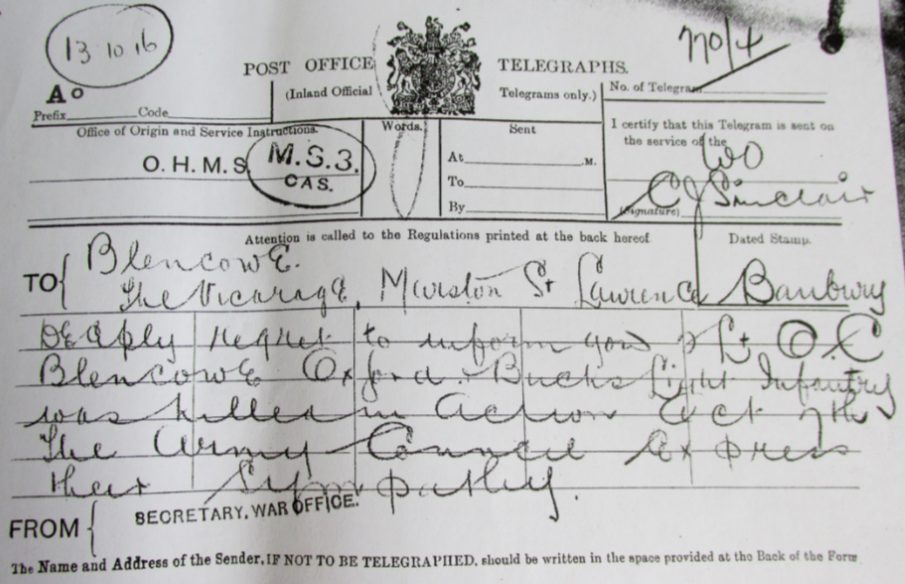
The news of Oswald’s death did not reach his parents until October 13th, six days after the event.

blencowe-telegram


October 3rd 1916

No regular reader of the newspapers and their lists of casualties can be in any doubt that the fighting on the Somme continues to be fierce and costly. (How grateful we are that we have suffered no fatalities since August).

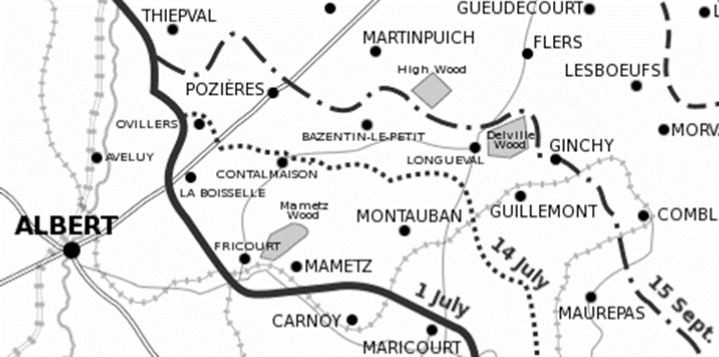
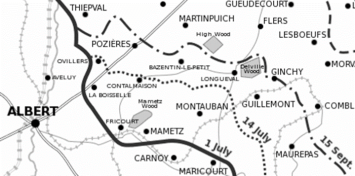
Lieut. Jack Gamlen (OBLI), who joined the Push on August 13th, tells me that he “has no great tale to tell.” I beg to disagree, as his description of the advances made from Ovillers towards Thiepval is most illuminating.
somme-map-2

“We struck north for Ovillers… it was my first sight of the front and I shall never forget it. Less than three hours march had carried us from corn-fields and unruined villages to an obscure desert which looked like nothing but the surface of the moon. We marched through Ovillers, passing streams of wounded and weary men who were returning from the front line.

Then we turned sharp to the left up a narrow, freshly dug, communications trench. In it I felt quite safe, though enemy 5.9 shells began to fall pretty thickly round us. We went on and on very slowly, and with many halts for half-an-hour, and then at last turned into the third line trench, which we were to occupy as company in reserve.”

Here Jack and his men had to endure some fairly heavy shelling, but were pulled back the following day for a brief period.

“We returned three days afterwards, and this time my Company took over the front line. We were heavily shelled from the first. One man in my platoon was killed by a shell, within three yards of me, just as we had taken up our position.”

Again, the shelling was constant but there were no infantry attacks and Jack returned safely.

“A week later we were back again, further to the left, and in full sight of Thiepval, which looks so harmless and so near in the strong sunlight of a hot morning.

In all this part of the line, the trenches were really not trenches at all. They had been blown to bits weeks before and gave scarcely any shelter to my men, several of whom were under fire for the first time.

On the afternoon of our first day up (August 23rd), an attack was to be made by the Bucks battalion on our left against the enemy line some 200 yards in front. I was in charge of a bombing section, with orders to push on to the enemy trench at Point ***  as soon as the Bucks went over, and to join up with them.

From a shell-hole I watched our wonderful preliminary bombardment of the enemy’s lines. It was terrifying, but extraordinarily interesting. I say ‘terrifying,’ because some of our shells burst very close to us; far too close to be pleasant. Then the barrage suddenly stopped, and the Bucks went over, alas, only to come back (what was left of them) in a very few minutes, for they were mown down by machine-gun fire which started the moment our own barrage lifted.

I now sent back for further orders, and was told to push on to Point ***  if I could. So I organised my bombing party, and sent two men up the communicator, where I already held a ‘bomb-stop,’ (a barricade in the trench dividing Br/Ger troops) to see how near the enemy was. They came back at once and reported about 20 of the enemy behind the next traverse but one. I didn’t believe them, so went myself, and found about 10 of them behind the next traverse but two. We looked at each other and I came back quickly. The attitude of the enemy was expectant, but not very menacing.

I waited for about half an hour, in order to allow the Huns to recover from the sight of me, and then advanced with my whole party. We all expected death, but there was no time to think about it.

When we reached the point at which I had sighted the enemy, I found a German, three yards in front of me, who was just about to descend into a dug-out. His head was already out of sight. I had a beautiful revolver shot at him, and his body and legs followed his head. It was a good moment.

Immediately afterwards the enemy woke up, and there was bombing at close quarters. We conjugated the verb “to bomb” in all its moods and tenses, and my party had wonderful escapes and only two slight casualties. The enemy then retired round the corner of the communicator into their own trench, and as I did not feel equal to attacking their whole first line with one section, I ‘consolidated my position,’ and remained where I was until I was relieved…

This is all I will tell you this time. The Somme trenches are very horrible; shells are very horrible; and fighting is tiring beyond anything which can be conceived at home.

What most impresses me is the speed with which one forgets the horrors as soon as one leaves them behind.”


August 23rd 1916

Rats are constant and entirely unwelcome guests everywhere where there is human flesh on which to feast. British soldiers fight as continuous a battle with them as they do with the Germans, and it is splendid that there should now be an Officer Commanding Rats!

Capt. Douglas Rose (Oxford & Bucks Light Infantry) writes of attempts at a scientific approach to their extermination:

DM Rose“It was at the Field Ambulance that I met O.C. Rats. I had come in that afternoon, not wounded this time but with a silly leg and foot which I hardly possessed it seemed, a result of sciatica. The medical officer for the day was looking round for the night and brought a companion with him whom he introduced at O.C. Rats.

I had been keenly interested in this appointment ever since we received the order in the front Line to look out for any Rats that appeared to have died from natural causes and to send any such, duly labelled, to Brigade Headquarters for examination by a Bacteriologist.

“Well,” I said, “how’s business?”

“Nothing doing,” he replied. “I have only had two carcasses to examine, one of these had most of its ribs broken and the other appeared to have died of senile decay.”

‘B,’ in the next bed, said he had fired 72 rounds with his revolver at the beasts, and generally had a shoot at night, but had never seen a naturally deceased rat. I related my experiences with a cane and how I had once made the mistake of moving my foot too soon when I trod on one in mistake on the duckboards.

O.C. Rats said we must let some of them die naturally, otherwise how could he judge the effect of the serum which had been given to the rats by a thoughtful Government with views to exterminating them entirely.

I explained to him that when a Platoon Sergeant lost his upper denture completely, rats having taken it off from the shelf in his dug-out whilst he slept, and the Company Sergeant-Major had all the vulcanite bitten off his lower denture when having a siesta, one could hardly expect a truce between the men and the rats, so that the serum could work out to a scientific conclusion.

We all promised to secure some remarkably fine specimens for the Rat Commander and I fancy he will find some lively corpses when he opens the bag I intend to send him. Curiously enough, I have just heard from the Quarter-Master Sergeant that the dirge which the infants sing about fifteen times day in the schools adjoining is Fontaine’s Fable “The Lion and the Rat.”

Ragging the OC Rats is entirely in character with a young Douglas in his schooldays!


May 13th 1916

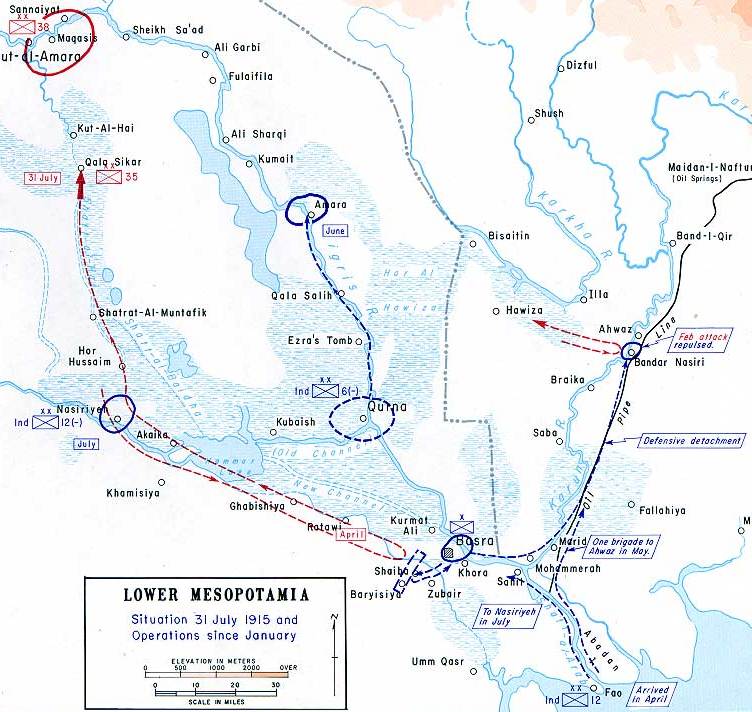
Following the news of the fall of Kut on April 29th we have now heard from 2nd Lieut. Leslie de Selincourt (who, you may recall, transferred from the 7th Hants to the OBLI), who has been wounded. He has written to us from the Club of Western India, Poona.

de Selincourt L27/4/16 “I lent my valuable assistance during the battles of Feb 21st and March 8th, though unfortunately both turned out rather abject fiascos.

On the night of March 16th I was out in front of the parapet of the front line trench burying some bodies, which had lain there too long to make living next door to them enjoyable. The moon appeared from behind a cloud; an ill-mannered Turk saw me and hit me in the arm; annoyed because I didn’t drop down on my stomach and crawl home, he hit me again. Unfortunately in a more disabling place, the bullet entering my shoulder and reappearing out at the small of my back. I dropped like a stone and was unable to rise until three weeks later.

I experienced the usual sensation when hit – ‘never more pained or surprised in my life.’ Some ribs got cracked, but no vital part was touched and I have been the subject of congratulations from every doctor.

Now I am going up to Naini Tal – a very good spot in the Himalayas. Then I suppose I go back to the Gulf.”

* * * * * * *

Lieut. Leslie Murray (RNAS) was also involved in the efforts to relieve Kut and he too is now in hospital:

3/5/16 “I expect you will be sorry to hear I have arrived at the Funk Hole at Buzra, otherwise known as the British General Hospital. I had been feeling pretty rotten since last Thursday (April 27th) and on Friday I discovered I had a temp of 100.3 degree, so I retired to bed altogether. The heat in my tent was almost unbearable, the only breeze was a hot draught.

The next day I was just as bad, so, as our Naval Doctor has gone down with dysentery, I was sent along to one of the Field Hospitals close by. It was very hot there and the biting flies were most irritating, as I had not got the energy to drive them out of my mosquito net.

It was in the afternoon that I got the news of the fall of Kut, which was rather depressing, although most of us were fairly certain that they could not hold out much longer and it seemed fairly obvious that under the present conditions it would not be possible to get through, because we had a very difficult position to attack.

The Turks were very strongly entrenched at Sannaiat, and with marsh on one side and river on the other, it would have required a much larger division than we had got at the time, to get through.

Of course, several attacks were made on the position, but whenever they got through, they were driven back. We expected Kut to surrender any time, as we knew we could not feed them from the air much longer. Neither the machines or the pilots could stand it…

I suppose we prolonged the agony for four or five days… By the way, the things we usually dropped were ‘atta’ (a native flour), sugar and occasionally chocolate. I usually took 200 or 250 lbs and an observer; the food was placed inside two strong sacks, four 50 lbs sacks being placed on a specially devised bomb rack under the engine or between the floats, the fifth bag was put in the observer’s seat to balance the back of the machine and was heaved overboard by him.”


February 9th 1916

2nd Lieut. Leslie de Selincourt (OBLI) has reached Ali Garbi but floods, a shortage of mule rations and an uncertainty as to the friendliness of the Arabs in the area make for slow progress.

de Selincourt L

Leslie de Selincourt

“There is a biggish Arab village 1½ miles downstream from which we bought eggs yesterday in large quantities. They charged a lot and they all turned out to be bad, so this morning we strapped on our revolvers, took half a dozen trusty followers with rifles and kit bags and marched straight into the village.

With the aid of an interpreter we interviewed the Sheik, explained our discovery about the eggs and demanded the right number in the right condition. It was about eight dozen. They hummed and hawed in excited tones and then some slunk away and after a considerable delay reappeared with two eggs. We explained that the compensation was inadequate. They merely looked stupid and pretended not to understand. So the word was given and we scattered through the village.

Time was called after sixteen minutes and the bag was as follows: 54 hens, 19 eggs, 2 leaded sticks, a Service Colt (loaded, ancient, but still serviceable), a cartridge belt containing 31 cartridges (also ancient) and a coffee pot. They came off very lightly, and as a hen in this country can be bought for four annas, we didn’t take enough to pay for our loss in eggs. But we didn’t want to make enemies of these people and if they don’t swindle us we are quite willing to trade fairly with them.”

So far Leslie and his troops have marched about 190 miles and they are now 42 miles from the firing line.

January 13th 1916

2nd Lieut. Leslie de Sélincourt has written to say that he has been transferred from the Hampshire Regiment in India to the 1st Battalion of the Ox & Bucks Light Infantry.

The Battalion itself is currently besieged at Kut and he is to join a provisional battalion at Ali Garbi to be part of a relief force.

Leslie is about to set off from Basra for Amara and he is currently doing battle with jackals and flies:

de Selincourt L5/1/16  “We are plagued by jackals who howl in the most dismal fashion round the tent at night. One came in last night and swallowed this morning’s breakfast while we all slept…

We are driven crazy here by flies. In spite of the cold – frost at night – they are as thick as… as…well, as flies. We have an admirable plan for catching them. Just a drop of methylated spirit in a glass which you hold under the fly as he sits on the roof of the tent; fuddled by the fumes, he immediately drops in. I caught 250 in 14 minutes.”


December 9th 1915

Lieut. Lindsay (Pug) Wallace has come home several times this term on ‘home-sick’ leave from his regiment in Bicester and is now quartered in Oxford. We were lucky to be able to secure his services as referee in the first few rugger matches (and he had a most enthusiastic and interested audience at the School House one Saturday evening whilst he explained the mysteries of his Machine Gun.)

Away matches have proved difficult, particularly if returning after dark, under black-out regulations (in case of attracting the attention of German zeppelins). The trip back from Eagle House in Sandhurst involved a brief halt in Reading to lay in a supply of provisions for the journey home; some narrow escapes for passers-by, lamp-posts and animals; various compulsory halts for interviews with special constables; an uninterrupted bump along the Iffley Road till finally arriving back at the School House.

1915 Rugger Team

Sadly our rugger season has come to a disappointing and unexpected end. We have been attacked and smitten, hip and thigh, by a devastating kind of influenza cold. We are glad to think that at least two of the unplayed games can be played next term.

Meanwhile, if (a) Pentreath can convince himself that the shortest distance between two points is a straight line; (b) Mallalieu will forget himself and realise that the man with the ball in his hands is the most likely person to score a try, on whichever side he is playing; (c) Gunther will remember that the haphazard pass in his own “25” is likely to lead to disaster (otherwise he is excellent); (d) Adamson will practise until he finds out that it is possible to be tackled without the ball being hurled in any direction and to any player of either side who happens to be on the look-out (his own tackling is v.g. indeed); Potts will find out that it is fatal to change your mind when attempting either to fall on the ball or to pick it up… we may confidently meet any of the teams who were opposed to us this term.


November 16th 1915

Mikado 10.1915

The school’s  recent performances of Gilbert & Sullivan’s ‘The Mikado’, could not go by without noting the pain we still feel at the loss of the two members of staff who have died in the War, Leslie Eastwood and Tom Higginson. Higgy it was who first brought G & S to the OPS stage.

How appropriate that we were joined in the audience by a number of wounded soldiers, who were most appreciative. As one of our reviewers said,

“How can one care to do anything so much as for these dear men who have gone out, simply, with a sort of bright eagerness and cheeriness, to lay down their lives and who, having nearly lost them, having seen death and hell and having suffered every torment and hardness, return with the same brightness and cheeriness in this dark world of loss and anxiety?”

The Friday audiences were cheered by many young soldiers, all longing to be out of the OTC and at the Front, and the mother of the School’s own VC, just home from seeing him in Egypt, and by some Dragons home from the Front in France, Russia and the Dardanelles.

2nd Lieut. Jack Gamlen (Ox & Bucks Light Infantry) attended the one of these performances.

“It was delightful to find this performance awaiting one as a treat after a cold and wet October in camp. We, too, when under canvas, had tried to warm ourselves by singing songs from the G & S operas.

Our greatest success was to rouse our Colonel in his pyjamas at 11 pm, by beating the big drum as an accompaniment to the Duke of Plaza-Toro’s  first song, and to be sent to bed. There were five of us, including a College Dean, two solicitors and a real wounded warrior from the Indian Army…”

When Jack came down from Balliol (to which he had won an exhibition from Rugby School) he trained as a solicitor and was practising here in Oxford in the firm of Morrell, Peel & Gamlen, when the war broke out. Much of his military training has been done locally and he likely to be sent to the Front before long.

July 29th 1915

In addition to the 8 killed, we will be listing in the next edition of our magazine, the names of 26 Old Dragons who have been wounded in action.

One of these is Captain Douglas Rose (Ox & Bucks Light Infantry), who has sent us the following description:

DM Rose

Capt. DM Rose

“The new C.O. is coming up at 5.30 to see what sort of sniping post we can get out in front of the edge of the wood, a good place for using the new telescopic sights he has brought out from home; I must decide what places I will suggest…

Working my way along the line, I point out various things to be cleared up and attended to. I come to the first place I want another look at… seems about the best bit of ground just forward. The trees and undergrowth are thick enough to screen me from the German lines, about 120 yds. in front, and it will be quite all right if I do not go right to the edge. Anyhow, I must get a more definite idea as to what sort of field of fire and cover there is.

I go forward a few paces, then a few more; some bullets about, stray ones I suppose – anyhow nothing unusual… I crouch down with eyes close to ground to get the lie, then have another look, bending fairly low.

‘Great Scott!’ I suddenly collapse into a sort of sitting posture. Slowly and with amazement I realize that I have been hit. I am reclining now on my right side, a burning feeling in my left thigh, my hand which instinctively feels for the damage comes back all over blood; I am really shot then! Enemy’s sniper away to the left must have spotted me and got me sideways. Better get help as I may ‘go off.’

Calls to the breastwork bring four or five to my assistance. I warn them off, don’t want any more casualties, rotten as it is. Second Captain comes up. He is in command now.

‘Get these fellows back,’ I say, ‘and tell the stretcher bearers to be careful. Pretty certain the fellow who got me knows I am lying here.’

Stretcher bearers creep up and give me some very warm water to drink; I feel all right, rather excited and getting stiff and numb in the lower parts of the body. Corporal says he must cut my breeches, but will try to keep to seam.

I ask if bullet is out. No, he says, it is not.

Iodine makes things smart. They begin to open stretcher.

No, I cannot get on the thing and you cannot carry me without exposing yourselves.

All right, I think I can crawl on my elbows, anyhow let’s try. Yes! I can get to the breastwork; you crawl behind and push my legs along.

I am a trifle tired when I get to safety.

Would I like to wait there a bit? I can feel my breeches very wet, seem full of blood so think best go on. Rather a job getting on the stretcher, find lying on my stomach best.”

From there Douglas was conveyed to safety.

* * * * * * *

Over 20 Old Dragons are serving with the OBLI and we are aware of the following promotions:

Lieut. CWH Bailie (2nd Bat) – from 2nd Lieut; 2nd Lieut. MC Cooper (4th Reserve) – from Private; 2nd Lieut. JCB Gamlen (3rd/4th Bat); Lieut. CSW Marcon (4th Bat) – from 2nd Lieut; Capt. GK Rose (1st/4th Bat) – from Lieut; 2nd Lieut. HEF Smyth (4th Bat) – from RMC Sandhurst; 2nd Lieut. RF Symonds (Bucks Bat); 2nd Lieut. WJL Wallace (3rd/4th Bat).

July 1st 1915

Last week Lindsay Wallace, know to us all, adults and children alike, as ‘Pug’, became the sixth member of the OPS staff to join the war effort – as a 2nd Lieutenant in the Ox & Bucks Light Infantry.

We have received this letter from him, addressed to us all.

6 Park Town, Oxford.

June 27th 1915.

Dear Fellow Dragons,

I am writing to thank you all very much indeed for the present, or should I say presents, which were thrust into my hands about ten days ago. Whenever I use them, and, as soon as I leave Oxford, that will be very frequently, I shall be reminded of the OPS and all of you and of the many happy days spent there both out of doors and indoors.

I first came to the OPS in January 1885, as a boy, and left in July 1890. I remember crying hard when my last summer term was finished. During the next ten years or so when I was at Winchester and Balliol, I was always to be found at the OPS if I had a chance. In fact at the time I came too often and was a nuisance. In my Varsity days I used to cadge a tea as often as I could from Hum or Maurice Church, in order to stay for the whole afternoon. In 1901 I returned as a master, and I’ve been there ever since.

I have stated this in detail to try and make clear to you how heart-broken I felt when I spent my last day with you as a genuine member of staff. I want to make it plain that I didn’t want to go, I don’t want to go, and I shall always want to be back.

I am going to play a new game, and I mean to play it for all I am worth, but, when that game is over, I shall change and come home as quick as I can. I don’t know whether I have made myself clear; thank you again very much for your present. Don’t forget

     ‘Pug’ 

Pug Wallace