May 28th 1917

Lieut. Hugh Sidgwick (RGA) has replied to Fluff Taylor’s proposal that the School should have a War Memorial for Old Dragons who lay down their lives in this war.

He accepts that the building of a chapel might be the “normal” thing for a school to do…

15/5/17 “But we are not an ordinary school, and our tradition has always been cast in the opposite extreme. Routine, orthodoxy, ritual, unreasoning compliance with comme il faut – all these we have deliberately avoided. Some would say we have gone too far and undoubtedly our tradition, like the others, has its dangers. But freedom and sincerity and spontaneity and genuineness, and the mistrust of the second-rate and the second-hand, are things worth a good deal of risk to obtain and it is my firm belief that the best part of our school tradition is marked with just these characteristics.”

Hugh fears that a chapel would have to be under diocesan supervision and that school services on our present lines (with the staff and boys running them) would be impossible.

“If so, I can only say that the prospect fills me with fear. I fear… the apathy of routine: I fear the wrong kind of parent coming and saying ‘how nice and proper’ : I fear the right kind of parent coming and saying ‘After all, there’s not much in it between this and other schools’…

I am not thinking merely of those whose parents and upbringing are of some other specific creed: and I leave out of account the French and other non-British boys who have been such a strength to the School. I am thinking rather of the numbers in whom religious sensibility develops late, or takes some other form than participation in a uniform code of outward worship. Cannot we find some way of commemorating our common sacrifice which does not leave them out in the cold, and which does really link together all Dragons, past, present and to come?

My own feeling is that the War Memorial should be a building habitually and freely used by all Dragons, where the whole school meets occasionally for certain purposes and where at other times any boy can go at any hour of the day to read or write or reflect, with the names and records and memorials of the honoured dead visibly before him.”

In short, Hugh would rather we thought in terms of “a library, assembly hall, reading room, museum, concert hall or any mixture of these.”


Lieut. Martin Collier (RN) has also written. He supports the idea of a chapel:

“Provided, of course, that the School services remain exactly as they are at present, conducted by the boys themselves…”


I hope others will contribute their views to this debate and I look forward to hearing them.


April 28th 1917

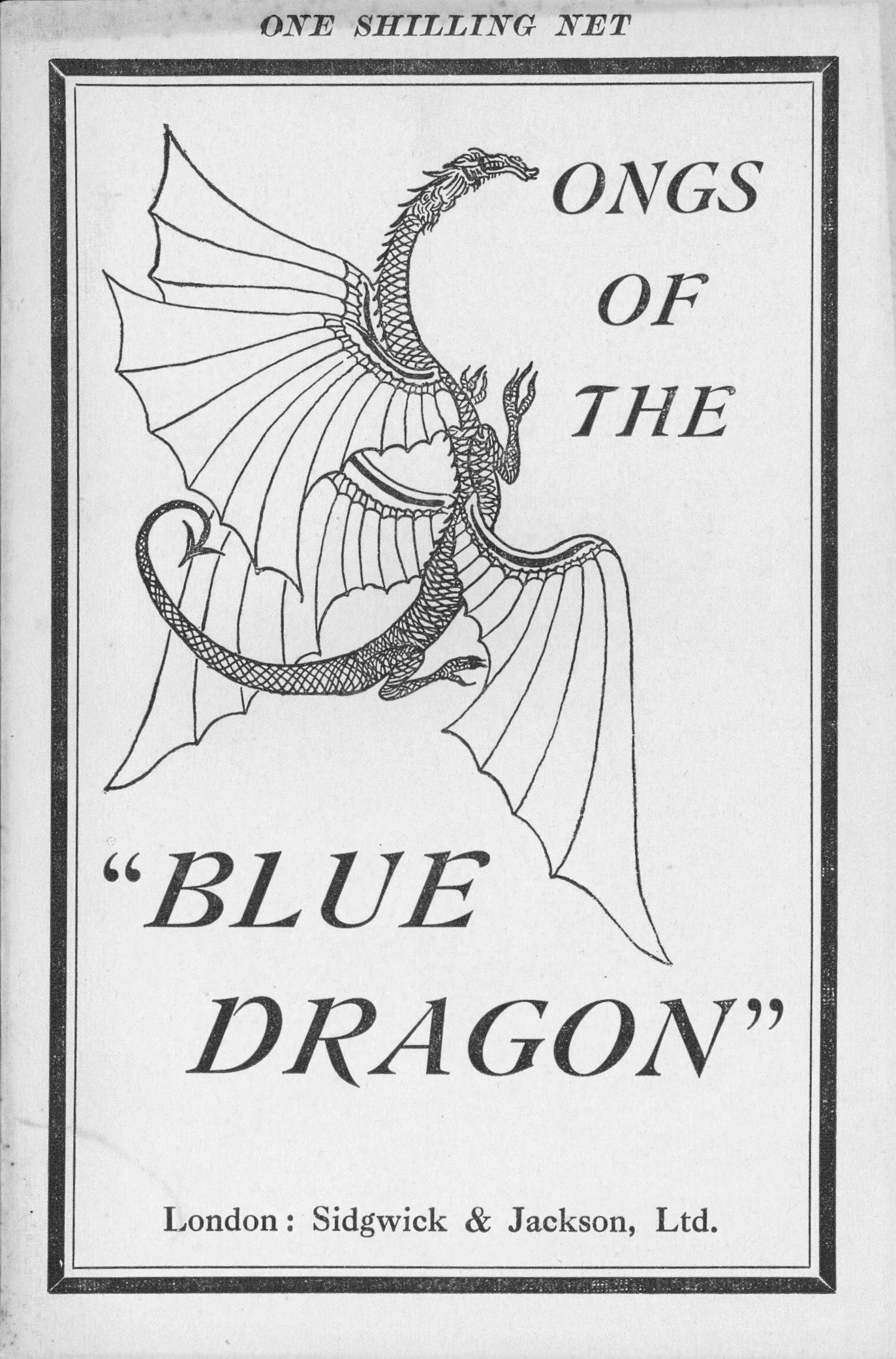
The holidays are a time to enjoy some light reading and I am delighted to say that Sidgwick & Jackson have just published a collection of songs and poems from the previously published ‘Logs of the Blue Dragon.’ It is now on sale for the princely sum of one shilling!

Both Frank and Hugh Sidgwick have contributed to this volume and here, by way of example, is one of Hugh’s contributions:

Nimium ne Crede Experto                               

“This narrow strait,” (the Sailing Directions said)
   “Is full of rocks and difficult to enter;
Whirlpools are common here at every tide;
There are uncharted reefs on every side
   And currents (twenty knots) along the centre.”
“Come,” said the Skipper, “we will go in there.”
            (We went in there.)

“There is no sand” (the Sailing Directions said),
   “The anchorage is thoroughly unsafe.
There is no shelter from the frequent squalls,
Save on the west, among the overfalls.
   Boats should go on to Loch MacInchmaquaif.”
“Come,” said the Skipper, “We will anchor here.”
            (We anchored here.)

                                  Hugh Sidgwick

In my humble opinion, this rather overrates my nautical abilities!

Mr SPB Mais, who came to teach at the OPS for the Summer Term of 1909 (on the recommendation of his tutor at Christ Church, our own Charles Fisher), has written enthusiastically about our new book. He is now at Sherborne School and he describes the arrival of the book there through the post as giving rise to high excitement in the Mais household:

“I forgot my bath, my shaving water, even my breakfast. I was late for chapel and nearly turned my lecture on Range-Finding into a reading on Voyages of a five and a twelve ton yawl. I managed to restrain myself until the English hour for Army candidates. Then for three-quarters of an hour I gave myself up to delirious pleasure…

It is enough to say that no past or present Dragon will feel satisfied until he has learnt by heart all the cheerful, witty, honest poetry which is here presented all for his delight.”


March 25th 1917

Last heard of, Lieut. Hugh Sidgwick (RGA) was in a dug-out in France, writing the Prologue for our production of ‘A Midsummer Night’s Dream.’

Since then, he has been summoned back to England by the Board of Education to assist the minister, Mr HAL Fisher, with a new Education Act. Important work no doubt and, in fact, more worthy of Hugh’s extraordinary intellectual capabilities than the RGA.

Here, in a welcome contribution to the next edition of the ‘Draconian,’ he depicts himself as a “shirker” in a “funk-hole” in London.

From a Funk-hole.
                    1.
This is the song of a shirker in a funk-hole.
He has alternated, and will continue to alternate, between
      being a shirker in a funk-hole, and an over-fed hero
      intrepidly sitting at a telephone in France.
But for the time being he is a shirker in a funk-hole again.
                    2.
The men in funk-holes are acute, over-worked, and tired.
They get no leave and no potatoes.
They are insulted in the press.
They are assisted temporarily in their labours by dons,
      women, and business men.
But they stick it.
                    3.
The warmth and cleanliness of the funk-holes are pleasant 
      after France.
The shirker is glad to have interesting work to do again
Until it comes to doing it.
In France the work is not so hard.
                    4.
London is a good place compared with France.
But it involves being taken to revues.
Revues are better than violent shelling,
But moderate shelling is better than revues.
                    5.
Of course there is the moral aspect.
But moral aspects don't worry the shirkers much.
                    6.
If you consider who are really enduring the hardships of war,
There are eleven classes in order of endurance.
The first six all consist of people who go into the
      front line and get shelled, or who go about in ships, or fly.
The seventh consists of people in this country who work.
The eighth consists of Staffs, Base Censors and others,
      who sit behind the line
And have a high old time.
The ninth consists of a Railway Transport Officer, whom I know.
The tenth consists of journalists.
The eleventh consists of people who appear in the Sketch
      in full evening dress as interested in War Work.
                    7.
The shirker has belonged to Classes Four, Seven and Eight.
So he knows.
At the moment he belongs to Class Ten
If you consider the 'Draconian' a journal.
                    8.
Having concluded his song the shirker returns to his funk-hole
In the hope of persuading someone else to do the work.
Unfortunately there are no N.C.O's there.

                                            17th March 1917

Class Ten? Needless to say, Hugh was never in anything but the top forms in his time at the OPS!

January 25th 1917

mnd-cast

Midsummer Night’s Dream

As is our custom, the term started last week with our annual Shakespeare play. We gave four performances of Midsummer Night’s Dream. The first was to an audience of teachers, boys and girls, from some of the Oxford Elementary Schools – an audience of about 350. Letters subsequently received showed that it was greatly appreciated and that Puck was specially popular.

The second performance was enjoyed by about 120 wounded soldiers, who were afterwards entertained to tea. On Saturday there were the usual afternoon and evening performances for parents and friends.

“It was indeed a welcome boon that the Dragons gave us this year,” wrote one of our reviewers, “to transport us for three hours’ space away from the sorrows and difficulties of this unintelligible war to the flowers and forest glades of Shakespeare’s Warwickshire…

While we were waiting for the play to begin, it was sad to notice the absence of ODs among the audience, and sadder still to reflect how many of them had consummated the great sacrifice for their country. Indeed Dragons, if any, will fully understand the meaning of the line –

‘We must be free or die, who speak the tongue
That Shakespeare spake.’

Many of the ODs now in the trenches were doubtless present with us in spirit that night and not only the writer of the noble prologue, which touched eloquently on the thought we all were feeling…”

The writer of “noble prologue” was Lieut. Hugh Sidgwick (RGA), whilst in a dug-out in France, and his words were delivered by Oberon:

Prologue
Think it not strange that at this hour, in a world of waste and wrath,
I come to lead your thoughts away by a wandering woodland path,
Far from the scarred terrain of war and the perilous haunted seas,
To the moonlight on the forest and the glimmer between the trees –
To light your steps in the murk and gloom by fancy’s fitful gleam,
From the dark, substantial winter day to a Midsummer Night’s Dream.

Not strange – they would not think it, our brother Dragons who stand
In the line in France or Flanders, on the deck or the desert sand.
They would not grudge our revels, or wonder that today
We come to enact before you the loveliest English play.
For all the cause they fight for, the things they hold most dear,
England, and Home, and Beauty – will you not find them here?

Hugh’s brother, Frank Sidgwick, also contributed a review to the ‘Draconian.’

“I needn’t tell ODs that everybody was word perfect. I think Theseus twice said: ‘For aye to be in a shady cloister mewed,’ and Lysander gobbed a difficult line in the afternoon, but got it right at night; the accents on ‘persever,’ ‘revenue,’ ‘edict,’ etc., were correctly given; and I think I heard ‘prehaps’ instead of ‘perhaps’ once or twice…”

One or two other faults were also noticed:

“Some of the actors were too fond of nodding and smiling at their friends in the audience. One of the characters, supposed to be lying asleep, actually clapped his hands in applause of a song by Puck!”

Ah well, we do not pretend to be prefect.


October 8th 1916

Lieut. Hugh Sidgwick (RGA) is proving a prolific correspondent.  Being currently under-employed behind the lines on the Somme, he apparently has plenty of time for both reading and writing.

sidgwick-ah-226/9/16. “I was in the most forward of our batteries the other day just at ‘zero’ time – i.e. the prearranged moment when the final bombardment begins. The noise was really appalling. Our own howitzers were comparatively mild members of the orchestra: the high velocity guns easily out-topped them: now and then came the roar of the really big guns far behind: while the rumble of field guns was practically continuous. If you don’t stop to think, it is something of an experience: if you do, you want to sit down and cry.

Generally, I feel a complete fraud and quite unworthy of print in the ‘Draconian’.  I have only been a combatant for about six weeks and am now a petty clerk. So this is my last contribution to the war columns. Veni, vidi, Vick-E: I came, I saw a little of it and it was all over. Any telephonist will explain the joke to you. It is the first I have made since 1902.

The modern Pepys and Shane Leslie book are much appreciated here. Leslie is quite interesting, but what right has he to be compiling memoirs and summing up an epoch at his age (31)?

Besides, I am not at all so certain that the epoch is over yet. Everyone I meet out here appears to wish to live after the war pretty much as he did before, though all agree that other people ought to reform their ways and show signs of spiritual uplift.

I hope all goes well with the OPS.”

September 30th 1916

We have another letter from Lieut. Hugh Sidgwick (RGA), who is keeping us in touch with events on the Somme. I am delighted to hear that he has received his copy of our magazine, even if I have every intention of overlooking his protest:

sidgwick-ah-2“The ‘Draconian’ has arrived and I have been devouring it in a hole beneath the earth, to the accompaniment of heavy howitzers and field guns.

But I must write at once to protest against the publicity given to my private and amateur attempt to translate Roger Mott’s inscription…  I have always hated and frequently insulted archaeologists and now they have got a handle against me.

If, as I expect, about six of them write to the next number of the ‘Draconian’, cutting off my head and holding it up afterwards to show that there are no brains in it, for Heaven’s sake either suppress the letters or bribe some really eminent archaeologist to say that my translation is right.” 

Since his last letter, Hugh has been sent back to the headquarters in order to attend a course that will equip him for the role of Adjutant.

20/9/16. “Headquarters are a number of dug-outs and tents in a sea of mud: the Adjutant is a cross between a bottle-washer and a private secretary and there are more and worse telephones than ever. So for all practical purposes I am back in Whitehall and any sympathy expended on me as surrounded by the horrors of war will be quite wasted. I feel an awful backslider in leaving my battery, but orders is orders…

What I find most difficult to realise is that since I came out I have been in the middle of a big battle. It is quite a shock to read the ‘Times’ and find names mentioned as critical and exciting points, when I have been there on the previous day.

There is a casual air about a modern battlefield, until the show actually starts – people walking about, horses standing in lines, men cooking food, and telephonists brooding over their instruments at tapping in stations.”


September 25th 1916

Hugh has finally escaped the clutches of bureaucracy, where he has been the Private Secretary to the Permanent Secretary to the Board of Education. He is now Lieut. Hugh Sidgwick (RGA).

He was commissioned into the Special Reserve of the Royal Garrison Artillery in January and is currently with a siege battery in France.  Having hoped that at the Front he would be free of modern communication systems that demand continual attention and instant reaction, he has been disappointed:

sidgwick-ah-2“The most distressing thing to me personally is the omnipotence and omnipresence of the telephone. It was my curse in civil life and I hated it bitterly and profoundly.

I did think that in military life I should escape it. But no; it is more important than ever; you range the country at the end of a telephone wire, and if it breaks you are an exile and outlaw at once; you come back and sit in your battery surrounded by telephones, all talkative and all meaning work.

The call to arms is a message dictated over the telephone and taken down on a pink form; the call to rest is the mystic word CI… I suppose when peace is declared the message will go round – Pip, Emma, Ack, C, E.

Of what is happening in the war we have not the slightest idea; a five day old Times is generally our latest news. We hear extraordinary rumours – that Roumania has come in, that a German Division has surrendered, that a Great Personage while addressing the Guards said that within 90 hours (now elapsed) something quite remarkable was going to happen. I believe these rumours are made up by Railway Transport Officers, to beguile the tedium of their existence.”

Hugh must have had to learn a lot in his new job rather quickly, but then scholars of Winchester & Balliol Colleges are quick learners. He makes it out to be easy enough:

“… the mathematics of siege gunnery are nothing alarming and many of the beautiful calculations we learnt in England go by the board. One has to know the difference between + and – , right and left, and to be able to add and work a slide rule, and read a map and take bearings, but that is about all.

I would volunteer to make quite an easy and profitable course of instruction in siege gunnery for VIa, and if they would give us a gun and let us practise on North Oxford from Shotover, so much the better for the cause of architecture.

If one of the Old Dragon airmen would come and observe, we could have a charming afternoon.”

I am not convinced as to the wisdom of arming the current VIa, and there might be mild concern amongst the residents of North Oxford as to whether their particular houses pass muster, or would be included in Hugh’s architectural cull.

April 15th 1916

A Balkan Find!

Major Roger Mott has written from “somewhere in Macedonia,” where he has indulged in some archaeological digging alongside his military duties.

“At ******** we have for some time been digging trenches and, being situated in a country of such classical associations, you may imagine that quite a number of interesting ‘finds’ have come to light – for instance, a tour of the trenches would reveal several old stone coffins, which make excellent ammunition or grenade stores; whilst for the storage of water you would, here and there, come across an amphora.

But the particular ‘find’ I refer to is a memorial tablet in white marble, in practically perfect condition and believed to date from the first or second century.

So I bethought me to have a copy made and sent to you. Maybe it will interest the modern Dragon, for I think ingenuity and a ‘Liddell & Scott’** will be able to unravel the hidden meaning thereof.

Alas, the early instruction in those class-rooms in Crick Road has been allowed to rust within my brain, so that my attempts to decipher the thing have not been altogether a success.

I got it reproduced somehow in small Greek characters, then tried to split it up into separate words, then searched a modern Graeco-French dictionary and finally a French-English one, with the result that I gather the city was extremely grateful to the gentlemen who bust up a ring of evil merchants. But you never taught me the last letter of the last line but one, which is annoying!”

Mott find

I am sure readers would like to have the opportunity to exercise of their brains over this Easter holiday to work this out. To help, Hugh Sidgwick has transliterated thus:

Sidgwick transliteration

** This capital text book has a close link with the OPS.  Dragons will know the rhyme:

Liddell and Scott, Liddell and Scott:
Some of it’s riddle, and some of it’s rot.
That which is riddle was written by Liddell,
That which is rot was written by Scott

Whereas Mr Scott (and his rot) has no connection with us, the riddle-some Dean Liddell (of Christ Church) is one of our founders.

(I am tempted, by the way, to add an extra line: “And little or none of it learnt by Mott!”)


January 25th 1916

Tempest E1916


We are now settled into the Easter Term and our school production of ‘The Tempest’ was very well received. We are grateful to Hugh Sidgwick for his review, which gives star billing to Barbara Hilliard’s portrayal of Ariel:

Ariel E1916

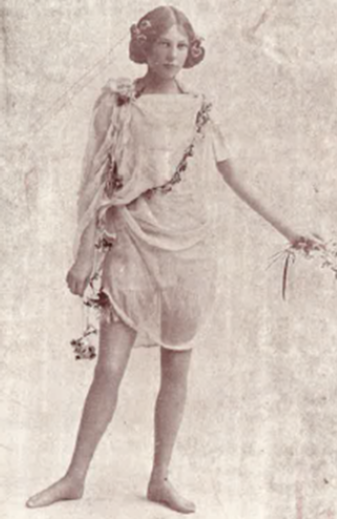
Barbara Hilliard as Ariel

“And then, hovering over and around these two and all the rest of the play, leading them at will, beguiling, enchanting, invisible and omni-present, we had the lovely vision of Ariel. It (I use the word advisedly, for this came nearer than any Ariel before to the ideal, sexless spirit of air and fire), it was the most beautiful thing I have ever seen on the stage; presence, gesture, motion and voice alike were exquisite.

Ariel intoxicated our senses so completely that I fear we hardly did justice to her acting; but apart from everything else it was a masterly reading of the character and of the play. Ariel made all the points with clearness and certainty, grasped exactly and revealed to us what was going on and interposed her presence among the deluded mortals always at the right moment and in the right way.

It is difficult to say how much the success of the play owed to her, and in particular to her most delicate and airy singing of the beautiful music of Purcell and Arne (Englishmen both, thank heaven, and much better at Shakespeare than Schubert and Mendelssohn).

* * * * * * *

I believe that an acting knowledge of at least one of Shakespeare’s plays is an important and useful part of an OPS education.

Shakespeare has indeed aided and abetted 2nd Lieut. Maurice Jacks (KRRC), in giving us Maurice’s location in France without falling foul of the censor:

“Being more or less conscientious I cannot tell you exactly where ‘here’ is, but if you remember where Polonius was stabbed, you will be within reasonable distance of the spot.”

Young Dragons will surely work this out – but can you?

November 30th 1914

The ‘Globe’ Newspaper recently noted a number of “interesting names” of Old Dragons serving. They included the England Rugby Captain, Lieut. Ronald Poulton Palmer; the Oxford stroke, 2nd Lieut. Bob Bourne; a Services Boxing champion, Lieut. Martin Collier; an Oxford Cricket Blue and Fellow & Senior Censor of Christ Church, Charles Fisher; an Oxford Hockey Blue & International, 2nd Lieut. Sholto Marcon; an Oxford Athletics Blue, 2nd Lieut. Aubrey de Selincourt; an Oxford Hockey Blue & International, and tutor to the Prince of Wales, Lieut. Lionel Smith. The list also includes the captain of the Oxford Athletics, a rowing blue who had a picture in last year’s Royal Academy, three first-class men in Greats at Oxford, all this year, many scholars of colleges and 2nd Lieut. CJ ffoulkes, RNVR, who is keeper of the Tower Armouries.

Only three years ago the OPS could indeed claim, amongst the 35 Old Dragons then up at the university, the captains of Rugby (Ronald Poulton Palmer), Hockey (Sholto Marcon) and Rowing (Bob Bourne). Most notable was the University Hockey XI, which that year contained no fewer than five Old Dragons in the team. They are all now members of His Majesty’s Armed Forces.

* * * * * *

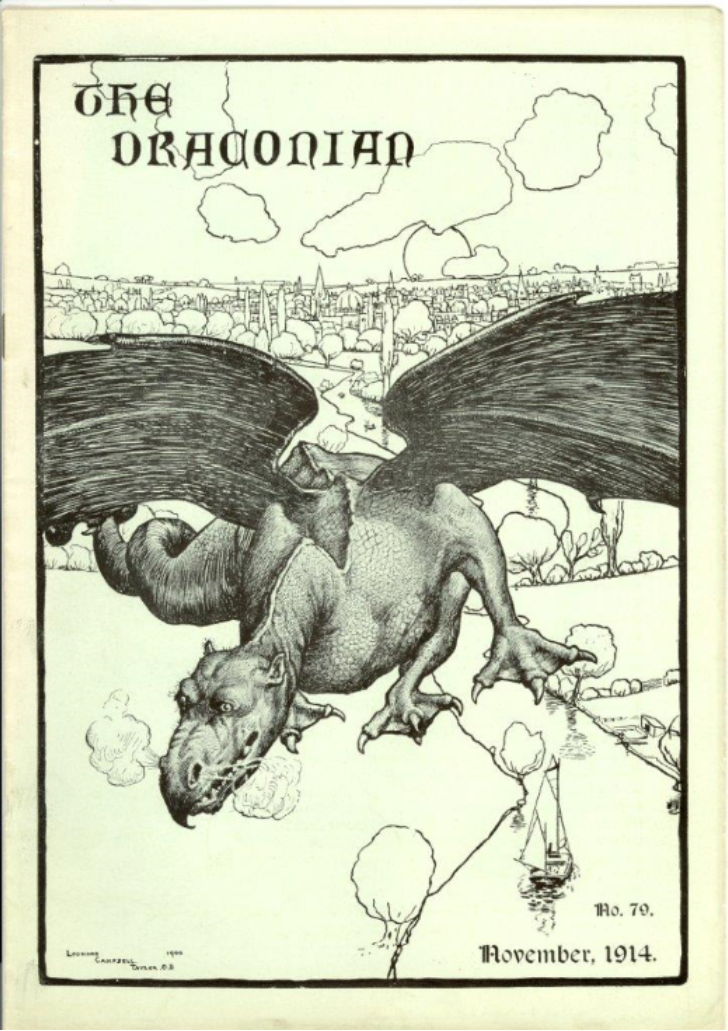
Draconian 79.

With the next edition of the ‘Draconian’ not due until after the end of term, we are issuing a special edition listing all those ODs who have answered the call to arms. It shows some 225 Old Dragons and staff already in uniform and a further 10 at Sandhurst, Keyham or Osborne. (Let it be remembered that when they were at the OPS, we only numbered 90-100 in the school).

We also include a poem by Frank Sidgwick, ‘The People’s Gift,’ which appeared recently in the ‘Saturday Review.’ This is the final verse:

Take the lesson, then, young Englishmen, when the war-cloud lowers black,

Let no man shift his burden of gift on to the next man’s back;

Answer today what part you will play, when your country gives the sign –

What gift will you bring to your country and King – is your blood water or wine?

* * * * * *

Frank’s brother, Hugh Sidgwick has been acting as private secretary to Sir Lewis Selby-Bigge, Permanent Secretary to the Board of Education. His work is deemed too important to allow him to join up. Instead he is doing duty as a Special Constable.

Special Constables – by one

Hugh Sidgwick SC

Hugh Sidgwick

“The Editor has asked for an article on Special Constables, and the motto of the force being obedience I can only comply. But one thing must be made clear at the outset. This nation at present consists of (a) the armed forces of the Crown; and (b) the rest. Special constabling is one of the forms of consolation for (b), who are small beer, and don’t matter much; it stands on a level with knitting socks, and putting on a light green uniform and gesticulating in Hyde Park on Saturday afternoons. It is miles away from the activities of (a), and must not be spoken of in the same breath. Therefore, if this article gets printed, let it be in the smallest of small print, in a corner far away from the ‘res gestae’ of soldiers and sailors. If that is quite clear, I can begin.

Special constables are amateurs who in their spare time assist the police in their lighter duties. They are sworn in for the period of the war – to carry out their duties without favour or affection, malice or ill-will, to preserve the King’s peace and guard the persons and property of his subjects, and so forth. They are provided with an armlet and a truncheon and a note-book and a warrant and a whistle and a badge; (I am going to make a song some day with this refrain). They may also provide themselves with a uniform. In our detachment it is a long blue overcoat and a yachting cap, in which we look like well-intentioned tram-conductors: but I am told that elsewhere there are variations in head-gear. Thus equipped, the special constable goes forth upon his duty.

So far the terror of our name has kept the malefactors away, and we have arrested only a bronze statue and a cat. But the moral effect has been enormous. The criminal classes and the foreign agents stand appalled at the reserves which the Executive has brought into play; they argue, ‘a fortiori’, that if respectable elderly gentlemen take such a lot of trouble about a little thing like that, what will happen if matters get really lively? Further, the ascendancy of the male sex is now re-established. I know of at least one dinner invitation which has been refused on the ground of constabulary duty. The dinner was on Tuesday and the duty on Thursday: but who could know that?”