January 25th 1916

Tempest E1916


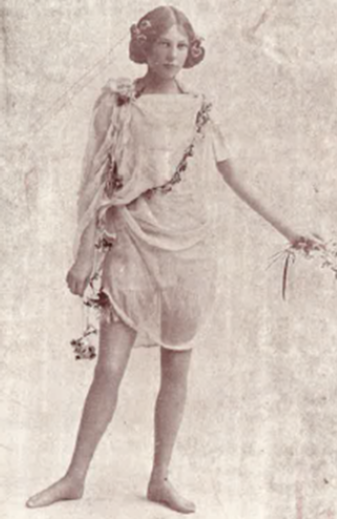
We are now settled into the Easter Term and our school production of ‘The Tempest’ was very well received. We are grateful to Hugh Sidgwick for his review, which gives star billing to Barbara Hilliard’s portrayal of Ariel:

Ariel E1916

Barbara Hilliard as Ariel

“And then, hovering over and around these two and all the rest of the play, leading them at will, beguiling, enchanting, invisible and omni-present, we had the lovely vision of Ariel. It (I use the word advisedly, for this came nearer than any Ariel before to the ideal, sexless spirit of air and fire), it was the most beautiful thing I have ever seen on the stage; presence, gesture, motion and voice alike were exquisite.

Ariel intoxicated our senses so completely that I fear we hardly did justice to her acting; but apart from everything else it was a masterly reading of the character and of the play. Ariel made all the points with clearness and certainty, grasped exactly and revealed to us what was going on and interposed her presence among the deluded mortals always at the right moment and in the right way.

It is difficult to say how much the success of the play owed to her, and in particular to her most delicate and airy singing of the beautiful music of Purcell and Arne (Englishmen both, thank heaven, and much better at Shakespeare than Schubert and Mendelssohn).

* * * * * * *

I believe that an acting knowledge of at least one of Shakespeare’s plays is an important and useful part of an OPS education.

Shakespeare has indeed aided and abetted 2nd Lieut. Maurice Jacks (KRRC), in giving us Maurice’s location in France without falling foul of the censor:

“Being more or less conscientious I cannot tell you exactly where ‘here’ is, but if you remember where Polonius was stabbed, you will be within reasonable distance of the spot.”

Young Dragons will surely work this out – but can you?

December 31st 1915

Christmas for our gallant old boys, stationed in numerous theatres of war, has varied considerably.

Capt. Geoffrey Carpenter (Uganda Medical Service) is currently somewhere in the vicinity of Kabale in Uganda:

“Xmas Day passed without any excitement and our mess managed to put up quite a decent dinner. Tinned tomato soup, herrings and jugged hare, a guinea-fowl (shot with a rifle) to take turkey’s place – they are as good eating as any bird I know.”

Capt. Charlie Childe (Gloucestershire Regiment), in a billet near Richebourg St. Vaast, on the other hand, has had no relief from the day-to-day realities of the war:

Charlie Childe“From 5 p.m. on Christmas Eve till 5 p.m. on Christmas Day all our batteries had more or less carte blanche and all started blazing away at midnight.

I went in on Christmas Day after tea and there was a great deal of whizz-banging and salvoes of shrapnel all night. I was quite pleased when I got back to my dug-out, as it was rather a poor game wandering about over the open in the pitch dark, and wet, with all this hatred breaking out from time to time.”

Lieut. Jack Smyth (15th Ludhiana Sikhs) is now in Egypt, defending Alexandria from attack by the German-supported Sennussi tribe. No Christmas spirit to be found there either:

Jack Smyth“I spent the most exciting Christmas Day and the coldest Christmas night I have ever spent in my life; the whole day was spent in an attack on the Sennussi position. I was doing Adjutant duties and as I had only a few days before come out of hospital in Alexandria, I was almost dead, not counting the additional ‘almosts’ from bullets…

I should love to have been able to get back to Oxford for Xmas, but must not think of such things till the war is over…”

2nd Lieut. Maurice Jacks (King’s Royal Rifle Corps), whose location is given simply as “this dreary corner of North France” has ascertained that the Boche may be suffering somewhat worse than our troops:

“A deserter came in the other day and to his amazement the men gave him cigarettes and tea, and Headquarters a dinner; he was feted all round, but we could not let him off without displaying a little ‘frightfulness’ and the whole battalion having just had a Xmas dinner of goose and plum pudding, we asked him, ‘I suppose you had goose and plum pudding on Xmas Day. We all did!’

He threw up his hands in amazement and was green with envy; he apparently had not even had a sausage!”

Lastly, my daughter, Kit Marshall (St. Leonard’s School YMCA hut, Camp 18, Harfleur Valley, near Havre) has been helping entertain those Tommies behind the lines, who were able to celebrate in some style:

KIt Lynam portrait“This morning we were all taken to the Irishmen’s and RFA dining halls to see their Christmas dinner and the decorations. They had turkey, geese, plum puddings, some given by the Ulster women, and beer.

Then at 3 p.m. we went to their concert. The men from both dining halls crammed into one… and they all joined in the choruses – ‘The little Grey Home’, ‘The Sunshine of Your Smile’, ‘Ragtime Cowboy Joe’ etc.

The pianist was splendid, played anything in any key; the voices were somewhat husky, the result of a huge dinner and a very smoky atmosphere. They had been given churchwarden pipes, too, by the Ulster women and the scene was most picturesque – all these men standing and sitting under the elaborate wreaths of different coloured paper and evergreens, all singing lustily.

Now I am sitting in the pay-box, having a slack time, as most of the men are down dancing in the lower Hut. All those under 5 ft. 6 ins. are decorated with ribbons, which shows that they are ladies…”

For these men, Kit’s old school (after the OPS of course!), St Leonard’s, provided Christmas presents:

…The men came up to the platform, each in turn, and dipped into a huge bran-pie for a present… 1,465 presents were given away and still some did not get any. They were awfully pleased with the things they got: wallets, handkerchiefs, socks, pocket-books, knives, pipes, purses, cigarette cases, cases for matchboxes etc etc. The School and Seniors gave the money, about £68, and Miss Grant chose and sent all the presents.”


December 9th 1915

Lieut. Lindsay (Pug) Wallace has come home several times this term on ‘home-sick’ leave from his regiment in Bicester and is now quartered in Oxford. We were lucky to be able to secure his services as referee in the first few rugger matches (and he had a most enthusiastic and interested audience at the School House one Saturday evening whilst he explained the mysteries of his Machine Gun.)

Away matches have proved difficult, particularly if returning after dark, under black-out regulations (in case of attracting the attention of German zeppelins). The trip back from Eagle House in Sandhurst involved a brief halt in Reading to lay in a supply of provisions for the journey home; some narrow escapes for passers-by, lamp-posts and animals; various compulsory halts for interviews with special constables; an uninterrupted bump along the Iffley Road till finally arriving back at the School House.

1915 Rugger Team

Sadly our rugger season has come to a disappointing and unexpected end. We have been attacked and smitten, hip and thigh, by a devastating kind of influenza cold. We are glad to think that at least two of the unplayed games can be played next term.

Meanwhile, if (a) Pentreath can convince himself that the shortest distance between two points is a straight line; (b) Mallalieu will forget himself and realise that the man with the ball in his hands is the most likely person to score a try, on whichever side he is playing; (c) Gunther will remember that the haphazard pass in his own “25” is likely to lead to disaster (otherwise he is excellent); (d) Adamson will practise until he finds out that it is possible to be tackled without the ball being hurled in any direction and to any player of either side who happens to be on the look-out (his own tackling is v.g. indeed); Potts will find out that it is fatal to change your mind when attempting either to fall on the ball or to pick it up… we may confidently meet any of the teams who were opposed to us this term.


November 16th 1915

Mikado 10.1915

The school’s  recent performances of Gilbert & Sullivan’s ‘The Mikado’, could not go by without noting the pain we still feel at the loss of the two members of staff who have died in the War, Leslie Eastwood and Tom Higginson. Higgy it was who first brought G & S to the OPS stage.

How appropriate that we were joined in the audience by a number of wounded soldiers, who were most appreciative. As one of our reviewers said,

“How can one care to do anything so much as for these dear men who have gone out, simply, with a sort of bright eagerness and cheeriness, to lay down their lives and who, having nearly lost them, having seen death and hell and having suffered every torment and hardness, return with the same brightness and cheeriness in this dark world of loss and anxiety?”

The Friday audiences were cheered by many young soldiers, all longing to be out of the OTC and at the Front, and the mother of the School’s own VC, just home from seeing him in Egypt, and by some Dragons home from the Front in France, Russia and the Dardanelles.

2nd Lieut. Jack Gamlen (Ox & Bucks Light Infantry) attended the one of these performances.

“It was delightful to find this performance awaiting one as a treat after a cold and wet October in camp. We, too, when under canvas, had tried to warm ourselves by singing songs from the G & S operas.

Our greatest success was to rouse our Colonel in his pyjamas at 11 pm, by beating the big drum as an accompaniment to the Duke of Plaza-Toro’s  first song, and to be sent to bed. There were five of us, including a College Dean, two solicitors and a real wounded warrior from the Indian Army…”

When Jack came down from Balliol (to which he had won an exhibition from Rugby School) he trained as a solicitor and was practising here in Oxford in the firm of Morrell, Peel & Gamlen, when the war broke out. Much of his military training has been done locally and he likely to be sent to the Front before long.

November 6th 1915

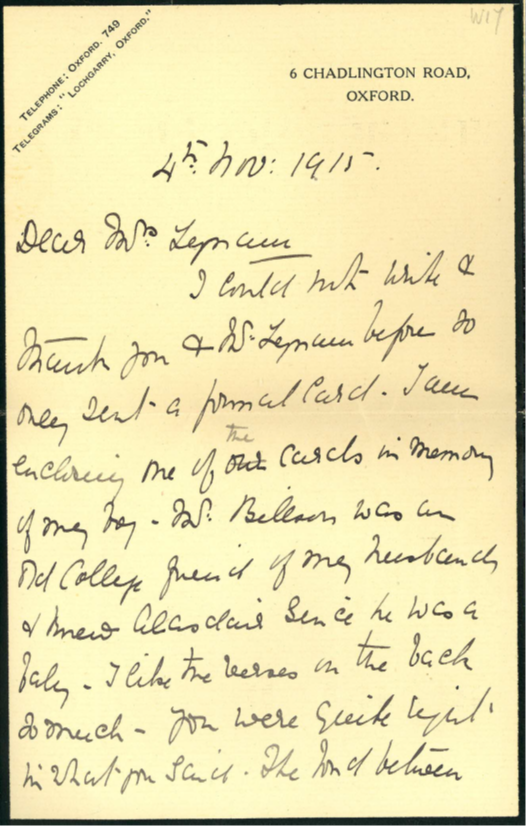
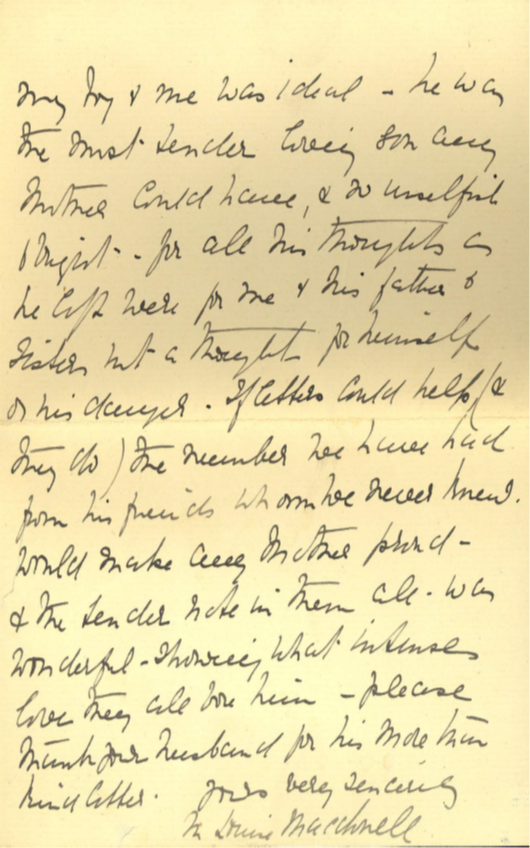
Yesterday, Mrs Hum (Lynam) received this touching letter from Alasdair Macdonell‘s mother:

6 Chad letter 1


Dear Mrs Lynam,

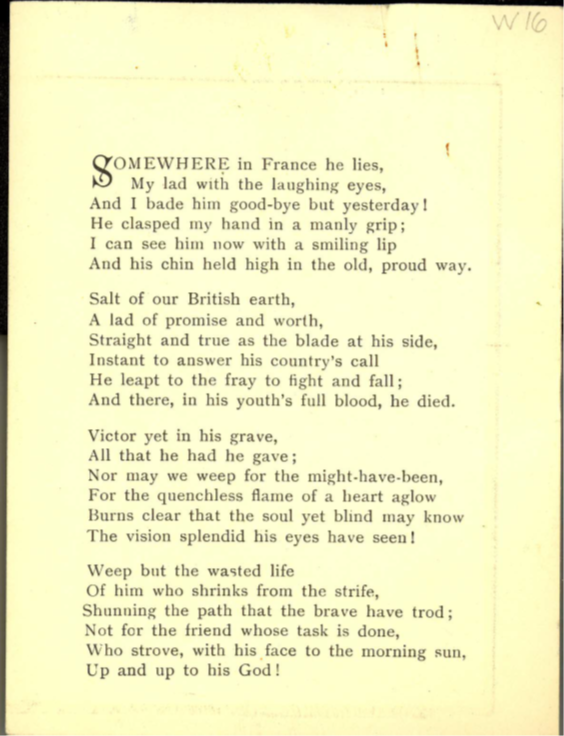
I could not write and thank you and Mr Lynam before, so only sent a formal card. I am enclosing one of the cards in memory of my boy – Mr Billson was an old college friend of my husband’s and knew Alasdair since he was a baby. I like the verses on the back so much. You were quite right in what you said. The bond between


6 Chad letter 2my boy and me was ideal – he was the most tender loving son any mother could have, and so unselfish and bright – for all his thoughts as he left were for me and his father and sisters but not a thought for himself or his danger. If letters could help (and they do) the number we have had from his friends whom we never knew would make any mother proud – and the tender note in them all was wonderful –  showing what intense love they all bore him – please thank your husband for his more than kind letter.

Yours very sincerely,

M. Louise Macdonell


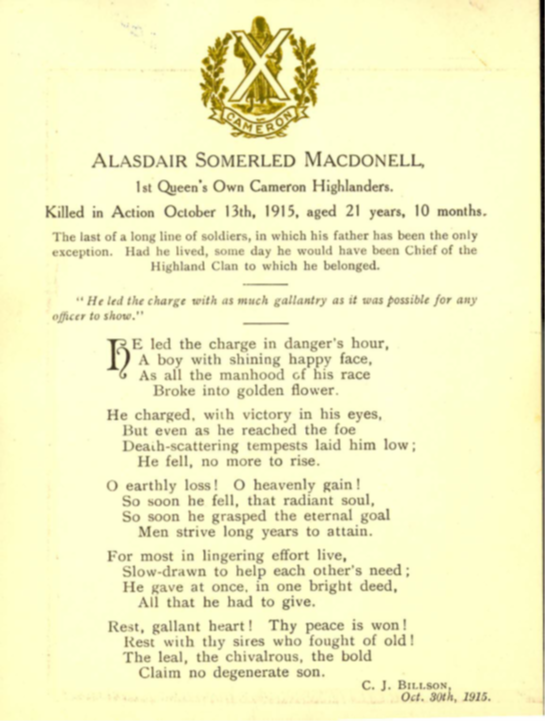
Macdonell card 1

Macdonell card 2

October 16th 1915

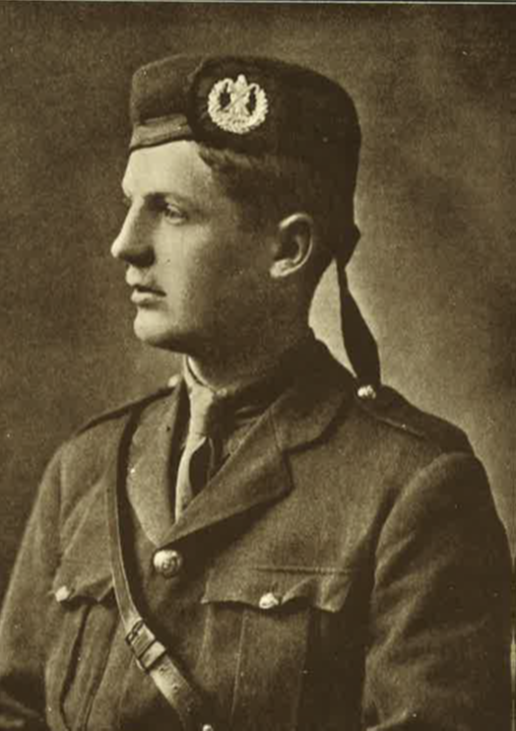
Alasdair Macdonell

2nd Lieut. Alasdair Macdonell (Queen’s Own Cameron Highlanders)

News of Alasdair’s death has come as the greatest of shocks to our community. Living next door – at 6 Chadlington Road – Professor & Mrs Macdonell are well known to us all. Alasdair we have known all his life. He was at the Front for a mere ten days before he was killed, in the renewal of the offensive at Loos three days ago.

The family have received this account of his death (on October 13th) from the Colonel of his Regiment:

“We only know that he was acting most gallantly with an advanced party of bombers down a trench leading into the German line. The actual portion of the trench where he was, was unfortunately regained by the Germans, and is still in their hands; hence nobody can say what actually happened to him…”

The Adjutant has provided some further detail:

“He was seen to fall wounded and a great many bombs, both ours and German, afterwards landed in the trench close to where your son fell, and we fear that he must have been killed by one of these.”

Another officer adds:

“We were unable to recover his body, as we had to build obstacles after he fell to prevent the enemy getting into our trenches.”


Alasdair, as a boy at the OPS, displayed many talents, performing in three of our Shakespeare plays, for example – but he was too shy and reserved to come into the front rank of our actors.

I think of Alasdair as one of the finest performers (if not the finest) in athletic sports we have had at the school. His record long jump of 17 ft 1 in marked him out as an athlete of promise. Indeed, when up at Balliol College, he won his Blue (and he was also captain of the Oxford ice-hockey team that played against Cambridge).

Yet another Old Dragon for whom one would have hoped for great things in life…


October 4th 1915

We can now reveal that Noel Sergent is part of the 51e Batterie, 10e Artillerie, E.N.E. Secteur 194, Armee d’Orient and not far from where Pat Duff is stationed. Recently Noel was inspected by Sir Ian Hamilton, the Commander in Chief of our forces in Gallipoli:

Noel Sergent

Sous-Lieut JNB Sergent

“Sir Ian Hamilton came round the guns and spoke to me and said he had played golf at Valescure (Saint-Raphael, in France) and that the links were very bad, and then, just as he was going off, he turned round and asked me how long I thought the war was going to last. I wasn’t going to make an idiot of myself by making a wild guess, so I said we have had so many surprises that I couldn’t possibly tell. So he told me that in his opinion the war would last about another year, and that the Germans weren’t counting on having to go through another winter campaign, and that next spring something decisive would happen, and that decisive something would come from this side.

Pat Duff came and saw me the other day; he is very thin owing to a touch of dysentery, so I gave him the pomegranate skin which had just reached me. He brought me over papers – Sphere, Tatler etc and I was delighted to see him.

27/9/15. Yesterday I had the pleasantest morning I have had yet. I returned Pat Duff’s visit and, after about half-hour’s tramp, I came to a farm where I found some of my R.E. friends, who had been here but had moved up. I gave them some lemons I had brought in my pocket and then went Duff-wards.

I went up this ravine (from Gully Beach) for about ten minutes and came to a notice-board: 460 Battery Winter Quarters. I asked for Duff and was shown to the top of Gurkha Bluff. There I found him in his dug-out. He is so situated as to be able to see Imbros and Samothrace and the sea through the ravine; lucky devil! … The gun is a quite nice 4.2. I photoed it with Duff and friend standing by.”                         


September 24th 1915

CHRISTMAS TERM 1915

It has been a very sad beginning of term, having to tell the boys that their dearly loved masters, Mr Eastwood and Mr Higginson, have both given their lives for their country.

They were the greatest of friends, although contrasting personalities. Eastwood was the practical, determined, go-ahead character, whilst Higgie was the idealist, the dreamer, the artist, musician and poet.

Leslie Eastwood had been with us since 1907 and had become a first-rate schoolmaster. His form was noted for its ‘thoroughness.’ Strict without being severe, he won the respect and love of his boys and they would at any time do anything for him. It was very seldom indeed that he had to ‘send’ a boy ‘in’ to me and yet he had his form always under control. At games, he was most keen and successful in his coaching and showed a manly and loyal spirit that was most stimulating. As a comrade to me on the Blue Dragon he was splendid.

‘Higgie’ was different in some ways. He was more of the idealist, more intellectual perhaps, a writer and thinker, a musician and artist; but he also endeared himself to us and his special work in inspiring enthusiasm for painting and singing was quite unique. The way in which he conquered the difficulties of the introduction of musical comedy at the OPS (H.M.S. Pinafore and The Pirates of Penzance) at once stamped him as a genius in organization and initiative.

Well, we are all proud of the part they have taken in our country’s hour of need and oh, so sorry that we shall no more have them amongst us.

We will all miss them very much.

September 22nd 1915

Higgy

Capt. Thomas Higginson (Shropshire Light Infantry).

Our most recent grief has been compounded by the news that on the day after the death of Leslie Eastwood, his friend and colleague on the OPS staff,  ‘Higgie,’ was killed in a most tragic accident.

The Commanding Officer’s letter to his parents explains the circumstances of his death:

“He was sitting in a dug-out with another officer about 1.30 a.m. yesterday morning, the 20th September, when the roof collapsed. He had spent most of the day before altering it and adding more bricks and earth to make it proof against shell fire. He must have put on more than the beams could stand, as it gave way.”

Higgie was educated at Ludlow Grammar School and won an Exhibition to Balliol College, Oxford. Here he helped his parents keep him at College by journalism, and made quite a large sum by his contributions to the ‘Westminster’ and ‘Pall Mall’ magazines, amongst others.

In the holidays, with congenial friends, he used to pose as a tramp. They hired a barrel-organ and would sing (in harmony) as they moved around the country, seeing life from a different standpoint to the ordinary one.

He leaves behind Winifred, his wife of only 4 months.

July 1st 1915

Last week Lindsay Wallace, know to us all, adults and children alike, as ‘Pug’, became the sixth member of the OPS staff to join the war effort – as a 2nd Lieutenant in the Ox & Bucks Light Infantry.

We have received this letter from him, addressed to us all.

6 Park Town, Oxford.

June 27th 1915.

Dear Fellow Dragons,

I am writing to thank you all very much indeed for the present, or should I say presents, which were thrust into my hands about ten days ago. Whenever I use them, and, as soon as I leave Oxford, that will be very frequently, I shall be reminded of the OPS and all of you and of the many happy days spent there both out of doors and indoors.

I first came to the OPS in January 1885, as a boy, and left in July 1890. I remember crying hard when my last summer term was finished. During the next ten years or so when I was at Winchester and Balliol, I was always to be found at the OPS if I had a chance. In fact at the time I came too often and was a nuisance. In my Varsity days I used to cadge a tea as often as I could from Hum or Maurice Church, in order to stay for the whole afternoon. In 1901 I returned as a master, and I’ve been there ever since.

I have stated this in detail to try and make clear to you how heart-broken I felt when I spent my last day with you as a genuine member of staff. I want to make it plain that I didn’t want to go, I don’t want to go, and I shall always want to be back.

I am going to play a new game, and I mean to play it for all I am worth, but, when that game is over, I shall change and come home as quick as I can. I don’t know whether I have made myself clear; thank you again very much for your present. Don’t forget

     ‘Pug’ 

Pug Wallace