April 20th 1915

Following his rugger match for the South Midland Division against the 4th Division on April 14th, Ronnie Poulton has returned to a tour of duty in the trenches:

Sunday 18th April. “About midday was warned to go up to our new trenches, at present held by the 4th Oxfords,  RWPP profileas we were taking them over tomorrow. I was to go up to see round them. You can enter these by day, so I went up in the afternoon and got a guide from the Oxford headquarters. A short walk along the edge of the wood brought us to the communication trench, and so into the trench well to the right of our line. Moved down this and got to our trench. This is a top-hole one, strong in front, apparently good wire, good parados in parts, not bad dug-outs and apparently never shelled by the enemy…”

And may this continue to be the case!

* * * * * *

BP Price

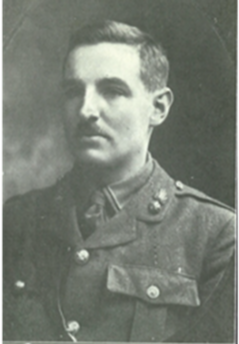
Lieut-Col BG Price DSO Ist Battalion Royal Fusiliers

Having been ‘Mentioned in Despatches’  (17/2/15), Bartholomew Price has now been ‘Promoted for Service in the Field’ and is transferring to take command of the 7th Battalion Warwickshire Regiment.

Bartholomew joined the Royal Fusiliers in 1892 and served in the Boer War, taking part in the Relief of Mafeking. He was awarded the DSO in 1901.

Bartholomew joined the OPS in its second year (1878). He is the son of the late Professor Bartholomew Price, Master of Pembroke College, one of the group of Oxford Resident Fellows who founded our school.

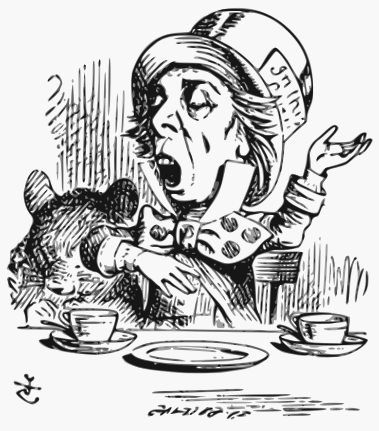
Professor Price is remembered as a teacher of Lewis Carroll (CL Dodgson) when he was an undergraduate studying Mathematics at Christ Church.

379px-MadlHatterByTenniel_svgCarroll referred to his teacher as ‘The Bat’ (‘Twinkle, twinkle Little Bat, How I wonder what you’re at’ as the Mad Hatter sang in ‘Alice’s Adventures in Wonderland’).


April 15th 1915

Ronnie Poulton’s first spell in the trenches has ended.

It may seem strange to read of it so Armentieres-North_Sea,_winter_1914-1915close to the enemy, but he has been playing rugger at Nieppe, near to where his battalion is at rest – a far cry from the new ground at Twickenham, which Ronnie graced when the first international was held there against Wales in 1910! (Even Twickenham – once a cabbage patch, incidentally – is part of the war effort, as I understand it is now being used for grazing for livestock).

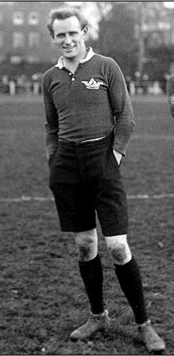
Wednesday 14th April. “I played Rugger for the South Midland Division (48th) against the 4th Division. It was an amusing game; we had opposite us players like WJ Tyrell (Ireland), HJS Morton (Cambridge & England), JG Keppell (Ireland Trials), WP Hinton (Ireland) and were refereed by Basil Maclear (Ireland). I had a goodish side, chiefly 5th Gloucesters and we won 14-0, but they stuck it well considering their condition. Several of the Liverpool Scottish came over from Ypres, including ‘Dum’ Cunningham and Dick Lloyd. It was splendid to see so many Rugger players about.

I changed in the room of the Captain of the 4th Divisional Staff. They live in great style, quite unnecessarily so I thought. In fact they rather bored me. They ought to do a turn in the trenches with us all.”

How extraordinary that Ronnie, England’s captain last season, should meet up with Dick Lloyd, his opposing captain for Ireland!

England & Ireland captains 1914

Ronnie Poulton with Dick Lloyd. Captains of the England & Ireland teams of 1914, taken in March 1914

* * * * * *

This cannot but bring back memories for many of us at the OPS of going to see Ronnie in the Varsity Match of 1909. GC Vassall (the editor of our school’s magazine) reported on the match:

RWPP Oxford2“This year’s Inter-Varsity match will always be remembered as Poulton’s match. After much discussion and a vast amount of ‘newspaper’ criticism (which means so little and produces so little effect, if ‘our special correspondents’ would only realise it), Poulton was given his Blue as a wing three-quarter and proceeded to silence his detractors by scoring 5 of the 9 tries in the record score which was piled up against the unhappy Cambridge team….  

Most of Poulton’s fielding was well done; he kept his position splendidly; his trick of holding the ball with both hands at the full extremity of his reach, his swaying for the feint, his masked pace, and his swerve fascinated everybody, and with it all he was rarely tackled.”

What happy times and sweet memories. We fervently hope that Ronnie and all those who contested the match at Nieppe return to give us more pleasure, nay excitement, when the war is over.


April 12th 1915

Training completed, but with still no real experience of being under fire, Ronnie Poulton’s company paraded on Saturday 10th April to take their turn in the trenches, intermingled, we understand, with companies of the Dublin Fusiliers. In his latest post Ronnie describes his first venture into ‘no-man’s-land’.

RWPP profileSaturday 10th April. “I carried a rifle and 15 rounds. We climbed through the wire and went a few yards forward and lay down, in the formation – Corporal and Officer together, and two men in rear, interval ten yards, distance from Officer about ten yards. They watched the rear and flank. I was lying for a quarter of an hour by a very decomposing cow! After listening hard we moved forward and again lay doggo. This went on for about an hour, during which time we were perhaps 100 to 150 yards out. Then we returned, each pair covering the other two.”   

Sunday 11th April. Trenches. “We all stood to arms at dawn, and the Germans started a tremendous fusillade, as is their custom. But soon after, all was quiet and you could see the smoke rising from the fires all down our line, and the German line.

About 11 a.m. our field guns put twelve shells on to the German trenches in front of us. Immediately the German guns opened on us, putting ten high explosive 6 in. shells and ‘White Hope’ shrapnel – their back-blast shrapnel. The result was 8 ft. of parapet blown down, another bit shaken down, one man with a dislocated shoulder of ours, and five men of the Dublins wounded, one seriously. As they were all within three yards of me, I was lucky. The brass head of a shell shot through the parapet, missed a man by an inch and went into a dug-out, where we obtained it.

The shelling is very frightening – the report, the nearing whistle and the burst and then you wonder if you are alive. Crouching under the parapet is all right for the high explosive, but for shrapnel it is no good, so that is why they mix them up. The men – the Dublins – were quite as frightened as we were as a rule, but some didn’t care a damn. Some were praying, some eating breakfast, one was counting his rosary and another next door was smoking a cigarette and cheering up our fellows. After a prolonged pause, we rose from our constrained position, and went on with our occupations; but it unnerved me for a bit.”

April 10th 1915

Ronnie Poulton is now in sight of the Front Line, at Romarin, two miles west of Ploegsteert (referred to asArmentieres-North_Sea,_winter_1914-1915 ‘Plug Street’ by Tommy). He is therefore only three miles behind the firing line.

Here are extracts from his journal entries for 8th/9th April:

Thursday 8th April. “About 9.30 p.m. my Company paraded for night digging. We marched to a point about 1,000 yards from the German lines and, as we came over the hill and down the avenue, we heard several stray bullets flying overhead. My Platoon was detailed to complete an all-round defence of a farm in the second line of the defences.

We got back safely about 3.00 a.m.”

Friday 9th April. “We were again paraded for night digging. This time it was to complete a breastwork between two of the actual British fire trenches, about 150 yards from the German lines. When we arrived at our rendezvous, the Engineer officer in charge said he could only take 50 of my 100 men, as the Germans were shelling and firing on the working parties.

We then proceeded down the road towards our object in fear and trembling, as it is covered by a German machine gun. On arrival at the reserve trenches of the firing line, I got my men into a communication trench and awaited orders. There was a lot of firing and shelling going on and finally he decided not to send out a party, which was a considerable relief to us.”

April 7th 1915

Ronnie Poulton’s Battalion has now moved on to Steenvoorde, the Brigade headquarters, where the troops were inspected by Sir Horace Smith-Dorrien (General i/c British 2nd Army),  who explained that they were to undergo further instruction before going up to the Front.

Ronnie’s journal tells of his other duties too.

RWPP profileSaturday 3rd April. “This day passed quietly with parades in the morning, spoilt by rain. The beautiful weather of the last few days seems to have broken up. We had several interesting talks with French soldiers who have just been relieved from the trenches. They were very cheery, but not very smart.

Franking the men’s letters is a great nuisance, though unavoidably one gets some interesting lights on their characters. The men were paid five francs this day.”

Easter Day was spent at Flêtre.

Monday 5th April. Flêtre. “The people round here in the farms are very much on the make. My French is coming on by leaps and bounds and I am doing my best to stop the fellows getting cheated. The food is very plentiful and good, but mostly tinned and biscuit; so they will buy bread at exorbitant prices.

It is much better fun than at Chelmsford because, though discipline is more strict in lots of ways and the punishments much more severe, the tone can be much more friendly with one’s men and it’s rather humorous to receive compliments unofficially by reading the men’s letters, as we have to censor them; and they are meant because the writers do not give their names and you only know that they come from the Company, but do not know which Platoon.”

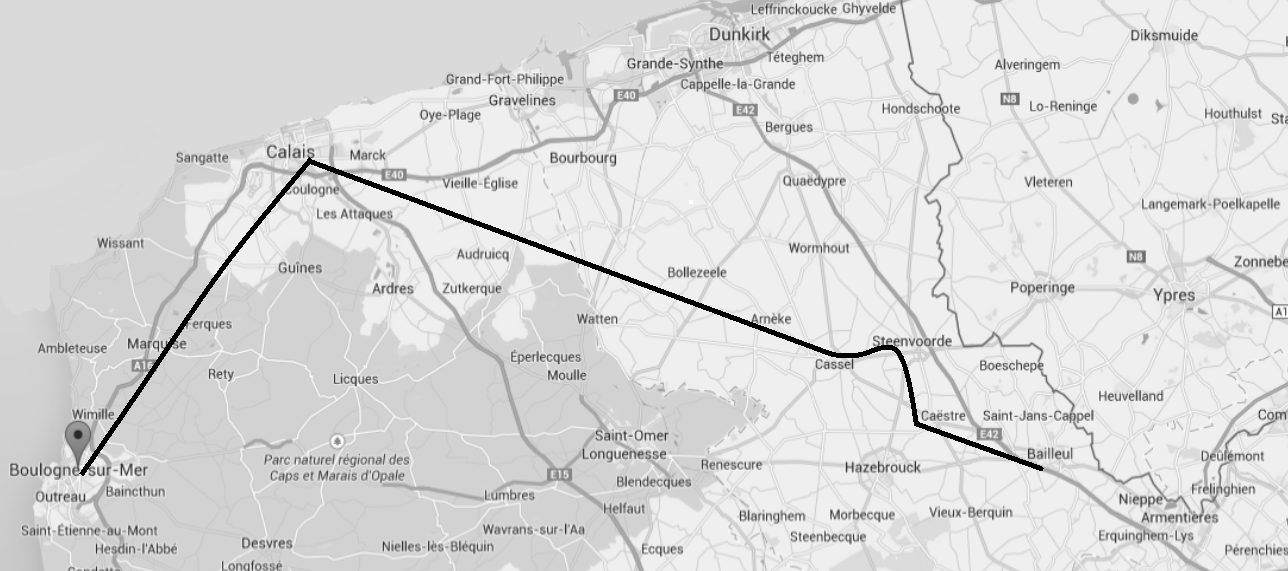
From Flêtre, Ronnie has now moved on to Bailleul and it cannot be long now before he reaches the Front.

Boulogne-Bailleul route

April 2nd 1915

Those who were at the OPS with Ronald Poulton will never forget the match we played (in 1902) against St. Edward’s School Oxford Juniors, in which he scored fifteen tries. Even then, aged 13, he was finding his way through opposition defences with a “regular rugby swerve”, as one member of our staff commented.

One of his more recent opponents is reported to have said, ‘How can anyone stop him when his head goes one way, his arms another, and his legs keep straight on?’ How indeed!

Now in France with the Royal Berkshire Regiment, he and his men are making their way towards the front line, marching from Cassel to Winnezeele (on the Ypres road). Here they were billeted for the night.

RWPP profileThursday 1st April. “The farms were found to be very comfortable, especially the one inhabited by my Platoon. The woman in charge supplied them with eggs, milk etc very cheaply and the barn they slept in had plenty of clean straw. They had a pond to wash in and a field to play football in so they were all right… I lived in the pub and was quite comfortable though the room and bed were very dirty.”

We look forward to hearing more news from Ronnie over the coming days.


April 1st 1915

England v France 1914

England v France, April 1914.

It is only a year ago that we were reading of England’s great victory at rugger over the French – now our allies – in a match that our dear old boy, Ronnie Poulton (now known as Ronald Poulton Palmer) captained the side to a 39-13 victory, scoring four tries himself – a record, surely, that will stand for a long time.

‘The Sphere’ reported the match in glowing terms, describing Ronnie as providing the moving spirit:

“It was a tremendously fast game, marred to some extent by roughness on the part of the French players, who do not yet seem to have learnt the true spirit in which to play the game. Poulton Palmer was again the moving spirit in the English attack and he has entirely confuted those critics who were for leaving him out of the English side this season on his poor showing in the trial games. Palmer is always worth playing in our international side as long as he is willing to do so, partly because of the fear he engenders in the opposition and partly because he is always likely to win a match off his own bat.”

‘The Field’ magazine commented that “Much has been said of his dodging, but his effectiveness has really lain more in his promptitude in discovering the right direction for his runs and the point at which he could best support his comrades.”

Ronnie is now a Lieutenant in the Royal Berkshire Regiment and we hope to follow his progress over the coming months and fervently hope that he will be returned to us safely when this war is over to resume his captaincy of the England team.

On crossing the Channel to go to the Front, he is keeping a journal and these are his first entries: 

RWPP profile

Lieut. RW Poulton Palmer


Tues 30th March. “We found ourselves boarding the ‘Onward’, the ordinary traffic steamer – Folkestone to Boulogne. I believe I crossed in it for the French match this time last year…

The embarkation was very well done, the men being quiet and orderly and our time of embarkation only just second to the Bucks, who easily beat the record for the port, which has seen 55,000 troops cross over. It was an eerie crossing, a full moon, a smooth sea, and a torpedo boat zigzagging about in front of us…

At Boulogne we disembarked and I found the Port Commandant was old Col. Eastwood of the Oxford OTC. We formed and marched up the hill to a camp. Here we fitted the men and got in ourselves and spent a very cold night (under canvas with only one blanket per man. They awoke to driving snow).”

Wed 31st March. “We marched off to the Pont des Briques , a matter of four miles. The men found the pack rode very heavy and two or three fell out. At the station the Battalion was divided into parties of 42 – each party to go in a goods van… There was a ghastly crush in the train, since we were one truck short and as many as 50 were in some. They could not sit down, but had to stand on the six hour journey. Off we went about 11pm and arrived at St. Omer via Calais; then on to Cassel which was our detraining point. A ghastly cold night and little sleep.”

March 29th 1915

Further to Nevile West’s news (see March 22nd), we have now heard from Jack Smyth (Lieut., 15th Sikhs) that he was also involved in the Battle at Neuve Chapelle.

Jack Smyth

Lieut. J. Smyth (15th Sikhs)

24/3/15. “We have just returned from Neuve Chapelle (the name has been mentioned so much in the papers lately that I don’t think the censor can object to my putting it in here). I left my A.D.C. job as we were transferred to another Brigade and I have been with the regiment since the 8th.

We did seven days in the captured German trenches, and they were about the best we have ever been in; they had been in them about three months and had made them very strong and comfortable and had done themselves pretty well too as the empty wine bottles and cigar boxes showed.

They must have lost very heavily indeed, as there were rows of dead bodies in front of our trench from when they made a counter attack to try and get the place back and came under the fire of our machine-guns.

It was a relief having the trenches a good way apart, so that we could have patrols out at night and sleep comparatively comfortably, instead of the jumpy nights when the trenches are 50 and 80 yards apart, as we have been having lately.

The first night we were there one of our (Indian) scouts jumped on to one of their scouts and sat on his head and yelled for help and he was brought in; he tried to make out that our people had stolen his pipe from his pack, but as tobacco is pollution to our people he was deemed a liar by everybody present.

We brought in three of their wounded, who must have been out there for five or six days. They seem very callous about that sort of thing and never made an effort to bring them in, although they were nearer their trenches than ours more than a good deal.

They bombarded us fairly hard with artillery every day but without much result. On the evening of the 12th we were reduced to 5 officers: the C.O., three Company Commanders and myself, the other Company being commanded by a Native Officer. But our Adjutant has come out and several others and we now have got 14.

The men are very fit and very bucked about the whole show, which is about the biggest knock the Germans have had up this way.”


March 26th 1915


 WG Fletcher - full

2nd Lieut. WG Fletcher (Royal Welch Fusiliers)

A seventh Old Dragon has perished in this war. George Fletcher was hit in the head by a sniper’s bullet on March 20th as he looked over the parapet of his trench.

Robin Laffan, who knew George all through the OPS, Eton and Balliol has written a heart-felt appreciation of his and our dear friend.

“The war has taken its cruel toll from a family universally beloved by all who know them. In August last, the three sons of Mr. CRL Fletcher flew to arms as a matter of course. Today Leslie, on board HMS Colossus, is the only one still with us. In November the tale of Regie’s splendid death (see November 2nd); and now the blow is renewed with the tidings of George’s similar end.

His letters from the trenches abound in the fun which kept himself and his men cheery in the midst of their hardships. Knowing his enemies, he had an intense admiration and even affection for them. Like a true patriot, he delighted in the different culture of foreign nations. Six months at Tilly’s and six months as a schoolmaster in Schwerin gave George a considerable knowledge of Germany and the Germans. He used to relieve the tedium of the trenches with friendly sarcasm shouted at the opposite lines. ‘It ain’t ‘arf a joke being in Lieut. Fletcher’s trench,’ said his men, ‘E talks to the b*****s in their own b****y language.’

Of George’s courage it is superfluous to say much. Readers of The Times will have seen how an officer described him as ‘the bravest man I ever saw.’ He was mentioned in despatches on Feb 18th and he was again recommended for distinction after his reckless feat of crawling through the German lines and recovering from a tree a captured French flag. By such deeds of daring he restored the jaded spirits of his men. But those who were lucky enough to see him in February, when at last he got his leave after six and a half months at the front, realised that the strain had told heavily on him. His light-hearted gallantry was not the result of mere animal vigour, but the triumph of spirit over bodily and mental exhaustion.”

He wrote and spoke of this desire, when in the trenches, to receive the Blessed Sacrament, of which he was able to partake at Christmas. Thinking of him as he leaves us, we feel the solid truth of the words:                                               

‘The men who drink the blood of God

Go gaily in the dark.’

RIP.”

News of George’s death was announced on page 4 of yesterday’s edition of the Times under the title of ‘An Eton Master’s Death’. Since his departure for the Front, his father, CRL Fletcher, a Fellow of Magdalen College, has been at Eton teaching his classes in his stead.

(George wrote most interesting letters which were published here on November 9th and November 23rd and he is mentioned on December 28th.)

March 22nd 1915

News has been received of the battle fought at Neuve Chapelle earlier this month. 2nd Lieut. Nevile West (Royal Berkshire Regiment) was involved.

Nevile West

Nevile West

Neuve Chapelle, 19/3/15. “I think I may tell you, now that it is all over for the present, that our Regiment and my Company led the attack on Neuve Chapelle, which you have probably read much about. The attack was dated for last Wednesday, March 10th, and the night before I was detailed by the Brigade to take a party out to remove all the wire in front of our trenches, the Germans being about 100 yards away, at the time a most precarious game, as they heard us working at it and cutting, and so sent up magnesium flares and opened fire on us. Fortunately none of us was hit.

The attack commenced the following morning with half-an-hour’s terrific bombardment of the Hun trenches, which, being so close, proved a terrible ordeal for us sitting cramped in the wet trenches, several shells pitching short in amongst us; anyway it blew all their barbed wire entanglements away, and their trenches and themselves to blazes.

When the half-hour was over, we advanced, the only opposition being a machine gun which did for several. The Hun trenches were a terrible sight when we got there, masses of horribly mangled remains, and the whole air full of picric acid fumes from the lyddite shells. The front line (ours) went straight across the three lines of their trenches, and proceeded as far as the near side of the village, when we started entrenching ourselves under heavy enfilade fire, shrapnel and high explosive shells included.

This was due to the attack on our left primarily failing; their second go cleared the situation, however. Another regiment then passed through us, took the village, and established a line a few hundred yards on the further side. The Indian Division was on our right, and they were too impetuous, and receiving less opposition, got too far ahead, and had to be brought back a bit. Prisoners and wounded were streaming down the road from Neuve Chapelle to our Aid Posts all day.

It was a terrible day, horrible sights. May it be a long time before I see such another, and when quiet came not with darkness, but about midnight, one’s nerves were all over the place. During the actual proceedings one has little time to think. The next day was quieter, the Huns shelled us continuously, but not so vigorously. My skipper was wounded, while next to me, by a shrapnel shell bursting overhead; and therefore left me in command of the Company, as I am still; being alone like that, at such a crisis, a horrible feeling of loneliness came over me, and does come now.

The next morning (Friday) the Huns made a counter-attack on our position, shouting in pure English, ‘Don’t shoot, we are the H.L.I,’ and as that regiment was on our right, and slightly in advance, we were at first taken in, but when it was discovered that it was the Huns advancing, rapid fire was opened, and the ground in front of our trenches now is heaped with their dead, and those that were wounded crawled into our lines. We cannot bury them, so must leave them there to rot; won’t it be terrible if the weather gets really warm, and the sun hot?

That same morning, the Huns, having failed in their counter-attack, bombarded our trenches and the village furiously for an hour, and God alone knows how we lived through it, the bits of shell and the fumes were horrible; it is impossible to get away from either, and I saw two men blown quite 30 feet in the air.

Their bombardment lulled at about 10.30, and at 11.00 we started bombarding their trenches preparatory to attacking again. We could see the wretched Huns flying for all they were worth. A and C Companies were then in support to the Rifle Brigade. When our bombardment ceased, the R.B’s got out of the trenches, and began to attack; they fortunately hadn’t gone far before (I should think) about 12 German machine guns opened fire, and God knows how any of them escaped; I was right in the open at the time and it was hell. Those that remained crawled back at dusk. A great friend of mine who was in the 1st Battalion with me was riddled with bullets, and killed instantly.

A bullet hit my camera which was in my coat pocket, and just turned its course enough. Otherwise, ‘I shouldn’t have gone no further.’ My luck has been extraordinary; may it long continue so. We have just been sent two more 2nd Lieutenants. Apart from that we have only five Officers left.

Well, such is my news, but you will learn more about it from the papers, as they get the operations taken as a whole. The Huns lost terribly, and I fear we did also, although with the modern machines of war, one can expect nothing else. It is terrible, real hell on earth.”