February 12th 1917

Capt. Rupert Lee (Worcesters) was a most welcome visitor and the boys much enjoyed the exhibition of conjuring he gave. He had learnt his tricks from a native in India.

Rupert gave us some excellent photographs, looted from the German Consulate (!) and has written an article for the next edition of our magazine on his time in Mesopotamia, of which this is a part:

“An extraordinary affair occurred in our Mess in Busra just before I left; we all had native servants and it was customary to put the most reliable in charge of the whole; this man incurred the lasting hatred of one of the other servants (of another religion) through accusing him of the theft of a tin of stewed fruit.

So one day, when the butler went out to the town to see some of his friends, this other man came to me and asked to be allowed out. On my giving him permission, he proceeded to steal a bottle of whisky: and fortified by it, took one of our revolvers and sallied forth intent on the slaughter of his enemy.

He explained to me afterwards that a natural delicacy forbade him carrying out this business in our quarters, where he could have met him any day.

We captured him after all his ammunition (about 20 rounds) was expended and he was locked up. His subsequent examination was really very amusing, if one could forget the tragic side; he explained the whole thing in detail, regretting that these men were killed, but of course that was their fault for getting in the way.

What he was really most sorry about was that he failed to kill the butler and made a petition that he might be allowed to do so before being hanged.

I tried to get a plea of insanity brought forward, but the man himself would not hear of it and from his behaviour after the event it would never have gone through.

Things like this brought before us very vividly the fact that we were living on the edge of a precipice.”
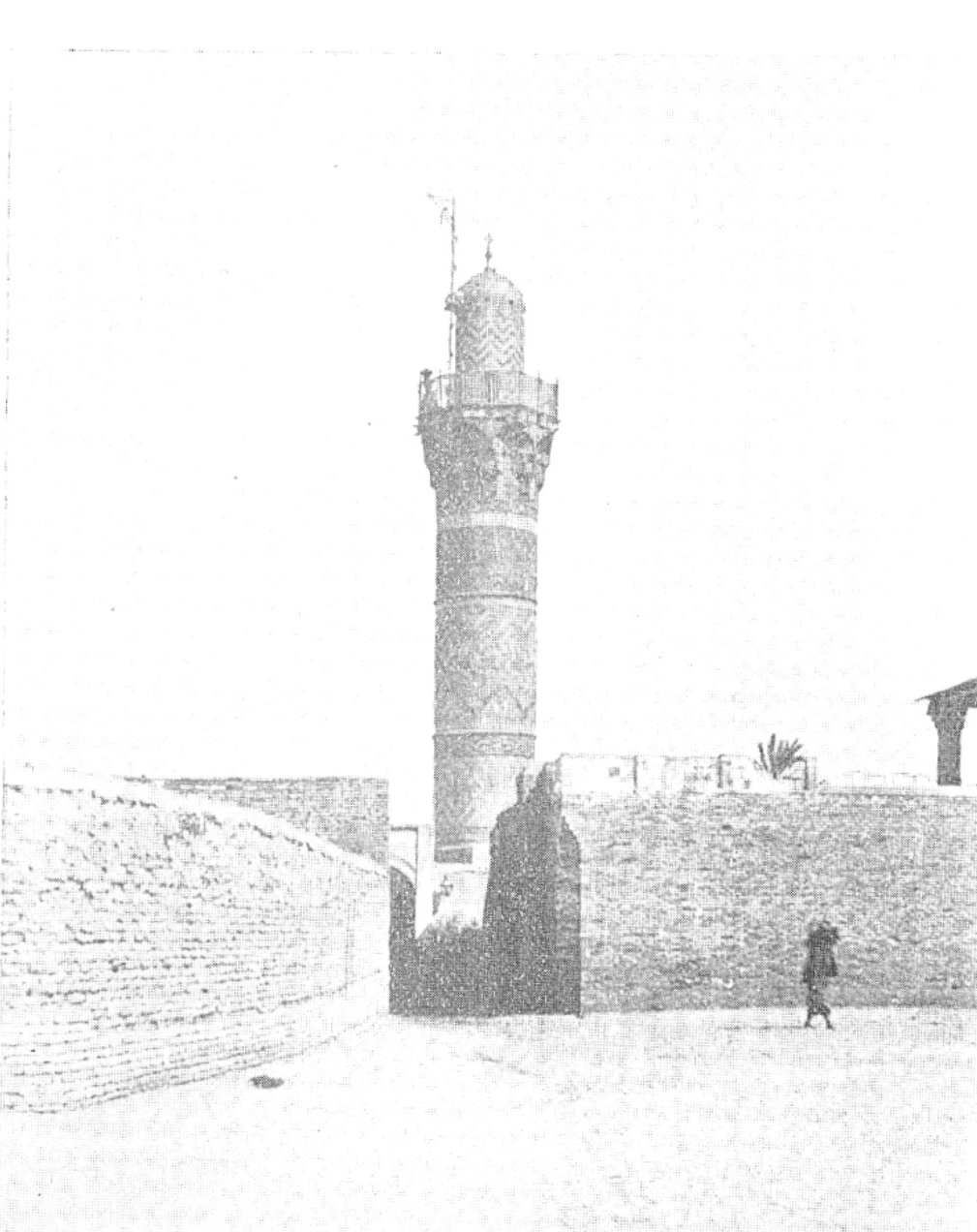
The Minaret at Busra

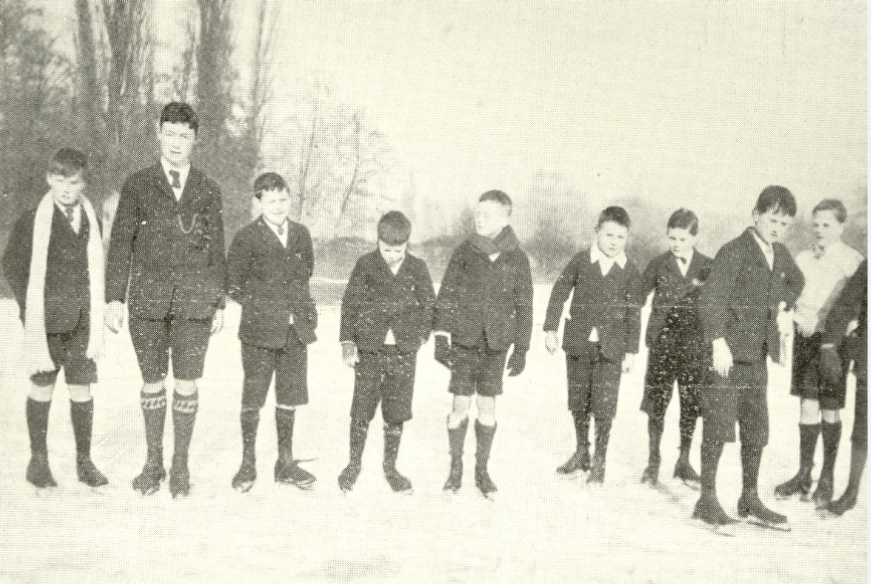
 

February 3rd 1917

ice-skating-2

Our attempts to keep the field clear for the boys to pay hockey have failed, but this cold spell of weather provides other opportunities too good to be missed!  Mr Haynes has found about 30 pairs of serviceable skates (rather primeval – but they will do).

We are taking some time off from our lessons to make the best of it whilst the conditions last. I have arranged with the University Skating Club that we use Long Meadow (by the Cherwell opposite Christ Church meadow).

ice-skating-1

As you can see, the boys were a bit tentative to start off, but they soon got the hang of it. You don’t get anywhere without falling over a few times.

ice-skating-4

The spills are all part of the fun!


January 28th 1917

The 2/4th Oxfordshire & Buckinghamshire Light Infantry were deployed to France towards the end of May last year and with it a number of Old Dragons.

2nd Lieut. Walter Moberly was an early casualty, wounded on a reconnaissance up to the German wire (in daylight). Only with great difficulty was he able to make it back to our lines.

Capt. Douglas Rose, who returned home wounded in July, kindly wrote to us shortly afterwards with a full description of how he was hit. Happily his brother, Capt Geoffrey Rose is still going strong.

We are delighted to hear from Lieut. Sholto Marcon, who performed on some pretty muddy hockey pitches in his time (Oxford XI 1910-13 and English International), but nothing compared to what he is currently experiencing:

marcon-csw16.1.17. “For the last two months we have been in mudland and about that spot north and south of which you can see in the daily paper, there is generally shelling going on…

Dec. 25th found us in (the trenches) less than a week. No fraternising of course took place, though a Hun, bored to distraction with the war in general, came to see us at HQ that day. A fine fellow, and, considering all things, most astoundingly clean!

One experience I suffered: I had to be dug out of the mud one night, and not till one has suffered this experience can one realise that it is possible for people to get drowned in the mud. We had gone out to lay a line, and about 20 yards from HQ I stepped into a mud patch, and there I had to stay till a duckboard and a spade were brought, and my leg was dug up, as you would dig up a plant.

The men stick the mud and weather conditions generally in splendid style, and are real bricks in all they do.

They had their Christmas Dinner on Jan. 4th, as they were well ‘back’ by then and with the help of the eatables kindly sent out by a Committee in Oxford, and supplemented by purchases from Canteens out here, everything was ‘tra bon.’

In the evening the Sergeants had a dinner on their own and seemed very cheery when we looked in half way through the proceedings.”


January 25th 1917

mnd-cast

Midsummer Night’s Dream

As is our custom, the term started last week with our annual Shakespeare play. We gave four performances of Midsummer Night’s Dream. The first was to an audience of teachers, boys and girls, from some of the Oxford Elementary Schools – an audience of about 350. Letters subsequently received showed that it was greatly appreciated and that Puck was specially popular.

The second performance was enjoyed by about 120 wounded soldiers, who were afterwards entertained to tea. On Saturday there were the usual afternoon and evening performances for parents and friends.

“It was indeed a welcome boon that the Dragons gave us this year,” wrote one of our reviewers, “to transport us for three hours’ space away from the sorrows and difficulties of this unintelligible war to the flowers and forest glades of Shakespeare’s Warwickshire…

While we were waiting for the play to begin, it was sad to notice the absence of ODs among the audience, and sadder still to reflect how many of them had consummated the great sacrifice for their country. Indeed Dragons, if any, will fully understand the meaning of the line –

‘We must be free or die, who speak the tongue
That Shakespeare spake.’

Many of the ODs now in the trenches were doubtless present with us in spirit that night and not only the writer of the noble prologue, which touched eloquently on the thought we all were feeling…”

The writer of “noble prologue” was Lieut. Hugh Sidgwick (RGA), whilst in a dug-out in France, and his words were delivered by Oberon:

Prologue
Think it not strange that at this hour, in a world of waste and wrath,
I come to lead your thoughts away by a wandering woodland path,
Far from the scarred terrain of war and the perilous haunted seas,
To the moonlight on the forest and the glimmer between the trees –
To light your steps in the murk and gloom by fancy’s fitful gleam,
From the dark, substantial winter day to a Midsummer Night’s Dream.

Not strange – they would not think it, our brother Dragons who stand
In the line in France or Flanders, on the deck or the desert sand.
They would not grudge our revels, or wonder that today
We come to enact before you the loveliest English play.
For all the cause they fight for, the things they hold most dear,
England, and Home, and Beauty – will you not find them here?

Hugh’s brother, Frank Sidgwick, also contributed a review to the ‘Draconian.’

“I needn’t tell ODs that everybody was word perfect. I think Theseus twice said: ‘For aye to be in a shady cloister mewed,’ and Lysander gobbed a difficult line in the afternoon, but got it right at night; the accents on ‘persever,’ ‘revenue,’ ‘edict,’ etc., were correctly given; and I think I heard ‘prehaps’ instead of ‘perhaps’ once or twice…”

One or two other faults were also noticed:

“Some of the actors were too fond of nodding and smiling at their friends in the audience. One of the characters, supposed to be lying asleep, actually clapped his hands in applause of a song by Puck!”

Ah well, we do not pretend to be prefect.


January 20th 1917

Today’s Daily Telegraph, I note, records on their Roll of Honour, the death of 2nd Lieut. Wallace Hardman, alongside five others from the Manchester Regiment. From articles over the past week it has become clear that he was killed in the engagement that took place on January 9th at Mahammed Abdul Hassan, north of Kut.

The Hardman and Mallalieu cousins are bearing up well in the face of the news, as we settle into a new term – the eighth of the war thus far.

Young Percival Mallalieu (aged 8 and in Form 1a), remembers being with his Aunt Minnie (Wallace’s mother) last autumn on a walk that took them past her local Post Office, when someone came out with a telegram. She must have feared the worst, but as it transpired it was only to give her the news that Laurie (her third son) had arrived safely back at Bedford School.

“Auntie Minnie held the message so that we could see it; but her hand was shaking so much that we could not read it.” Percival recalled.

The telegram she so feared at that moment was the one she received a week ago, on January 13th:

hardman-telegram


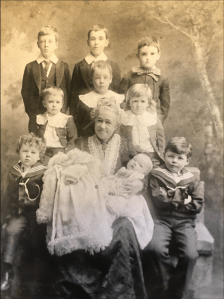
I am very grateful to the Hardman family for this most charming picture of their grandmother with ten of her grandchildren, taken in 1902. Three of them have now given their lives and four others are serving officers.

hardman-grandchildren

The older boys in the back row are David Westcott Brown (killed), Maurice Campbell (Lieut., RAMC) and Percy Campbell (killed).

The middle row shows Pat Campbell (2nd Lieut., RFA) Hugh Brown (Capt., Bedfordshires and recently wounded) and Geoffrey Brown.

With their grandmother in the front row are Donald Hardman (Artists Rifles for RFC) and Wallace Hardman (killed).

How can anyone look at such a picture without shedding a tear?

January 16th 1917

hardman

2nd Lieut. Wallace Hardman (13th Manchester Regiment)

The term could not have a worse start than to coincide with the death of another gallant Old Dragon. That it should be another member of the Hardman family, who have already lost two cousins (Percy Campbell & David Westcott Brown), is an even greater tragedy.

Indeed, five of Wallace’s cousins are current pupils, who will return for the beginning of the new term tomorrow, their hearts heavy with this news.

Although Wallace was commissioned into the 13th Battalion of the Manchester Regiment in March 1915, he was then attached to the 1st Battalion, which was deployed to Mesopotamia in January 1916.

Wallace joined his Battalion on August 28th 1916 to be part of the new British offensive on Kut, which started last month under Lieutenant-General Sir Stanley Maude. Thus his active service amounted to less than five months.

Wallace’s mother received the news of his death on the 13th. Since then Wallace’s servant has written with the details of how he died:

“On the 9th of January, early in the morning, he and some of his brother officers took part in an attack against the Turks. A native regiment ran away and Wallace went after them and forced them to return…

Later on, while going along the trench, seeing that all of his Lewis guns were ready, the word came for the attack. One of the gunners, a small man, could not lift his gun over the parapet; Lieut. Hardman lifted it for him and was shot dead in doing so.”

The letter from his Commanding Officer shows the great esteem in which he was held by his fellow officers:

“Your son was shot through the head and died instantaneously, while gallantly leading his men in an attack on January 9th.

His conduct during the attack in its earlier stages was so gallant that I intend particularly to mention his name when the next despatches are sent in as, in conjunction with several others, he succeeded in saving what at one time looked like a very dangerous situation.

Your son was one of my best officers  and was beloved by us all and I cannot tell you how we miss him.”


Wallace was the first son of an Old Dragon to come to the OPS, when he arrived aged 9 in 1906. I recall that, at his father’s request, I allowed the school an extra half-holiday in honour of the occasion.

January 13th 1917

1917-easter-p-2075-pilkington-a-h

Arthur Pilkington (OPS master & bursar 1890-1906)

Yesterday, I attended the burial of my old friend Pilk in the St. Cross, Holywell cemetery.

Pilk was a month younger than me and we have known each other man and boy for forty-four years. We entered King William’s College on the Isle of Man at the same time and what scrapes we got into and out of! (Perhaps it is as well to draw a veil!)

I was delighted when I was able to persuade him to join the OPS staff from St. Edward’s School in 1890. As a schoolmaster, he was first-rate both as a teacher of the classics and as a sportsman.

However, it was his offer to take over the running of the financial side that importantly ensured a successful move was made from Crick Road to our current location on the Bardwell Road. His work ensured that the £4,000 required for the new hall, classrooms and ‘The Lodge’ was raised.

I was much relieved not to have to deal with school bills. I am being always reminded of the occasion when I took them and the school reports off at the end of a Summer Term to complete whilst on my boat, ‘The Blue Dragon’. Unfortunately they all got washed overboard in a storm. My solution was to send the parents a letter saying, “Your boy is doing splendidly. Please pay what you think you owe.”

There may also have been some truth in the story that I occasionally borrowed off one member of staff to pay another. Anyhow, Pilk’s more conventional methods proved much more satisfactory all round.

In 1906 Pilk left the OPS, seeing the prospect of doing even better. He set up a first-rate coaching business further up Bardwell Road. He had Germans, Frenchmen and Poles, all of the best class, who were going in for various Oxford exams. (It is a curious fact that in this war one of his French pupils took prisoner one of his German pupils).

Around this time the younger of his two daughters (Madge) – the apple of his eye – died after a long illness and this was a terrible blow to his affectionate heart.

Just before the war broke out, his foreigners all left – they were chiefly German then – and he was offered and accepted a classical mastership at Cheltenham College where he was, as usual, successful and popular, until, at the middle of last term, he broke down. Then came the tragic and mysterious end.

He was last seen on 1st December. His body was found on 3rd January; he had drowned in the sea that washes the shores of his old school on the Isle of Man.

He was a splendid specimen of the best Irish type, boyish, mercurial, a capital raconteur, humorous and most lovable.

One and all are most grieved that our old friend has ‘gone west.’


January 10th 1917

It is most gratifying to hear from 2nd Lieut. Humphrey Arden (RGA) that our school magazine is giving pleasure:

arden6/1/17. “Thanks so much for ‘Draconians’; they are more interesting to anyone out here than all the Maudes, Bellocs or Churchills and other experts, from the War side alone, and of course one can’t do without the School news.

I was lucky enough to get home for Christmas, but the journey back counteracted all the rest I had had, chiefly owing to the accidental blocking of a port and the lack of accommodation at the one substituted. And anyhow 15 hours in a French 3rd class carriage with no facilities for food or warmth left me feeling like a piece of wet blotting paper…”

Humphrey’s letter goes on to give a most interesting explanation as to the capabilities of the artillery, which are clearly not as great as the infantry might like.

“Those who are not gunners mostly have two delusions and if the same men rise to command without having learnt better, silly things will happen – but of that more presently.

The two delusions are (i) that, when a gun is laid in such a way that the shell hits a particular spot, it will hit the same spot if it is laid in a similar way. With regards to the first, it is only necessary to remember that gunnery is a mechanical science and not a game of skill. Experts find out the laws of the science and the Royal Regiment follows the law. The personal element practically does not, or should not come into it.

With regard to (ii), it would take too long to explain the ‘error of the gun.’ But it is a fact that if a gun is laid in exactly the same way for a hundred rounds, the shells will cover an oblong some hundreds of yards long and several yards wide. This ‘zone’ varies according to the gun and the range – any gun being much more accurate for line than it is for range. Take an example. 

Some months ago a cunning man thought unto himself a scheme. ‘We will bombard a piece of trench,’ said he, ‘and start at the outside ends together, gradually working in to the centre. The Boche will be forced to crowd in and finally will have to jump out of the trench and run for his life. Whereupon the Field and the Heavies (60 pdrs) shall slay him.’

Well, a Siege Battery was allotted some 200 rounds for the job and the trench selected was at right-angles to the line of fire, i.e the shells would have to drop at precisely the same range to a yard every time to hit the trench.

The Battery Commander calculated that 5 of the 200 might fall in the trench. That is to say. with the most perfect laying, ammunition and weather conditions, the gun itself could not put more than 2½ % of rounds in exactly the same spot at that range, and of course the ammunition, wind, temperature, barometer etc. never are perfect. So the Battery Commander did pretty well to get 3 of the 200 in the trench.

The Field and the Heavies waited in vain, or realising the fatuousness  of the whole proceedings, did not wait at all.

You must excuse this didactic letter. So few think it worth while to understand guns, whereas really they are the most interesting things in the War.”

January 5th 1917

Not all our correspondents focus entirely on the War. Some, such as Lieut. Alan Jenks (RE), like to recall their schooldays  –  and playground warfare:

jenks-arc24.12.16 “I remember Martin Collier quite distinctly, also Jack Haldane. When engaged in tactical skirmishes with the latter, my motto used to be ‘he who fights and runs away will live,’ a motto which I have faithfully pursued (so far) through life. If I am caught, it will be through not running away fast enough…”

(I think Leslie Grundy with his water-pistol was equally guilty of getting the vast but clumsy Jack into such a state that he uprooted a sapling to attack his tormentor with wild swipes of trunk and root.)

“As for France and Flanders, which is where I am (Censor Volens, or words to that effect) – well, one’s chief impression is mud and water. I learnt at Lynam’s or elsewhere that water flowed downhill. France is the exception. No well-behaved water does it here. It just stays.

As for work, generally one digs a trench or ditch in peace-time in order to drain a field. Here one has to try to drain the trench into the field. That is what sappers are endeavouring to do here. Action and reaction being equal and opposite, result nil. The only feasible method is to use language so warm that the water boils and so evaporates. This is only a temporary expedient however.

Very best wishes for the School and Staff.” 

December 31st 1916

With 1916 drawing to a close, we look back on the terrible loss of life we have endured and remember in particular the nine Old Dragons who were killed in the four and a half months that comprised the battle on the Somme:

July 1st.

clarke-s1

Geoffrey Clarke (2nd Lieut. Rifle Brigade). Aged 33.

ruttledge-s2

John Ruttledge (Capt. West Yorks Regiment). Aged 21.

July 6th

counsell-s3

Christopher Counsell (Lieut. Hampshire Regiment). Aged 26.

July 7th

gibson-s4

Robert Gibson (Lieut. South Staffs Regiment). Aged 21.

July 14th

brown-s5

David Westcott Brown (Capt. Leicestershire Regiment). Aged 23.

July 27th

burton-s6

Paddy Burton (Temporary Capt., 4th Bedfordshires). Aged 23.

August 22nd

benham-s7

Frank Benham (Captain, RFA). Aged 30.

October 7th

blencowe-s8

Oswald Blencowe (2nd Lieut., Ox & Bucks Light Infantry). Aged 26.

October 10th

raikes-s9

John Raikes (2nd Lieut. Essex Regiment). Aged 20.

All these families have suffered tragic losses and Claude Burton, Paddy’s father, a regular contributor of verse to the ‘Daily Mail’ under the pseudonym of ‘Touchstone,’ has put into words most poignantly the feelings of sacrifice and pain experienced by parents:

Killed in Action
The world seems full of you, now you are gone.
You were, of all these dear familiar things,
Part of our daily life that still drags on
And still around small, trivial objects clings
The sweet and subtle fragrance that is you,
Half balm, half torture to the stricken heart 
That knows high courage is a hero's due - 
That we, like you, must strive to bear our part.

Though the blood drip unseen from wounds within
That even length of years must leave unhealed - 
You bid us conquer pain that we may win
To that high goal your passing has revealed.
You gave your life, and if we too must give
Our very flesh and blood - a sacrifice
That that great cause that claimed you still might live;
Surely the gift is fitting in God's eyes.

Somewhere beyond the range of mortal sight
We know you strive as nobly as of yore,
A soldier still amidst the Hosts of Light;
Though we may see your well-loved face no more.
Oh! Pity us if from these realms unknown
Your eyes look down upon our mortal pain
And plead for us before your Captain's throne
That we may reach those heights you died to gain.