September 21st 1918

C H R I S T M A S   T E R M   1 9 1 8

Yesterday we started the new school year with numbers standing at 170, including 15 girls. Hopefully everyone has returned as refreshed as I am from a break with school life.

Having failed to include them on these pages before, I would like to draw attention to some things I said on Prize Day in July:

“I have long looked forward to having Hum as a recognised partner in the Headmastership of the School, and that I am pressing for a scheme to carry this out; there are difficulties, chiefly the fact that the School is not exactly my own financially! But I expect there is a way out.

I have enjoyed taking a larger share in the teaching than I have done for a good many years, but I was 60 a few weeks ago, and alas as the years glide by one cannot expect to maintain the vigour and resources of even middle age and one is happily not not yet senile enough to imagine oneself as efficient as one should be in running a great school like this.

Parents have been uniformly kind and helpful both to Hum and myself in the changes we have made. The changes have been all to the good and all the good traditions of the Boarders have been maintained. Self-reliance, freedom, absence of unmeaning convention, originality of character, all these have been fostered, the almost unique (in Preparatory Schools) encouragement of parents to see as much of their children as possible during term time and so to keep the home tie strong, this tradition of our school has been carried on – hospitality to Old Boys and parents, another traditional feature, has been maintained as far as and even further than rations will allow.”

In particular, we look forward to welcoming our Old Boys back – indeed a visit is expected shortly from Fluff Taylor – now a Brigadier-General in charge of 93rd Brigade – no doubt ordering me to grant the boys an extra ‘half-day’!


September 19th 1918

I mentioned on last term’s Prize Day that two of our staff had fallen victims to one another’s charms and on September 17th, as reported in the papers, they were happily married!

* * * * * * *

Roland Sturt

This is not the only piece of good news. Roland Sturt, who left us last year to go to St. Edward’s School, gallantly saved a child from drowning in the summer holidays and has been presented with the Royal Humane Society’s Certificate.

We are proud of him, as no doubt his parents are. I would like to take this opportunity also to recognise the considerable contribution his mother has made to the life of the school. I think we have been more than fortunate in having such an enthusiastic and able teacher of drawing and painting as Mrs Sturt. Some people think that unless a boy has a special talent for drawing it is of no use for him to learn. I don’t agree. Drawing is a school subject here and I believe a most useful one. There are very few boys who under proper training can get no pleasure or use from drawing lessons.

September 16th 1918

With the new term starting on September 20th, we are now into the final week of the summer holiday.

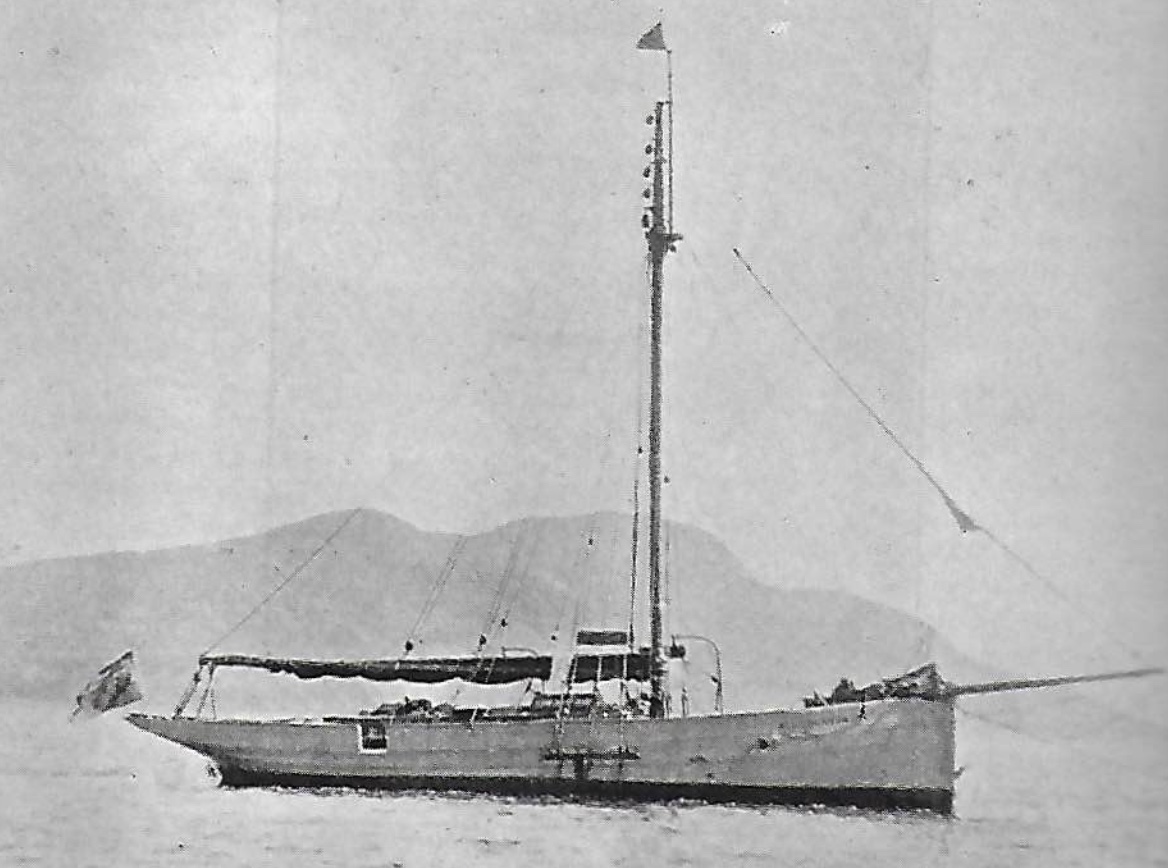
No doubt we will all reassemble with many new stories to tell – in my case that of finding a new boat!

The future ‘Blue Dragon III’ is at present the ‘Onnie’ 12.6 reg. tonnage cutter, 42 ft. overall length, 11 ft. 4 in. beam, 5 ft. 6 in. draught. She is in dock at Burnham-on-Crouch in Essex, and is almost a duplicate of ‘Blue Dragon II‘ which I had to sell in 1916, as she was derelict in the Christiania fiord.

Blue Dragon III

I spent six weeks on board the ‘Onnie’ in the summer, cruising up and down 17 miles of the Crouch estuary. The place has its charm, but one longed ‘to beat the open seas.’ The tide was very strong at Burnham, and it requires some care to navigate a big boat amongst the hundreds of vessels of all sorts that throng the narrow estuary.

We got on the mudbanks several times, had one capital sail carrying away the leach of the mainsail, had grand displays of search-lights, aeroplane machine-gun practice, anti-aircraft barrage, and once got overhauled by a Motor Launch for landing against regulations.

It was the first time since 1914 that I had been afloat and it made me long for more unrestricted sailing which Peace must eventually bring.

September 12th 1918

Capt. Geoffrey Buck (RAF)

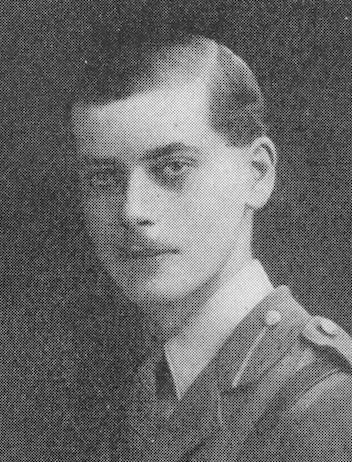
Geoff Buck has been killed returning from a night raid on September 3rd. He was with No. 215 Squadron, flying Handley-Page bombers capable of long flights into Germany. As Flight Commandant he was responsible for five aircraft and crew.

He crashed his plane into a high petrol tank building in the black darkness, and that was the end. He once said that very few people knew how hard it was to keep every nerve strained and the brain working its utmost for five hours on end.

In August 1917 Geoff was awarded a richly deserved Military Cross:

“He has taken part in many offensive patrols and had led seventeen, frequently attacking hostile troops on the ground. He has also successfully attacked and destroyed hostile aircraft on several occasions, setting a fine example of dash and determination.” (London Gazette, August 1917).

He has recently been awarded the DFC, although the citation has yet to be published.

Geoff Buck had joined the Royal Fusiliers in 1914, aged 17, and served in the trenches. In 1916 he transferred to the RFC, writing us some interesting letters about his training and early experiences as a pilot.

He had no fear of death; he wrote from France earlier this year saying that “Life has been so topping that I don’t mind how short life is.”


Geoff was a great reader, mostly of philosophy, psychology, history and good novels (both modern and standard), and had keen artistic perception. In fact, there was no good thing that he came across in his short life which he did not appreciate and enjoy.


September 6th 1918

Whilst everyone’s attention is fixed on the exciting developments on the Western Front, letters continue to come in from Old Dragons in more distant parts of the world. For the first time we have received a letter from the New World.

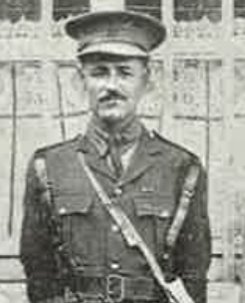
Capt. Sholto Marcon (OBLI), having been given “6 months’ rest,” has spent the last two months of them in America, attached to a Military Mission.

The Deming Club, Camp Cody, Deming, New Mexico. (British Mission).

21/8/18.

“I got glimpses of Halifax, New York and Washington on my way here – and of course saw a good deal of the east, south and south-west on my actual journey to this out-of-the-way spot, ‘Wild and Woolly Cody.’

This is certainly some spot, and I have made the acquaintance of such friends as sandstorms, ‘dust devils,’ yucca and cactus plants, tarantulas, horned toads, jack rabbits, ‘children of the earth‘ (insects which some of the natives say have human faces, and which they fear considerably), turkey buzzardsgophers, prairie dogs, (similar to squirrels – living in communities in the sand), and locusts. Rattlesnakes and centipedes, though quite numerous in this area, I have not yet seen…”

Sholto has taken the opportunity to explore the area extensively.

“Many Indian tribes have made their home in the State in the past and even now, of course, there are many Indian Reservations and Pueblo Indian dwellings. The Apache and Navajo were most common, and one can get many blankets, mats etc made by the latter.

We hear great tales of Geronimo, who must have been a wonderful leader in his way (according to ‘old-timers’ who, if one can get them to talk, prove most interesting historians)…”

September 2nd 1918

Lieut. Follett Holt (OBLI/Tank Corps)

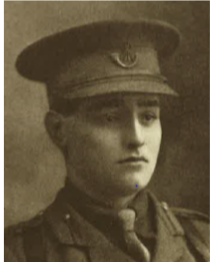
The recent advances made on the Western Front were bound to be at a price and it is with sadness that I have to report Follett’s death on August 22nd near Bray-on-Somme in the battle to re-take Albert.

Follett served in France with the 6th Battalion, Oxfordshire and Buckinghamshire Light Infantry (the same unit as Oswald Blencowe, who died on the Somme in 1916), but since June he has been attached to the 4th Tank Carrier Company.

His captain wrote most generously of the love both officers and men had for him and how he died a gallant Englishman:

“On the 22nd we went forward in the attack just north of Bray and it fell to Follett’s lot to carry up some much needed supplies to the infantry under a devastating barrage…

He never hesitated but pressed forward to his objective, and the last I saw of them they were moving forward to the enemy lines. Unfortunately, a direct hit from a shell knocked them out before they arrived at their destination…

His corporal rushed up to him and found him dead along with one of his men, three others being wounded in the same tank.” 

Despite the circumstances, it is very much hoped that Follett will receive a proper burial:

“We made several efforts during the day to reach the tank which was in the enemy lines, and at last I succeeded in getting to it yesterday morning when I saw Follett’s remains, but was unable to remove his body owing to very heavy shelling. However, the news tonight is that the Boche has been pressed further back, and I hope by daylight tomorrow to be able to get to the tank and bury him.”

As a young Dragon, Follett’s gentle, affectionate nature won him many friends amongst us, and his love of home was a guiding factor in his life.


The German successes earlier in the year have been dramatically reversed and since August 8th and the advances made in the Battle of Amiens it really seems possible that the tide may have turned.

Daily Telegraph, September 2nd 1918


August 28th 1918

In addition to the Military Crosses won recently by Jim MacLean, Pat Campbell and Philip Frere, we must record the honours gained over recent months by eight other Old Dragons.

Bar to DSO

Lt.-Col. JGP Romanes (Royal Scots): “For conspicuous gallantry and devotion to duty. He commanded his battalion with great skill and courage in a night attack. Under his leadership the battalion captured all its objectives without check, inflicted heavy casualties on the enemy, captured over 50 prisoners, and consolidated all the ground won under intense shell fire.” (London Gazette 26/8/18).

DSO

Capt. EH Evans (Royal Welch Fusiliers): “For conspicuous gallantry and devotion to duty during an attack. He showed great skill in consolidating and organising against counter-attack. He moved about the firing line continuously encouraging the men and organising the defences.” (London Gazette 18/8/18).

Maj. EHW Williams (Hussars): “For conspicuous gallantry and devotion to duty. He led a mounted charge along a hostile line, after the infantry line had broken back, taking the line in flank, and in the face of the heaviest machine-gun fire, he carried out the manoeuvre successfully, sabring nearly 100 of the enemy, and taking 100 prisoners, although his own troop was only 150. His fine action rallied the infantry, who advanced and recovered over 3,000 yards in depth of the whole line.” (London Gazette 26/7/18).

2nd Bar to MC

Capt. CM Hughes Games (Gloucs). “For conspicuous gallantry and devotion to duty. Whilst in command of the support company of the battalion he displayed wonderful energy and determination in checking the enemy advance, which had broken into our front line. He formed a block and organised its defence with machine-guns until badly wounded by a sniper. His example of courageous coolness was responsible for holding the hostile advance, and gave his battalion time to reorganise and take up a new defensive position.” (London Gazette 18/7/18).

MC

Capt. GC Drinkwater (RFA). (London Gazette 16/1/18).

Capt. RJK Mott (Special List). (London Gazette 3/6/18).

Lieut. DEI Innes (RE). (London Gazette 3/6/18).

Capt. CP Warren (Rifle Brigade). (London Gazette 3/6/18).

August 22nd 1918

Lieut. Will Scott

Capt. Walter Moberly

2nd Lieut. Gifford Turrell


Today, August 22nd, evokes mixed emotions, being the anniversary of the death of Will Scott on the one hand, and on the other hand, the occasion when Walter Moberly won his DSO.

They both took part in an attack made by the Ox & Bucks as a small part of the third battle at Ypres, along with Gifford Turrell, whilst another Old Dragon, Geoffrey Roserecorded events for posterity.

Whilst Walter’s conduct earned him the DSO, Will Scott was killed leading his company into the attack and Gifford Turrell suffered such severe wounds that he died of them nearly three months later. Thus, tragedy outweighed any pleasure one might have derived from Walter’s triumph.


We are very proud that the Oxfordshire and Buckinghamshire Light Infantry has included no fewer than 22 Old Dragons in their ranks:

Capt. CWH Bailie – mentioned in despatches; wounded

2nd Lieut. OC Blencowe – killed on the Somme (1916)

Major JJ Conybeare – MC

Lieut. LS Dowson – wounded

Lieut. JCB Gamlen

Lieut. JTS Hoey – Croix de Guerre; wounded

2nd Lieut. FH Holt – attached to Tank Corps

2nd Lieut. H Jefferson – killed near Ypres (1917)

Capt. S Marcon

Capt. WH Moberly – DSO, thrice wounded; twice mentioned in despatches

Lieut. JE Pogson Smith

Major DM Rose – wounded

Major GK Rose – MC & Bar; mentioned in despatches

Major RRS Rowell

Lieut. WD Scott – killed near Ypres (1917)

2nd Lieut. HA Smith – wounded

Lieut. HEF Smyth

Capt. RF Symonds – Croix de Guerre; twice wounded

2nd Lieut. HG Turrell – died of his wounds (November 1917)

Capt. WJL Wallace – disabled & invalided from the Service

Lieut. CL Wicks

August 16th 1918

Lieut. Brian Bickmore (RN)

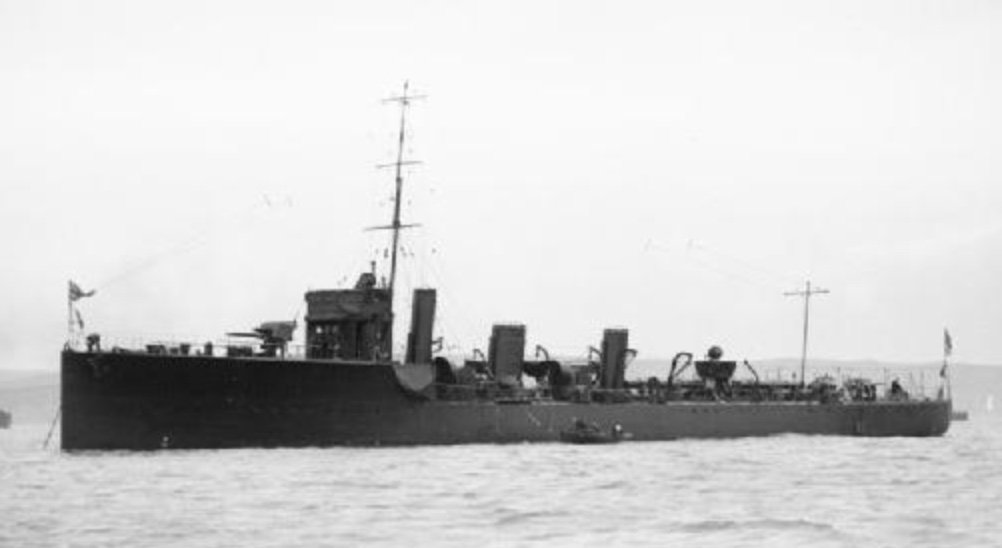
Brian Bickmore has been the victim of a tragic accident. His ship, the destroyer HMS Comet, was escorting SS Gordonia from Taranto to Malta when they collided on August 4th.

The Captain of HMS Comet, despite it being a very difficult time for him (as you will read below), has been able to furnish the family with the following details concerning Brian’s death:

“He was in his cabin at the time, and it was completely destroyed by the ship which ran into us. He must have been killed instantly. Nothing was ever seen of him afterwards, although a thorough search was made.”

Brian had served for nearly three years in the Mediterranean and was expected home on leave when the accident happened.

At the OPS he was a keen, determined boy with a merry twinkle in his eye, loyal and affectionate. He was full of life, and took the keenest interest in his work.

HMS Comet

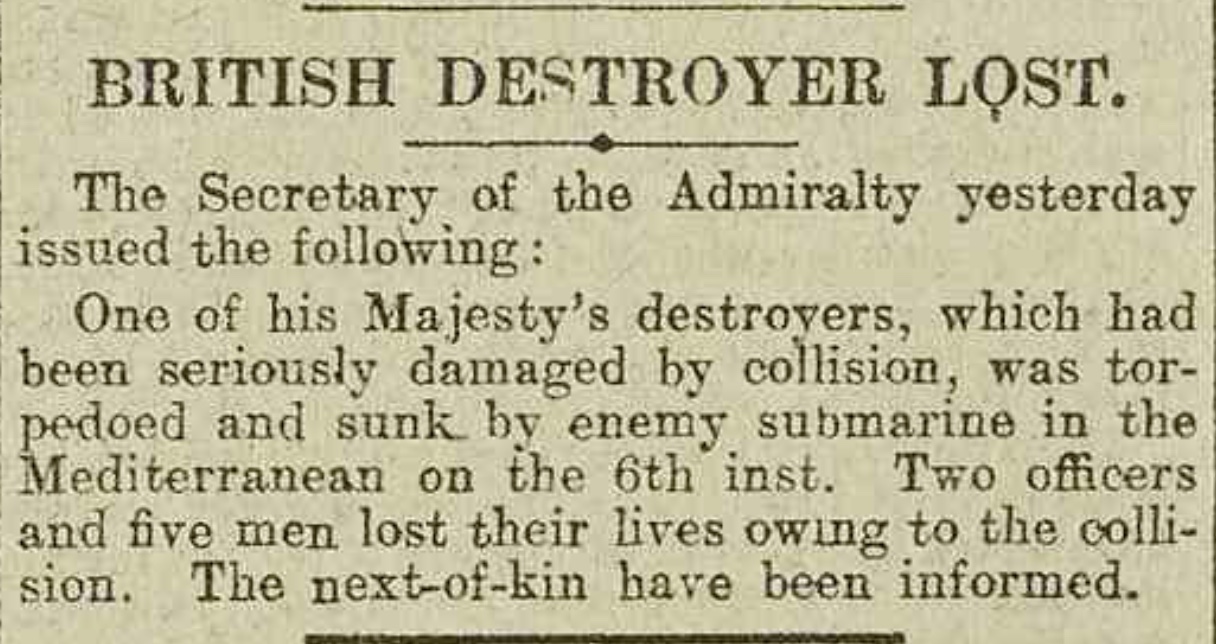
Two days afterwards (on August 6th), HMS Comet, having lost a significant part of her stern as a result of the collision, was herself under tow when an explosion occurred, which sank the ship.

This short article in the ‘Daily Telegraph’ must surely refer to HMS Comet’s demise:

Daily Telegraph, 14/8/1918


August 11th 1918

After a considerable period of time, we have heard from Capt. Jack Smyth (Sikhs, Indian Army) with his news:

21.7.18 “I’ve been travelling about a good deal lately; I left my regiment last Christmas up in Pershawar and went down to the Central Provinces to the Staff School, where I remained for three months. It was most awfully hard work, but all very interesting, and we had long days riding all over the country doing schemes…

Shortly after the course was over, I was appointed Brigade Major, Bombay, which was about the best job I could have got, and I went there in April.

I was then transferred as Brigade Major, 43rd Brigade, Lahore. Of course this place, being in the Punjab, is fiendishly hot in the hot weather (it has been 118° in the shade by day and 97° in a room with electric fans by night), but the work is interesting and there are heaps of troops here.

One thing I did love about Bombay was the sea; the yachting season was just over, but I did a good deal of bathing.

In the Yacht Club all men bowed down to me on account of my being one of the crew of the ‘Blue Dragon.’ You have no idea how the fame of the ‘Blue Dragon’ has spread in Bombay. I was always introduced as ‘Capt. Smyth, one of the crew of the ‘Blue Dragon’ you know,’ whereupon I was looked upon with awe, the choicest wines were produced, I was asked innumerable questions by people who knew the Log off by heart, my opinion was asked on different rigs which I knew nothing about, and I received numerous offers to go as ‘crew’ on some of the best yachts for next season.

So, if ever Skipper chances to go to the Yacht Club, Bombay, they will receive him with open arms…”

What an enticing thought, but I suspect Jack was diverting attention away from talk of his VC exploits.