March 17th 1924

Victor Sergent, whose death we recently reported, was a double international, playing for France at both cricket (1906-7) and association football (five times between 1907-13).


The Championship-winning Stad Raphaëlois XI of 1912

The Sergent brothers together with Lindsay (Pug) Wallace (who married their sister, Deta) played in the team that won the French Championship of 1912 – see above: Victor (standing, 2nd left), Noel (kneeling, left), Lindsay Wallace (kneeling, centre) and Dick (sitting, 2nd right).

‘The Draconian’ of August 1912 recorded their success thus:

The Stad Raphaëlois, the team that won the Championship of France at Association Football, contained 4 ODs. Victor Sergent (captain and full back), Noel Sergent (right half), Dick Sergent (inside left) and Lindsay Wallace (centre half). All four played in the final and the semi-final, winning the final after two hours play by 2-1 against the Association Sportive Française. Apropos of this, soon after the final, Victor Sergent was elected a conseiller municipal of St Raphaël at the head of the poll…

Les Sergents de Saint-Raphaël, Le Matin le 29 avril 1912 (Victor, Noel, Dick and Lindsay Wallace)

On receiving the news of his death, the Town Council of St Raphaël decided to honour Victor’s memory by changing the name of their football field and calling it ‘Stade Victor Sergent’.


March 11th 1924

Victor Sergent (1886-1923)

Rather belatedly (for which apologies),  we announce the sad news that Victor died on December 28th 1923.

Victor, who was at the OPS (1894-1900), was one of three brothers (with Noel and Dick) and a sister (Deta), all of whom joined the school from their family home in France. On leaving the OPS Victor went on to Winchester as a Scholar, where he shone both academically and as an athlete.

On leaving Winchester, Victor opted to finish his education in France, rather than go up to Oxford.

GC Vassall, our editor, writes in the up-coming edition of ‘The Draconian’:

He went first to the Lycée Saint Louis in Paris, and afterwards to the École de la Rue Violet, where he studied engineering… he also played soccer for the Racing Club de France, and was in the side which won the French Cup. At this time he played for France on many occasions…

Sgt VLB Sergent (ASC)

Victor was in England when war broke out. He joined up with the MT in England and was at Bury St. Edmunds for a time, with the rank of sergeant [making him Sergeant Sergent!]. Later, in France, he was riding a motor-bicycle between two lorries carrying munitions, when his fork broke for reasons unknown, and he was knocked unconscious. When he woke up, he was lying in hospital with a hole in his knee.

Following a period of convalescence in England, he was sent out to Basrah in Mesopotamia, where he gained his commission. He was one of the famous expedition to the Caspian Sea through Persia, being in charge of a certain number of Ford cars, all of which completed the double journey.

After the war, Victor spent time working as a travelling agent for Agricultural and General Engineers in Algeria, Tunisia and Morocco. Returning home to France, Victor recently started a motor transport service with his brother Dick. They had made a good start and it had been going for about eight months when Victor developed broncho-pneumonia, from which he died after a short illness, aged 37.

Much more can be said of Victor, particularly as a footballer, but this must be for another day…


January 14th 1921

S K I – I N G    I N    S W I T Z E R L A N D 

The British Championship

The first ever British Ski Championship was held at Wengen in Switzerland on January 6th and 7th, and yesterday’s edition of ‘The Times’ reveals that it was won by an Old Dragon!

The correspondent writes:

“The championship was awarded on the combined marking of a race and a style competition. It is notorious that races are often won by inferior ski-runners who run straight, risking falls and using their stick for changes of direction and control of speed. It would be a pity if the British Champion was a stick-rider, however plucky, who has not mastered the graceful and effortless Norwegian style, and it was to insure against any such depressing result that the committee decided to mark the race and the style competition equally.

Mr Leonard Dobbs, a young Cambridge undergraduate, won both parts of the championship. He scored 82% on style against Mr RB McConnell’s 80, and was 67 seconds faster than McConnell in the race. His victory was popular, for he is a sporting runner who does not shirk steep slopes, and he is the son of another fine ski-runner, Mr GC Dobbs, so well known to Wengen and Villars visitors. Mr Patrick Dobbs was second in the race and fourth in the Championship, so the family have every reason to remember with pride the first British Championship.”

Leonard’s father, Mr George Dobbs, was a director of the tourist agency belonging to Sir Henry Lunn and as a result the family spent a lot of time in Switzerland before the war, where they learnt to ski.

Whilst Patrick displayed great academic ability whilst at the OPS – indeed he won a scholarship to Winchester College – Leonard was less so. On the advice of a friend of the family he was sent to Bedales School. He is currently up at St John’s College Cambridge studying mathematics and science.

The Draconian of his time records one less than successful moment in his career with us, regarding his performance in a poetry recital in December 1913:

“Of 35 boys, half got practically full marks, and there was only one failure, L. Dobbs.”

November 10th 1920

Dr Hubert Burge

The Rt. Rev. The Lord Bishop of Oxford,

(Headmaster of Winchester College, 1901-11)

Any description of The Service of Dedication would be incomplete without recording the contribution made by the Bishop of Oxford more fully.

After the reading out of all the names of those being commemorated and the recitation of Dr Alington’s poem, ‘The Trust’, the Bishop performed the dedication with these words:

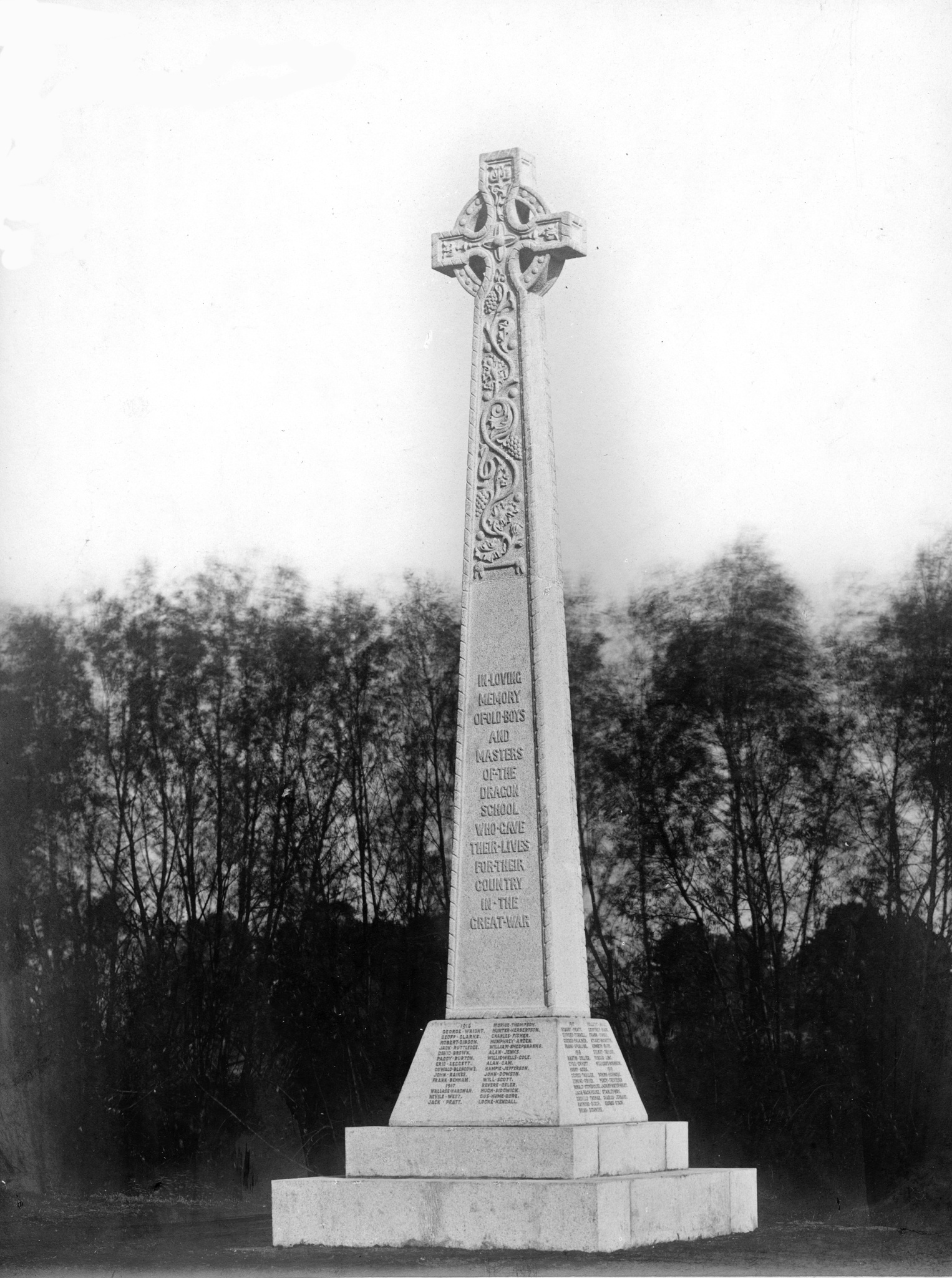
In the name of the Father, and of the Son, and of the Holy Ghost. We dedicate this Cross to the Glory of God, in proud and grateful memory of the Old Boys and the Masters of this School, who gave their lives in the Great War. May their example inspire us to courage in the greater war against all evil: may their memory ever burn brightly in those who remember their deeds, and, strengthened by their fellowship, look forward to reunion with them in the inheritance of the saints in light.”

After further readings and prayers, the Bishop gave the following address:

“The ceremony in which we are taking part means a great deal to everyone present, and may I say it means also much to me personally – perhaps as much as it does to anyone. My heart is full of memories of many of those to whom we are paying tribute this afternoon, of those who came to Winchester full of the promise of all their brilliant gifts. I can see them standing on Lavender Meads as they wait to pass before me at roll-call; I can see them again as they kneel in chapel. All their gifts, all their promise – light-hearted and happy they were, on the threshold of the Golden Age of early manhood – they put on one side in the choice they made at their country’s call. The truest comradeship, undaunted, unflinching courage, and loyal service and self-sacrifice for their country and her cause in the hour of her deep need marked that choice…

They gave without reserve to the cause that claimed them. There was nowhere else they could possibly think of being; there was nothing else in the world they could conceive of themselves as desiring or doing. And a noble tribute they paid…

There is a joy incalculable in facing and doing duty, in self-sacrifice and service: it is in truth the crowning joy of human life. And the secret of that joy is the completeness of the self-surrender, when there are no reserves, no keeping back from what we give to our duty: something to ensure our own comfort and ease: something that will make the effort less difficult: some thought of self. 

That joy, I know, crowned the lives of these our brothers: one of them, Roderick Haigh, was writing to me in a short spell after the days of terrific fighting in the first autumn of the war: these were the last words he ever penned: ‘We have been having a most tremendous time of it these last ten days, but I never enjoyed myself more: you won’t understand me: I never knew what it was to be taken so out of oneself.’

Those whose names are inscribed on the cross differed in their lives and in their temperaments; some had surely been cut out for great things, and some for the quieter life of the student. Yet at the time of great emergency all took their stand for the right. 

May you also be given the same power to take up the challenge when it comes, to accept the high, and, maybe, the seemingly impossible line…”


Of the nine Wykehamist Old Dragons on our Memorial, seven were at Winchester in Dr Burge’s time as headmaster:

Robert Pringle – the first to fall.

Roderick Haigh – killed in the 1st Battle of Ypres

Geoff Clarke – the son of our first headmaster

Robert Gibson – a Somme casualty

William Sheepshanks – the son of the late Bishop of Norwich

Revere Osler – the only son of Oxford’s Regius Professor of Medicine

Geoffrey Buck – a winner of the DFC


November 9th 1920

THE DEDICATION OF THE MEMORIAL

TO THOSE WHO FELL IN THE GREAT WAR

November 8th 1920

Yesterday we were delighted to welcome the Rt. Rev. The Lord Bishop of Oxford to oversee the service of Dedication of our Memorial Cross, who set the tone for the occasion with these well chosen words:

“We are met together today as one family, to dedicate a Cross to the Glory of God, and in thankful memory of those who went out from among us during the late war, and have laid down their lives for their country and for mankind. We shall make mention of their names, commit their souls to the mercy of Almighty God, and give Him thanks for their good example…”

Following the reading out of the names of all those who gave their lives, one of the boys, Percival Mallalieu,  read ‘The Trust’ by Dr Alington. The dedication, prayers, a hymn and readings were followed by the Bishop’s address (which we will publish tomorrow).

We are grateful to an Old Dragon (who prefers to remain anonymous) for this account of the day’s events:

“Many parents and relations of the fallen ODs and a fair number of ODs were able to attend the Dedication of the School War Memorial on Monday 8th November. At 8.30 a.m. there was a special Communion Service at which the celebrant was the Rev. LJ Percival (OD) assisted by the Rev. HW Spurling (OD). In addition to these, the following clergy were with the Bishop of Oxford at the Dedication Service in the afternoon: Rev. HH Arkell (OD), Rev. TT Blockley, Rev WM Merry and the Rev. A Karney.

It was fortunate indeed that Dr Burge was able to dedicate the Cross. As Headmaster of Winchester he had, as he reminded us, known, and been the friend, of many of those whose names it bore, and the simple sincerity of his address helped everyone to feel that the occasion was just the intimate, family gathering which the fallen would themselves have wished it to be. The Bishop addressed himself, as was fitting, to the boys, but perfectly expressed the thoughts of everyone. We cannot be too grateful to him for what he said…

All are agreed that the Cross perfectly expresses the intention of those who raised it. It must make the Skipper’s father happy to think that, at 92, he has been able, by this splendid monument, to crown his long work for a School to which he belongs as much as any of us. And now his work stands in the place of all places where it should, that boys may learn, and, having learnt, remember, the meaning of ‘Pietas’.

It is needless to say more. This Cross expresses thoughts which are the better for being unspoken. But it is a very happy thing to know that future generations of Dragons will possess it as part of themselves. We can trust them to keep it worthily, and to remember the Bishop’s words about the Old Dragons who fell for their country watching them from their graves.”

March 1st 1920

I n   G e r m a n y   ( 1 9 1 4 – 1 8 )

123456789 – 101112131415 – Part 16

Cyril King‘s journal finally comes to an end with this entry, dated November 25th 1918 when, after four years in captivity he finally returned to his native shores.

“We left the camp on the morning of the 23rd (I think) – after hours of lining up and waiting about – all those over 26 having left the day before. The train moved very slowly and took 20 hours to cover the 150 miles to Sassnitz over the never-ending ugly North German plain, and it was very cold and uncomfortable.

From Sassnitz we crossed to Copenhagen on a big Danish steamer and at Copenhagen we were transferred to two smaller cargo steamers in which we had to take the place of butter in the ‘holds’ – but it has been very calm and they have been extraordinarily kind to us and have fed us deliciously on as much bread, butter, eggs and apples as we have been able to eat.

Now, after 36 hours on board, we are lying off Leith, waiting to land as soon as it is morning.

‘Tomorrow to fresh fields and pastures new.'”

And land they did, the following morning, at Leith, welcomed by the pipers of the Gordon Highlanders.

Cyril is now happily ensconced in King’s College Cambridge, where he is reading Economics, and I hope to see him at our Cambridge dinner later this week.

February 24th 1920

I n   G e r m a n y   ( 1 9 1 4 – 1 8 )

123456789 – 1011121314Part 15

Berlin, in the week after the Armistice was signed on November 11th, appears to have been an extraordinary place – not what one would have expected in the aftermath of national defeat and humiliation. Cyril King and his fellow prisoners in Ruhleben were free to roam at will and rather enjoy themselves:

20/11/18. “I think that’s the date, but I am not quite sure, as we have lost all count of time. What a week it has been! I have been out to Berlin several times and have slept three nights there in a clean and comfortable hotel where a friend of R’s got us a room.

The first time we made elaborate plans for escape, but now I just wait at the gate until it is opened to let a soldier in or out, and then slip boldly through. A tram stops practically at our doors and runs all the way into Berlin…

I got some cash by selling an old German frock-coat and trousers, which I had bought in Baden-Baden for 100 marks, but it is all gone already, as money runs away like anything, and one has to pay 15 marks for a two course dinner of soup and potatoes and vegetables!..

I have seen ‘Measure for Measure’ twice, and ‘Twelfth Night’ at Reinhardt’s Theatre once and could have seen ‘Hamlet’ or ‘The Merchant of Venice’ if I had had time – as they are all on in Berlin now! ‘Measure for Measure’ was too wonderfully done for words and I have never seen anything like it. Both times the house was packed and it was a tremendous success – whilst all the time the town is starving – for it is indeed, and I haven’t seen a single cheek that wasn’t deadly pale.

They talk about nothing but the revolution and seem to have forgotten all about the war. ‘Now we are free like you,’ someone said to me in a restaurant. Everyone is very polite but not cringing as I had expected…

I have heard some speeches by Socialists and have seen the marks of machine-gun shots in the walls of the Palace and War Office, and the four-mile long funeral procession of the ’80 heroes’ of the revolution – most of the sights in fact. It is all very depressing.

The camp is a horrible place now – full of soldiers, searching the dustbins and trying to buy old clothes and food and haggling… about prices. The ground is everywhere covered with paper and rags and wood.

We may go at any time now, and it is unsafe to keep away from the camp too long. We have placed our books and most valuable possessions in wooden boxes, which we have stacked in the YMCA hall, in the hope that the Dutch Embassy will forward them later.”

Berlin was indeed a strange place at this time.

February 15th 1920

I n   G e r m a n y   ( 1 9 1 4 – 1 8 )

123456789 – 10111213Part 14

The staleness of which Cyril King wrote in October 1917 probably explains why he did not write much until the end of the war was in sight.

Towards the end of October 1918, when the German naval commanders ordered the Imperial fleet to sail out to engage the forces of the Royal Navy, the German sailors mutinied and this triggered a general state of revolution in Germany, leading to the Kaiser’s abdication on November 9th 1918.

News of this soon reached Ruhleben:

10/11/18. “They have had a revolution and are mightily pleased with it. Everyone here is wildly excited. A soldiers’ council has been formed among the garrison and representatives have just left for Berlin in the officers’ dog-cart flying a red flag. The officers have changed into mufti and most of them have gone home; but one, we hear, is to be courtmartialed.

A red flag has been hoisted on the flagstaff in the square where so many black and white eagles have flown during the last four years, for innumerable victories and royal birthdays! 

We heard firing last night and expect to be attacked by a mob at any minute – especially as several people have escaped, carrying food with them – and a bodyguard has been formed to patrol the camp and keep people from entering or leaving the camp.

They are absolutely certain to sign the armistice now.

How right Cyril was; at 11 o’clock on the eleventh day of the eleventh month, after four long years, the war was brought to an end.

11/11/18. They have signed all right. Powell has gone to the soldiers’ council at the War Office and asked about release. They say they will probably let us go as soon as they can get a train, but they don’t know whether we are to be counted as ‘prisoners of war.’

I am off to Berlin tomorrow to look round and see ‘Measure for Measure,’ which I hear is on at the ‘Volse’s Bûhné.”

Who would have believed that amongst such chaos, theatres continued to operate? Cyril’s adventures in the week that followed are the subject of the next instalment.

February 4th 1920

I n   G e r m a n y   ( 1 9 1 4 – 1 8 )

123456789 – 101112 – Part 13

The story of Cyril King‘s incarceration in Ruhleben for the duration of the war must be completed. This is the final part of his journal dated October 28th 1917, and conjures up an air of staleness. The novelty has worn off.

“Everything has seen its best days and is carried on rather mechanically and professionally. The old enthusiasm has died. ‘Family’ life has become rather a strain. We sit over our meals vacantly and in silence – every topic of conversation having been exhausted…

The camp is littered with dead and broken friendships and no one has a scrap of energy left.”

There were of course many attempts at escape, some of which were successful. But the thought of being transferred to a worse camp if caught deterred many, including King.

“There have been many attempts at escapes, and one or two successes. Last year in fact everyone was talking of trying, but the authorities decreed that failure would be punished by a fortnight’s dark cells, followed by a removal to Havelberg, which is a much worse camp, where one would have to begin life all over again – so that it doesn’t seem worthwhile, unless one had very good plans.

In order to lessen the chances of success still further, they have instituted two ‘Appels’ (roll-calls) a day – one at 8 am and the other at 7 pm when we have to line up and march on to the racecourse to be slowly and carefully counted. It is tiresome having to get up so early, but we have reduced it to a fine art so that we don’t jump out of bed till half a minute before the barrack moves off.

The camp is much emptier now, as most of the people over 45 have been released to England and about 200 invalids have been moved to Holland.”

November 25th 1919

I n   G e r m a n y   ( 1 9 1 4 – 1 8 )

123456789 – 1011 Part 12

Cyril King took a two year break from journal writing between October 1915 and 1917, by which time Ruhleben had grown most impressively:

28/10/17. “Two more years have rolled [by] since I wrote last. There have been no great changes in our life and we have almost forgotten the world outside. The only new institution is the Horticultural Society and it is perhaps the greatest of all and certainly works most smoothly. It has succeeded in acquiring a lease for the other half of the inside of the racecourse, and after tremendous struggles with the soil in which most of the camp joined, has turned it into a model market garden! In the summer we were able to buy lettuces, cucumbers, tomatoes, radishes and a few melons at almost nominal prices, while all over the camp there were bowers, borders and beds filled with every kind of garden flower. It makes all the difference in the world.

The school has greatly increased in size, filling a whole stone barrack and several sheds around it. It has from 1000 to 1500 pupils and about 100 teachers, several small class-rooms, a big reading-room, an office, two big lecture rooms, an arts and crafts department where people bind marvellous books, while others work in leather or hammer silver; a big science research laboratory where, as we hear, new ‘elements’ are discovered every day; a ‘wool and worsted’ shed, where they dye clothes in many colours and where someone has invented and constructed an apparently epoch-making weaving loom; an engineering shed; and a real live motor car, which is daily taken to pieces and put together again.

The theatre has seen over a hundred plays in five languages, including five by Shakespeare, two by Ibsen, one by Chekhov, two by Rostand, several by Maeterlinck, Synge, Lady Gregory, Yeats, Shaw and Galsworthy, five Gilbert and Sullivan Operas, two pantomimes, a German musical comedy, variety shows and numerable French and English farces, melodramas and other plays – nearly all completely successful and I think really awfully well done. The fortnightly chamber orchestral and choral concerts, and the weekly debates and lectures, have been continued unbrokenly, and in the summer we have had open air concerts on the promenade des Anglais.”