July 9th 1916

JF Ruttledge 2

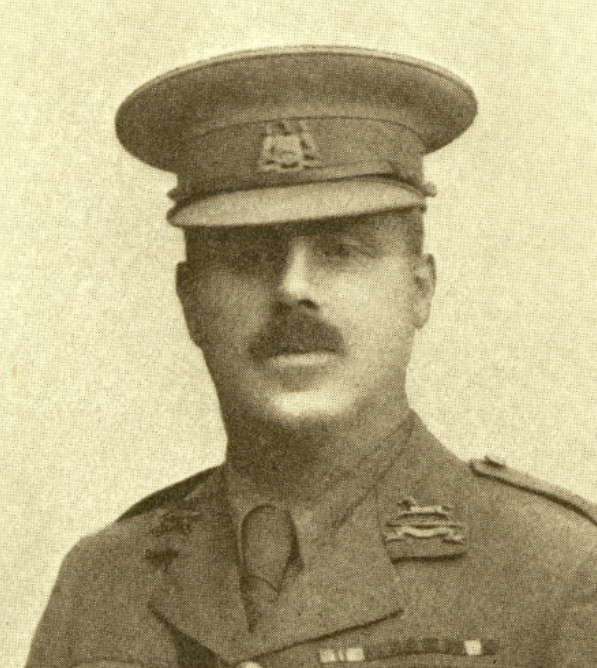
Capt. John Ruttledge (Prince of Wales’s Own West Yorks Regiment)

It was inevitable, I know, that a number of our Old Boys would be involved in the “Push” that has taken place on the Somme and inevitable too that we would be adding to our “Roll of Honour.”

Jack Ruttledge was involved in the second wave, supporting the Middlesex & Devonshire Regiments in their assault on the German-held village of Ovillers eight days ago, on July 1st.

The Commanding Officer has written to Jack’s father explaining the circumstances of Jack’s death:

He led his men with great gallantry right up to the enemy trench, where he was killed by a shell, (he was wounded early in the battle but went on leading his men). I personally noted the fine leading of his company at the commencement of this action under heavy fire.

The battalion maintained its splendid reputation; 702 went over and only 192 were left unwounded.

I cannot adequately express my grief at the loss of your gallant son. He was my best company commander… Had your son survived I would have recommended him for the DSO.”

The scale of our losses are considerably greater than one would have thought from the reading of the newspapers this week. One can only hope that this state of affairs is not reflected in the attacks on other parts of the front.

July 4th 1916

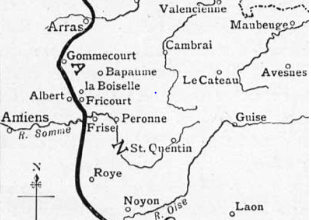
Somme map

The Anglo-French Offensive

The Push has indeed started, but we have little news as yet.

The report (as it appeared in yesterday’s Daily Telegraph) was general in scope, but positive in tone. However, the German statement quoted on page 10 suggests that the Germans were well prepared for this and that we suffered “very heavy casualties.”

Today’s paper (page 9) does mention that the West Yorks Regiment were involved in an attack on Fricourt and that they “went across toppingly.” Whilst we know that its Commanding Officer, Lieut. Col. Stuart Taylor is not involved (he is recovering from wounds received earlier in May in Princess Alexandra’s Hospital for Officers in London), Capt. Jack Ruttledge is a West Yorks man and may well be in the thick of it.

Lieut. Robert Gibson, whose letter we received only a few days ago, may well now be in action, as the Bedfordshires are also mentioned as taking part in this offensive.

We most earnestly hope that our dear Old Boys all come though unscathed, but meanwhile their parents are condemned to live in continual fear of the post boy with a telegram for the duration of this great battle.

We must all be brave.


March 4th 1916

Lt. Col. Stuart Taylor (West Yorks) is currently with 93rd Brigade, 31st Division in Egypt. He is of course known to us all at the OPS as ‘Fluff’ and is the most loyal of Old Boys. He has contributed on numerous occasions to the pages of the Draconian on his time in the South African War, on horseback in Crete and in Northern Nigeria.

On leave in 1897, Fluff acted briefly as our swimming instructor and clearly his interest in matters aquatic continues unabated!

Stuart Taylor 2“We saved 1000 gallons of water in the last week out of our water allowance and yesterday, Sunday, we celebrated the close kinship of cleanliness to godliness by letting every man indulge in a bath! They made nice oval holes in the sand, spread their mackintosh sheets over the holes and pressed well down into them; and then poured in their hard-saved water – and then, the joy of it! It reminded me of days when I watched seals at the Zoo revelling in their plunges in and out of their various water ponds. Soap, sunshine, splash and singing, it made up a wonderful picture and how they all enjoyed it.

These men of mine are passionately fond of soap and water and the absence of these things worries them more than short rations or sleepless nights…”

Fluff has paid us two visits since this war started. On the first occasion, last April, he was – for reasons unexplained – escorting a Turkish prisoner along Charlbury Road and dropped in. Last term, before he went out to Egypt, he came and demanded of me two ‘extra halves’ and two ‘no preps’ – the biggest yet – and this of course was met with great enthusiasm by the boys, so that I could hardly refuse.

March 15th 1915

Ruttledge MC

Capt. JF Ruttledge

In this week’s ‘London Gazette’ is the announcement that Jack Ruttledge, now a Captain in the Prince of Wales’s Own (West Yorkshire Regiment), has been honoured with the award of the Military Cross.

The citation reads, ‘For great coolness and gallantry on 19th December 1914, near Neuve Chapelle. When his company were moving over open ground under very heavy fire, many casualties occurred and Lieutenant Ruttledge remained to the last, helping the wounded away to cover.’

 * * * * * * *

An anonymous Old Dragon has written in to give us a glimpse on the sort of life being enjoyed in the trenches at present.

“In the Trenches

La Belle France

March 12th 1915

 The last three days and nights were very noisy and a bit bomby and grenadey. On several occasions we had Brigade orders to open heavy machine gun and rifle fire at the German breastworks backed up by artillery fire at a certain time, and the row usually lasted for about half-an-hour. These unaccustomed bursts of activity were partly to make the Huns as nervy as possible, and partly to prevent them sending reinforcements while attacks were being made between here and * * * * *   (censored).

I was rather lucky in not getting hit the other day. I was working with two men a few yards behind the parados, where one ought, barring accidents, to be pretty safe, when a rifle grenade suddenly dropped and exploded six yards from us. We felt the shock of the explosion and gust of hot air in our faces, but none of us got hurt. We have been sending quite a lot over into their trench (70 yards distant) lately, and they invariably send just the same number back. Some 15” howitzers have arrived at the front, and are apparently found to be a great success. They say that if one of these shells drops in a decent sized factory it absolutely levels the whole place.”

Whereas further south, in the region of the Somme, it is possible to dig deep trenches with underground dug-outs, we understand that in the Ypres area the water table is much higher and such trenches are nigh impossible to build.

“I don’t know if I have explained to you that we aren’t in actual trenches at all, but behind a parapet made of sand bags riveted up with sheets of corrugated iron, hurdles etc., with earth thrown up on the enemy’s side. This parapet varies in height, but I should say the average is between 6 and 7 feet.

This sort of breastwork is of course only of use when we are too near to the enemy to have much fear of artillery fire. The old earth trenches became uninhabitable long ago on account of the mud, but the men still have to dig in where they get shelled, as of course our parapets are no protection against shell-fire.”

Trench pic