June 29th 1919

Hum Lynam with the first Juniors (1906).

Our junior department was opened in 1906 at 1, Charlbury Road, for children from 4-8 years of age. The aim has been thoroughly to ground the children in reading and writing; the older ones do easy English and Bible History, Geography and Arithmetic, and begin on a little French.

The school (now consisting of 19 boys and 4 girls) has this term had their first ever Sports Day, and what a joyous occasion it was. I am grateful for this account of the occasion for the ‘Draconian.’

“I wasn’t quite up to time (10 minutes late), but it didn’t matter, as owing to the hubbub, the competitors had not realised that it was desirable to start operations some time near the given hour.

When all superfluous energy had been exhausted in cart-wheels and games of ‘he,’ the younger members ran a race, followed by the older ones, and after that came the race for the whole school.

There were various ways of running a race at the Baby School: some flatly refused to remove their hats, others shed them, as well as shoes, while one budding athlete was seen busy rolling up his shirt sleeves and after that his trouser legs. Someone started with his hands in his pockets, but the smallest competitor went one better and waited the signal to start in the most correct position, crouching on one knee and steadying himself with one finger of each hand on the ground…*

There was a long jump. I didn’t attend it properly as two small sisters had to be shown where the river was; but I heard afterwards that he in the white shorts who fell over in the black earth was as big a hero, if not bigger, than he who won the event rather brilliantly…

When these and the [cricket ball] throwing were duly finished, the high jump was prepared. This appeared the most popular event amongst the children; great excitement prevailed, and it didn’t matter if Dick took Tom’s turn, or Douglas got two to everyone else’s one, all were fearfully happy and just lived for the next opportunity of a jump.

After this came greater and more frantic excitement still – the team race, a really wonderful effort, one side only just winning by a yard or so.

This and a rush to the tent for lemonade and buns ended for me one of the most enjoyable afternoons of this term. Let us hope that if these sports are made a yearly institution, they will all be as successful and give as much pleasure as the first Junior School Sports certainly did to onlookers and candidates.”

* Unfortunately, what he gained in style he lost in speed of gaining balance and actually starting!

I also gather Mrs Hum made an appearance with a large box of sweets, which almost stopped the show!

June 21st 1919

‘The Battle of Blenheim’ by Robert Southey has been studied this term and some of the best work resulting from it will be in this term’s ‘Draconian’ magazine.

I hope that in the future my English VIth form will appreciate the English poetry I have given them to learn, its rarity and interest and beauty, and also my efforts to get them to become poets too!

Young James Alford (aged 13) is the author of this poem. It recalls the day the Armistice was declared last November, when James was at home, following our decision to send all our boarders to their families at a time of considerable concern over the influenza epidemic.

Sadly, James leaves us at the end of this term to go to Rugby School.

THE ARMISTICE
(Begging Mr. Southey's pardon).

It was a winter morning,
My French that day was done;
I sauntered down into the town
For exercise and fun.
The board-school children could be seen
A-sporting on the Richmond Green.

Just then a hideous syren
Sent up a frightful sound
The guns at Kew and hooters too
And church-bells all around,
And flags and shouts announced the fact 
The Huns had been severely whacked.

The shops in flags were shrouded
Banners were waved about,
Munition-workers crowded
To drink the publics out,
And all day long the vast mobs swell
From Kensal Rise to Camden Hill.

And when the dark had fallen
And the bright day had gone,
I went to bed with weary head
And slept until the dawn;
And thus if rightly I remember
I spent the 11th of November.

June 11th 1919

We were very pleased that Potter Baldwin, who wrote to us back in October, was able to visit us last month. We have now received this delightful letter from him:

6/6/19. Prisoner of War Escort Co. 271, APO 772, American Expeditionary Force.

I arrived back in camp the night of June 1st after having had of course easily the pleasantest 14 days since I left the States and one of the best two weeks of my life.

You can’t realize how wonderfully fine I felt to be in Oxford again and see the old School and my former teachers to whom I owe a tremendous lot. The preliminary training a boy receives is of course the foundation of his career and therefore the better it is, the easier his future is to be.

After I returned to the States I out-distanced the American boys in many of the subjects I was taught at the Dragon School, and was ready to enter College at 17, although I put if off for a year.

I was lucky to be in Oxford just at the time I was there. It could not have been more beautiful, everything in full bloom, the colours and odour of the flowers in St. John’s were gorgeous, and I am sure could not have been equalled anywhere…”

July 2nd 1919

I thought the parents and friends of OPS pupils might light to try their hand at the examination paper set for the top 3 forms this term. The papers have been marked by Frank Sidgwick and we will publish his report together with the results tomorrow!

1. Write short notes on 'The Nibelungenlied,' 'The Twilight of 
the Gods,' Excalibur, Circe, Mulvaney, the Arethusa, Becky Sharp, 
Mr Pyecroft, Mr Jingle, the Divine Comedy, Kotik, the Tales of a 
Grandfather, Perdita, Ophelia, the Boojum, the Lorelei.

2. Describe and illustrate the character of Shylock.

3. Continue these quotations for not more than 3 lines, say 
from what work each comes, and by what author: 
a) Ah! Love, could thou and I with Fate conspire 
b) Taking one consideration with another - with another 
c) Nay, too steep for hill-mounting; nay, too late for 
   cost-counting 
d) From too much love of living, from hope and fear set free 
e) Yours is the earth - and everything that's in it 
f) And the Man of Blood was there, with his long essenced hair 
g) If you have tears prepare to shed them now 
h) Last scene of all, that ends this strange eventful history 
i) On the cabin roof I lie 
j) Forty years on when afar and asunder 
k) When shall we three meet again 
l) The lights begin to twinkle from the rocks

4. Describe carefully the story of a book which you used to 
like and now do not care for, and have not read for a long 
time. State your reasons for having ceased to care for it.

5. Supposed you had to live ten years alone on a desert island, 
what five books would you choose from the whole of the world's 
literature to read during that time? Say why you would choose 
them.

6. Write a love song in 12 lines, for Lorenzo to sing to Jessica.

June 8th 1919

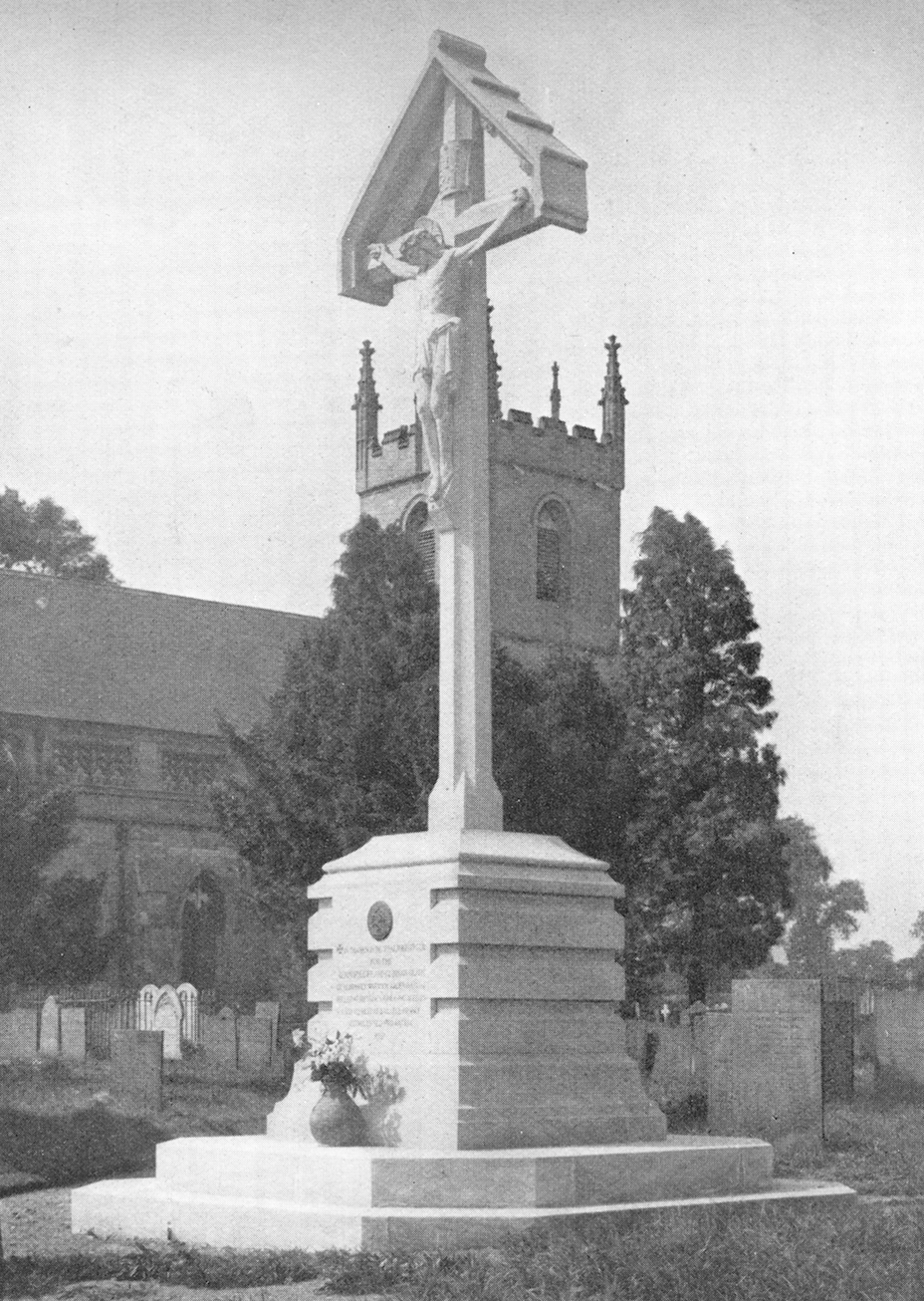
On the second anniversary of the death of Humphrey Arden (June 6th 1917) a Calvary has been dedicated in his memory in Yoxall Churchyard in Staffordshire. The Bishop of Stratford carried out the dedication in the presence of many relatives and friends, amongst whom were Hum and me.

The Calvary was erected by Messrs Bridgeman of Lichfield (who are to erect the OPS Memorial Cross). It stands 23 feet high and dominates the village street.

The inscription reads: “In thanksgiving to Almighty God for the beautiful life and glorious death of Humphrey Warwick Arden, BA Cantab. Killed at Messines, June 6th, 1917, aged 25. Laid to rest at Bailleul, France. Sed miles, sed pro patria. RIP.”

The following tribute to Humphrey is from the ‘Church Times’:

“He was one of those whose lives gave promise of a brilliant future. A Cambridge Honours man, a great athlete, a musician of no mean promise, one who exercised extraordinary influence on his fellow men, a lover of all the arts and of everything beautiful, great things were expected of him had he been spared.

A week before his death his fellow officers unanimously decided to recommend him for the MC which had been offered to the battery.

The Calvary was erected by his parents in Yoxall, where his grandfather, Dr Lowe, was rector for many years, and where twelve  generations of Ardens lie buried under the high altar.”

May 24th 1919

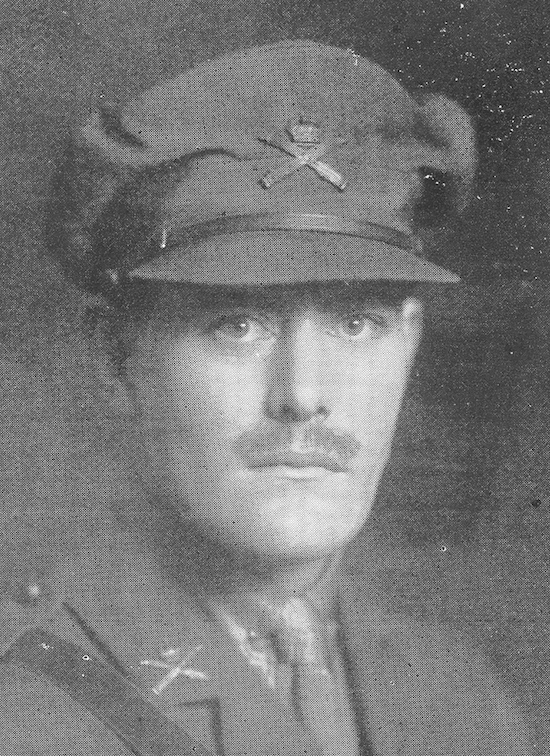
Capt. Charles Jerrard (Dorsets)

Another Old Boy has suffered an accidental death – this time by way of a motor bicycle accident. Charles Jerrard was travelling from Cologne to Bonn on May 15th when the crash occurred. The causes of it are as yet unknown.

Charles had a distinguished war, being ‘Mentioned in Despatches’ twice and winning the MC last November at Ors, when he dashed across the Sambre Canal, and with 18 men pushed forward, capturing 70 of the enemy, besides putting a number of machine guns out of action, and finally capturing a battery of 4.2 Howitzers.

He was twice wounded, and was admitted into Somerville Hospital in April 1918 to recover from mustard gas.

Earlier this year Charles was attached to the headquarters of the Lancashire Division as Sports Officer at Bonn.


I recall that on one of his ‘leaves’ a very fine smart young officer, whom I did not recognise at first, rode round to the School on his motor bicycle. He dashed up to me and with a hearty handshake said, ‘You don’t remember me, but I remember you very well and the whackings when I was sent in! And I expect I deserved them, sometimes at any rate.’


May 16th 1919

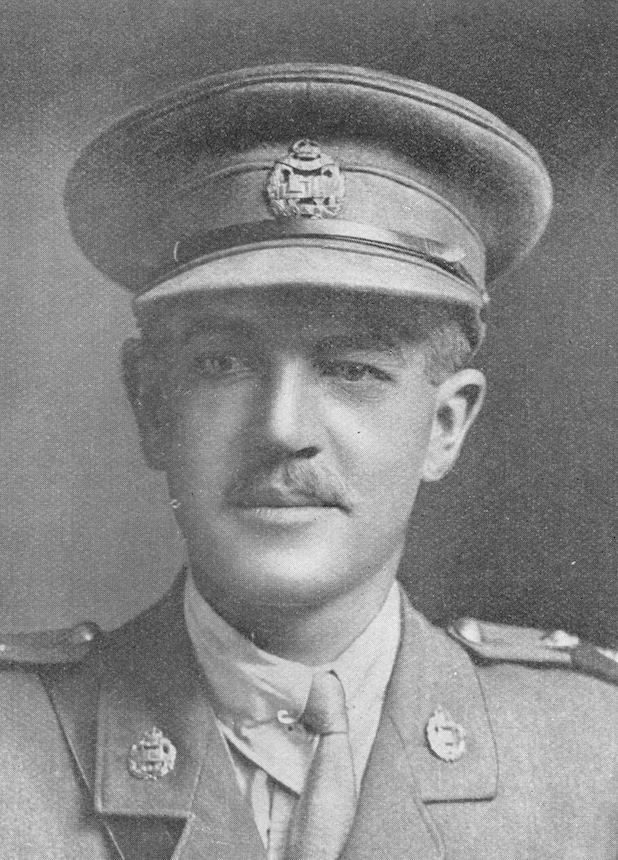
Capt. Henry Stanley Way (Royal Fusiliers & Tank Corps)

We are very sorry to hear that on May 6th Stanley Way, who was on duty in France with the Tank Corps, during the loading of tanks on to a train for removal to Germany, was accidentally killed. He has been buried with full military honours at St. Pol.

Stanley went through the whole war untouched. His letters home were full of his adventures behind the lines, and notes on bird-life, of which he was very fond – a great observer and student, and if spared he would have been famous as an ornithologist.

His quiet unassuming manner, combined with more than ordinary pluck and determination, marked him out amongst brilliant contemporaries. He would have tackled the reconstruction problem had he been spared, in just the same spirit as he faced the war. Those who knew him are the better for the privilege of knowing him.

He visited us on his last leave in March and he was full of joy at the thought of going to Southern Russia.

* * * * * *

It is to be regretted that it is still not possible for families to visit British graves in France or Belgium. However, an article in the papers today states that work needs to be done to exhume those in isolated graves in favour of central cemeteries. There is also at present a great lack of transport and accommodation. So for the time being, the War Office is not granting permission to families to travel to these areas.

Those who have read Geoffrey Freyberg‘s account of his visit to the battlefields around Reims, might also wonder how safe they are, even now.

May 11th 1919

Six Captains of the Fleet Row Admiral Tyrwhitt Ashore in his Galley at Harwich

“A signal honour was paid to Admiral Sir Reginald Tyrwhitt KCB DSO when he hauled down his flag as Admiral of the Harwich Fleet, for six captains rowed him ashore in his galley, while all hands lined the deck of the flagship and cheered again and again as the galley put off down a lane formed by gaily-decorated small craft. Admiral Tyrwhitt has been in command of the Harwich patrol since the early days of the war, and greatly distinguished himself at the battle of Heligoland Bight.”

The above picture and caption formed the front page of yesterday’s edition of ‘The Sphere.’ This follows an article in ‘The Times’ on Friday 2nd May, entitled “Admiral Tyrwhitt’s Farewell to Harwich.”

When Sir Reginald disembarked on the pier, buglers sounded a fanfare and the band of the Royal Marines played “Rule Britannia.”

The following farewell message from Sir Reginald was signalled to the Fleet:

“On hauling down my flag as Rear-Admiral in command of the Harwich Force, I wish to express to captains, officers, and ships’ companies my deep appreciation of their services rendered during the war. I am deeply sensible of the arduous work they have performed, and am grateful for their loyalty and assistance on every occasion.”

Sir Reginald is now due six weeks well-deserved leave before setting off for his new appointment as the Senior Naval Officer at Gibraltar.

May 6th 1919

Commander Geoffrey Freyberg (RN), who reported on the surrender of the German U-boats in November, has returned from a week of celebrations in Paris and Cherbourg at the invitation of a grateful French nation. He and his ship, HMS Valiant, have now returned to Scapa Flow, from where he has written to us.

The French government had wished to honour the work of the Royal Navy in the War and on April 23rd (St George’s Day) held a review of our naval troops in the Court of Honour of the Hotel des Invalides, conducted by the Governor of Paris. It was attended by both Rear-Admiral Reginald Tyrwhitt and Admiral Sir David Beatty, their staffs and various ships’ companies.

On April 26th Geoffrey and his fellow officers were taken to see Reims and something of the war-torn countryside:

“From Château Thierry and Épernay we passed through the devastated area. Every town and every village was in ruins. Famous Châteaux with their roofs battered in, with broken beds gaping out of holes in the walls, and Churches with perhaps only half the Chancel or the Choir still standing, made one realize for perhaps the first time the feelings of intense hatred of the French towards the Boche, and one now understands why it is the Frenchmen are still burning to revenge themselves…

Reims had 100,000 inhabitants before the war, but only 10% now remain. Sixteen houses only are undamaged in the City. Little or no repair has been undertaken in the devastated area owing to lack of building material.”

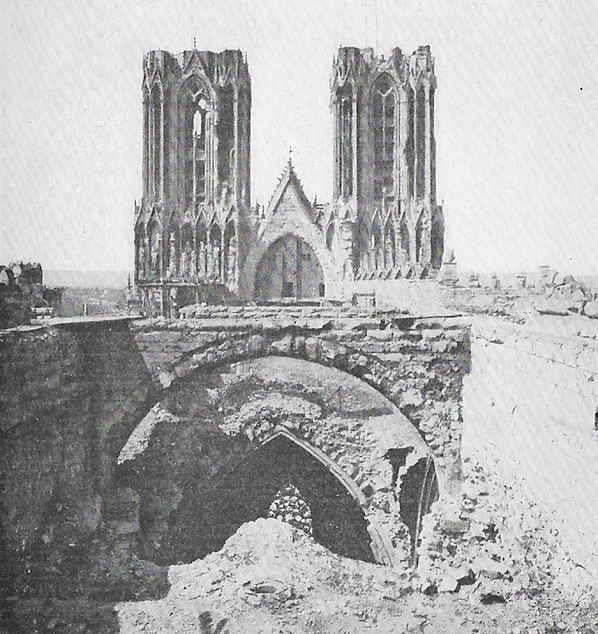
Reims Cathedral is in a particularly bad condition.

“Outside its western front we were met by Cardinal Luçon (aged 83) and conducted round the ruins of what was once the most glorious Church in France. The building is no longer open to the public as it is in a state of dangerous collapse, the roof lies on the floor, the High Altar has vanished and the Northern Tower looks very shaky.”

Reims Cathedral nave.

“We now motored out in the rain to Fort la Pompelle, the N.E. corner of the Reims defences and the scene of desperate fighting. All the trenches are filled in, but shells, grenades, human bones and an occasional dead horse with miles of wire lie everywhere. Two grenades went off without hurting anyone, and of course most fellows carried back trophies in the shape of broken rifles or fragments of shell.

La Pompelle Fort

A French Colonel of Infantry at one place said, ‘Gentlemen, this is holy ground, as you stand on the bodies of all my officers and most of my men. I ask you to salute them.'”

When they had all returned to Paris that evening, at the end of a very full day, they looked for some lighter entertainment:

“Although feeling rather tired, we again sallied forth to visit the magnificent Allied Officers’ Club next to the British Embassy. Finding this rather dull we moved on to Maxims, which has just been reopened after the recent brawl there, which resulted in four American and French officers being killed or wounded because an American kissed a French lady…”

April 5th 1919

My brother Hum, in his role as Housemaster of School House, has prepared some remarks reflecting on the past term, for the next issue of the ‘Draconian’:

“The epidemics were not as formidable this term. The ‘flu’ was of a much milder type than the onslaught which we dodged last term, and it considerately spread its visitation over several weeks. We were lucky in getting excellent additional nurses, and in escaping complications in all cases.

It is almost ridiculous to treat German Measles seriously. In most cases there was no rise in temperature and the rash sometimes only popped out for a few hours. Our difficulty lay in dealing with boys normally ill, and infectious, but actually very full of life and mischief.

* * * * * *

On the last Sunday of term we anticipated what we hope may be a frequent delight next term, by a very enjoyable bike-ride and picnic to Begbroke, where the woods were explored and a rare plant was discovered by Mr. Haynes.

* * * * * * 

School services have been held each Sunday, sometimes at School and sometimes, during the ‘flu’, at the House. We hope and believe that our short services, with prayers, hymns and readings carefully selected, and rendered strikingly well by the boys themselves, followed by an address from a varied selection of preachers, each knowing the needs of boys, may engender an attitude towards worship different from that which has too frequently held among school boys. We hold that the religious life of a school – even a Preparatory School – should be the care of the boys and staff, lay as well as clerical.

It should claim interest least as much as cricket or football, and it should not be regarded as priggish to show such interest… We shall at all times be glad to welcome any Old Boy or friend who is willing to come and talk for 10-15 minutes to the boys at one of these services.

* * * * * * 

Mr W Bye BSc, at present Capt. Bye MC DSO, returns to us next term from military service. He will have a ‘small’ house (12 Bardwell Road) where he will be in charge of about a dozen boarders. There has been considerable demand for a ‘small’ house for boys just beginning their school career, and new boys will usually start with a term or two in this house.”


To this I may add that Noel Sergent, who entered the French Army as a poilu and won his commission in the Heavy Artillery, is joining the staff next term. He went right through the Gallipoli campaign, was torpedoed in the Mediterranean (a very narrow escape, only due to his wonderful powers of swimming) and fought through the last part of the war in Flanders.

His perfect French and good mathematics, besides his strong personality, should make him a valuable addition, and I hope a permanent one, to our staff.

We are most grateful to Old Dragons  Maurice Jacks, Pat Duff, Jack Richards and Oliver Sturt, who have been most useful in giving us temporary help over this past term and we are greatly indebted to them.