June 5th 1916

CDF at sea cropped

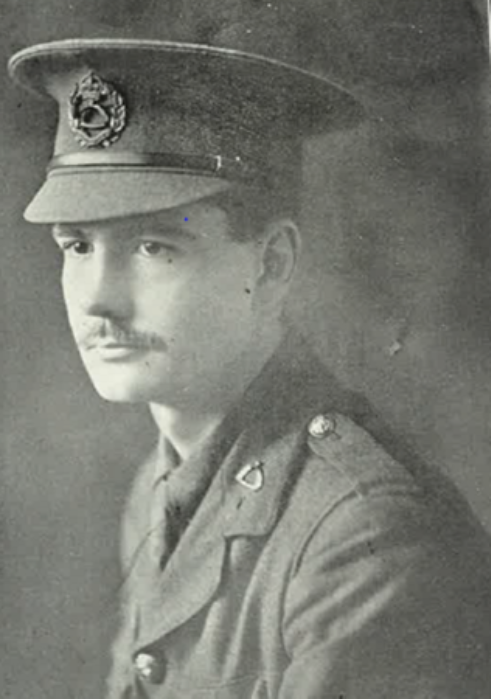
Lieut. Charles Fisher (RN)

The death of Charles Fisher is confirmed in the papers this morning. He is described as “a well known Oxford tutor… a great cricketer in his day and a man of very remarkable qualities… His death will be deeply felt not only by his comrades, but by many generations of Oxford men.”

Never have truer words been said of our dear friend.

His was a glittering career. He was first in the Westminster Challenge (winning therefore the top scholarship) when he left the OPS in 1889; he won the Slade Exhibition and got a First Westminster Studentship to Christ Church, where he obtained a First Class in Honour Moderations and Second in ‘Greats.’

He was a don at Christ Church from 1901-14. In 1910 he was Junior Censor and then became a member of the Board of Faculty and of Literae Humaniores and finally Senior Censor.

“His authority was based much more on an extraordinary personality than on the powers of his office, though these were great.”

Academically, his special study was Tacitus, on whom he did much work as editor for the Oxford University Press. He was widely read in Modern & Medieval literature, English, French and Italian.

A writer to the Morning Post said, “Charles Fisher towered a very prince among his fellows.  He was of huge stature and splendid in bearing. The formidable shoulders, the active hands, the swinging gait, the characteristic toss of the foot, above all the noble face and head… He loved games and the men who played them, and cricket and cricketers above the rest.”

He achieved his ‘Blue’ at Oxford and played a number of first-class games for Sussex (his highest score being 80 against Worcestershire).

He was present at all our OD dinners from 1908-13 and frequently used to stroll up to the school to encourage and criticise our games. He once told me that he and I had been classed together as the worst dressed men in Oxford – a great honour to me! And he would laugh his glorious laugh and pull out a dirty pipe and tell us some undergraduate story or some anecdote of his many travels; and always a shadow seemed to fall as he strolled away.

That shadow is today a very long one.

June 4th 1916

Following the news of the sinking of HMS Invincible, our deep concern for the well-being of Lieut. Charles Fisher continues. As always, whilst we fear the worst, we must hope for the best.

We are also aware of others who may well have been involved in this battle off Jutland. Charles’s brother, Captain William Fisher (HMS St. Vincent) is known to be part of Jellicoe’s 1st Battle Squadron.

HMS St Vincent

HMS St Vincent

Mr & Mrs CRL Fletcher have already lost two sons to the war: Regie Fletcher was killed at Ypres on October 31st 1914 (a day that claimed three OPS victims), followed in March 1915 by his brother George Fletcher. Their oldest (and only remaining son) Lieut. Leslie Fletcher is known to be serving on HMS Colossus (also part of the 1st Battle Squadron). Surely fate cannot be so cruel as to take from the Fletcher family their only remaining child.

Attached to the 5th Battle Squadron are HMS Valiant and HMS Malaya. Both have Old Dragons aboard: Commander Geoffrey Freyberg in the former and Midshipman Percy Trevelyan in the latter.

Midshipman Francis Studdy is believed to be on HMS Temeraire in the 4th Battle Squadron, Lieut-Commander John Bywater-Ward is on HMS Ajax and, lastly, we think Lieut. Desmond Stride is on HMS Conqueror.

We await news of all of them.

June 3rd 1916

“On the afternoon of Wednesday, May 31st, a naval engagement took place off the coast of Jutland…”

Today’s Daily Telegraph  has the news of a major battle at sea and reports the loss of HMS Invincible. This is most distressing and we fear for our old friend Lieut. Charles Fisher. The report states the ship was sunk and we can but wait and hope that Charles might be amongst the survivors – if there are any.

CDF despatch rider

Charles Fisher

When war broke out, Charles was over age, and moreover  found that his varicose veins  disallowed him from active service, according to the medical regulations in force. Inaction, however, was impossible for him, and offering himself for the work which would most quickly bring him to the front, he crossed the Channel in the autumn of 1914 as an orderly in a British Red Cross Motor Convoy.

In 1915 he became Adjutant and was mentioned in despatches. Thereafter he transferred to the RNVR with a lieutenancy. Charles turned his mind from the classics to range-finding, commenting that a ship was a ‘floating laboratory with a foreign language of its own, as difficult as Greek.’ He has become an expert range and rate-finder, and we presume he was directing the fire of HMS Invincible in this battle.

Forty or so Old Dragons are serving in the Royal Navy and it is quite possible a number of them were also involved. I am sure many have been champing at the bit to have their chance to engage the enemy and maybe the stories they have to tell will be of a rather more positive nature than the view given in the newspaper.

We hope that over the next few days we will have news of their safe return to port.


May 27th 1916

Raymond Drew

Sergeant Raymond Drew (Royal Fusiliers)

Raymond Drew has been killed in an action that was not intended. He was in the trenches between Givency and Souchez near Vimy Ridge.

On May 23rd his Battalion was due to attack, along with the Battalions to their left and right. The attack was then cancelled and re-scheduled. However, this attack was also cancelled, as one of the flanking Battalions  was unable to advance, due to a heavy German barrage.

It appears that the message did not reach Raymond’s Company, which advanced and took the German trench, remaining in it for an hour and half until recalled.  It is likely that Raymond was one of the seven members of this Company killed in the attack.

Raymond came from an academic background, as his father was an assistant master at Eton College. He attended the OPS from 1893 till 1897 and won a Classical Scholarship to Rossall.  Thereafter he worked for the Bombay Burmah Trading Corporation.

In 1914 he returned from India to join up as a private soldier in the 22nd (Kensington) Battalion, Royal Fusiliers, and was subsequently promoted to the rank of sergeant.


May 24th 1916

Sous-Lieut. Noel Sergent (French Artillery) has met up with a number of his old OPS friends in recent months in Salonika:

“I’ve seen Molyneux, Wicks and Hoey once at a tea party to which I was invited. Molyneux was just the same as when he commanded an army of small boys and stormed the mound which was stoutly defended by ‘Captain’ Rupert Lee and his followers…”

Noel’s recent letter describes how he witnessed the shooting down of a German Zeppelin:

11/5/16. “We saw a Zep get knocked out in grand style. It was a trap. They pretended not to have noticed him till he was well over Salonika. (The aerial raid alarm had sounded three-quarters of an hour before and the aviators had already taken up their posts in the air.

Then at a given signal the searchlights were flashed on and spotted him immediately and the guns started blazing away. One beastly gun fired short every time and showered shrapnel and iron on our poor little camp and gave us a bad time for ten minutes. The old Zep was a long way up, but with my glasses I could get a ripping view; it looked splendid and I wouldn’t have missed it for anything.

Then one of our aeroplanes flashed a light on six times and the search-lights were turned off and the guns stopped firing and left the rest to our ‘Avion-canon’ (Voisin biplanes with a small naval gun on board).

Some time later we could see a huge bonfire a long way off in the distance and a huge flame shot up. Later again there were three or four explosions and a telephone message came through to say it was the Zep gone to glory, and a huge cheer went up.”

As no British plane has yet managed to shoot a Zeppelin out of the skies over England, it is difficult to believe it was the French planes that were totally responsible for this singular success.

May 18th 1916

2nd Lieut. George Wright (Somerset Light Infantry) wrote to us last month – he went out to the Western Front in July 1915.

Wright EGE16/4/16 “How is the school going along? Oxford must be very different in war time. The school must be the least changed thing there.

We are not having a very jolly time here, as we are in the wrong place for amusement as the musical accompaniment is too pronounced for my aesthetic ear.

The weather is simply topping here now, blazing sun and not a cloud in the sky.

Yesterday I had some splendid sport: we fished with bombs – that is to say  we chucked bombs into the canal and then waited till the fish floated down to the next bridge. I’m afraid we should be ostracised for such an illegitimate type of sport in England, but perhaps we may be excused out here.

You know, I rather envy the fellows out in the East in spite of their hardships. They do get a chance of some real open fighting instead of going into the same old trenches time after time.

I’m afraid you will think this is a very ‘grousy’ letter. As a matter of fact, I am as cheery as anything. This old war has been absolutely the chance of a lifetime to most of us, and will be the making of such of us as come out intact. I think most people out here realise that they will never have another chance to make good like this. And there are extraordinarily few failures out here – and most of them are excusable.

But, all the same, we won’t be sorry when we can all come back again and think it all over quietly, and see all the old places again. One will get much more enjoyment out of life after the war than one did before.”

* * * * * * *

George’s comment as to how things must have changed in Oxford draws my attention to the fact that the deeds of our local parents have gone largely unrecorded thus far. In fact, a number of them are doing their bit for the war effort locally:

Mrs Grundy (mother of  Leslie Grundy) has been instrumental in the organisation of the food for the 3rd South General Hospital, catering for several hundred patients.

Mrs Poulton (mother of the late Ronald Poulton Palmer) is involved with the Union Jack Club, which provides time and place for mothers and wives of serving soldiers to meet and comfort each other.

Lady Osler (whose son Revere Osler is with the RFA) has been organising a group making bandages and other medical necessities.

Mrs Gamlen (mother of Jack Gamlen) started a branch of the Needlework Guild devoted to war work.

Mrs Kingerlee (mother of Cyril & John Kingerlee) started the idea of having Flag days to raise money in Oxford to finance the war.

Mrs Vinogradoff, whose son Igor has only just left the OPS (and is only the second Russian boy we have had in the school), is raising money for Russian POWs.

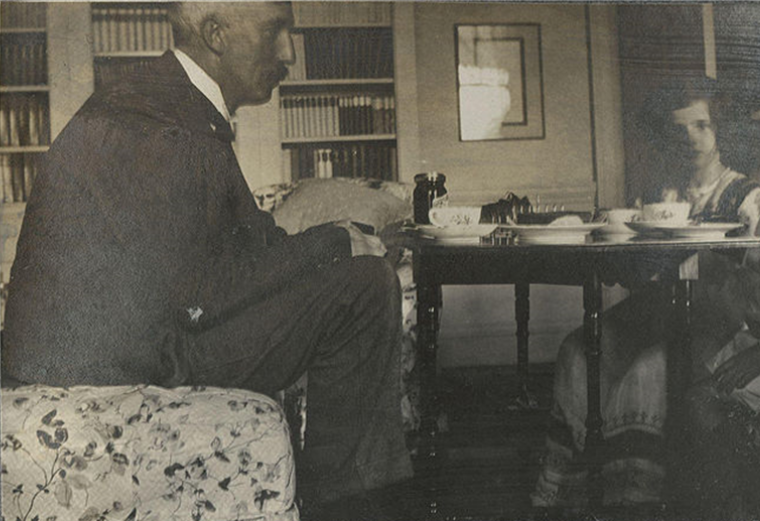
Sir Walter Raleigh (father of Adrian Raleigh) who, apart from being Oxford’s Professor of English Literature, is prominent in the Oxford Volunteer Corps (sometimes referred to as ‘Godley’s Own’). Here is a delightful picture of him with Igor Vinodradoff’s mother. The picture is taken by Lady Ottoline Morrell, the wife of Philip Morrell, who was at the OPS (1878-80) and currently is the Liberal MP for Burnley.

Raleigh & Vinagradoff

As for other changes, George might like to know that street lighting is almost non-existent and ‘Great Tom’ at Christ Church has been silenced for the duration.


May 13th 1916

Following the news of the fall of Kut on April 29th we have now heard from 2nd Lieut. Leslie de Selincourt (who, you may recall, transferred from the 7th Hants to the OBLI), who has been wounded. He has written to us from the Club of Western India, Poona.

de Selincourt L27/4/16 “I lent my valuable assistance during the battles of Feb 21st and March 8th, though unfortunately both turned out rather abject fiascos.

On the night of March 16th I was out in front of the parapet of the front line trench burying some bodies, which had lain there too long to make living next door to them enjoyable. The moon appeared from behind a cloud; an ill-mannered Turk saw me and hit me in the arm; annoyed because I didn’t drop down on my stomach and crawl home, he hit me again. Unfortunately in a more disabling place, the bullet entering my shoulder and reappearing out at the small of my back. I dropped like a stone and was unable to rise until three weeks later.

I experienced the usual sensation when hit – ‘never more pained or surprised in my life.’ Some ribs got cracked, but no vital part was touched and I have been the subject of congratulations from every doctor.

Now I am going up to Naini Tal – a very good spot in the Himalayas. Then I suppose I go back to the Gulf.”

* * * * * * *

Lieut. Leslie Murray (RNAS) was also involved in the efforts to relieve Kut and he too is now in hospital:

3/5/16 “I expect you will be sorry to hear I have arrived at the Funk Hole at Buzra, otherwise known as the British General Hospital. I had been feeling pretty rotten since last Thursday (April 27th) and on Friday I discovered I had a temp of 100.3 degree, so I retired to bed altogether. The heat in my tent was almost unbearable, the only breeze was a hot draught.

The next day I was just as bad, so, as our Naval Doctor has gone down with dysentery, I was sent along to one of the Field Hospitals close by. It was very hot there and the biting flies were most irritating, as I had not got the energy to drive them out of my mosquito net.

It was in the afternoon that I got the news of the fall of Kut, which was rather depressing, although most of us were fairly certain that they could not hold out much longer and it seemed fairly obvious that under the present conditions it would not be possible to get through, because we had a very difficult position to attack.

The Turks were very strongly entrenched at Sannaiat, and with marsh on one side and river on the other, it would have required a much larger division than we had got at the time, to get through.

Of course, several attacks were made on the position, but whenever they got through, they were driven back. We expected Kut to surrender any time, as we knew we could not feed them from the air much longer. Neither the machines or the pilots could stand it…

I suppose we prolonged the agony for four or five days… By the way, the things we usually dropped were ‘atta’ (a native flour), sugar and occasionally chocolate. I usually took 200 or 250 lbs and an observer; the food was placed inside two strong sacks, four 50 lbs sacks being placed on a specially devised bomb rack under the engine or between the floats, the fifth bag was put in the observer’s seat to balance the back of the machine and was heaved overboard by him.”


May 10th 1916

Nevil Norway

Mrs Sturt tells me that she and her husband have received a postcard from Mrs Norway’s sister to say that young Nevil Norway is now safely back at Shrewsbury School for the Summer Term. He visited his aunt on the way back from Dublin on May 5th and reported that the family are well but had lost a number of valuable possessions, which had been stored safely – so they thought – in his father’s office in the burnt-out GPO.

Mrs Norway has also passed on another story of Nevil’s work with the Red Cross:

30/4/16. “This week has been a wonderful week for Nevil, never before has a boy of seventeen had such an experience. Yesterday morning he was at the Automobile Club, filling cans of petrol from casks for the Red Cross Ambulances. In the afternoon he went round in an ambulance with the Lord Mayor collecting food for forty starving refugees harboured in the Mansion House, and then went out for wounded, and brought in an old man of 78 shot through the body. He was quite cheery and asked Nevil if he thought he would get over it? So Nevil said, ‘Good Lord, yes! Why not?’ and bucked the old man up.”

You might wonder at Nevil’s pluck, but nowadays at the Public Schools the Officer Training Corps are preparing the boys for war and Nevil will have had two years of training, so that he was in readiness for such events as occurred in Dublin.

Sackville St in Dublin after the uprising…


May 7th 1916

William Esson

Major William Esson (Royal Marines Light Infantry) 

Lance Freyberg

Lieut-Commander Lance Freyberg (RN)

On 27th April 1916, off the port of Malta, HMS Russell struck two mines laid by a German U-boat and sank. 27 Officers and 98 ratings were lost, including two Old Dragons, William Esson and Lance Freyberg.

HMS Russell

HMS Russell

HMS Russell was flying the flag of Admiral Fremantle, who was amongst the 702 saved. He has written from Malta to say of William Esson, “His cabin was immediately over where the mine struck us. We were hit only four miles from the entrance to Malta Harbour. At that time all the officers, except those actually on duty, were in their cabins, and it is for that reason that we lost such a very large proportion of officers. The great majority of the people on the deck below the main deck, including your husband and five lieutenants (this must include Lance Freyburg) were never seen after the explosion, indeed there are now alive only two men who were in that part of the ship… ”

Whilst 24 officers together with the Captain and Admiral were saved, 27 were killed – almost 50%.

The degree of grief currently the lot of the Esson family can only be understood when one remembers that William Esson’s sister Margaret is the wife of Capt. Edmund Gay (Norfolks), who has been “missing” since last August.

Of Lance Freyberg, Captain Bowden-Smith wrote, “He was asleep in his cabin at the time (5.30 a.m). The explosion took place immediately under his cabin and I think he must have been killed instantaneously and did not suffer. I am afraid that all his belongings went down with the ship. Nothing was saved.”

Clearly, William’s and Lance’s cabins were in very close proximity and it is some small comfort that two Old Dragons should be together, comrades in life and death.

HMS Russell was one of the ships for which our boys supplied the crew with pipes in November 1914. Lance wrote a charming letter back to them. It is a great sadness that the pipes have not become pipes of peace, as he had hoped.


May 5th 1916

A second letter from Mrs Norway has been received, covering the events of April 27th-29th in Dublin.

28/2/16. “Yesterday was the worst day we have had, as there was desperate fighting in Grafton Street at our back and the side streets and several volleys in our street. In the morning I was sitting on a big settee in the window of the Lounge, looking out, and listening to the firing in Grafton Street when some shots were fired just outside our windows, and the Manager rushed in and said “We must shut all the shutters, it is getting a bit too hot,” so all the shutters were closed and I moved up to the drawing room, which also overlooks the street. Just then, the Red Cross sent in to call for volunteers and several men, including Nevil, went off.”

The situation improved in the afternoon, although Mrs Norway witnessed considerable looting from a nearby fruiterer’s shop:

“I never saw anything so brazen: the mob were chiefly women and children with a sprinkling of men; they swarmed in and out of the side entrance bearing huge consignments of bananas, the long bunches on the stalk, to which the children attached a cord and then ran away dragging it along; other boys had orange boxes which they filled with tinned and bottled fruits, women with their skirts held up received from the windows showers of oranges and apples and all kinds of fruit, which were thrown down by their pals…”

The following day (April 28th) was a day of considerable stress for Mrs Norway:

“I am still rather shaky from a fright I got last night. It is too long a story to write in detail, but we had reason to think that Nevil, who is working with the Red Cross Ambulance, had fallen into the hands of the rebels, and we spent an hour I don’t even like to remember and that unnerved me more than I like to think possible. The thing was unfounded and we found out he was all right, and this morning he turned up to breakfast and has now gone off again.

He is, of course, safer attached to the Red Cross than roaming the streets making rescues on his own, but the risks are many and great: among other things, they enter houses where there are known to be wounded Sinn Feiners and bring them out. This Nevil was doing yesterday…”

Nevil has indeed shown a lot of pluck for a boy of his age – but having lost her older son already to the war, Mrs Norway’s resolve is also to be marvelled at.

The night of the 28th was no easier for Mrs Norway and fellow residents in the Royal Hibernian Hotel. Bullets came through windows in an annexe, which had to be evacuated. All of them had to take refuge in the hotel’s lounge, fearing all the time that the hotel might be set on fire by the rebels. Only later could they venture to bed:

“Things quieted down and about 11.30 we crept up to our room and lay down in our clothes.”

In the morning an officer visited the hotel to try to persuade everyone that it had been the military whose bullets came through their windows the previous evening. Mrs Norway felt this to be the case.

“People were constantly pulling up their blinds with the lights on, probably servants and residents, to look at the fires, and the military have orders to fire on anything that resembles signalling, without asking any questions, and I expect that this is the true version.”

Mrs Norway rounded off her letter with the news of the rebels’ surrender:

29/4/16 4pm. “Sir M. Nathan has just rung up to say that the rebels have surrendered unconditionally. We have no details and the firing continues in isolated parts, but if the leaders have surrendered it can only be a question of a few hours before peace is restored and we can go forth and look on the wreck and destruction of this great city.

And so end six of the most terrible days in the history of Ireland, comparable only to the Indian Mutiny.”