December 23rd 1924

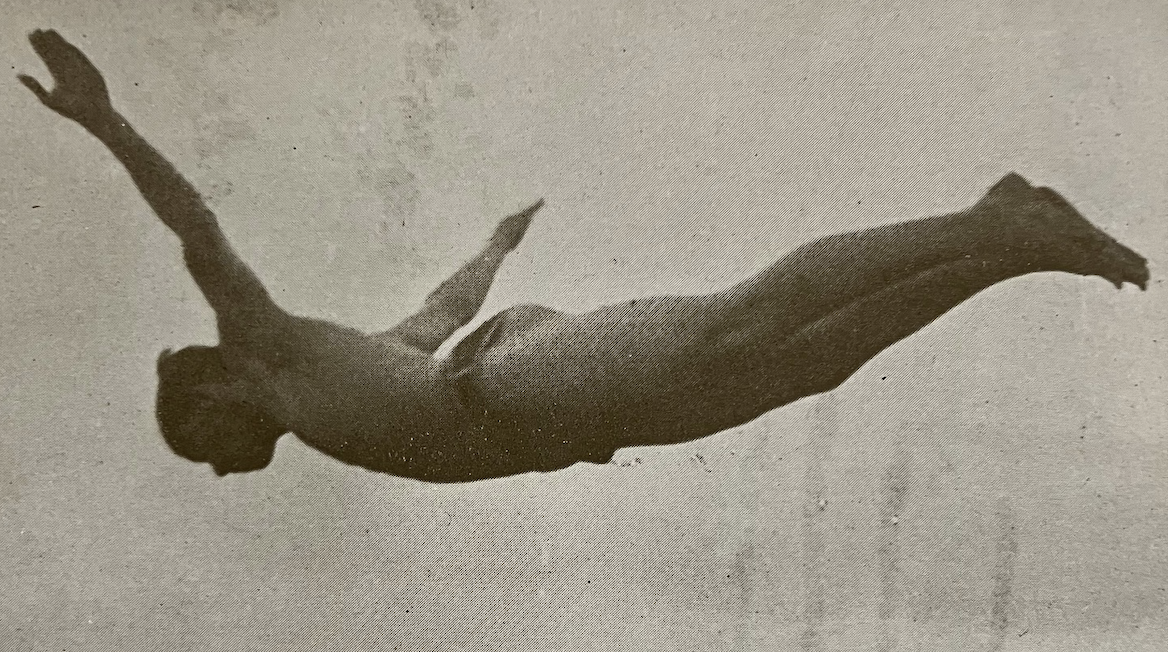
Dick Sergent diving at Repton  

It seems right to celebrate the life of Dick Sergent more fully, particularly as a sportsman of some note. In addition to his prowess as a diver (he won our diving prize every year from 1899-1903), he was a talented player of both rugger and hockey – once captaining our team which contained seven future Half-Blues, of whom two became internationals.

He left Repton after only three years to complete his education at the Lycée Saint-Louis in Paris, so as to be with his brother Victor. Here the two brothers attempted to introduce the Lycée to football, but they were called up before the “Censeur” and told to get rid of the football immediately. “If someone breaks a leg or an arm, the parents will hold us responsible,” said the Censeur!

Nonetheless, Dick went on to become a formidable player of association football. In 1912 he was (along with his brothers) in the winning team of the French Soccer Cup and was selected to play for France at the Olympic Games at Stockholm, in a side which his brother Victor was to have been captain. Unfortunately, the French Committee was unable to send the team, owing to lack of funds.

After leaving the Lycée, Dick entered the Polytechnikum in Zurich where he excelled, captaining the Zurich ice-hockey team and stroking the winning four at the Lucerne regatta. However, it was his proficiency in boxing, together with his craving for adventure, that led him into serious trouble.

In the summer of 1911, one of the items on the programme at the Corso (a large and popular music-hall) consisted in the appearance on the stage of a large number of plump German ‘fraus’ wearing German ‘pickkelhaube‘ and singing one of the popular French songs, which was enough to offend any high-minded Frenchman. Consequently a number of the French students interviewed the manager and asked him to remove that item from the programme.

This the manager refused to do; so the next day the Frenchmen came in force to the performance and drowned the French marching song with hostile shouts and remarks. They were, however, immediately surrounded by a large company of plain-clothes Zurich policemen, who they mistakenly took to be local roughs.

A fierce fight ensued, which was continued in the streets. Dick, who had come as a ‘neutral’, on being hustled, joined forces whole-heartedly with the Frenchmen. Unluckily, they were outnumbered and Dick was ultimately overpowered, but only after he had knocked out five policemen. He was condemned to three weeks in prison and a 1,000 franc fine – which was paid by a subscription among the Frenchmen. The hardships of prison life were alleviated by letters of congratulation from English sportsmen, who had read about it in one of the papers.

This is an early example – three years early – of England and France joining hands against German aggression and misappropriation. As in 1914, it seemed to meet with the approval of the British public!


December 19th 1924


Raoul ‘Dick’ Sergent (1889-1924)

We have to record with sincere grief the death of Dick Sergent, at Lons le Saunier, Jura, France on Thursday 4th December, aged 35.

His death, following within a year of his brother, Victor Sergent, seems particularly sad, as they were fine athletes, both of whom had gone safely through the war, and both have died suddenly so soon after it.

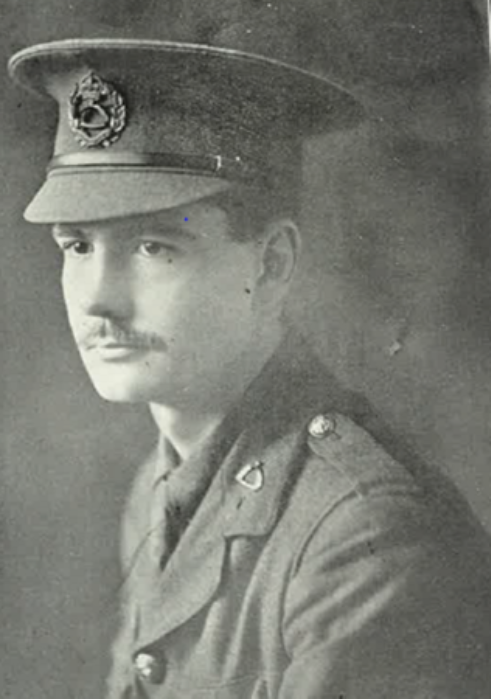
Although half French, Dick was born in England and therefore a British subject. Whilst his brothers joined the French Army, Dick joined the British forces and in 1915 he was sent to Mudros, then Suvla Bay (Dardanelles) and Imbros. He wrote a capital account of his experiences in the final withdrawal from the peninsula in January 1916.

In 1917 he obtained a commission, and was Lieutenant RNVR in the anti-submarine department at the Admiralty, under an Old Dragon, who is now Admiral WW Fisher.

After the war he trained as an electrical engineer, but his various jobs did not work out and when his brother Victor started a motor-bus business in the Jura, Dick joined him as a partner. This was May 1923 and then when Victor caught broncho-pneumonia and died last December, Dick carried on alone. In the course of the year that followed Dick worked himself to the bone; he was enormously strong, but his strength could not last forever. He was persuaded to employ an under-manager.

It is a cruel irony of fate that when the under-manager arrived and Dick was showing him the ropes, he (Dick) collapsed suddenly at his wheel and died. He leaves a widow and two children – a girl of four and a boy of two.

I think Dick’s greatest pleasure in life was to come down to the School in summer and use the bathing-place for some of his wonderful dives. I have seen him many times do a dive off the top board – a run and a leap into the air, legs thrown forward up to the moon, body bent round with a jerk, and finish up in a dive. Another of his stunts was a long-arm balance on the top board, followed by a double somersault into the water. He must have broken himself many times practising these and many other fancy dives, but he was a ‘tough nut.’

Dick had a most unselfish character and generous heart. His death leaves a gap in our hearts which will never be filled.


April 26th 1924

The main purpose of this log was achieved some time ago: to record the events of the period of the Great War, as they impacted our small school here in Oxford. In particular, it sought to honour those who gave their lives.

However, I continue to follow the careers of those who fought and have survived the war and will record their peacetime progress.

Sadly, the news has reached us that another of those brave men who served in the war has died: Geoffrey Simeon, on December 27th 1923 at the Presidency General Hospital in Calcutta, following an accident, aged 35. On leaving us, he attended Marlborough as a Foundation Scholar, before going on to Oriel College Oxford. In the war, he served as a 2nd Lieut. with the Gurkha Rifles. At the time of his death he was working for Imperial Forest Services in India.

The latest edition of ‘The Draconian’, which has just been published, includes news concerning four of our wartime warriors:

Pat Duff, having been private secretary to Mr Stanley Baldwin, is now similarly private secretary for the new Prime Minister, Mr Ramsay MacDonald.

Sholto Marcon has played hockey for England and Donald Innes for Scotland.

Jack Haldane has had another book published: ‘Daedalus. or Science and the Future‘. It is based on a lecture he gave to the Heretics Club at Cambridge last year. In it he lists a number of developments he feels to be ‘probable’ in the next 50 years – for example:

“Though coal and oil fields fail, the intermittent energy of the wind will be transformed into continuous electrical power.”

He also voices a concern that not all scientific advances will be beneficial, unless there is a similar advance in ethics.

Perhaps the most startling of Jack’s ideas (at least to me as a non-scientist) is that concerning “ectogenesis“, suggesting that babies in 150 years time might be mostly conceived and grow outside the mother’s womb, in laboratory conditions (presumably). But this is not the full extent of Jack’s vision of the future.

“In the future perhaps it may be possible by selective breeding to change character as quickly as institutions. I can foresee the election placards of 300 years hence, if such quaint political methods survive, which is perhaps improbable, “Vote for Smith and more musicians”, “Vote for O’Leary and more girls”, or perhaps finally “Vote for Macpherson and a prehensile tail for your great-grandchildren”. We can already alter animal species to an enormous extent, and it seems only a question of time before we shall be able to apply the same principles to our own.”

This book has apparently inspired some intense debate. I am not surprised!

March 17th 1924

Victor Sergent, whose death we recently reported, was a double international, playing for France at both cricket (1906-7) and association football (five times between 1907-13).


The Championship-winning Stad Raphaëlois XI of 1912

The Sergent brothers together with Lindsay (Pug) Wallace (who married their sister, Deta) played in the team that won the French Championship of 1912 – see above: Victor (standing, 2nd left), Noel (kneeling, left), Lindsay Wallace (kneeling, centre) and Dick (sitting, 2nd right).

‘The Draconian’ of August 1912 recorded their success thus:

The Stad Raphaëlois, the team that won the Championship of France at Association Football, contained 4 ODs. Victor Sergent (captain and full back), Noel Sergent (right half), Dick Sergent (inside left) and Lindsay Wallace (centre half). All four played in the final and the semi-final, winning the final after two hours play by 2-1 against the Association Sportive Française. Apropos of this, soon after the final, Victor Sergent was elected a conseiller municipal of St Raphaël at the head of the poll…

Les Sergents de Saint-Raphaël, Le Matin le 29 avril 1912 (Victor, Noel, Dick and Lindsay Wallace)

On receiving the news of his death, the Town Council of St Raphaël decided to honour Victor’s memory by changing the name of their football field and calling it ‘Stade Victor Sergent’.


March 11th 1924

Victor Sergent (1886-1923)

Rather belatedly (for which apologies),  we announce the sad news that Victor died on December 28th 1923.

Victor, who was at the OPS (1894-1900), was one of three brothers (with Noel and Dick) and a sister (Deta), all of whom joined the school from their family home in France. On leaving the OPS Victor went on to Winchester as a Scholar, where he shone both academically and as an athlete.

On leaving Winchester, Victor opted to finish his education in France, rather than go up to Oxford.

GC Vassall, our editor, writes in the up-coming edition of ‘The Draconian’:

He went first to the Lycée Saint Louis in Paris, and afterwards to the École de la Rue Violet, where he studied engineering… he also played soccer for the Racing Club de France, and was in the side which won the French Cup. At this time he played for France on many occasions…

Sgt VLB Sergent (ASC)

Victor was in England when war broke out. He joined up with the MT in England and was at Bury St. Edmunds for a time, with the rank of sergeant [making him Sergeant Sergent!]. Later, in France, he was riding a motor-bicycle between two lorries carrying munitions, when his fork broke for reasons unknown, and he was knocked unconscious. When he woke up, he was lying in hospital with a hole in his knee.

Following a period of convalescence in England, he was sent out to Basrah in Mesopotamia, where he gained his commission. He was one of the famous expedition to the Caspian Sea through Persia, being in charge of a certain number of Ford cars, all of which completed the double journey.

After the war, Victor spent time working as a travelling agent for Agricultural and General Engineers in Algeria, Tunisia and Morocco. Returning home to France, Victor recently started a motor transport service with his brother Dick. They had made a good start and it had been going for about eight months when Victor developed broncho-pneumonia, from which he died after a short illness, aged 37.

Much more can be said of Victor, particularly as a footballer, but this must be for another day…


December 9th 1922

Dr Robert Garner Lynam (1859-1922)

On Friday 1st December Hum and I lost our dear brother Robert, who has served our school most loyally and skilfully for the past 32 years.

It was only a couple of months ago that he took up residence with me at 12 Bardwell Road – an arrangement I had fondly hoped we would both enjoy for many a year to come. It was not to be.

Yesterday’s edition of the ‘Oxford Times’ paid tribute to his life:

“He was the second son of the late Charles Lynam, of Stoke-on-Trent. He, with his five brothers, was educated at King William’s College, Isle of Man… In 1879 he gained a scholarship at King’s College, London, and in 1880 the Warneford Scholarship. He was one of Dr Lister‘s pupils…  and from 1884-89 became house surgeon and house physician at the North Staffordshire Infirmary.

In 1890 he joined Dr WT Brooks as medical practitioner in Oxford and in 1896 he took his MA degree as a member of Hertford College…”

Captain RG Lynam

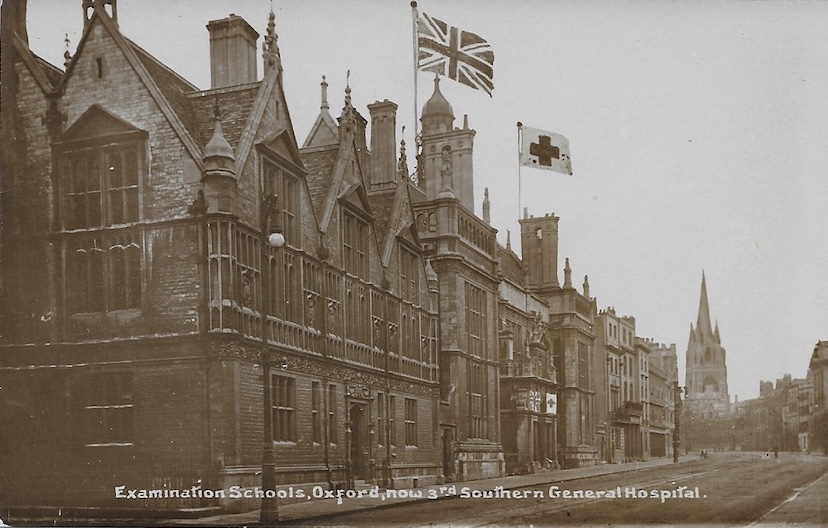
During the war ‘The Doctor’ was given a commission and served as captain in the RAMC, working for the 3rd Southern General Hospital.

His partner in the Oxford practice, Dr WT Brooks, is quoted as saying “as an anaesthetist he was without rival and I believe he never lost a single patient out of the many thousands he anaesthetised. This is remarkable when it is remembered that this applies not only to his private and hospital patients, but to the large number of severely wounded men who needed operations at the 3rd Southern General Hospital.”

In addition, he was commandant of the Oxford Women’s Voluntary Aid Division, getting the highest praise from the inspecting officer. He also gained a high reputation as anaesthetist to the Headington Orthopaedic Hospital.

His obituary gave good account of his interests and character:

“He was President of the Oxford University Chess Club and played two years against Cambridge and against the American Universities. He was a capable and active member of the University Skating, Lawn Tennis and Croquet Clubs. His papers contributed to the Oxford Medical Club on literary, social and art subjects were full of a dry humour and subtle wit which made them always popular…

To these high and varied achievements in Dr Lynam was added a character of indomitable courage, of devotion to duty and of a refined purity of life and thought, which filled all those who knew him intimately with a proud and admiring love. With a deep reserve in religion, he had a firm faith in a good and Almighty God and in the certain reunion of kindred souls hereafter…”

However, it is as part of our school community that we will remember him best. As Hum has observed, he had become part of the place, and was known by everybody at the School. He was daily at the School House tending to our boarders’ needs.

The ‘Oxford Times’ echoed our feelings for him and described his final days:

“He gave the most unremitting care and loving attention to the health of the boys as medical officer to his brother’s preparatory school, and on Armistice Night, the day before his fatal illness, he attended at the school field during the fireworks and bonfire so as to be on the spot in case of accident…”

He died after three weeks’ brave and patient endurance, from an attack of pneumonia, aged 63. He had been a life-long sufferer from asthma.

The funeral was held on Monday (4th) and the ‘Oxford Times’ noted that “As the cortege passed Lynam’s School in Bardwell Road, students and masters paid a tribute of respect to their headmaster’s brother by lining the pavement with heads bared.”

The service was held at the Wolvercote Cemetery. The committal sentences were read by Rev TT Blockley (who taught Divinity at the School before the War and whose son Nigel Blockley was a Dragon).

Nearby is the grave of young Kenneth Stradling, who left us almost exactly two years ago, aged 10.


September 24th 1922

THE BOOK OF WAR MEMORIALS

This long-awaited book has now been published and one copy of it is being sent free to the nearest of kin of each of those commemorated (83); also to each subscriber (about 400) to the War Memorial Fund. The cost of this will be covered by the Fund. There will also be about 300 copies, which may be obtained from the Controller, University Press, Oxford at £1 each. Of this £1 all but 2/- (for packing and postage) will go to the School Exhibition Fund.*

The School has bought, and will continue to buy, a certain number of copies for school prizes etc and the payment for these will go to the same Fund. The Press have agreed to keep the type standing for six months and we can have 250 more copies, in addition to the 750 that were originally ordered.

It is, I hope you will agree, a beautiful volume, bound in dark blue with designs in gold on the cover, by Leonard Campbell Taylor. A coloured frontispiece, also by him, shows a Dragon boy and girl at the foot of our Memorial Cross.

Then comes a short dedication to ‘Dragons of all generations,’ then a photo of the Cross and the list of the 83 names in alphabetical order. The poem ‘Two Voices’ by David Brown (killed 1916) serves as introduction to the memorials which follow, each illustrated by a photo of the boy as a Dragon, as well as one or more in later life.

At the end is Leonard Taylor’s coloured cartoon, ‘Peace.’  I hope parents will give their sons the opportunity of reading, or hearing read aloud, these splendid lives. They are better than any sermon.

* This is to assist parents of boys in the school who are unable to pay the ordinary fees. Their circumstances are such it that would otherwise be impossible for a boy to remain at the School, or to go on to a Public School; in addition, there are at least two sons of Old Dragons killed in the war for whom we shall wish to provide Preparatory School education without charge.

* * * * * *

A bound copy of ‘The Draconian, 1914-18,’ was sent by request to the official Historian of the War, who acknowledged it in a very kind and appreciative letter. We have also received the following letter, and in reply are sending a copy of ‘The Draconian 1914-18,’ and also a copy of the ‘War Memorials.’

Dear Sir,

With reference to the book 'The Draconian, 1914-18' I venture to 
ask if you will honour the Imperial War Museum with a 
presentation copy of this work, to be placed among the records 
in the Library.

Yours faithfully,

J.H.H. Dare (Capt)
Librarian

September 3rd 1922

The arrival of September sees the completion of the 104th edition of ‘The Draconian’, by its editor of these past 14 years, GC (Cheese) Vassall, covering the events of last term. There have been many highlights, one of which was on May 21st, VC Sunday, the annual celebration of Jack Smyth and William Leefe Robinson‘s wartime achievements.

It was a delight to have Major Tyrrell Brooks MC give the address at our Sunday Service. As a title he took these (unattributed) words:

‘You must remember that people with visions from high mountains must also pass through deep valleys – you must realise what is happening and that Light will come again.’

He started his address by explaining how these words struck a chord with him, as someone returning from the war:

“To me, when I was told [these words], they meant an infinite deal. The war was over, and we who had been living on our nerves for five years were subject to deep fits of depression, alternating with optimism – in other words, the main issue of one’s professional life had passed and had left a blank, and the world seemed upside-down, and nothing normal…”

Having emphasised the difficulty of adjusting to a new world of peace, Tyrrell expanded on how, some eight years ago, Europe descended into war and the standing armies had been swamped and their places taken up by thousands of volunteers:

“About the time I am referring to everybody had gone from the mountain tops and were in the deep valleys. The great opening battles of the war had been fought and a paralysis, through lack of manpower and temporary exhaustion, had made the battle front a desolate and gloomy picture of trenches and mud. Into these conditions the volunteers of the early days were thrust; no chance of distinction, no glamour of moving battle, but simply a duty to be performed, and that was sticking it out while the nation re-organised to win.

Looking back on those days, one realises so well that the attribute which pulled one out of the deep valleys was a thing called ‘patient courage’ – the power and grit to live, and cheerfully live, under conditions which, to say the least of it, were appalling…”

He ended his address by urging us all to confront the challenges of the present and future, warning us to expect ‘ups and downs’ and to realise that if something is worth having, it is worth fighting for.

“I often think it is a good thing to think and ponder over those great years of 1914-18; it is good to realise what the patient courage of those that fell meant in that great struggle; it is good also to train yourself to acquire that patient courage in everyday life – and when you are in doubt, think of the lines which are inscribed on a stone cross in a quaint little old Devonshire village to commemorate those who had given their lives to keep England free:

‘Those who live on ‘midst English pastures green, look at this Cross and think what might have been.'”

Tyrrell contributed on a number of occasions to the wartime editions of ‘The Draconian’ – his letter about Tommy Atkins was particularly striking.


July 22nd 1922

Prizegiving marks the end of another school year, the fourth since the end of the war. It was evidently much enjoyed by parents too, one of whom commented, “The prizes seemed as numerous and satisfying as ever. The constant applause indicated that they had reached the right persons. I am always impressed by the Draconian joy in the success of others, and by the vicarious delight of those who have won no prizes.”

One cup that is very special and prized above all others is the Officers’ Cup, presented in 1917 by a group of officers recovering from their wounds in Somerville College. They stipulated that it should be awarded, by the vote of the whole school, to the boy who had “the most gentlemanly bearing and best influence on other boys.” This year’s winner is Percival Mallalieu:

Along with two other young Dragons (John Anderson and Gabriel Carritt) Per received a mention in Hum’s speech to the parents:

“We have had fine fellows, fine scholars and fine athletes before: but never have we had, at the same time in the School, three boys who each combined in himself the fine fellow, fine scholar and athlete as they are combined in these three. It has been a wonderful privilege to masters and boys to have these three to lead the School.”

Three of Per’s cousins were casualties in the War: David Brown, Percy Campbell and Wallace Hardman. They would have been proud of his success.

Per leaves us this term – with a scholarship – for Cheltenham College. We will watch his future progress with much interest!

July 16th 1922

Leslie de Selincourt

News has reached us of Leslie’s death in Switzerland, aged 30, on July 14th.

During the war he served with the Hampshire Regiment, but in 1916 was attached to the Oxfordshire & Buckinghamshire Light Infantry. He was part of the army sent to relieve Kut which ended in failure. Leslie was wounded and was taken to recover in India, where he recovered but also caught malaria.

He stayed in the army through to October 1920, at which point he transferred as a Captain to the Territorial Reserves. Thereafter we rather lost touch with him. Given he died at Hotel Les Chamois in Leysin, a sanatorium, it seems likely he died of tuberculosis.

Leslie did not marry, but leaves a considerable family behind including his brother, Aubrey de Selincourt, who was shot down, we now know by German ace Werner Voss (his 31st victory), and spent the final year of the war in captivity. He is now teaching at Bembridge School on the Isle of Wight.

Before the war, their sister Dorothy married Mr A.A. Milne, an assistant editor of the ‘Punch’ magazine who had a novel (‘The Red House Mystery’) published earlier this year. They have a two-year old son, Christopher Robin Milne.