April 7th 1915

Ronnie Poulton’s Battalion has now moved on to Steenvoorde, the Brigade headquarters, where the troops were inspected by Sir Horace Smith-Dorrien (General i/c British 2nd Army),  who explained that they were to undergo further instruction before going up to the Front.

Ronnie’s journal tells of his other duties too.

RWPP profileSaturday 3rd April. “This day passed quietly with parades in the morning, spoilt by rain. The beautiful weather of the last few days seems to have broken up. We had several interesting talks with French soldiers who have just been relieved from the trenches. They were very cheery, but not very smart.

Franking the men’s letters is a great nuisance, though unavoidably one gets some interesting lights on their characters. The men were paid five francs this day.”

Easter Day was spent at Flêtre.

Monday 5th April. Flêtre. “The people round here in the farms are very much on the make. My French is coming on by leaps and bounds and I am doing my best to stop the fellows getting cheated. The food is very plentiful and good, but mostly tinned and biscuit; so they will buy bread at exorbitant prices.

It is much better fun than at Chelmsford because, though discipline is more strict in lots of ways and the punishments much more severe, the tone can be much more friendly with one’s men and it’s rather humorous to receive compliments unofficially by reading the men’s letters, as we have to censor them; and they are meant because the writers do not give their names and you only know that they come from the Company, but do not know which Platoon.”

From Flêtre, Ronnie has now moved on to Bailleul and it cannot be long now before he reaches the Front.
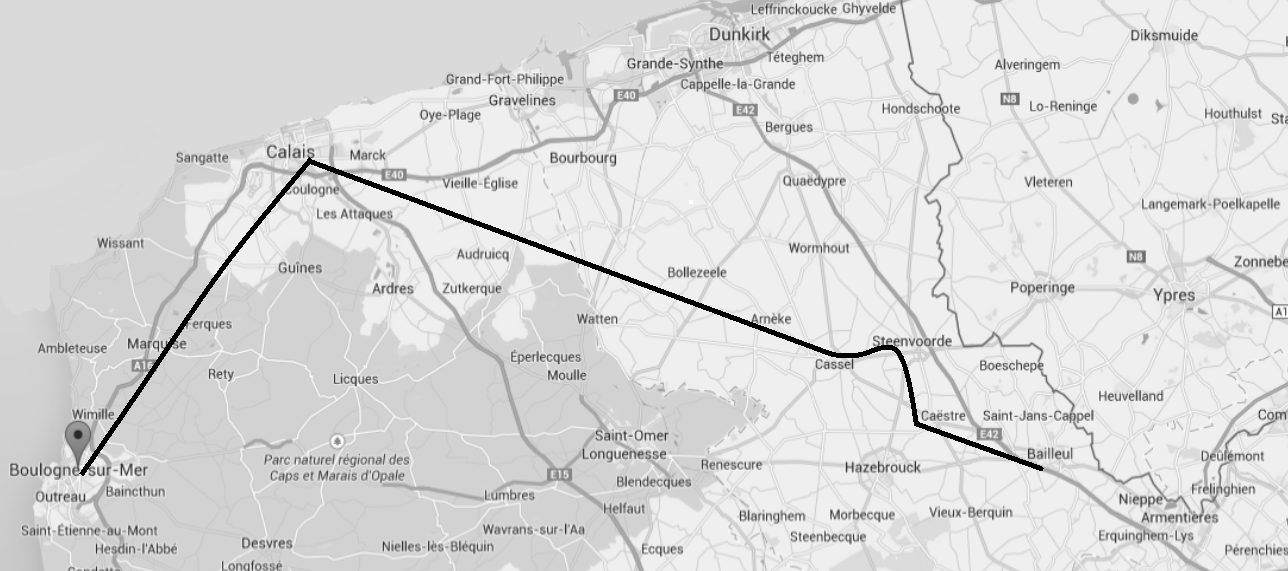
Boulogne-Bailleul route

April 2nd 1915

Those who were at the OPS with Ronald Poulton will never forget the match we played (in 1902) against St. Edward’s School Oxford Juniors, in which he scored fifteen tries. Even then, aged 13, he was finding his way through opposition defences with a “regular rugby swerve”, as one member of our staff commented.

One of his more recent opponents is reported to have said, ‘How can anyone stop him when his head goes one way, his arms another, and his legs keep straight on?’ How indeed!

Now in France with the Royal Berkshire Regiment, he and his men are making their way towards the front line, marching from Cassel to Winnezeele (on the Ypres road). Here they were billeted for the night.

RWPP profileThursday 1st April. “The farms were found to be very comfortable, especially the one inhabited by my Platoon. The woman in charge supplied them with eggs, milk etc very cheaply and the barn they slept in had plenty of clean straw. They had a pond to wash in and a field to play football in so they were all right… I lived in the pub and was quite comfortable though the room and bed were very dirty.”

We look forward to hearing more news from Ronnie over the coming days.


April 1st 1915

England v France 1914

England v France, April 1914.

It is only a year ago that we were reading of England’s great victory at rugger over the French – now our allies – in a match that our dear old boy, Ronnie Poulton (now known as Ronald Poulton Palmer) captained the side to a 39-13 victory, scoring four tries himself – a record, surely, that will stand for a long time.

‘The Sphere’ reported the match in glowing terms, describing Ronnie as providing the moving spirit:

“It was a tremendously fast game, marred to some extent by roughness on the part of the French players, who do not yet seem to have learnt the true spirit in which to play the game. Poulton Palmer was again the moving spirit in the English attack and he has entirely confuted those critics who were for leaving him out of the English side this season on his poor showing in the trial games. Palmer is always worth playing in our international side as long as he is willing to do so, partly because of the fear he engenders in the opposition and partly because he is always likely to win a match off his own bat.”

‘The Field’ magazine commented that “Much has been said of his dodging, but his effectiveness has really lain more in his promptitude in discovering the right direction for his runs and the point at which he could best support his comrades.”

Ronnie is now a Lieutenant in the Royal Berkshire Regiment and we hope to follow his progress over the coming months and fervently hope that he will be returned to us safely when this war is over to resume his captaincy of the England team.

On crossing the Channel to go to the Front, he is keeping a journal and these are his first entries: 

RWPP profile

Lieut. RW Poulton Palmer


Tues 30th March. “We found ourselves boarding the ‘Onward’, the ordinary traffic steamer – Folkestone to Boulogne. I believe I crossed in it for the French match this time last year…

The embarkation was very well done, the men being quiet and orderly and our time of embarkation only just second to the Bucks, who easily beat the record for the port, which has seen 55,000 troops cross over. It was an eerie crossing, a full moon, a smooth sea, and a torpedo boat zigzagging about in front of us…

At Boulogne we disembarked and I found the Port Commandant was old Col. Eastwood of the Oxford OTC. We formed and marched up the hill to a camp. Here we fitted the men and got in ourselves and spent a very cold night (under canvas with only one blanket per man. They awoke to driving snow).”

Wed 31st March. “We marched off to the Pont des Briques , a matter of four miles. The men found the pack rode very heavy and two or three fell out. At the station the Battalion was divided into parties of 42 – each party to go in a goods van… There was a ghastly crush in the train, since we were one truck short and as many as 50 were in some. They could not sit down, but had to stand on the six hour journey. Off we went about 11pm and arrived at St. Omer via Calais; then on to Cassel which was our detraining point. A ghastly cold night and little sleep.”