November 6th 1916

Although France is currently the centre of attention in this war, the North-West Frontier continues to require policing, in order to thwart German efforts to threaten British power in India.

north-west-frontier

Lieut. Jack Smyth VC (15th Sikhs), who wrote to us in June about the signalling course he was sent on, has written to say that he is back on active service there:

Jack Smyth28/10/16 “Here we are on the frontier, once more on active service and I am writing this in the Mess tent, well dug down below ground to escape stray bullets…

I arrived at Peshawar to find the regiment had marched out the day before and orders awaiting me to command the Depot.

A newly joined subaltern came up and reported that he had been left as Adjutant and handed over piles of correspondence, which we had to get down to at once…

We had two or three very strenuous days with the usual notes from everyone who had gone out with the regiment asking for various things they had left behind. This sort of thing:

‘Please get the keys of my bungalow from my gardener and on the bunch you will find a brass key, which opens the third drawer of my writing table. At the back of the drawer you will find my despatch case and in it my cheque book. Please send this out by the milk lorry tomorrow. Awfully sorry to bother you, as I know how busy you must be,’  but this is part of the Depot commander’s job…

Three days ago I was relieved and sent out to join the regiment. The Mohmands with whom we are fighting, or supposed to be fighting, have so far left us severely alone, but come down at night and snipe and hurl abuse at us…

We can’t attack them because they would only retire to their hills and we should need a large force and a long line of communication to follow them, and they won’t attack us because they think barbed wire and mountain guns an unfair advantage.”

Before this, Jack had been on leave in Kashmir, where he reports that he met up with fellow Old Dragon, 2nd Lieut. Edward Sheepshanks (Indian Army) at a dinner party,

“…and thereupon had an OD dinner on our own and drank to the Skipper and the OPS, which astonished the rest of the party…”

Knowing how lively an affair an OD dinner can be, I am not surprised they were astonished!

(At least there were no Wykehamists present to sing a joyous chorus in praise of the present subjunctive – and they did not have to suffer my recitation of the Banjo Song!)

* * * * * * *

Roderick HaighToday is the second anniversary of the death of Lieut. Roderick Haigh (Queen’s Royal West Surreys). Thanks to his bequest, which paid for our shooting range, the boys will be competing for the Roderick Haigh Cup at the end of this term.

He was a noble man, who saw it as a privilege to die for his country.

September 18th 1916

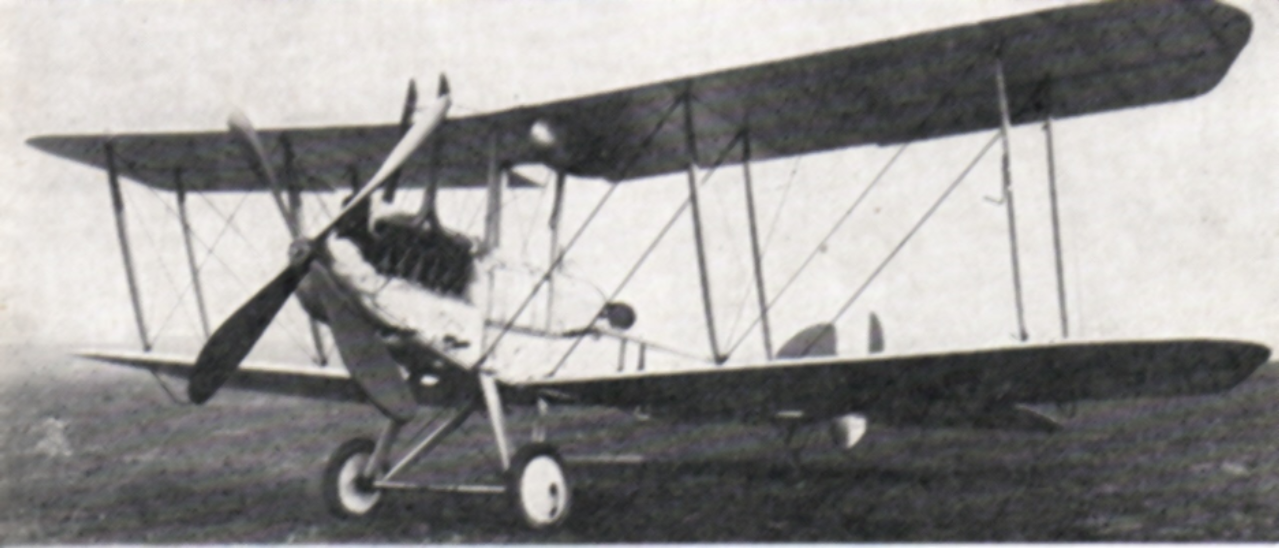
2nd Lieut. Sydney Carline (RFC, 19th Squadron) was shot down and wounded at the end of August over the Somme battlefield, on a bombing expedition against a railway cutting some 20 miles behind the front line.  His brother, George Carline, visited him in hospital and has extracted the following details:

George Carline

“After Sydney had dropped his bombs and was returning, it appears he got separated from the rest of his squadron and was attacked by four German machines. These machines had been flying at about 15,000 ft on the look-out for any separated machine to tackle. It is one of their methods to fly high and dive at a great speed on an enemy machine, firing their machine gun as soon as they are within range until they catch it up, when they turn to one side and continue their dive to their aerodrome and safety.

My brother was apparently unconscious of any enemy machines about, until he heard the firing of the gun behind him. He says that owing to the noise of the engine it is impossible to hear anything except a gun at close range or the explosions of anti-aircraft shells.

The first German machine damaged his engine slightly and wounded him in the leg. He says there were eight holes in the petrol tank, and other shots hit the back of the seat he was sitting on.  With his damaged engine he had to put his nose down to keep up speed and consequently could not bring his gun into play. His machine was a single-seated scout, with a Vickers gun timed off the engine to fire through the propeller, and to aim the gun the whole machine had to be directed towards the object, as the gun is a fixed one.

Not being able to turn and fly upwards at the German machines and so use the gun, he had to continue his course and keep turning about trying to escape the Germans or at least make their firing harmless, and at the same time firing a Lewis gun fitted behind him. But this gun, he says, is very difficult to aim with success and fly a machine at the same time.

One after another of these machines dived on to him firing their guns, and after he had dropped about 5,000 ft., the Germans made off home, and he was able to get over the lines again at about 5,000 ft. up. Crossing again by the Somme, ‘Archie’ left him alone, anywhere else he would have made a good target at that height.

His leg was numbed by the wound, so that it did not pain him, and by using his heel on the rudder instead of his toe, he was able to manage his machine all right and get back to the aerodrome. The petrol pouring from his tank was very useful, he said, as it kept his leg cool and he was able to drive his engine off his spare tank.”

b-e-12-carline

A B.E 12 aircraft of the type flown by the 19th Squadron.

Sydney has told George that he is spending his sick leave in helping with an invention connected with flying.

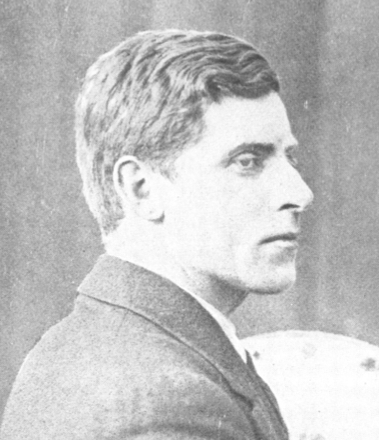
Sydney Carline

Before the war Sydney was a budding artist, following in the footsteps of his father George Carline. In 1911, W. Davis of Turl Street commissioned him to complete six charming etchings of Oxford.

On the outbreak of war he became a dispatch rider before joining the RFC.

August 10th 1916

Paddy Burton‘s father, who writes under the pseudonym of ‘Touchstone’ for the Daily Mail, has sent us this poem for the forthcoming edition of the ‘Draconian,’ to be printed alongside the notice of his son’s death.

How well it captures the pain all parents must feel when receiving such heart-breaking news as the death of a beloved son.

Burton P (2b)

Deeply regret to inform you that Capt HPC Burton 1st Bedford Reg’t was killed in action July 27. The Army Council expresses their sympathy.

A SCRAP OF PAPER
A scrap of paper! “Killed in action,” so
Die all the dreams of happier days to be!
And yet, thank God, you were the first to go
When England called for Men to keep her free.
Thank God for that pure, manly heart and true
That kept your face for ever towards the light
That lit the only path you ever knew
And made you victor still in death’s despite.

Not all our sighs, not all our selfish tears,
Can call you back, but you whose clear young eyes
Looked on the promise of the coming years,
You never grudged the final sacrifice.
Is it not written that your latest breath
Bade him who brought you succour not to stay
But to pass onward through that land of death,
To lead your well-loved soldiers in the fray?

A scrap of paper? Nay, a sacred scroll,
A great and glorious treaty, signed and sealed
In your heart’s blood, wherein our England’s soul
For those who shall come after, stands revealed.
So thank we God who in his mercy gave
His own dear son to death upon the tree,
For all who follow him who died to save
And win the deathless crown of victory!
                                       Touchstone

August 5th 1916


Paddy Burton

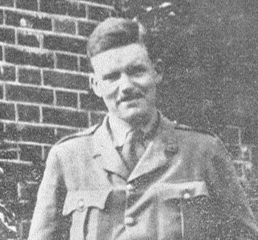
Captain Paddy Burton (4th Bedfordshires)

Alongside the notification of the death of Robert Gibson, The Times yesterday also listed the death of Paddy Burton.

On July 27th, Paddy led an attack on Longueval by the 1st Bedfordshires (to whom he had been attached since May 1915). This was a success, but there were isolated pockets of resistance. He and another officer discussed how they could dislodge the Germans from a house, where a machine-gun was sweeping over the British position. Paddy decided on an attack with hand grenades, during which he fell wounded in the leg.

Company Sgt Major Afford went to his assistance, dressing his wound before attempting to carry him to a place of safety. However, before Afford could move him, Paddy received a second and fatal wound, caused by a bullet having come through the lip of the shell hole and penetrating the lower part of his head.

Afford reported that Paddy “…remained conscious for a few hours, during which time I stayed with him and comforted him. His last words were to me, requesting me to carry on with the task he had so nobly set out to do…

At day-break I supervised his body being laid to rest close by the spot where he met his end.”

The day before he was killed, Paddy Burton had reconnoitred the approaches to the village of Longueval together with another officer, who recalled:

“It was a very trying job, as our guide lost himself and we sent him back. We were under incessant shell-fire and we knew that a great part of the ground was exposed to snipers, and we had to find out absolutely everything for ourselves. I don’t think I could have done it without Paddy… He must have been at least as tired and depressed as I was, but he wouldn’t allow it to show.”

Paddy was one of those boys who make life ceaselessly interesting to a schoolmaster. It may be said that he was a strange compound of liberal and conservative, but what characterized him most was his independence of judgement and his pluck.

He was to have been married during his next leave.

July 11th 1916

AG Clarke

2nd Lieut. Geoffrey Clarke (Rifle Brigade)

It is with particular sadness that I have to give you the news of the death of Geoff Clarke. His brother, Capt. “Bim” Clarke (10th Gurkhas) received the telegram on July 7th and the notice of Geoff’s death is in the Times this morning.

Geoff, who was first thought to have been killed on July 2nd, was in fact a casualty of the initial attacks on July 1st. The Redan Ridge, north of Beaumont Hamel, was the objective of the 4th Division, which included Geoff Clarke’s Rifle Brigade. Although it must have been hoped that the bombardment of which we have read in the newspapers had obliterated the German defences, this does not appear to have been the case in this instance. When their time came to advance, The Rifle Brigade was repulsed with heavy losses.

Geoff was one of the few to reach the second line of German trenches, though twice wounded on the way. A fellow officer has kindly written to the family to explain the circumstances of his death:

“He led his bombers well on to his objective under a heavy fire before he fell, wounded, into a shell hole. One of our bombers dressed his wounds and Geoffrey continued to throw bombs into the enemy trench till he was killed by a Boche bomb.”

Geoff was the son of my predecessor, Rev AE Clarke, the first headmaster of the OPS. Geoff was only aged 3 when his father died and I have known him all his life. He boarded at the OPS, in the house run by his mother. He won scholarships to Winchester and then New College, Oxford.

He spent five years as an assistant master at the Royal Naval College at Osborne and then two years in Bethnal Green, helping to found Boys’ Clubs and studying the social and economic conditions. ‘A Text Book of National Economy’ resulted, for use in schools.

In 1914 he had attempted to enlist, but was rejected on medical grounds. He therefore undertook a course of physical training, first for Home Service and shortly after for General Service in the Royal Fusiliers (Public School Brigade). He obtained promotion to non-commission rank, and later received a commission in the Special Reserve 5th Rifle Brigade.

The last time I saw Geoff was at Tonbridge in 1915. He ‘spotted’ me in the Ford, and we had a pleasant lunch together and a long talk about old times and about the war.


June 23rd 1916

TOT +GCV 3

Treffry, recovering from his wounds last summer, with Mr Vassall

Capt. Treffry Thompson (RAMC) has recovered from his wound and is now working on a Medical Board at the Cowley Barracks assessing those who are a little less enthusiastic about joining up, following the introduction of conscription earlier this year.

He has written with details of some of the cases with which he has been involved.

The following one concerns a time when two gypsies were presented to him:

“The entire room is suddenly disturbed by loud groans from No. 2 of the above pair who is in the hands of the 2nd Inquisitor.

Watch the performance. He groans loudly while his arms and legs are gently moved; swears he cannot move his right shoulder; forgets this a minute later and says it is his left. Says he has violent pains in the right knee and cannot bend it. Limps badly on trial, but unfortunately on the wrong leg.

The 4th Inquisitor arrives with another victim; a hard burly looking man, obviously very reluctant to be passed.

‘This man says he cannot work and never has.’

‘How old are you?’’          ’32.’

‘What’s your work?’          ‘Labourer.’

‘When did you do any labouring?’          ‘I can’t do none.’

‘What do you live on?’          ‘On me wages.’

‘Well you can work then?’          ‘Yes.’

‘What do you complain of?’          ‘Pains.’

‘Where?’          ‘In me ‘ed.’

‘Do you get any pains in your chest?’          ‘Yes, awful pains.’

‘Do you get any in your stomach?’          ‘Yes they does fair double me up.’

‘Do you get any in your back?’          ‘Yes, something cruel.’

‘Do you ever drink any beer?’          ‘What me? No never. Well perhaps I does have a drop occasionally.’

‘Do you get any trembling fits?’          ‘Yes, I goes all of a tremble at times.’

‘Especially when you see work?’          ‘Yes – er no.’

‘Do your feet get cold?’          ‘My feet gets terribly cold.’

‘Well, when you are in the army you can find out what “Cold Feet” means.’”

Cowley Barracks

May 24th 1916

Sous-Lieut. Noel Sergent (French Artillery) has met up with a number of his old OPS friends in recent months in Salonika:

“I’ve seen Molyneux, Wicks and Hoey once at a tea party to which I was invited. Molyneux was just the same as when he commanded an army of small boys and stormed the mound which was stoutly defended by ‘Captain’ Rupert Lee and his followers…”

Noel’s recent letter describes how he witnessed the shooting down of a German Zeppelin:

11/5/16. “We saw a Zep get knocked out in grand style. It was a trap. They pretended not to have noticed him till he was well over Salonika. (The aerial raid alarm had sounded three-quarters of an hour before and the aviators had already taken up their posts in the air.

Then at a given signal the searchlights were flashed on and spotted him immediately and the guns started blazing away. One beastly gun fired short every time and showered shrapnel and iron on our poor little camp and gave us a bad time for ten minutes. The old Zep was a long way up, but with my glasses I could get a ripping view; it looked splendid and I wouldn’t have missed it for anything.

Then one of our aeroplanes flashed a light on six times and the search-lights were turned off and the guns stopped firing and left the rest to our ‘Avion-canon’ (Voisin biplanes with a small naval gun on board).

Some time later we could see a huge bonfire a long way off in the distance and a huge flame shot up. Later again there were three or four explosions and a telephone message came through to say it was the Zep gone to glory, and a huge cheer went up.”

As no British plane has yet managed to shoot a Zeppelin out of the skies over England, it is difficult to believe it was the French planes that were totally responsible for this singular success.

February 23rd 1916

With magazines such as our Draconian making their way to front line trenches, some thought has to be given to security.

We are requested by the Director of Military Intelligence at the War Office to state that the matter contained in any War Article or Letter in the Draconian is to be treated as confidential, and that no extracts from them may be sent for publication to the newspapers.

* * * * * * * *

It is good to know that magazines, such as our own Draconian, are well received by our old boys. Capt. Maurice Jacks (KRRC) writes from Northern France:

jacks-ml3“In a stray ‘Oxford Chronicle’ which found its way to this dreary corner of Northern France the other day I read an account of ‘The Tempest’ and a letter from the Skipper about the bad state of the roads. These two led my thoughts to the ‘School House afar’ and hence this letter. My ‘Draconian’ has not turned up yet; but I can’t get on without it and have written for a copy from home.”

The Draconian has certainly made its way to General Headquarters where Major Cecil Lucas (RHA) and friends “simply devoured every word… and look forward to every number like anything.”

Capt. Charlie Childe (Gloucestershire Regiment), on reading what he had written in the first months of the War, now finds that he sees things differently:

Charlie Childe“I have just had the ‘Draconian’ and was very glad to get it. I’m afraid some of my letters now display a rather green and enthusiastic spirit. In fact I rather wonder at myself in the first days of August and September as a fierce hero! I see I said I didn’t mind shells. However, I am not ashamed to admit that familiarity doesn’t breed contempt. Jack Smyth quite agreed with me in this when I saw him last, so that is enough to go by…”

Lieut. Jack Smyth VC (15th Ludhiana Sikhs) has received his Draconian in Egypt:

Jack Smyth“I wrapped myself up in two blankets in  a deck chair yesterday evening and read the ‘Draconian’ from start to finish.

Charlie Childe’s letters interested me a great deal, as I have been practically in all the places he mentions.”


February 5th 1916

We heard last month from Sub-Lieut Dick Sergent (RNVR) on his escape from Gallipoli. We are now equally delighted to receive this letter from his brother Sous-Lieut. Noel Sergent (French Artillery) on the island of Mudros. He was amongst the final troops to leave, on January 8th.

Noel Sergent

Sous-Lieut. Noel Sergent

23/1/16. “Our battery was the last French battery to go off. They fired up to 5 in the evening, then at 7 the Captain, Lieutenant, another, myself and seven men remained at the guns. We rammed earth sacks down the mouths of the guns, then put 26 dynamite cartridges in each and a Cordon Bickford and more sacks. Then we got our packs and banged about with a sledge-hammer, put the breeches of the guns on the trucks and started off.

At the crossroads we met the 52nd division coming down quite noiselessly, in fours. This was the last division and that meant that if the Turks chose to attack they could simply come straight through, as our trenches were empty.

When we got to Sedd-ul-Behr we left our packs behind the Chateau d’Europe and went on to the water’s edge. Just then, as I was emptying the breech into the water, the horn announcing a flash from Asia sounded. That meant 40 seconds before the shell came along. We all got behind anything and the shot went just over our heads on to the quay by the River Clyde and the bottom of the old shell went off into the sea. .

We have been badly bombed and shelled lately and the batteries up against us were getting really too numerous, so in one way it was time we went, but at the same time it is sickening to think that we have been under fire for six months and that the total result of our fighting is that we have got to go and leave our material and everything, especially some 100,000 dead, in the hands of the Turks.

It is a good thing anyway that England has at last realised her mistake and has been brave enough to own up to it.”

January 10th 1916

Over the past weeks we have been anxiously awaiting news from those of our old boys involved in the Gallipoli campaign.  We  can at least account for Capt. Geoffrey Smyth (6th Loyal North Lancs. Regiment), who wrote from on board the ‘Hunts Green’ (a captured German ship being used to evacuate his men) following the evacuation from the Anzac and Suvla bridgeheads, which took place on 18th/19th December.

GM Smyth

Capt. GM Smyth

22/12/15. “I suppose by the time you get this the evacuation of Suvla will be old news. I really believe we did deceive the enemy this time – anyway, about five divisions got away without leaving anyone behind; and in our brigade there wasn’t a casualty.

For two weeks before, all the spare equipment and baggage was sent away and also the postal service, hence the reason why no letter for a fortnight. I marched the last party but two of our battalion to the beach, starting at 8 p.m., the last party leaving the trenches at 1.30 a.m.

They say everything was normal up till the last. The night before, half the troops were evacuated, and all the last day the line was pretty thinly held. Everything was excellently planned and worked without a hitch…”

* * * * * *

Sub-Lieut. Dick Sergent (RNVR) has also made a successful escape from Gallipoli and has written to provide further information as to how this was achieved with so few casualties:

Dick Sergent

2/1/16. “We are now in Imbros again after having left Anzac, the whole bunch of us. This is to let you know something of the way we did it… We got some wind of it about a week, or perhaps more, before the evacuation (we were instructed only to speak of it as ‘embarkation’).

Our men set some automatic rifles when they left, and some mines and barbed wire in the trenches. The rifles were managed by way of billy-cans on the triggers with water dripping into them so they went off when the cans were heavy enough; they were set to go off raggedly, as if we were firing normally, for about 1½ hours after our men had gone.

We were to have boarded the Colne, but she was not to be found, so we picked up the first destroyer we came across, the Basilisk.. I went up into the W/T cabin and put on a pair of phones to hear the stations at Suvla and Anzac give their ‘dismantling’ signals. We heard the two at Suvla do so, but not our own.

Finally we got a bunting signal that all stragglers etc had been picked up, including the last field hospital which was to have stayed on to look after the wounded in case we had to fight for it…

We had the supreme pleasure of seeing John Turk shelling our first line trenches at 6.30 a.m. at Suvla and Anzac, and the beach at Anzac also.”