May 18th 1915

Pat Duff (another of our 1911 Oxford Hockey Blues – see May 4th picture) is now a 2nd Lieutenant in the RFA with our forces in Gallipoli. He has some amusing stories to tell about our French allies.
9/5/15 “There have been some strenuous night attacks, and stray people dashing into one’s lines at night give alarming views of what is going on. The Frenchman gets rattled at times. One dashed into my lines two nights ago (being nearly shot by my guard).

I shouted ‘Francais, venez ici.’ He was a little man with a huge rifle and bayonet, and looked as if he were supporting a lamp-post. I asked what was happening, and where were his comrades.

He gesticulated and danced about saying ‘on crie, sauve qui peut. Rien ne va plus; les Turcs do this, that, and the other and I am a most miserable soldier.’

So I replied, ‘Courage, comrade; revanche, Marseillaise, Paris attaque, grande attaque.’

Upon which he took heart and returned whence he came, leaving me, however, a bit disconcerted, as that was the only news of the situation I had, and the shrapnel was very frequent and rifle fire seemed to be getting nearer. However, Frenchmen always get hold of the wrong end of the stick, so I decided to wait for confirmation, which of course didn’t come…

Great fun talking to the French tommies, and hearing how as the Corporal was about to bayonet a Turk, another Turk was just about to knife the Corporal when Alphonse and Pierre appeared behind the last-named Turk. As they go to kill him, a sniper appears in the rear.

‘But I am here, and tire mon fusil and lui make brûler la tête, which flees into two piece’ – whereat he waves his arms like a windmill.

15/5/15. There was rather fun the other day, though I didn’t see it. A hare got up and all the English, of course, leapt to their feet with fearful yells. Presently a French General came to complain of this behaviour: ‘à la guerre, comme à la guerre, et à la chasse come à la chasse!’  He explained that his enfants think it is the Turks who arrive when they hear the row. 

I must honestly say that I think this is going to be a long affair, but I hope to return some day.”

May 4th 1915

A number of Old Dragons are involved in the battle that has been going on in the Ypres area since April 22nd. Donald Innes enlisted immediately at the start of the war as a despatch rider in the Motor Cycle Corps:

Donald Innes

Sgt. D. Innes

May 1st 1915. “On one of my rides I came across Treffry Thompson OD at Hazebrouk; he seemed very fit. Since Ypres is at present the centre of interest, perhaps a short account of it would not be amiss… 

One’s first view of the Cathedral reminds one of Magdalen tower; and the cloisters attached are very like those there also. The town has been smashed up more or less in zones, just short of and just beyond the Cathedral: where the shells fell short or overshot it. I was there the night before the attack on Hill 60, and then the Cloth Hall did not seem so very badly damaged, but of course I don’t know what this other bombardment has done.

The inhabitants seem to take things very philosophically, and one got a limited but quite excellent dinner there in a more or less patched up café. Where the shops are absolutely smashed, the owners sell their goods in the street outside.

With regard to the actual fighting, one sees very little of it and it is just a matter of chance if one happens to be there at the time, the trenches acting as a kind of touch-line inside which we play; so I will leave the description of that to ODs who are in the thick of it. 

I saw a little of Neuve Chapelle, and for an infantry man a modern attack can only be described as ‘Hell let loose.’ I thanked God I was a Despatch Rider. Our troubles are rather neatly put by one of the D.Rs in what he called the D.R’s prayer:-

From holes, shells, and motor ‘bus

Good Lord deliver us.”

 * * * * * * *

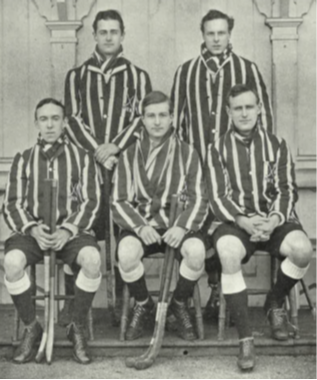
Donald Innes was one of the five Old Dragons to win Oxford hockey blues in 1911. All five of them are now in the Army.

1911 Hockey Blues

Standing: Donald Innes (Sgt. Motor Cycle Corps) and Patrick Duff (2nd Lieut. RFA in Gallipoli)

Sitting: John Brooks (2nd Lieut. Indian Army), Sholto Marcon (2nd Lieut. OBLI), Ronnie Poulton (Lieut. Royal Berks).


April 30th 1915

We have further news from Ronnie Poulton. No sooner are troops out of the trenches than they are put to hard work. It does seem right to call it “Rest.”

Saturday 24th April. “We came out after four days in last night, and immediately went off digging, after ¼ hour’s RWPP profilerest.

The whole thing as a war is an absolute farce. This is honest fact. We went up to part of the line near here, which has a gap of 200 yards in it. Here Territorial Engineers are building a magnificent breastwork and parados and Territorials supply working parties. The joke is we are 120 yards from the German trench and about 80 from the German working parties. And we make a hell of a row, laugh, talk, light pipes etc and sing and nobody fires a shot, except one old sniper who seems to fire high on purpose; and yet when the flares go up, we stand stock-still so as not to be seen!!”

The period of so-called rest being over, Ronnie Poulton returned to do another spell in the trenches on April 27th, but he was only there for a day before going back into reserve for three days.

Having told us that snipers were not a thing to worry about at night, I cannot help but feel they should not be underestimated. Snipers are an ever present threat, clearly:

Thursday 29th April. “It is quite absurd to see the quite immovable landscape, with no movement of any kind on it and yet to hear the most accurate shots on our parapet, shots which have killed two men dead in the last two days, who foolishly put their heads up carelessly in a low part of the parapet to look back. Don’t worry about me in this respect.”

This is easier said than done. Parents, family, schoolmasters on the touch line of any rugger match – we  are always more nervous than the players, who are wrapped up in the game.

* * * * * *

Readers of the Times yesterday will have seen the letter written by our neighbour Dr. JS Haldane to Lord Kitchener, in which he confirms that the gas used by the Germans on our troops at Ypres last week was almost certainly chlorine or bromine.

Having witnessed a post mortem at a Casualty Clearing Station at the Front, he has returned with one of the man’s lungs for further examination in his laboratory at his home, ‘Cherwell.’ He is now involved in experiments to find an effective respirator for the troops. Apparently, so his daughter Naomi tells us, the ideas given in the press for various home-made appliances are totally ineffective.

As for Dr Haldane’s son Jack, who was the first of my boys to win the top scholarship to Eton, he is now Lieut. JBS Haldane of the Black Watch, improvising bombs to lob into enemy lines, so I am told.