March 22nd 1915

News has been received of the battle fought at Neuve Chapelle earlier this month. 2nd Lieut. Nevile West (Royal Berkshire Regiment) was involved.

Nevile West

Nevile West

Neuve Chapelle, 19/3/15. “I think I may tell you, now that it is all over for the present, that our Regiment and my Company led the attack on Neuve Chapelle, which you have probably read much about. The attack was dated for last Wednesday, March 10th, and the night before I was detailed by the Brigade to take a party out to remove all the wire in front of our trenches, the Germans being about 100 yards away, at the time a most precarious game, as they heard us working at it and cutting, and so sent up magnesium flares and opened fire on us. Fortunately none of us was hit.

The attack commenced the following morning with half-an-hour’s terrific bombardment of the Hun trenches, which, being so close, proved a terrible ordeal for us sitting cramped in the wet trenches, several shells pitching short in amongst us; anyway it blew all their barbed wire entanglements away, and their trenches and themselves to blazes.

When the half-hour was over, we advanced, the only opposition being a machine gun which did for several. The Hun trenches were a terrible sight when we got there, masses of horribly mangled remains, and the whole air full of picric acid fumes from the lyddite shells. The front line (ours) went straight across the three lines of their trenches, and proceeded as far as the near side of the village, when we started entrenching ourselves under heavy enfilade fire, shrapnel and high explosive shells included.

This was due to the attack on our left primarily failing; their second go cleared the situation, however. Another regiment then passed through us, took the village, and established a line a few hundred yards on the further side. The Indian Division was on our right, and they were too impetuous, and receiving less opposition, got too far ahead, and had to be brought back a bit. Prisoners and wounded were streaming down the road from Neuve Chapelle to our Aid Posts all day.

It was a terrible day, horrible sights. May it be a long time before I see such another, and when quiet came not with darkness, but about midnight, one’s nerves were all over the place. During the actual proceedings one has little time to think. The next day was quieter, the Huns shelled us continuously, but not so vigorously. My skipper was wounded, while next to me, by a shrapnel shell bursting overhead; and therefore left me in command of the Company, as I am still; being alone like that, at such a crisis, a horrible feeling of loneliness came over me, and does come now.

The next morning (Friday) the Huns made a counter-attack on our position, shouting in pure English, ‘Don’t shoot, we are the H.L.I,’ and as that regiment was on our right, and slightly in advance, we were at first taken in, but when it was discovered that it was the Huns advancing, rapid fire was opened, and the ground in front of our trenches now is heaped with their dead, and those that were wounded crawled into our lines. We cannot bury them, so must leave them there to rot; won’t it be terrible if the weather gets really warm, and the sun hot?

That same morning, the Huns, having failed in their counter-attack, bombarded our trenches and the village furiously for an hour, and God alone knows how we lived through it, the bits of shell and the fumes were horrible; it is impossible to get away from either, and I saw two men blown quite 30 feet in the air.

Their bombardment lulled at about 10.30, and at 11.00 we started bombarding their trenches preparatory to attacking again. We could see the wretched Huns flying for all they were worth. A and C Companies were then in support to the Rifle Brigade. When our bombardment ceased, the R.B’s got out of the trenches, and began to attack; they fortunately hadn’t gone far before (I should think) about 12 German machine guns opened fire, and God knows how any of them escaped; I was right in the open at the time and it was hell. Those that remained crawled back at dusk. A great friend of mine who was in the 1st Battalion with me was riddled with bullets, and killed instantly.

A bullet hit my camera which was in my coat pocket, and just turned its course enough. Otherwise, ‘I shouldn’t have gone no further.’ My luck has been extraordinary; may it long continue so. We have just been sent two more 2nd Lieutenants. Apart from that we have only five Officers left.

Well, such is my news, but you will learn more about it from the papers, as they get the operations taken as a whole. The Huns lost terribly, and I fear we did also, although with the modern machines of war, one can expect nothing else. It is terrible, real hell on earth.”

January 4th 1915

This is the third letter we have received from Tyrrell Brooks (Capt. Duke of Cornwall’s Light Infantry) – see September 28th & October 29th for his previous ones. With some nine years’ experience in the Army, he has got to know “Tommy” pretty well.

“Dear Skipper,JBBrooks

A strange mixture of sentiment and pathos is Private Thomas Atkins. A splendid grouser when in clover, when really up against it he faces with equanimity the longest of days and most trying trench work.

In letter writing he uses the most pious and well rounded phrases which would delight the soul of a cleric and give him hope, and afterwards you will hear the same hero expressing to his friends his grievances in language that even a bargee would resent.

The glamour of the battlefield of the last century is conspicuous by its absence in this. The bayoneting of the German is not a daily occurrence, but when the chance comes it is taken and afterwards affords pleasurable thought and scope for writing home – as after all there is little to write about when you live in a trench for four days at a time, having shrapnel for breakfast, high explosive for lunch, and rifle fire when you should be having your evening glass of ale in the canteen.

Perhaps the great thing which buoys up T.A during the weary days in the trenches is “castle building.” By this I mean highly exaggerated thoughts of home, his best girl (they all have them) and of the time and reflected glory, consequent on the defeat of the enemy, that will be his when he gets there. And if he is wounded – well somebody else will take his place and he will become a ‘ERO.

His sense of humour allows us to name the various kind of shells he is daily in contact with. They are “Little Willies,” “Dirty Dicks,” “Black Marias,” and “Jack Johnstons,” according to their size.

Here is a good and true story. Just after Ypres, a troop train full of enthusiasts pulled up opposite a hospital one in a siding. Those in the troop train were longing to perform deeds of valour and longing for blood. Those in the hospital train had already shed much in the lowlands of Flanders. Those in the troop train were hanging out of the windows and trucks joking with each other. Suddenly the hospital train started slowly forward and a troop train enthusiast shouted out “Are we downhearted?” and the chorus answered “No” – but again he shouted “Are we downhearted?” and again the chorus bellowed “No.” This was more than a figure in the hospital train, swathed in bandages, could stand. Propping himself up he retorted “Ain’t you? Well you bloody soon will be!” which said, he returned to a prone position.

Remember Pte Thomas Atkins and the great work he is doing under conditions which are difficult, to put it very mildly, and wish him a speedy return to realize the “castles” that he built in the trenches.”

 *  *  *  *  *  *

Jack Smyth played Juliet in the 1906 production of Romeo and Juliet here at the OPS to good reviews and if this did not necessarily suggest a military future for him, the following year he played a very youthful Macduff in Macbeth and, as the reviewer noted,  “looked a sort of Sir Galahad in his armour, but he showed plenty of fire when his opportunity came in the final scenes.”

Coincidentally, now a 21 year old Lieutenant in the 15th Sikhs, he writes in a similar vein about the splendid British Tommy:Jack Smyth

“The British Tommy is simply magnificent… One in a regiment close to us the other day came up very pale, and saluted, and asked if he could go to the rear. ‘Whatever for?’ said his officer. ‘Well sir, I’ve been ‘it three times’ he said.

Before we came under fire for the first time I asked a sergeant who had been at Mons what it was like. ‘Perfect ‘ell, sir,’ he replied, and he wasn’t far wrong.”

November 2nd 1914

We can consider ourselves most fortunate that thus far there has only been one OPS fatality in the frightful conflict in which we are engaged. However, our good fortune has now ended and it is with a heavy heart that I report the deaths of three Old Dragons, all who have given their lives and all on the same day:  Saturday 31st October.

The fighting in the Ypres salient has stretched our forces to the very limits and they have valiantly prevented the Germans from breaking through. Rupert Lee’s regiment, the Worcesters, played a vital role (Rupert was wounded on the 16th and did not take part). Their counter-attack in which they retook the village of Gheluvelt saved the day and may yet prove to be a turning point in the battle.

Regie Fletcher

2nd Lieut RG Fletcher (RFA)

It was at that very moment that Regie Fletcher, who is serving in the RFA, was hit by shellfire as he crossed open ground from his dug-out to his guns. Attempts to save him were to no avail and he died two hours later. His burial was supervised by one of his close friends from Eton, who was nearby.

From the OPS Regie had won a scholarship to Eton (in 1905) and had gone on to Balliol College, Oxford. He rowed in the 1914 Boat Race for Oxford.

He loved to sleep in the open air, and would sleep quite comfortably under several degrees of frost. As in face and colouring, so in his fierce independence of character, he seemed like some old Norse Rover; and it was this same independence that made one of his schoolmasters compare him to Achilles. He was extraordinarily well-read for a man of twenty-two, in the best modern literature. His highest delight was in Greek poetry; he knew enormous stretches of Homer and Aeschylus by heart, and would chant them, to the amazement of his crew, in the Balliol barge.

He was second in command of the Artillery section of the Oxford University OTC (1913-14) and obtained his commission on the day war was declared. He sailed for France on August 20th with the RFA and so only saw just over two months’ service.

*  *  *  *  *  *

Whilst the Worcesters were saving the day, a number of the senior commanders were at nearby Hooge Chateau. General Munro and a number of other staff officers, including Arthur Percival, were conferring with the Divisional Commander, Major-General Lomax when a shell hit their office. Whilst Munro was only concussed, Arthur & six others were killed outright and General Lomax was very seriously wounded.

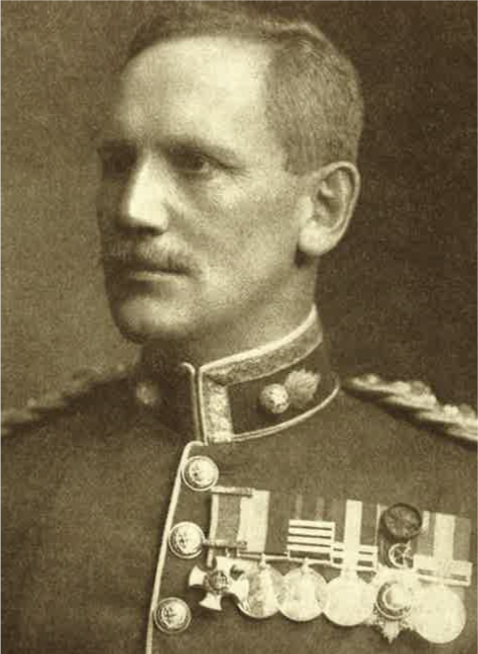
A Percival

Lt. Col Arthur J-B Percival (Northumberland Fusiliers).

Arthur Percival, the son of the Rt Rev John Percival, the late Bishop of Hereford (and previously Headmaster of Clifton College, President of Trinity College, Oxford and Headmaster of Rugby) arrived at the OPS in 1879, only two years after the school was started. He was a resolute and sturdy little fellow, who went his own way regardless of what others might think of him, not afraid to stand up to anyone who tried to bully him, however big his opponent.

From the OPS Arthur went to Marlborough College before transferring to Rugby, when his father became headmaster there.  After Sandhurst he joined the Northumberland Fusiliers. He was present at the Battle of Omdurman in 1898. He also fought in the Boer War and was the first Old Dragon to win a DSO in 1901.  During the first eleven weeks of the current war he was twice mentioned in Sir John French’s dispatches and was one of the first British officers to receive the Croix d’Officier of the Legion of Honour. He has been serving as General Staff Officer to Major-General Munro (2nd Division of the First Army Corps).

*  *  *  *  *  *

 Alan Leggett

2nd Lieut. Alan Leggett (North Staffs Regiment)

South of Ypres, the North Staffs Regiment has been engaged in action near Armentières. Alan Leggett ‘s trench was hit by a shell. A fellow officer and friend, 2nd Lieut. Pope, has written to say “His death, I trust, was almost painless, for he was asleep when he was hit, and he became unconscious almost immediately.”

At the OPS he was always a chivalrous and gallant lad and, after Tonbridge and Sandhurst, Alan followed his father into the Army in 1912.

The day before he was killed, Alan’s name was forwarded hopefully to be mentioned in dispatches. Lieut. Pope’s words should provide some consolation to his parents in this time of grief:

“During our last engagement the Company, belonging to another Regiment which he had reinforced, withdrew, leaving him isolated on the Battalion’s right flank, but he absolutely refused to retire, because by so doing he feared he would expose our flank to the German attack, and so stayed there alone, and undoubtedly saved the part of his Company, if not the whole regiment.”

*  *  *  *  *  *

Missing in Action

Percy Campbell, who has been serving as a 2nd Lieutenant in the 2nd Wiltshire Regiment at Ypres, has been declared “missing.” On October 24th there was such an intensive attack by both artillery and infantry that his battalion was virtually wiped out. Only 170 are accounted for, but it is known that a large number of our troops were captured in the first surprise attack made by the Germans and we fervently hope that Percy is one of them.

October 29th 1914

Whilst the German advances through Belgium and France have now been arrested, attempts to outflank the German forces seem to have failed.   Tyrrell Brooks (Duke of Cornwall’s Light Infantry) does not think we can now hope for a quick victory.

JBBrooks

23/10/14 “We have been in this place for eight days and there is a sort of state of siege – each side digging in – so one hardly ever gets on a horse and consequently they are all eating their heads off. I have three extraordinarily good horses, all of which would make real good hunters.

This war is going to be a very slow one, and a decisive victory seems hard to realise or rather imagine, owing to the length of the line and the various ups and downs which occur in it. There is one thing I am sure of and that is the Germans are as tired and cold as we are, perhaps more so, as I doubt if their Commissariat is as good as ours. The RAMC have done splendid work out here and the removal of the sick has been quickly and splendidly carried out.”

* * * * * * *

Roderick Haigh (Royal West Surrey Regiment) has been wounded in the battle going on at Ypres, although thankfully not badly:

Roderick HaighSt Crispin’s Day (25/10/14). “This has been no St Crispin, but a quiet, peaceful Sunday in Reserve after a week’s very heavy fighting.

On Tuesday last I was wounded by a shrapnel bullet in my thumb. These bullets are about 1/3 to ½ inch in diameter. The bullet was ¾ covered. I at once bit the bullet out, and Capt. Weeding put on my ‘First Field Dressing.’ It is a very slight wound indeed, and is healing up well. I am remaining with my unit, and can even write orders, although, as it is my right hand, I cannot write as fast as usual.

I cannot tell you how much I enjoy it all. There is something so noble and something so grand about the whole show, which places it on a far higher plane than any other scene in which one has acted in this life.”

September 28th 1914

Our Old Dragon correspondent at Winchester has reported that Cyril King, who was due to be a House Prefect this term “is at present unavoidably detained in Germany.”

At the end of July 1914 Cyril was at Schluchsee in the Black Forest with his mother, four sisters and a tutor from New College, Coote. Although there were rumours of war, they were confident that if anything came of it, they would be able to return to England. Instead on August 7th they were arrested. We await further news.

*  *  *  *  *  *

We have received news from Rupert Lee, a Lieutenant in the 3rd Battalion of the Worcestershire Regiment.  In good OPS tradition, he is keeping a diary, although rather different in content to the usual Dragon offerings at the end of the summer holidays.

“This diary must be read and criticised very leniently, being rather a disjointed sort of narrative. Pieces of it were written in strange postures and places, in varying frames of mind, sometimes left for weeks without an entry and then written up to date… It does not profess to be a connected narrative but merely a conglomeration of statements of happenings as they appeared to me at the moment…”

He writes of a very narrow escape he had during the retreat from Mons:

“Just as I got about twenty yards away from a wood a shell came crashing through the tops of the trees and burst quite close to me. My horse got it badly in the stomach. I got off and shot him to put him out of his agony… I then stood up and looking round saw, just at the end of the ride, two Germans. I bolted for the wood and as it happened it was extraordinarily fortunate that I did so. For they both dismounted and came down the ride  looking into the other side to that on which I was hidden. Just as they got opposite me the leading man put his gun up sharply. I shot him and bolted, as did his companion in the opposite direction.

I went about twenty yards and lay down behind a bush. Nothing happened, so after about twenty minutes I went back very quietly, took his shoulder strap off him and walked away.”

*  *  *  *  *  *

JBBrooks

Capt. W.T. Brooks

Tyrrell Brooks (recently promoted to Captain in the Duke of Cornwall’s Light Infantry and ADC to General Morland) writes:

September 14th.

“We are having a VERY hard time and now the weather has changed to rain it is cold and greatly adds to the discomforts which we are undergoing. Our Infantry has been brilliant and have more than kept up their high traditions, their marching having been really good and their fighting power at the end of the trek has been unimpaired.

We have now started a great forward movement which, though costing many lives, will undoubtedly test our enemy to the utmost and they are, I think, in rather a tight hole from which it will take them all their skill to extricate themselves. However, they are splendid tacticians, but I doubt if they have the material which is worthy of their well planned tactics.

How long this war will last I know not, but one thing is certain and that is it will leave all concerned crippled with regard to fighting material and armaments. Our casualties have been large but the German ones must have been larger.”

*  *  *  *  *  *

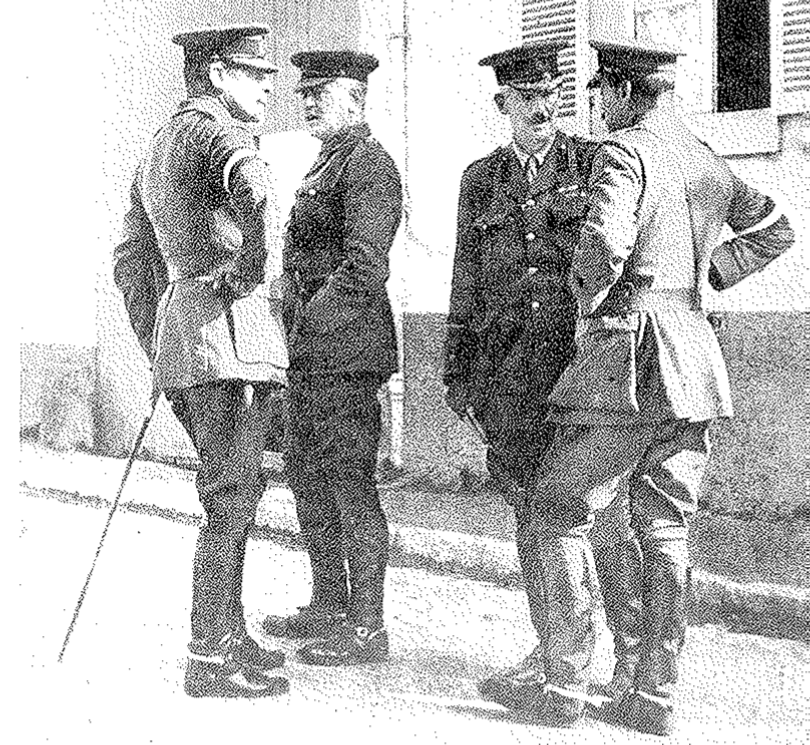
Readers of the “Illustrated London News” may have noticed the photograph below, probably taken during the retreat from Mons, which shows our old boy, Arthur Percival, with a number of notable figures. Arthur, a veteran of the Boer War and the first Old Dragon to have won a DSO, is serving as a General Staff Officer to Major-General Monro.

Percival & Generals

(Left to Right): Gen. Sir Douglas Haig, Maj-Gen Monro, Lt Col AJB Percival DSO and another.