

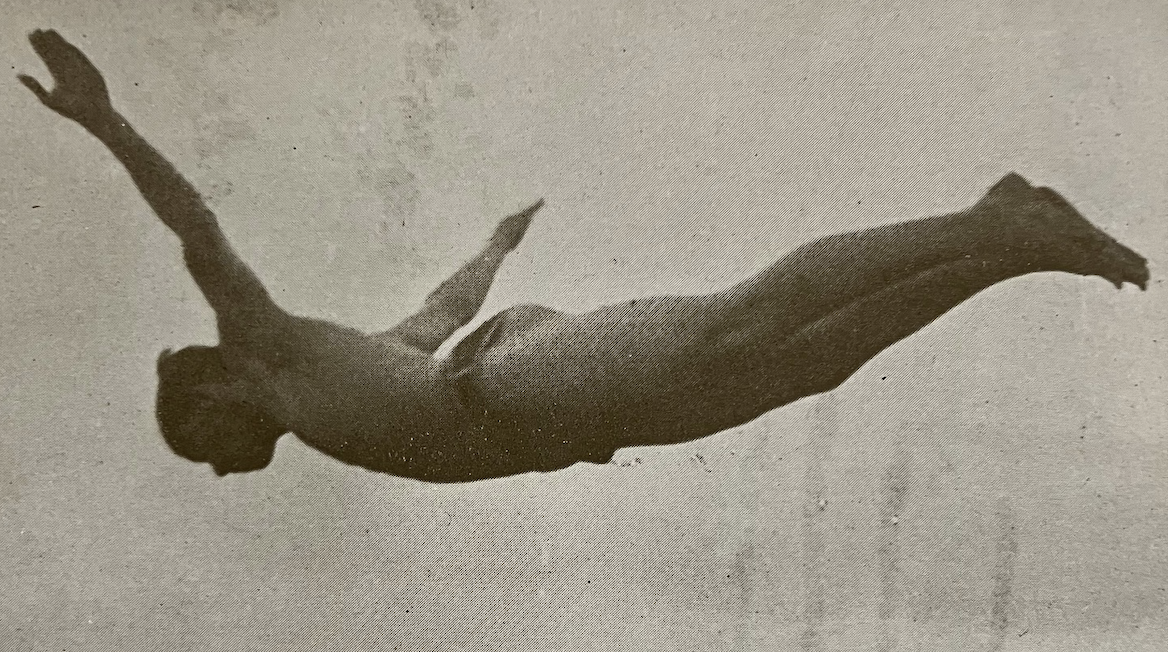
Dick Sergent diving at Repton
It seems right to celebrate the life of Dick Sergent more fully, particularly as a sportsman of some note. In addition to his prowess as a diver (he won our diving prize every year from 1899-1903), he was a talented player of both rugger and hockey – once captaining our team which contained seven future Half-Blues, of whom two became internationals.
He left Repton after only three years to complete his education at the Lycée Saint-Louis in Paris, so as to be with his brother Victor. Here the two brothers attempted to introduce the Lycée to football, but they were called up before the “Censeur” and told to get rid of the football immediately. “If someone breaks a leg or an arm, the parents will hold us responsible,” said the Censeur!
Nonetheless, Dick went on to become a formidable player of association football. In 1912 he was (along with his brothers) in the winning team of the French Soccer Cup and was selected to play for France at the Olympic Games at Stockholm, in a side which his brother Victor was to have been captain. Unfortunately, the French Committee was unable to send the team, owing to lack of funds.
After leaving the Lycée, Dick entered the Polytechnikum in Zurich where he excelled, captaining the Zurich ice-hockey team and stroking the winning four at the Lucerne regatta. However, it was his proficiency in boxing, together with his craving for adventure, that led him into serious trouble.
In the summer of 1911, one of the items on the programme at the Corso (a large and popular music-hall) consisted in the appearance on the stage of a large number of plump German ‘fraus’ wearing German ‘pickkelhaube‘ and singing one of the popular French songs, which was enough to offend any high-minded Frenchman. Consequently a number of the French students interviewed the manager and asked him to remove that item from the programme.
This the manager refused to do; so the next day the Frenchmen came in force to the performance and drowned the French marching song with hostile shouts and remarks. They were, however, immediately surrounded by a large company of plain-clothes Zurich policemen, who they mistakenly took to be local roughs.
A fierce fight ensued, which was continued in the streets. Dick, who had come as a ‘neutral’, on being hustled, joined forces whole-heartedly with the Frenchmen. Unluckily, they were outnumbered and Dick was ultimately overpowered, but only after he had knocked out five policemen. He was condemned to three weeks in prison and a 1,000 franc fine – which was paid by a subscription among the Frenchmen. The hardships of prison life were alleviated by letters of congratulation from English sportsmen, who had read about it in one of the papers.
This is an early example – three years early – of England and France joining hands against German aggression and misappropriation. As in 1914, it seemed to meet with the approval of the British public!


 The Skipper's War