

Old Dragons are also involved in fighting the war in other parts of the world. Geoffrey Carpenter (Capt. Uganda Medical Service) is in charge of a field ambulance in British East Africa and has written to tell us of the Battle of Tanga, which took place in early November.
 “You will have seen in the papers that there had been some stiff fighting in BEA, mostly on the coast, where an attack on a fortified town (where our men had been told there would be no opposition) was repulsed with considerable slaughter. The Germans had a very large number of maxims, in trees, or firing through holes cut in enormous tree trunks, each one covered by another behind, and with all the ranges carefully marked off. They had also enlisted the services of large numbers of bees – ferociously stinging – which set upon our men and of course considerably aided the rout. Indeed one or two men died of bee stings…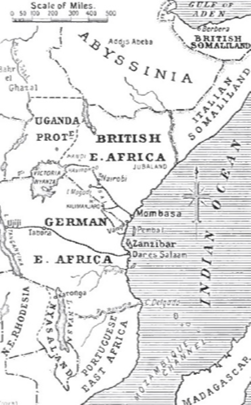
We do not have enough troops to do more than maintain a defensive position and have made our line of defence along the north bank of the river Kagera, which flows into the lake at about the middle of its west coast… As it is impassable in most places, owing to dense belts of papyrus along its banks, it makes a most excellent line of defence. The actual political frontier is some miles to the north of the river, so that we hold a strip of territory really part of GEA. I think I may claim to be (at least one of) the first Old Dragons to invade German territory.
I am now (with one other white man) in a fort which we have taken over from the Germans, who retired when we advanced. They had simply erected four walls enclosing a square space. Since we have been here (2½ months) we have taken it in hand and have made no end of a place of it – bomb-proof houses to live in, underground magazine, underground passage leading to an outlying maxim pit, and other dodges so that it seems a very strong place now.
We are about four miles north of the river on a hill top, overlooking a flat plain, with other hills to the east and west. Curiously enough the other white man, who is in charge of the fort and of a section of the line of defence, is Captain Bertram Garratt of the Indian Army, Old Dragon and who was a little senior to me. We both hope the squareheads will attack so that we can have some fun.”
* * * * * *
Meanwhile, we gather Frank Sidgwick is finding training difficult – particularly on the Parade Ground.
“Form Fours”
A Volunteer’s Nightmare.
If you’re a Volunteer Artist or Athlete, or if you defend the Home,
You sacrifice “Ease” for “Attention,” and march like a metronome;
But of all elementary movements you learn in your Volunteer Corps
The one that is really perplexing is known as the Forming of Fours.
Imagine us numbered off from the right: the Sergeant faces the squad,
And says that only the odd files move – I always seem to be odd!
And then his instructions run like this (very simple in black and white) –
“A pace to the rear with the left foot, and one to the right with the right.”
Of course if you don’t think deeply, you do it without a hitch;
You have only to know your right and left, and remember which is which;
But as soon as you try to be careful, you get in the deuce of a plight,
With “a pace to the right with your left foot, and one to the rear with the right!”
Besides, when you’re thoroughly muddled the Sergeant doubles your doubts
By saying that rules reverse themselves as soon as you’re “turned about;”
So round you go on your right heel, and practise until you are deft
At “a pace to the front with the right foot, and one to the left with the left.”
In my dreams the Sergeant, the Kaiser, and Kipling mix my feet,
Saying “East is left, and Right is Might, and never the twain shall meet!”
In my nightmare squad all files are odd, and their Fours are horribly queer,
With “a pace to the left with the front foot, and one to the right with the rear!”
No.5 Balham A.V.F., A Company. Platoon 1 = F.Sidgwick.

 The Skipper's War