April 30th 1915

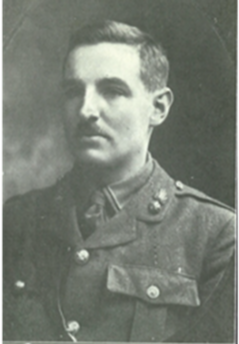
We have further news from Ronnie Poulton. No sooner are troops out of the trenches than they are put to hard work. It does seem right to call it “Rest.”

Saturday 24th April. “We came out after four days in last night, and immediately went off digging, after ¼ hour’s RWPP profilerest.

The whole thing as a war is an absolute farce. This is honest fact. We went up to part of the line near here, which has a gap of 200 yards in it. Here Territorial Engineers are building a magnificent breastwork and parados and Territorials supply working parties. The joke is we are 120 yards from the German trench and about 80 from the German working parties. And we make a hell of a row, laugh, talk, light pipes etc and sing and nobody fires a shot, except one old sniper who seems to fire high on purpose; and yet when the flares go up, we stand stock-still so as not to be seen!!”

The period of so-called rest being over, Ronnie Poulton returned to do another spell in the trenches on April 27th, but he was only there for a day before going back into reserve for three days.

Having told us that snipers were not a thing to worry about at night, I cannot help but feel they should not be underestimated. Snipers are an ever present threat, clearly:

Thursday 29th April. “It is quite absurd to see the quite immovable landscape, with no movement of any kind on it and yet to hear the most accurate shots on our parapet, shots which have killed two men dead in the last two days, who foolishly put their heads up carelessly in a low part of the parapet to look back. Don’t worry about me in this respect.”

This is easier said than done. Parents, family, schoolmasters on the touch line of any rugger match – we  are always more nervous than the players, who are wrapped up in the game.

* * * * * *

Readers of the Times yesterday will have seen the letter written by our neighbour Dr. JS Haldane to Lord Kitchener, in which he confirms that the gas used by the Germans on our troops at Ypres last week was almost certainly chlorine or bromine.

Having witnessed a post mortem at a Casualty Clearing Station at the Front, he has returned with one of the man’s lungs for further examination in his laboratory at his home, ‘Cherwell.’ He is now involved in experiments to find an effective respirator for the troops. Apparently, so his daughter Naomi tells us, the ideas given in the press for various home-made appliances are totally ineffective.

As for Dr Haldane’s son Jack, who was the first of my boys to win the top scholarship to Eton, he is now Lieut. JBS Haldane of the Black Watch, improvising bombs to lob into enemy lines, so I am told.

March 26th 1915


 WG Fletcher - full

2nd Lieut. WG Fletcher (Royal Welch Fusiliers)

A seventh Old Dragon has perished in this war. George Fletcher was hit in the head by a sniper’s bullet on March 20th as he looked over the parapet of his trench.

Robin Laffan, who knew George all through the OPS, Eton and Balliol has written a heart-felt appreciation of his and our dear friend.

“The war has taken its cruel toll from a family universally beloved by all who know them. In August last, the three sons of Mr. CRL Fletcher flew to arms as a matter of course. Today Leslie, on board HMS Colossus, is the only one still with us. In November the tale of Regie’s splendid death (see November 2nd); and now the blow is renewed with the tidings of George’s similar end.

His letters from the trenches abound in the fun which kept himself and his men cheery in the midst of their hardships. Knowing his enemies, he had an intense admiration and even affection for them. Like a true patriot, he delighted in the different culture of foreign nations. Six months at Tilly’s and six months as a schoolmaster in Schwerin gave George a considerable knowledge of Germany and the Germans. He used to relieve the tedium of the trenches with friendly sarcasm shouted at the opposite lines. ‘It ain’t ‘arf a joke being in Lieut. Fletcher’s trench,’ said his men, ‘E talks to the b*****s in their own b****y language.’

Of George’s courage it is superfluous to say much. Readers of The Times will have seen how an officer described him as ‘the bravest man I ever saw.’ He was mentioned in despatches on Feb 18th and he was again recommended for distinction after his reckless feat of crawling through the German lines and recovering from a tree a captured French flag. By such deeds of daring he restored the jaded spirits of his men. But those who were lucky enough to see him in February, when at last he got his leave after six and a half months at the front, realised that the strain had told heavily on him. His light-hearted gallantry was not the result of mere animal vigour, but the triumph of spirit over bodily and mental exhaustion.”

He wrote and spoke of this desire, when in the trenches, to receive the Blessed Sacrament, of which he was able to partake at Christmas. Thinking of him as he leaves us, we feel the solid truth of the words:                                               

‘The men who drink the blood of God

Go gaily in the dark.’

RIP.”

News of George’s death was announced on page 4 of yesterday’s edition of the Times under the title of ‘An Eton Master’s Death’. Since his departure for the Front, his father, CRL Fletcher, a Fellow of Magdalen College, has been at Eton teaching his classes in his stead.

(George wrote most interesting letters which were published here on November 9th and November 23rd and he is mentioned on December 28th.)

December 28th 1914

We hear that George Fletcher (Royal Welch Fusiliers) is making a name for himself on both sides of the front line. Apparently he taunts the Germans with any news that comes his way of Allied successes, which he chalks up on a board. The Saxons opposite then take pot shots at it, which the Tommy likes to score as if he was on the ranges at Bisley!

George was trying to persuade the Germans to join in a beer, sausage and plum pudding evening on Christmas Day but his C.O was not impressed. Nonetheless, the Germans did provide two barrels of beer and there was general fraternization and exchanging of food and cigarettes.

*  *  *  *  *  *

Greville Drew (Capt. R.E.) was able to enjoy a more relaxed time well behind the front line.

Greville DrewXmas Day.  “We are very glad to be out for Xmas and a few days’ rest. We are in an extremely comfortable billet with a dining room, sitting room, kitchen, and two bedrooms for the four of us that there are now – three officers and an interpreter – or interrupter as the Indians all insist on calling them.

We have decided to have a real day off today and are leaving the men to their own devices for the first time since we have been in the country. Tomorrow we shall start getting them really straightened out. All the same, we are not to be caught napping today. We have orders to stand by in case the enemy should consider Xmas Day a suitable opportunity for a little devilry, so we are all ready to move at a moment’s notice.

The King’s Xmas cards to all ranks have just arrived.

I am glad to see from the ‘Daily Mail’ that they are at last publishing in the papers the fact that all the troops are amply provided with clothing and comforts. Really since we got a mention in despatches, the things sent to us have become a positive nuisance. For instance someone sent us 300 cardigan jackets (for about 150 men we have left in the Company). We don’t know what to do with them, and we have been fully occupied with more important duties than sorting out what we do want and what we don’t, and sending them back again. What is wanted is a central depot in London for each corps, or division, and then when a unit wants something it can write and ask for it.”

November 30th 1914

The ‘Globe’ Newspaper recently noted a number of “interesting names” of Old Dragons serving. They included the England Rugby Captain, Lieut. Ronald Poulton Palmer; the Oxford stroke, 2nd Lieut. Bob Bourne; a Services Boxing champion, Lieut. Martin Collier; an Oxford Cricket Blue and Fellow & Senior Censor of Christ Church, Charles Fisher; an Oxford Hockey Blue & International, 2nd Lieut. Sholto Marcon; an Oxford Athletics Blue, 2nd Lieut. Aubrey de Selincourt; an Oxford Hockey Blue & International, and tutor to the Prince of Wales, Lieut. Lionel Smith. The list also includes the captain of the Oxford Athletics, a rowing blue who had a picture in last year’s Royal Academy, three first-class men in Greats at Oxford, all this year, many scholars of colleges and 2nd Lieut. CJ ffoulkes, RNVR, who is keeper of the Tower Armouries.

Only three years ago the OPS could indeed claim, amongst the 35 Old Dragons then up at the university, the captains of Rugby (Ronald Poulton Palmer), Hockey (Sholto Marcon) and Rowing (Bob Bourne). Most notable was the University Hockey XI, which that year contained no fewer than five Old Dragons in the team. They are all now members of His Majesty’s Armed Forces.

* * * * * *

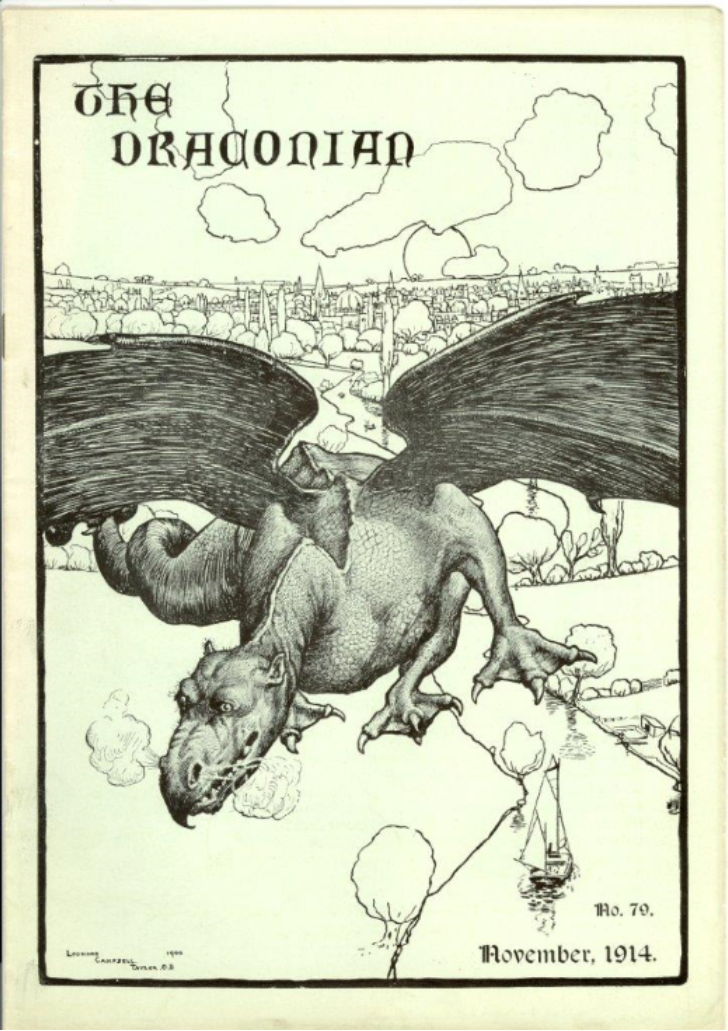
Draconian 79.

With the next edition of the ‘Draconian’ not due until after the end of term, we are issuing a special edition listing all those ODs who have answered the call to arms. It shows some 225 Old Dragons and staff already in uniform and a further 10 at Sandhurst, Keyham or Osborne. (Let it be remembered that when they were at the OPS, we only numbered 90-100 in the school).

We also include a poem by Frank Sidgwick, ‘The People’s Gift,’ which appeared recently in the ‘Saturday Review.’ This is the final verse:

Take the lesson, then, young Englishmen, when the war-cloud lowers black,

Let no man shift his burden of gift on to the next man’s back;

Answer today what part you will play, when your country gives the sign –

What gift will you bring to your country and King – is your blood water or wine?

* * * * * *

Frank’s brother, Hugh Sidgwick has been acting as private secretary to Sir Lewis Selby-Bigge, Permanent Secretary to the Board of Education. His work is deemed too important to allow him to join up. Instead he is doing duty as a Special Constable.

Special Constables – by one

Hugh Sidgwick SC

Hugh Sidgwick

“The Editor has asked for an article on Special Constables, and the motto of the force being obedience I can only comply. But one thing must be made clear at the outset. This nation at present consists of (a) the armed forces of the Crown; and (b) the rest. Special constabling is one of the forms of consolation for (b), who are small beer, and don’t matter much; it stands on a level with knitting socks, and putting on a light green uniform and gesticulating in Hyde Park on Saturday afternoons. It is miles away from the activities of (a), and must not be spoken of in the same breath. Therefore, if this article gets printed, let it be in the smallest of small print, in a corner far away from the ‘res gestae’ of soldiers and sailors. If that is quite clear, I can begin.

Special constables are amateurs who in their spare time assist the police in their lighter duties. They are sworn in for the period of the war – to carry out their duties without favour or affection, malice or ill-will, to preserve the King’s peace and guard the persons and property of his subjects, and so forth. They are provided with an armlet and a truncheon and a note-book and a warrant and a whistle and a badge; (I am going to make a song some day with this refrain). They may also provide themselves with a uniform. In our detachment it is a long blue overcoat and a yachting cap, in which we look like well-intentioned tram-conductors: but I am told that elsewhere there are variations in head-gear. Thus equipped, the special constable goes forth upon his duty.

So far the terror of our name has kept the malefactors away, and we have arrested only a bronze statue and a cat. But the moral effect has been enormous. The criminal classes and the foreign agents stand appalled at the reserves which the Executive has brought into play; they argue, ‘a fortiori’, that if respectable elderly gentlemen take such a lot of trouble about a little thing like that, what will happen if matters get really lively? Further, the ascendancy of the male sex is now re-established. I know of at least one dinner invitation which has been refused on the ground of constabulary duty. The dinner was on Tuesday and the duty on Thursday: but who could know that?”

November 23rd 1914

The arrival of winter weather has put an end, at least for the time being, to the fighting at Ypres. Both sides have suffered most horribly and there have been times when British troops have risked their lives to help the enemy wounded. George Fletcher (Royal Welch Fusiliers) describes an incident in which he was involved.

George Fletcher

“We were fortunate in being able to rescue one wretched man. He was one of the advanced party in the charge, and had seven bullets in him. He stopped for a day in front of us shouting, but we were getting such a peppering from snipers all that day that we were not allowed to fetch him. At night I got two volunteers to come and fetch him, and just as we were getting out such a hail of bullets came that we nipped back.

I kept up a conversation (shouted) with him next day – he told me the Germans had been practically up to him in the night, but had refused to help him. I told him to hang on till night, and we would try and rescue him again. So at dusk I got two volunteers again, and we pulled him in successfully, and doctors say he will live in spite of his seven wounds. Funny thing, war.”

 * * * * * *

Whilst the war takes up the thoughts of us adults, it is important that life at the OPS continues as smoothly as possible for our young Dragons.

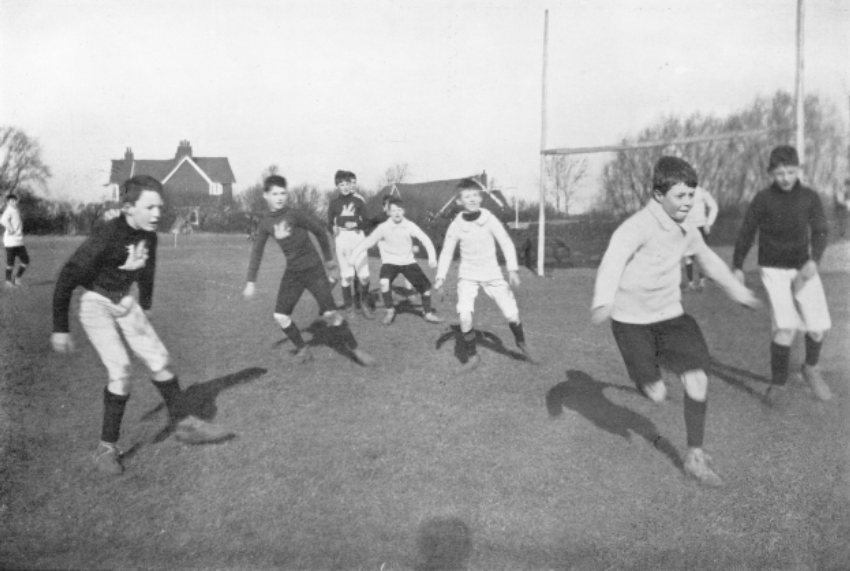
rugger

The beautiful weather which held for the first month of term made rugger impossible. In the first match, against Eagle House on November 4th, considering all things, although the team lost 0-22, they made a good show and look as they might develop into a good side.

I am not convinced of the desirability of keeping each boy to play in a particular place practically always. To know the game properly, a boy ought to be prepared to play half or forward or three-quarters as he may happen to be asked.

There seems to me nowadays a sort of prevalent fear of doing the wrong thing, and not enough initiative, not enough determination to get through and to score against the opponents…

I must say I think criticism of an individual’s play, sometimes very emphatic and loud-tongued, should be entirely abolished during the progress of the game; and nothing but encouragement allowed. Personally I know what the effect on myself would be if I were yelled at as a slacker or funk in the middle of a match!

Why, oh why do not Winchester, Charterhouse, Repton and Shrewsbury play rugby instead of the disgraced ‘soccer’? Malvern, Radley and Rossall have abandoned the professional game and joined the Rugger ranks…

 * * * * * *

The boys have sent stamps to the Base Hospital, and indeed have made a very large money collection considering their small incomes! The ‘Blue Dragon’ gramophone with its lovely old records and many new ones has delighted the inmates of Medical Ward V, where it is guarded jealously from the raids of other wards.

Hum Lynam

Hum Lynam

‘Hum’ has been almoner-in-chief and has installed and looked after Belgian refugees at the Lodge and elsewhere. He has also collected and forwarded sweaters, pipes, pencils and writing books, subscribed for by the boys, to various quarters, including HMS Colossus, HMS St. Vincent and HMS Russell.


We have had the following replies:

H.M.S. St Vincent

First Battle Squadron

November 20th 1914.

My Dear Dragons,

Pipes very much appreciated – now smoked by His Majesty’s Jollies.

Pipe 1
Who owned?                         


And the other one that might have been made by Krupp?

Pipe 2


It was a kind thought and entailing some sacrifice I’ve no doubt – parting with old friends – Censor allows no news.

William Fisher (Capt. R.N.)

H.M.S Russell

21/11/14

Dear Dragons,

A line to thank you all for sending us that generous supply of briar pipes. The men are no end pleased, and wish me to thank you for your kind thought for them. I only wish I could come and thank you all personally for them! But I shan’t be able to do that until they become Pipes of Peace.

 Lance Freyberg (Lieut-Commander R.N)

November 9th 1914

One of the first Old Dragons to volunteer was George Fletcher, an older brother of Regie, whose death we recently reported.  He is known to some young Old Dragons as a ‘beak’ at Eton. He was summoned to join the Intelligence Corps, as he is a fluent German-speaker. He was last seen departing London for Southampton on a motorbike! He has somehow now found his way into the Royal Welch Fusiliers.

This letter was written by George Fletcher to colleagues on the staff at Eton and has been passed on to us. It describes life in the trenches and his experiences in the battle still being waged at Ypres:

2/11/14. “The rule of existence in trenches is, on the whole, this: – 5.30 a.m., daybreak – nothing much visible in front – except certain groups of grey-clad figures and a few spades appearing and re-appearing above the earth 300 yards away. When the grey figures are moving about I am at a loophole in the trench with field-glasses.

‘No. 15 section! Three hundred yards! At the Germans moving three fingers right of sloping apple tree! Five rounds! Fire!’

Then a shindy, and the grey figures either squat or fall down.

‘Now, you silly asses, don’t waste ammunition when you can’t see them!’ – and so on.

Probably now for the rest of the morning the Germans do not appear again, but they dig and dig, sticking out snipers and Maxim guns in houses or on haystacks, so that they sweep the trenches and plough the brain of anyone who puts his head above the trench  the whole day.

About 7 I go off down the trench to a little hole where the Captain is, and eat anything there is. There is probably some bread and jam or sardines, and very likely some rum. The rations are procured at dusk, when sniping has ceased and the attack is not going on.

Then are seen figures flitting to our rear with great biscuit tins on their backs, or mackintosh sheets full of water bottles. Sometimes, however, these loads never get into the lines, for the store where they are kept has been shelled and the rations wiped out – once, anyhow, for forty-eight hours the men had to exist on what they carried in their pockets. The ration party also bring back our letters, and the reception of letters in the trench was the one thing that kept us alive…

Sniping till evening, then there is a hush; then just after dusk a Maxim rings out and a great fusillade starts from the enemy’s side. There are attacks every night, but there was one particularly big one when, as a wounded German told me, they hoped to take the trenches but failed.

There began on this occasion, soon after dark, a terrible musketry outburst on our right. It rolled along, and soon the enemy began firing from in front of us. There was a continual rattle of pellets on our parapet, and on looking out, or rather, bobbing the head up for a moment, one could see the flashes from their rifles. Then we got the order to answer it, and we did so. All through the night this went on, fiercer and fiercer, and the artillery took it up from both sides, the flash after the exploding shrapnel lighting up the battlefield at intervals. Not only that, but the enemy, who had hidden some bold spirits in rifle pits thirty yards ahead of us, with wire cutters, began by means of these to throw up bright green flashlights to illuminate our trenches – also illuminating themselves for our benefit. All this time I was crawling about among the men and saying, “Don’t fire in the air, you ass. Fire occasionally. Rapid fire. Slow fire,” etc., etc.

At about 2 a.m., the fire slackened, and there were rustlings in the turnips ahead, and callings, and rallyings among the Deutschers.

‘The rally for the charge,’ said I to myself. And it was.

There were hoarse captains crying,

‘Erste Compagnie, hierber! Wurst! Schweinhund! Einhundertzweiundzwanzigstes Regiment!’ and so on.

Then a pause again, and suddenly, ‘Alle Fertig! Vorwarrts! – Los!!’ and they came on. They got as far as the open ground and near our wire, thirty yards away, and then fell face-forward on the ground with heads to the enemy like the good men they are. Of course, it is a terrible thing to attack a strong entrenchment full of thoroughly armed defenders, and they never got nearer than thirty yards.

One poor devil did, however, and I pointed him out to my next man, who shot him. Unfortunately the poor devil had wanted to give himself up – being sick of the war (of course he deserved to be shot for this). We took him into the trench, and he lay till 4 p.m. next day in my dug-out, when he died. Only yesterday did I wipe his blood off my hands – which were a crust of this and of mud!

Well, this attack waned again at dawn, and ‘in the morning they were all dead corpses,’ like Sennacherib. We saw 200 in front of our Company. Add to those the number of dead in the turnips which we did not see, perhaps 200 more = 400. Add to these the number of wounded which must have been removed (six wounded to one dead) = 2,400 + 400 dead = nearly 3,000 out of action in front of our Company, if such calculations are worth anything…

Imagine the conditions: trench just wide enough for two men to squeeze by: parapet just high enough to fire over comfortably, and so necessitates continual crouching while walking along. Perfect quagmire whenever rain falls, as it did in torrents for several hours one or two nights, drenching wet clothes, of course, and covering you with a perfect plaster layer of yellow mud, especially about the hands. Squashed frogs underfoot, and all around stinks. Let me enumerate the (printable) stinks.

Carcases

(a) of cows which were killed in an early morning attack the first day I got there. They came browsing within thirty yards of us, and the Germans fired at them on purpose, as I believe, to leave them there and stink us out.

(b) Of men; after every attack more dead men, some within thirty yards of the trench, and some of these, by now, a week or more old. Of course, whenever we attempt to remove them they fire on the parties, even those bearing the Red Cross, so I believe it is also part of their object to stink us out with the dead bodies of their own brothers and comrades.

(c) Of sheep; same case as the cows.

(d) Tins of old beef, sardines etc.”

November 2nd 1914

We can consider ourselves most fortunate that thus far there has only been one OPS fatality in the frightful conflict in which we are engaged. However, our good fortune has now ended and it is with a heavy heart that I report the deaths of three Old Dragons, all who have given their lives and all on the same day:  Saturday 31st October.

The fighting in the Ypres salient has stretched our forces to the very limits and they have valiantly prevented the Germans from breaking through. Rupert Lee’s regiment, the Worcesters, played a vital role (Rupert was wounded on the 16th and did not take part). Their counter-attack in which they retook the village of Gheluvelt saved the day and may yet prove to be a turning point in the battle.

Regie Fletcher

2nd Lieut RG Fletcher (RFA)

It was at that very moment that Regie Fletcher, who is serving in the RFA, was hit by shellfire as he crossed open ground from his dug-out to his guns. Attempts to save him were to no avail and he died two hours later. His burial was supervised by one of his close friends from Eton, who was nearby.

From the OPS Regie had won a scholarship to Eton (in 1905) and had gone on to Balliol College, Oxford. He rowed in the 1914 Boat Race for Oxford.

He loved to sleep in the open air, and would sleep quite comfortably under several degrees of frost. As in face and colouring, so in his fierce independence of character, he seemed like some old Norse Rover; and it was this same independence that made one of his schoolmasters compare him to Achilles. He was extraordinarily well-read for a man of twenty-two, in the best modern literature. His highest delight was in Greek poetry; he knew enormous stretches of Homer and Aeschylus by heart, and would chant them, to the amazement of his crew, in the Balliol barge.

He was second in command of the Artillery section of the Oxford University OTC (1913-14) and obtained his commission on the day war was declared. He sailed for France on August 20th with the RFA and so only saw just over two months’ service.

*  *  *  *  *  *

Whilst the Worcesters were saving the day, a number of the senior commanders were at nearby Hooge Chateau. General Munro and a number of other staff officers, including Arthur Percival, were conferring with the Divisional Commander, Major-General Lomax when a shell hit their office. Whilst Munro was only concussed, Arthur & six others were killed outright and General Lomax was very seriously wounded.

A Percival

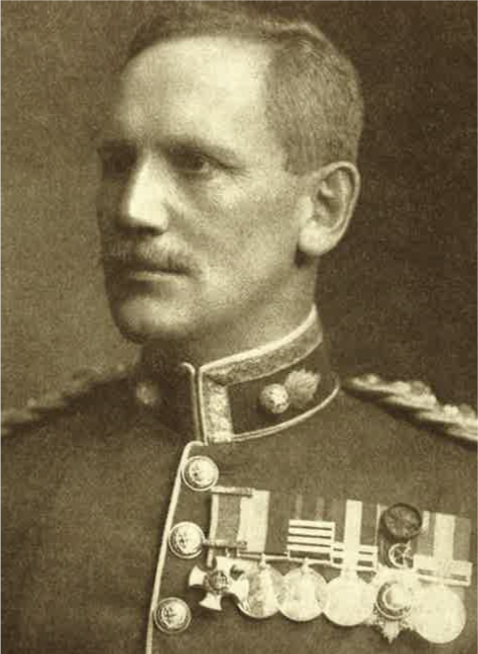
Lt. Col Arthur J-B Percival (Northumberland Fusiliers).

Arthur Percival, the son of the Rt Rev John Percival, the late Bishop of Hereford (and previously Headmaster of Clifton College, President of Trinity College, Oxford and Headmaster of Rugby) arrived at the OPS in 1879, only two years after the school was started. He was a resolute and sturdy little fellow, who went his own way regardless of what others might think of him, not afraid to stand up to anyone who tried to bully him, however big his opponent.

From the OPS Arthur went to Marlborough College before transferring to Rugby, when his father became headmaster there.  After Sandhurst he joined the Northumberland Fusiliers. He was present at the Battle of Omdurman in 1898. He also fought in the Boer War and was the first Old Dragon to win a DSO in 1901.  During the first eleven weeks of the current war he was twice mentioned in Sir John French’s dispatches and was one of the first British officers to receive the Croix d’Officier of the Legion of Honour. He has been serving as General Staff Officer to Major-General Munro (2nd Division of the First Army Corps).

*  *  *  *  *  *

 Alan Leggett

2nd Lieut. Alan Leggett (North Staffs Regiment)

South of Ypres, the North Staffs Regiment has been engaged in action near Armentières. Alan Leggett ‘s trench was hit by a shell. A fellow officer and friend, 2nd Lieut. Pope, has written to say “His death, I trust, was almost painless, for he was asleep when he was hit, and he became unconscious almost immediately.”

At the OPS he was always a chivalrous and gallant lad and, after Tonbridge and Sandhurst, Alan followed his father into the Army in 1912.

The day before he was killed, Alan’s name was forwarded hopefully to be mentioned in dispatches. Lieut. Pope’s words should provide some consolation to his parents in this time of grief:

“During our last engagement the Company, belonging to another Regiment which he had reinforced, withdrew, leaving him isolated on the Battalion’s right flank, but he absolutely refused to retire, because by so doing he feared he would expose our flank to the German attack, and so stayed there alone, and undoubtedly saved the part of his Company, if not the whole regiment.”

*  *  *  *  *  *

Missing in Action

Percy Campbell, who has been serving as a 2nd Lieutenant in the 2nd Wiltshire Regiment at Ypres, has been declared “missing.” On October 24th there was such an intensive attack by both artillery and infantry that his battalion was virtually wiped out. Only 170 are accounted for, but it is known that a large number of our troops were captured in the first surprise attack made by the Germans and we fervently hope that Percy is one of them.