We can consider ourselves most fortunate that thus far there has only been one OPS fatality in the frightful conflict in which we are engaged. However, our good fortune has now ended and it is with a heavy heart that I report the deaths of three Old Dragons, all who have given their lives and all on the same day: Saturday 31st October.
The fighting in the Ypres salient has stretched our forces to the very limits and they have valiantly prevented the Germans from breaking through. Rupert Lee’s regiment, the Worcesters, played a vital role (Rupert was wounded on the 16th and did not take part). Their counter-attack in which they retook the village of Gheluvelt saved the day and may yet prove to be a turning point in the battle.
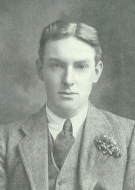
2nd Lieut RG Fletcher (RFA)
It was at that very moment that Regie Fletcher, who is serving in the RFA, was hit by shellfire as he crossed open ground from his dug-out to his guns. Attempts to save him were to no avail and he died two hours later. His burial was supervised by one of his close friends from Eton, who was nearby.
From the OPS Regie had won a scholarship to Eton (in 1905) and had gone on to Balliol College, Oxford. He rowed in the 1914 Boat Race for Oxford.
He loved to sleep in the open air, and would sleep quite comfortably under several degrees of frost. As in face and colouring, so in his fierce independence of character, he seemed like some old Norse Rover; and it was this same independence that made one of his schoolmasters compare him to Achilles. He was extraordinarily well-read for a man of twenty-two, in the best modern literature. His highest delight was in Greek poetry; he knew enormous stretches of Homer and Aeschylus by heart, and would chant them, to the amazement of his crew, in the Balliol barge.
He was second in command of the Artillery section of the Oxford University OTC (1913-14) and obtained his commission on the day war was declared. He sailed for France on August 20th with the RFA and so only saw just over two months’ service.
* * * * * *
Whilst the Worcesters were saving the day, a number of the senior commanders were at nearby Hooge Chateau. General Munro and a number of other staff officers, including Arthur Percival, were conferring with the Divisional Commander, Major-General Lomax when a shell hit their office. Whilst Munro was only concussed, Arthur & six others were killed outright and General Lomax was very seriously wounded.
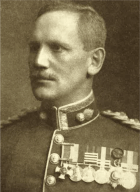
Lt. Col Arthur J-B Percival (Northumberland Fusiliers).
Arthur Percival, the son of the Rt Rev John Percival, the late Bishop of Hereford (and previously Headmaster of Clifton College, President of Trinity College, Oxford and Headmaster of Rugby) arrived at the OPS in 1879, only two years after the school was started. He was a resolute and sturdy little fellow, who went his own way regardless of what others might think of him, not afraid to stand up to anyone who tried to bully him, however big his opponent.
From the OPS Arthur went to Marlborough College before transferring to Rugby, when his father became headmaster there. After Sandhurst he joined the Northumberland Fusiliers. He was present at the Battle of Omdurman in 1898. He also fought in the Boer War and was the first Old Dragon to win a DSO in 1901. During the first eleven weeks of the current war he was twice mentioned in Sir John French’s dispatches and was one of the first British officers to receive the Croix d’Officier of the Legion of Honour. He has been serving as General Staff Officer to Major-General Munro (2nd Division of the First Army Corps).
* * * * * *

2nd Lieut. Alan Leggett (North Staffs Regiment)
South of Ypres, the North Staffs Regiment has been engaged in action near Armentières. Alan Leggett ‘s trench was hit by a shell. A fellow officer and friend, 2nd Lieut. Pope, has written to say “His death, I trust, was almost painless, for he was asleep when he was hit, and he became unconscious almost immediately.”
At the OPS he was always a chivalrous and gallant lad and, after Tonbridge and Sandhurst, Alan followed his father into the Army in 1912.
The day before he was killed, Alan’s name was forwarded hopefully to be mentioned in dispatches. Lieut. Pope’s words should provide some consolation to his parents in this time of grief:
“During our last engagement the Company, belonging to another Regiment which he had reinforced, withdrew, leaving him isolated on the Battalion’s right flank, but he absolutely refused to retire, because by so doing he feared he would expose our flank to the German attack, and so stayed there alone, and undoubtedly saved the part of his Company, if not the whole regiment.”
* * * * * *
Missing in Action
Percy Campbell, who has been serving as a 2nd Lieutenant in the 2nd Wiltshire Regiment at Ypres, has been declared “missing.” On October 24th there was such an intensive attack by both artillery and infantry that his battalion was virtually wiped out. Only 170 are accounted for, but it is known that a large number of our troops were captured in the first surprise attack made by the Germans and we fervently hope that Percy is one of them.


 Wednesday 21st April: “The work is the most important thing, as I am in charge of it, and my time is filled up with it – by day getting the work organised for the night. This has got better and better, and now I have a good system. Of course it is nearly all done at night. It is curious, at ‘stand to’, at about 8 p.m. to hear the sniping dying down, and then suddenly the ‘tap tap’ of the German party starting. Then we know we are safe, as there is a kind of mutual agreement not to fire on each other’s working and ration parties. So out we go and hardly a shot is fired.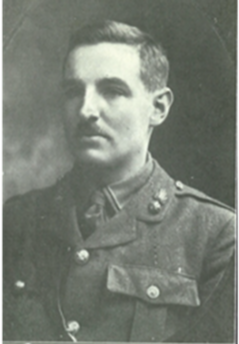

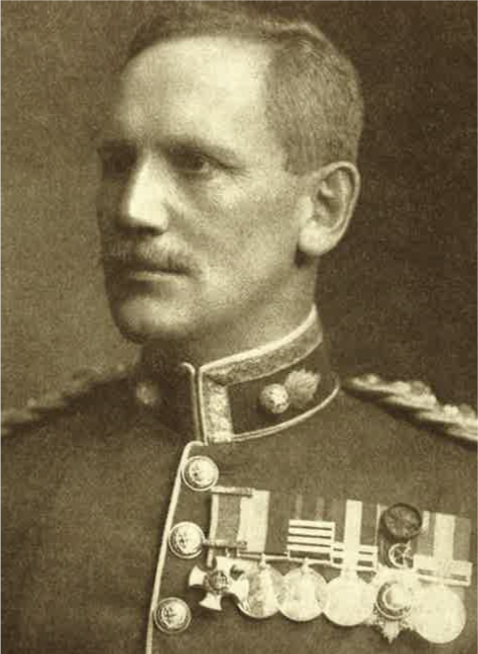
 The Skipper's War