July 29th 1916


DW Brown

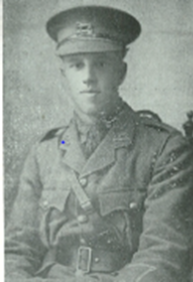
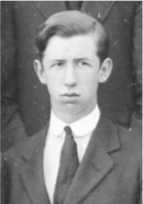
Capt. David Westcott Brown (Leicestershire Regiment)

It has now been confirmed that David was killed in the fighting for Bazentin le Petit on July 14th. Although his body has not been found, a Sergeant reported seeing it.

Like many, David realised in the spring that the summer months ahead would see the launching of a new offensive. Foreseeing the high number of casualties amongst officers, he felt the need to prepare himself – and his family. He wrote to his cousin Lillian in May:

“…. I am writing like this because summer is here, and I don’t think our present peacefulness can go on much longer. People at home are beginning to wonder what they pay us for; and I think Death must come to many of us, if not to most (I am talking of officers now) before very long: and, if it does come to me, I don’t want you to feel it as a shock, and I don’t want you or anyone to grieve.

You know it is rather an honour to die now, to die for all that we hold precious, for our country, to die that we may live, and to die with so many better men.

I don’t want to die. I want to live and tell how I was in the War, how I was a fighter in it, not merely a server; but, if I do get killed, I want you and everyone to know that I knew of the possibility, that I was ready for it, and facing it, and not shirking and dodging the thought of it. It seems to me that for a man who is, if not ready or willing to die, at least aware of the presence of death, and looking it in the face not caring or wondering what lies beyond, Death has lost its power. When you cease to fear Death you have conquered it, and Death has become only a gate, no harder to pass through than the door of a room.

Am I just being morbid? I hope not; because I feel somewhat that should the worst happen it may help Mother and Dad to know that I was not caught by surprise, not realising what I was in for…”

David also wrote a poem around this time, when still behind the lines:

Two Voices
“The roads are all torn” ; “but the sun’s in the sky,”
“The houses are waste” ; “but the day is all fair,”
“There’s death in the air” ; “and the larks are on high,”
“Though we die – ” ; “it is spring-time, what do we care?”
“The gardens are rank” ; “but the grass is still green,”
“The orchards are shot-torn” ; “there’s a bloom on the trees,”
“There’s war all around” ; “yet is nature serene,”
“There’s danger” ; “we’ll bear it, fanned by the breeze.”
“Some are wounded” ; “they rest, and their glory is known,”
“Some are killed” ; “there’s peace for them under the sod,”
“Men’s homes are in peril” ; “their souls are their own,”
“The bullets are near us” ; “not nearer than God.”

David was a cousin of Percy Campbell (one of the first OPS casualties) and the godfather of a current young Dragon, Per Mallalieu.

He won a scholarship to Marlborough and then went to Balliol to read ‘Greats’, when war broke out and he joined up.

July 20th 1916

DW Brown 2The length of the lists of those who have become casualties in the newspaper this morning is truly horrifying, and now we have heard that Capt. David Brown (Leics Regiment) has been reported as “wounded and missing” since July 14th.

His father understands that David went out with a sergeant to reconnoitre prior to an attack. The sergeant was subsequently found dead but there was no sign of David.

Further information is awaited.

* * * * * * *

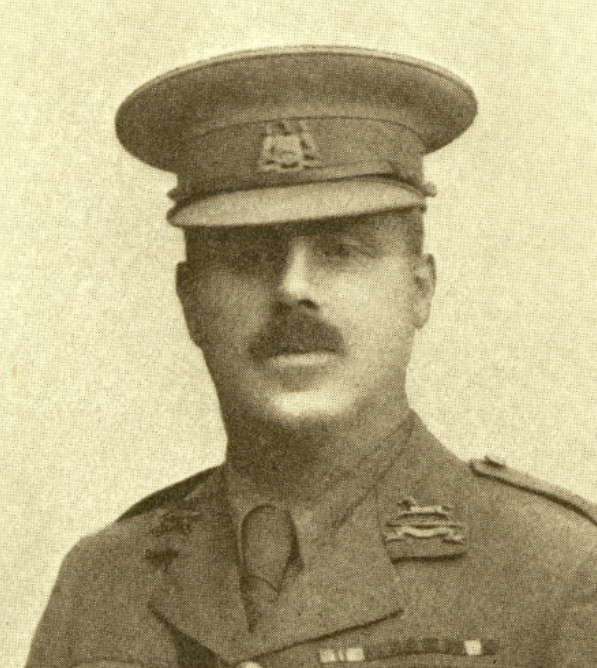
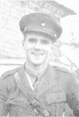
One of the hardest hit regiments on July 1st was the Leeds Pals Battalion (West Yorks). Their commanding officer, Lieut. Col. Stuart Taylor, was not with them as he is recovering from wounds he received in an earlier encounter with the enemy in May.

He has written from the Queen Alexandra’s Hospital in London to the Yorkshire Evening Post:

Stuart Taylor 2“I mourn the loss of tried comrades and dear friends with whom I have been closely associated day and night, in sunshine and storm, for the past fourteen months. But with my sorrow is mingled an immense pride, a great gladness, as I hear from all sources of the magnificent bearing and heroic conduct of our dear lads, who have cheerfully given their lives for their King and country.

The tidings of their gallant conduct and courageous deeds causes me no surprise, as I well knew how splendidly they would stand the test when the supreme call was made upon them.

To those who are left behind to mourn their loss, may God grant consolation in the sure knowledge of their dear ones’ valiant deaths. For the wounded I pray earnestly for a speedy return to health and strength.

For myself, my only wish is that I had been able to be with the battalion in their great and glorious attack.”

On July 1st, 233 of his men lost their lives. In addition, 15 of his 24 officers were killed (and the rest were wounded).

June 20th 1916

Wright EGE

2nd Lieut. George Wright (Somerset Light Infantry)

George Wright is dead. He was not killed in battle, but was a victim of one of the many shells that fall on Ypres daily. On June 16th, he was walking down a street when a shell fell and killed him outright.

He went out to France in July 1915 and was wounded soon after.  In November 1915 George won the Military Cross for conspicuous gallantry:

“Hearing that a Sergeant had been buried in the fall of a gallery, he went down and along the gallery to rescue him, but, getting entangled in wire, got back only with great difficulty. Later he went down again with a mining officer and recovered the Sergeant’s body.”

He was a regular visitor to the OPS, attending three dinners before the war. His frequent visits are full of the most delightful memories and we will miss his cheery wit and humour.

The shock to us is all the greater as George was engaged to be married and was here watching games on the School Field with his fiancée when on leave, just a week before he was killed.

May 18th 1916

2nd Lieut. George Wright (Somerset Light Infantry) wrote to us last month – he went out to the Western Front in July 1915.

Wright EGE16/4/16 “How is the school going along? Oxford must be very different in war time. The school must be the least changed thing there.

We are not having a very jolly time here, as we are in the wrong place for amusement as the musical accompaniment is too pronounced for my aesthetic ear.

The weather is simply topping here now, blazing sun and not a cloud in the sky.

Yesterday I had some splendid sport: we fished with bombs – that is to say  we chucked bombs into the canal and then waited till the fish floated down to the next bridge. I’m afraid we should be ostracised for such an illegitimate type of sport in England, but perhaps we may be excused out here.

You know, I rather envy the fellows out in the East in spite of their hardships. They do get a chance of some real open fighting instead of going into the same old trenches time after time.

I’m afraid you will think this is a very ‘grousy’ letter. As a matter of fact, I am as cheery as anything. This old war has been absolutely the chance of a lifetime to most of us, and will be the making of such of us as come out intact. I think most people out here realise that they will never have another chance to make good like this. And there are extraordinarily few failures out here – and most of them are excusable.

But, all the same, we won’t be sorry when we can all come back again and think it all over quietly, and see all the old places again. One will get much more enjoyment out of life after the war than one did before.”

* * * * * * *

George’s comment as to how things must have changed in Oxford draws my attention to the fact that the deeds of our local parents have gone largely unrecorded thus far. In fact, a number of them are doing their bit for the war effort locally:

Mrs Grundy (mother of  Leslie Grundy) has been instrumental in the organisation of the food for the 3rd South General Hospital, catering for several hundred patients.

Mrs Poulton (mother of the late Ronald Poulton Palmer) is involved with the Union Jack Club, which provides time and place for mothers and wives of serving soldiers to meet and comfort each other.

Lady Osler (whose son Revere Osler is with the RFA) has been organising a group making bandages and other medical necessities.

Mrs Gamlen (mother of Jack Gamlen) started a branch of the Needlework Guild devoted to war work.

Mrs Kingerlee (mother of Cyril & John Kingerlee) started the idea of having Flag days to raise money in Oxford to finance the war.

Mrs Vinogradoff, whose son Igor has only just left the OPS (and is only the second Russian boy we have had in the school), is raising money for Russian POWs.

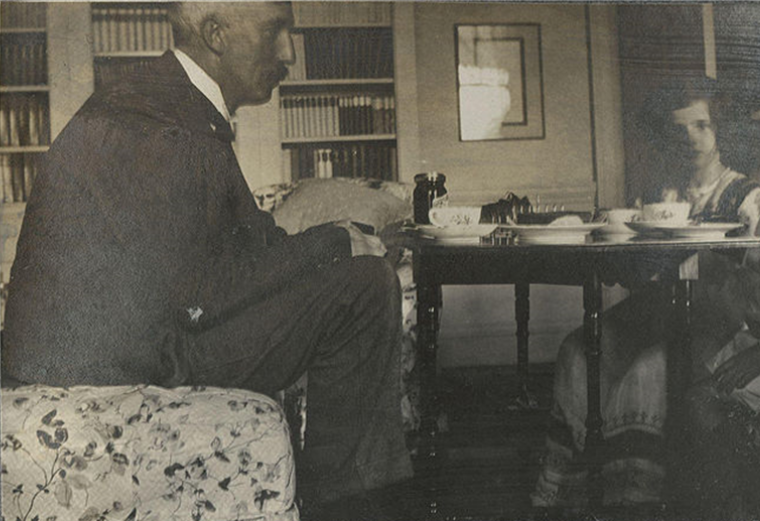
Sir Walter Raleigh (father of Adrian Raleigh) who, apart from being Oxford’s Professor of English Literature, is prominent in the Oxford Volunteer Corps (sometimes referred to as ‘Godley’s Own’). Here is a delightful picture of him with Igor Vinodradoff’s mother. The picture is taken by Lady Ottoline Morrell, the wife of Philip Morrell, who was at the OPS (1878-80) and currently is the Liberal MP for Burnley.

Raleigh & Vinagradoff

As for other changes, George might like to know that street lighting is almost non-existent and ‘Great Tom’ at Christ Church has been silenced for the duration.


May 10th 1916

Nevil Norway

Mrs Sturt tells me that she and her husband have received a postcard from Mrs Norway’s sister to say that young Nevil Norway is now safely back at Shrewsbury School for the Summer Term. He visited his aunt on the way back from Dublin on May 5th and reported that the family are well but had lost a number of valuable possessions, which had been stored safely – so they thought – in his father’s office in the burnt-out GPO.

Mrs Norway has also passed on another story of Nevil’s work with the Red Cross:

30/4/16. “This week has been a wonderful week for Nevil, never before has a boy of seventeen had such an experience. Yesterday morning he was at the Automobile Club, filling cans of petrol from casks for the Red Cross Ambulances. In the afternoon he went round in an ambulance with the Lord Mayor collecting food for forty starving refugees harboured in the Mansion House, and then went out for wounded, and brought in an old man of 78 shot through the body. He was quite cheery and asked Nevil if he thought he would get over it? So Nevil said, ‘Good Lord, yes! Why not?’ and bucked the old man up.”

You might wonder at Nevil’s pluck, but nowadays at the Public Schools the Officer Training Corps are preparing the boys for war and Nevil will have had two years of training, so that he was in readiness for such events as occurred in Dublin.

Sackville St in Dublin after the uprising…


May 1st 1916

Although today’s papers have more detailed news of recent events in Dublin and indicate an improvement in the situation, we are none the wiser as to the fate of the Norway family. There has been no mail and the country is under Martial Law.

We do know that the Norways have been living in the Royal Hibernian Hotel on Dawson Street, off St. Stephen’s Green. As the rebels have been in possession of the Green and that there are reports of numerous snipers in the area, one can only assume that they have been in some considerable danger.

The GPO, where Mr Arthur Hamilton Norway has his office, has been all but destroyed but, being a Bank Holiday, the hope is that he would not have been present when the rebels attacked.

His son, Nevil Norway was a day-boy here at the OPS from 1910-13, residing with the Sturt family close by in Park Town. The Norway family met the Sturts on holiday in Cornwall and they became friends.

We hope that Mr & Mrs Sturt, who are in touch with Mrs Norway’s sister, will receive some news shortly.

* * * * * * *

Also in today’s newspaper is an announcement that Mr Arthur Lionel Smith, the father of Lionel Smith (who was at the OPS  1890-94) has been elected the new Master of Balliol College, Oxford.

By my estimation, there are about twenty Old Dragons who later attended Balliol now fighting in this war. Of those 21 Old Dragons who have been killed, Regie Fletcher, George Fletcher, Ronald Poulton, Alasdair Macdonell together with Tom Higginson are all Balliol men.


April 15th 1916

A Balkan Find!

Major Roger Mott has written from “somewhere in Macedonia,” where he has indulged in some archaeological digging alongside his military duties.

“At ******** we have for some time been digging trenches and, being situated in a country of such classical associations, you may imagine that quite a number of interesting ‘finds’ have come to light – for instance, a tour of the trenches would reveal several old stone coffins, which make excellent ammunition or grenade stores; whilst for the storage of water you would, here and there, come across an amphora.

But the particular ‘find’ I refer to is a memorial tablet in white marble, in practically perfect condition and believed to date from the first or second century.

So I bethought me to have a copy made and sent to you. Maybe it will interest the modern Dragon, for I think ingenuity and a ‘Liddell & Scott’** will be able to unravel the hidden meaning thereof.

Alas, the early instruction in those class-rooms in Crick Road has been allowed to rust within my brain, so that my attempts to decipher the thing have not been altogether a success.

I got it reproduced somehow in small Greek characters, then tried to split it up into separate words, then searched a modern Graeco-French dictionary and finally a French-English one, with the result that I gather the city was extremely grateful to the gentlemen who bust up a ring of evil merchants. But you never taught me the last letter of the last line but one, which is annoying!”

Mott find

I am sure readers would like to have the opportunity to exercise of their brains over this Easter holiday to work this out. To help, Hugh Sidgwick has transliterated thus:

Sidgwick transliteration

** This capital text book has a close link with the OPS.  Dragons will know the rhyme:

Liddell and Scott, Liddell and Scott:
Some of it’s riddle, and some of it’s rot.
That which is riddle was written by Liddell,
That which is rot was written by Scott

Whereas Mr Scott (and his rot) has no connection with us, the riddle-some Dean Liddell (of Christ Church) is one of our founders.

(I am tempted, by the way, to add an extra line: “And little or none of it learnt by Mott!”)


March 1st 1916

It has been delightful to receive a visit from Lieut. Patrick Duff (RFA) on his safe return from the Gallipoli campaign. He is kindly allowing us to publish extracts from the diary he kept at the time.

The entries below cover the events from December 30th until January 9th, when he was evacuated.

Any starred space has been censored to meet the requirements of paragraph 453, King’s Regulations.

Lieut. Pat Duff

30/12/15. “I think there is very little doubt that we are going. I write this in the middle of a large expenditure of ammunition on what seems a useless target, just, I take it, to get rid of the stuff…

It is quite exciting and I have no sentimental objection to leaving Gallipoli, as the show is obviously a failure, and we shall see another war in a new country…

31/12/15. Ordered to remove two guns today; spent busy morning packing heavier kit and arranging about despatch of my two guns…

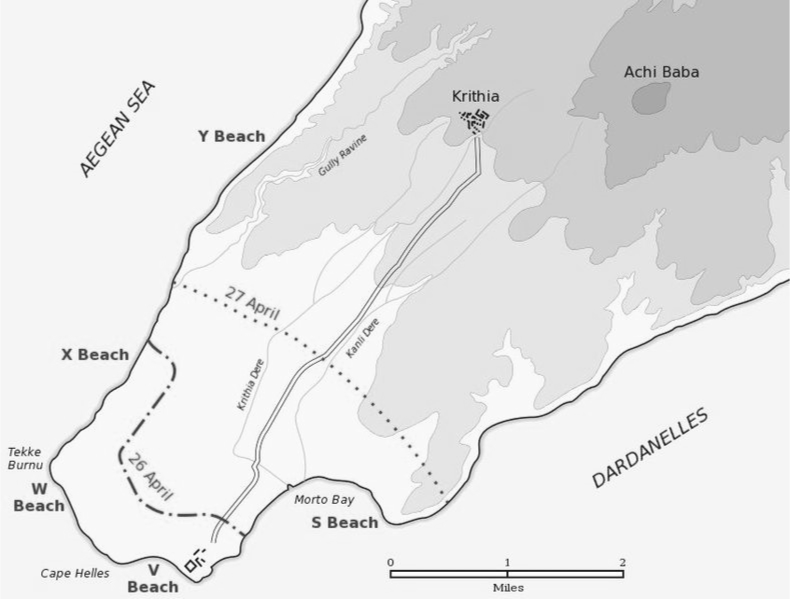
At W Beach delivered two guns, two G.S. wagons and four gharries with men’s kit and some of my own on lighters, and saw them safely off. Rather tired and sleepy as we are having pretty hard days and nights. Write this at 3 a.m. smoking a cigar instead of going to bed, feel absolutely dead tired in the mornings, but the coldness of the night keeps one going for the night work.

1/1/16. We rode into W Beach to learn how to blow up guns in case we had to abandon them..

W_Beach_Helles_Gallipoli 2

Preparation for evacuation. W Beach – January 1916

Thank God we don’t evacuate every day of our lives; it is tiring, as one pulls about guns and heavy stuff in addition to getting no sleep.

General ******* sent us a wire this morning wishing us a ‘Happy and victorious New Year.’ A farcical epithet at a moment when we are in the act of sneaking away from a place we’ve held for eight months and in a deadly funk every minute that the Turk will spot it and jump on us. Took teams out at 11 p.m. and got to Clapham Junction in Krithia nullah about 12.30, having had to wait on Artillery Road owing to block of traffic. Was at W Beach at about 2 a.m., where I soon got rid of the guns. Back to bed about 3.30.

2/1/16. Am staying up for the purpose of seeing wagons loaded with oats, hay and our kit (We are all packed up, leaving out only shaving things and flea bags).

The ravine presents already the appearance of the abomination of evacuation standing where it ought not. All dug-outs have been left as they stood, but it is perceptible that the Peninsula is emptying.

3/1/16. We have now one gun, 58 men and all the horses. Probably I shall leave tomorrow night with our last gun…

4/1/16. 9.45 p.m. The wind is rising. We have got one gun and about 50 rounds of ammunition; if the wind continues we can’t get away. It is beginning to howl like the devil outside. I wonder –

5/1/16. The beach is in a state of disorder; I noticed that last night they had embarked nothing as there was a long train of 18 pounders waiting to go off…. All the ordnance tents were turned inside out, piles of stuff lying about in confusion… There was every kind of thing there if one could only have carried it away. Rather pathetic. Everything is going to be piled up on the edge of the cliff and to be blown to blazes by the Navy the morning after we leave….

Tonight the wind has gone, so that we may be able to get away. The storms here generally last at least three days, so it is nothing short of providential.

6/1/16. Rode out on my little horse with the gun about 8, and thought how I should follow the dim roads of Gallipoli by night no more. Some of the more recent arrivals hail the departure with delight; but we who have been here since the very beginning find it hard to leave the place. One knows it more intimately than any spot on earth, having moved about on it at all hours of the night, and dug ourselves into it in every direction.

Frightful crush on the beach. I managed to get a move on and presently brought my gun to the pier. Shells were dropping on the other side of the beach, but nothing close to us. The horses were unhooked and sent away; my saddle was taken off my little horse and put on the limber and off he went in the dark…. Got out to a ship and had the gun and limber on it by about 5 a.m., and so now I write this sitting on the floor of a cabin, feeling the wiggle of the screw and beginning to realise that, for the time being, I have saved my soul alive.

7/1/16. I have left nothing in Helles, only my little horse, which will be shot. I told ***** to take off a shoe for me.

Started back to Helles about 5… I worked in the hold until about 4 a.m. getting stuff on board; but got some sleep in the night. Yesterday I felt quite sick with sleepiness. Still calm, perhaps we shall be able to get some horses off yet.

8/1/16. Everyone thinks this is ‘Z’ night, when everyone comes off. Wish I were on shore.

About 4 a.m. the Chief woke me and said, ‘the bonfires are lit.’ I went on deck; on W beach about eight great fires were burning and the blaze lighted up the whole place. *********

****** suddenly a terrific explosion came ******* throwing up the earth in the shape of a huge fan about 100 feet into the air. Shortly after came another awful burst, hiding the whole beach behind the falling debris and smoke. Flaming splinters seemed to be flying about everywhere, some falling in the sea.

There was another fire on V beach, and I could see the huge wall of the castle of Sedd-ul-bahr in the glare (reminded me rather of Virgil’s description of the fall of Troy when the forms of the malignant gods loomed out above the smoking walls). Just around the corner from W beach another heap ************* was ablaze, and there was a fire on Gully beach. For an hour or more I stood watching the flames; the Turks were at first firing shrapnel into the middle of the beach, thinking they had set fire to something and that they would catch those who were putting it out. About 5 a.m. they seemed to realise we were gone, as they started shelling out to sea among the ships.

About 5.30 we began to move slowly away and the fires grew smaller in the distance. So we left W beach, looking likes the gates of hell, as it was when we first came there….

This is the end of the Expedition which was to have opened the Dardanelles, filled up Russia with supplies, and as we fondly hoped, advanced in rear of the Austro-Germans along the Danube. How far the frightful waste of men and materials will affect England’s fortunes one can’t tell, and just now it is hard to take a dispassionate view; but, results apart, I cannot think there is any enterprise comparable to this, except the Athenian Expedition to Sicily, which started with the same high hopes and ended…****************”

February 23rd 1916

With magazines such as our Draconian making their way to front line trenches, some thought has to be given to security.

We are requested by the Director of Military Intelligence at the War Office to state that the matter contained in any War Article or Letter in the Draconian is to be treated as confidential, and that no extracts from them may be sent for publication to the newspapers.

* * * * * * * *

It is good to know that magazines, such as our own Draconian, are well received by our old boys. Capt. Maurice Jacks (KRRC) writes from Northern France:

jacks-ml3“In a stray ‘Oxford Chronicle’ which found its way to this dreary corner of Northern France the other day I read an account of ‘The Tempest’ and a letter from the Skipper about the bad state of the roads. These two led my thoughts to the ‘School House afar’ and hence this letter. My ‘Draconian’ has not turned up yet; but I can’t get on without it and have written for a copy from home.”

The Draconian has certainly made its way to General Headquarters where Major Cecil Lucas (RHA) and friends “simply devoured every word… and look forward to every number like anything.”

Capt. Charlie Childe (Gloucestershire Regiment), on reading what he had written in the first months of the War, now finds that he sees things differently:

Charlie Childe“I have just had the ‘Draconian’ and was very glad to get it. I’m afraid some of my letters now display a rather green and enthusiastic spirit. In fact I rather wonder at myself in the first days of August and September as a fierce hero! I see I said I didn’t mind shells. However, I am not ashamed to admit that familiarity doesn’t breed contempt. Jack Smyth quite agreed with me in this when I saw him last, so that is enough to go by…”

Lieut. Jack Smyth VC (15th Ludhiana Sikhs) has received his Draconian in Egypt:

Jack Smyth“I wrapped myself up in two blankets in  a deck chair yesterday evening and read the ‘Draconian’ from start to finish.

Charlie Childe’s letters interested me a great deal, as I have been practically in all the places he mentions.”


January 27th 1916

I wonder if you have worked out where Capt. Maurice Jacks was when he wrote:

“Being more or less conscientious I cannot tell you exactly where ‘here’ is, but if you remember where Polonius was stabbed, you will be within reasonable distance of the spot.”

Polonius stabbed

Polonius was hiding behind a rich tapestry (typically hung to make a screen) when stabbed by Hamlet. Such a tapestry was called an arras.

So, our man is somewhere near the town of Arras, to the north of Albert in the region of the Somme.

W Front map


Two marks if you got it right, one if you got it wrong!