March 29th 1917

It is now over a year since Lieut. Jack Gamlen (OBLI) last visited us. His witty poem, sent to the boys before their performance of ‘A Midsummer Night’s Dream’ earlier this term was much appreciated, and now he writes to sing the praises of our French allies. He is quite a Francophile!

Here he describes his experience of taking over a section of the trenches from the French:

“I think that none of our party shared my excitement and joy at meeting the French army in the field. In the British area it is difficult to feel that one is in France; even Amiens and Abbeville breathe a mixed (a very mixed) atmosphere. But here, below ground (in a dug-out), we were in France at last. We got to business at once and I began my duties as Brigade Interpreter. The French Brigadier impressed us all very much…

As it was now mid-day, the Colonel suggested that we should have lunch before we came to business. We agreed, and ate one of the best lunches I ever came across. There were five courses, there was red wine, there was champagne, yet everything was simple and the meal was short. At first everyone was shy and I had to do the talking for the English side. But as time went on, both sides thawed, and by the time we had coffee everyone was talking some sort of French.

After lunch we got to business at once. The Colonel was wonderful. He had every detail that we wanted at his finger tips and scarcely ever referred to his Adjutant. After an hour in looking at maps and discussing dispositions, he took us some way forward to an O.P, from which we had a wonderful view of the German front…

The next day I returned with the Brigade Major and again called upon the French Brigadier in order to arrange the final details of the forthcoming relief…

He spoke the most exquisite French and had the most exquisitely simple manners. I am sure that he is descended from one of those French Officers of the old days, who used to call out to their men ‘Messieurs les gendarmes de la maison du Roi, veuillez assurer vos chapeaux. Nous allons avoir l’honneur de charger…’

The French fighting man is a glorious creature and the sight of him should convince any armchair pessimist that nothing can ever kill France, however full her cemeteries may be (and they are terribly full round here)…

Let there be no misunderstanding about what France is. She is, and has been for a thousand years, the most civilized country in the world and her salvation is the first and greatest object of the war, for the presence of a single German soldier on French soil is an obscene thing.

My dear Dragons, educate yourselves to love France. Learn to read and speak French well, NOW, and, after the war, get your parents, whether they can afford it or not, to take you often to France…

There is nothing un-British or decadent in this love of France; and there is something very stupid and ugly in the want of it.  Every civilized being ought to write on his heart the fine old motto, ‘Chacun a deux pays: le sien et La France.’

Clearly we must have more French lessons!

March 25th 1917

Last heard of, Lieut. Hugh Sidgwick (RGA) was in a dug-out in France, writing the Prologue for our production of ‘A Midsummer Night’s Dream.’

Since then, he has been summoned back to England by the Board of Education to assist the minister, Mr HAL Fisher, with a new Education Act. Important work no doubt and, in fact, more worthy of Hugh’s extraordinary intellectual capabilities than the RGA.

Here, in a welcome contribution to the next edition of the ‘Draconian,’ he depicts himself as a “shirker” in a “funk-hole” in London.

From a Funk-hole.
                    1.
This is the song of a shirker in a funk-hole.
He has alternated, and will continue to alternate, between
      being a shirker in a funk-hole, and an over-fed hero
      intrepidly sitting at a telephone in France.
But for the time being he is a shirker in a funk-hole again.
                    2.
The men in funk-holes are acute, over-worked, and tired.
They get no leave and no potatoes.
They are insulted in the press.
They are assisted temporarily in their labours by dons,
      women, and business men.
But they stick it.
                    3.
The warmth and cleanliness of the funk-holes are pleasant 
      after France.
The shirker is glad to have interesting work to do again
Until it comes to doing it.
In France the work is not so hard.
                    4.
London is a good place compared with France.
But it involves being taken to revues.
Revues are better than violent shelling,
But moderate shelling is better than revues.
                    5.
Of course there is the moral aspect.
But moral aspects don't worry the shirkers much.
                    6.
If you consider who are really enduring the hardships of war,
There are eleven classes in order of endurance.
The first six all consist of people who go into the
      front line and get shelled, or who go about in ships, or fly.
The seventh consists of people in this country who work.
The eighth consists of Staffs, Base Censors and others,
      who sit behind the line
And have a high old time.
The ninth consists of a Railway Transport Officer, whom I know.
The tenth consists of journalists.
The eleventh consists of people who appear in the Sketch
      in full evening dress as interested in War Work.
                    7.
The shirker has belonged to Classes Four, Seven and Eight.
So he knows.
At the moment he belongs to Class Ten
If you consider the 'Draconian' a journal.
                    8.
Having concluded his song the shirker returns to his funk-hole
In the hope of persuading someone else to do the work.
Unfortunately there are no N.C.O's there.

                                            17th March 1917

Class Ten? Needless to say, Hugh was never in anything but the top forms in his time at the OPS!

February 28th 1917

Rev. Robin Laffan, who was elected a Fellow and Chaplain of Queen’s College Cambridge in 1912, has been appointed as padre to the Mechanical Transport Companies, who are supplying the Serbs in the mountains of Western Macedonia, from where he writes:

9/2/17 “A short time ago there arrived a most fascinating number of the ‘Draconian’ (which, I may say, moved everyone’s admiration out here, when I said it was the magazine of a Preparatory School). So I felt that, although I hate letter-writing, it is my part to send a letter for the ‘Draconian,’ if it be thought worthy…

The language difficulty is a nuisance. It prevents our knowing the Serbs as we would like and occasionally gives rise to disasters.

For instance, a doctor in one of our hospitals for Serbs, thinking that he was beginning to get on well with the language, went round his ward asking each patient ‘Imate li jenu?’ (which means, though he was after something quite different: ‘Have you a wife?’) Those who replied ‘yes’ were left in peace. When any patient replied ‘no,’ the doctor told the nurse to give him a dose of castor oil.

The next day all the patients asserted they were married. As they did so again the third day, the doctor asked a further question. ‘Koliko imate jene?’ (How many wives have you?) At this they thought he was being insulting and an unpleasant situation was only saved by calling in an interpreter, who explained that the ‘gospodin doktor’ was really inquiring after bowel movements, not families.”

December 27th 1916

Whilst it is to be very much hoped that everyone is enjoying their Christmas holiday, there is one task that the VIth Form must not forget to complete.

As is the tradition, they spent the second half of term getting to know a Shakespeare play – in this case ‘A Midsummer Night’s Dream.’ The parts have been assigned and must be known absolutely pat. Boys should get their sisters etc to improve their acting during these holidays.

Normally, that most faithful of Old Dragons, Lieut. Jack Gamlen (OBLI), would attend a performance to review it, but he has written to say he is otherwise engaged on the Western Front and he tells us that he will instead, “dream mid-winter nights’ dreams” about us all.

The boys will enjoy this witty poem, written for them by Jack, whilst on active service in France:

TO THE CAST OF 'A MIDSUMMER NIGHT'S DREAM.'
Dear Players, take from one who used,
Each year, to be your faithful critic - 
A task he'd never have refused,
Though deaf or blind, or paralytic -

A tribute to your former skill,
Good wishes for your next excursion
In plays which universal Will
Devised for his and your diversion.

I mind the day, in 'ninety-eight,
When I myself appeared as Theseus,
(At two days' notice, let me state,)
Expecting hisses loud as geese use.

And, I can tell you from my heart,
To have such memories to remember,
Helps me to play the harder part
Of fighting Germans in December.

          J.G., France, Dec., 1916

December 5th 1916

Lieut. Jack Gamlen (OBLI) was last in touch back in October, to tell us the story of his regiment’s involvement in the Somme battle in August. He said then that the Somme trenches were “very horrible.” His latest letter tells that, for the time being at least, he has escaped them:

23.11.16. “When you have been wet through for a week, have just come out of the trenches and are standing in the main street of a horrible and historic village, looking through glasses at the German lines, it is pleasant suddenly to have your elbow jogged by your Commanding Officer and to be told that you are to report forthwith at the Brigade Headquarters. Every so often a subaltern is detailed for attachment for instruction in staff duties…

As I approached Brigade Headquarters, I remembered that I had neither washed nor shaved for a week and felt very much ashamed of my appearance…

I was conducted into the presence of the Brigadier, a young and very handsome man with many medals. He was reading the ‘Times’ and told me to sit down and eat.

After a pause he put down his newspaper, looked long at me and in a mild, tired voice said, ‘Soaked through I suppose!’

‘Yes, sir.’

‘And the men?’

‘Soaked through all the time, Sir.’

Then he gave a very refined groan and went on reading the paper.

It was not long before I learnt that this Brigadier was as ready to be soaked through as any of the men, but, at the time, he seemed an exquisite being, remote from war, and mud, and hardship.

I made myself presentable by lunch, when we were joined by the OC Machine Gun Company, no less a person than L Grundy OD. He is my junior by many years and we had never met before. Now we meet nearly every day, but have not yet found time to talk much about the School…

By night I was mostly at Headquarters, but by day I often went out with the Brigadier on his visits to the various Battalion Headquarters. We were frequently shelled and once or twice had quite narrow escapes, but the Brigadier’s personality is such that I think no shell would dare to come too close to him…

My chief job was to write the daily Brigade Intelligence Report, which goes on to the Division. To do so sometimes made me shiver at the cold-bloodedness of my task. It is one thing to put down, ‘The right-half Battalion sent out a patrol between 2 and 4 a.m. which did so and so,’ and a very different thing to go on patrol oneself. The same is true of ration-carrying parties. How well I know them! One must see the game oneself in order to realize how much hardship, danger and often heroism, is compressed into six cold lines of an Intelligence Report.”


November 30th 1916

2nd Lieut. Maurice Jacks (KRRC) has returned wounded from the Front. He was involved in the attacks that took place around the River Ancre earlier this month.

jacks-ml3“The preliminary bombardment was in full swing, and our guns were giving the Germans beans; we were in the middle of them, so the noise was pretty terrific. The censor will not allow me to tell you how many there were, but I believe in this battle there were more than in any other of the Somme offensive.

It was the night of November 12th when we swam into our tents; we had to be up early the next morning ready to support the Division who were attacking. At 5.40 a.m. the guns loosed off ‘five minutes intense,’ and at 5.45 the infantry went over the top.

Shortly afterwards we moved up close behind them and halted in a valley to await orders. Bunches of ‘kamerads’ were coming in, many of them wounded and all more or less sullen; even our witticisms failed to cheer them up. Absurdly exaggerated reports of the success of the attack were current.

It was not until late in the afternoon that our orders arrived; and it was dark when, heavily laden with every conceivable form of tool and weapon, we went over the top. The guns showed amazing excitement, and their flashes were even more brilliant and alarming than Skipper’s lighting in ‘Macbeth.’

Our job was to clear out the first three German lines, which in their haste the attacking troops had not properly dealt with in the morning. There were any number of Huns, especially in the fourth line, where we finally settled down; all were reduced more or less to the Kamerad stage, with the exception of a few rash Prussians, and all night long we were coming across large dug-outs full of prisoners.

The trench was about one foot deep, having been battered out of recognition by our artillery. All the hours of darkness we had to spend in trying to make some cover, and when the foggy morning came we had it about four feet deep.

beaucourt-2We were not more than 70 yards from Beaucourt – or what was left of it; and at 7 a.m. we were to attack and take it. About 6.30 the Boches clearly ‘got the wind up,’ and bombarded us vigorously; a large chunk of shell hit me in the shoulder, but the wound was not bad; I was buried four times, and the fifth burial, which was complete, finally laid me out – leaving me with nine bits of shell in the head and face.

Somebody dug me out and bandaged me; and for the next half-hour I was busy digging out my Company Commander, who had been buried by the same shell, and tying up badly wounded men. Then feeling rather ‘groggy’ I decided to try to get out; by this time the trench had been nearly filled in, and the Germans were active with their M.G’s; so the journey was not altogether a safe one.

I came across a wounded Hun (a Prussian) hit in the foot and walking with difficulty; I gave him a hand – he was in a terrible funk, and full of ‘Kameradie’ (a very technical term), and altogether rather beastly! He thought that we would win the war but ‘would not need many ships to take our men home.’ This, I must say, is a very prevalent idea among the German privates.

On the way down, I met a man I knew escorting a bunch of prisoners, among whom were two officers; the latter, he said, had complained to him at being put under the escort of a private soldier – they expected English officers to escort them!

At the dressing-station I was patched up, and from there my progress to Blighty was slow and painful, but sure.”

Maurice arrived back in England on November 20th and has now been granted 8 weeks sick leave. Not surprisingly, he is still suffering from headaches. We wish him a speedy recovery.

October 8th 1916

Lieut. Hugh Sidgwick (RGA) is proving a prolific correspondent.  Being currently under-employed behind the lines on the Somme, he apparently has plenty of time for both reading and writing.

sidgwick-ah-226/9/16. “I was in the most forward of our batteries the other day just at ‘zero’ time – i.e. the prearranged moment when the final bombardment begins. The noise was really appalling. Our own howitzers were comparatively mild members of the orchestra: the high velocity guns easily out-topped them: now and then came the roar of the really big guns far behind: while the rumble of field guns was practically continuous. If you don’t stop to think, it is something of an experience: if you do, you want to sit down and cry.

Generally, I feel a complete fraud and quite unworthy of print in the ‘Draconian’.  I have only been a combatant for about six weeks and am now a petty clerk. So this is my last contribution to the war columns. Veni, vidi, Vick-E: I came, I saw a little of it and it was all over. Any telephonist will explain the joke to you. It is the first I have made since 1902.

The modern Pepys and Shane Leslie book are much appreciated here. Leslie is quite interesting, but what right has he to be compiling memoirs and summing up an epoch at his age (31)?

Besides, I am not at all so certain that the epoch is over yet. Everyone I meet out here appears to wish to live after the war pretty much as he did before, though all agree that other people ought to reform their ways and show signs of spiritual uplift.

I hope all goes well with the OPS.”

October 3rd 1916

No regular reader of the newspapers and their lists of casualties can be in any doubt that the fighting on the Somme continues to be fierce and costly. (How grateful we are that we have suffered no fatalities since August).

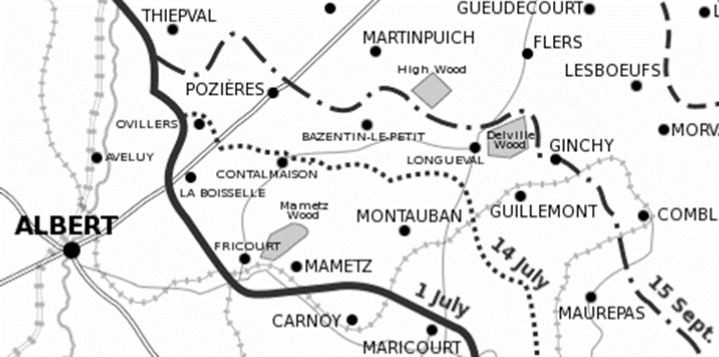
Lieut. Jack Gamlen (OBLI), who joined the Push on August 13th, tells me that he “has no great tale to tell.” I beg to disagree, as his description of the advances made from Ovillers towards Thiepval is most illuminating.

somme-map-2

“We struck north for Ovillers… it was my first sight of the front and I shall never forget it. Less than three hours march had carried us from corn-fields and unruined villages to an obscure desert which looked like nothing but the surface of the moon. We marched through Ovillers, passing streams of wounded and weary men who were returning from the front line.

Then we turned sharp to the left up a narrow, freshly dug, communications trench. In it I felt quite safe, though enemy 5.9 shells began to fall pretty thickly round us. We went on and on very slowly, and with many halts for half-an-hour, and then at last turned into the third line trench, which we were to occupy as company in reserve.”

Here Jack and his men had to endure some fairly heavy shelling, but were pulled back the following day for a brief period.

“We returned three days afterwards, and this time my Company took over the front line. We were heavily shelled from the first. One man in my platoon was killed by a shell, within three yards of me, just as we had taken up our position.”

Again, the shelling was constant but there were no infantry attacks and Jack returned safely.

“A week later we were back again, further to the left, and in full sight of Thiepval, which looks so harmless and so near in the strong sunlight of a hot morning.

In all this part of the line, the trenches were really not trenches at all. They had been blown to bits weeks before and gave scarcely any shelter to my men, several of whom were under fire for the first time.

On the afternoon of our first day up (August 23rd), an attack was to be made by the Bucks battalion on our left against the enemy line some 200 yards in front. I was in charge of a bombing section, with orders to push on to the enemy trench at Point ***  as soon as the Bucks went over, and to join up with them.

From a shell-hole I watched our wonderful preliminary bombardment of the enemy’s lines. It was terrifying, but extraordinarily interesting. I say ‘terrifying,’ because some of our shells burst very close to us; far too close to be pleasant. Then the barrage suddenly stopped, and the Bucks went over, alas, only to come back (what was left of them) in a very few minutes, for they were mown down by machine-gun fire which started the moment our own barrage lifted.

I now sent back for further orders, and was told to push on to Point ***  if I could. So I organised my bombing party, and sent two men up the communicator, where I already held a ‘bomb-stop,’ (a barricade in the trench dividing Br/Ger troops) to see how near the enemy was. They came back at once and reported about 20 of the enemy behind the next traverse but one. I didn’t believe them, so went myself, and found about 10 of them behind the next traverse but two. We looked at each other and I came back quickly. The attitude of the enemy was expectant, but not very menacing.

I waited for about half an hour, in order to allow the Huns to recover from the sight of me, and then advanced with my whole party. We all expected death, but there was no time to think about it.

When we reached the point at which I had sighted the enemy, I found a German, three yards in front of me, who was just about to descend into a dug-out. His head was already out of sight. I had a beautiful revolver shot at him, and his body and legs followed his head. It was a good moment.

Immediately afterwards the enemy woke up, and there was bombing at close quarters. We conjugated the verb “to bomb” in all its moods and tenses, and my party had wonderful escapes and only two slight casualties. The enemy then retired round the corner of the communicator into their own trench, and as I did not feel equal to attacking their whole first line with one section, I ‘consolidated my position,’ and remained where I was until I was relieved…

This is all I will tell you this time. The Somme trenches are very horrible; shells are very horrible; and fighting is tiring beyond anything which can be conceived at home.

What most impresses me is the speed with which one forgets the horrors as soon as one leaves them behind.”


September 30th 1916

We have another letter from Lieut. Hugh Sidgwick (RGA), who is keeping us in touch with events on the Somme. I am delighted to hear that he has received his copy of our magazine, even if I have every intention of overlooking his protest:

sidgwick-ah-2“The ‘Draconian’ has arrived and I have been devouring it in a hole beneath the earth, to the accompaniment of heavy howitzers and field guns.

But I must write at once to protest against the publicity given to my private and amateur attempt to translate Roger Mott’s inscription…  I have always hated and frequently insulted archaeologists and now they have got a handle against me.

If, as I expect, about six of them write to the next number of the ‘Draconian’, cutting off my head and holding it up afterwards to show that there are no brains in it, for Heaven’s sake either suppress the letters or bribe some really eminent archaeologist to say that my translation is right.” 

Since his last letter, Hugh has been sent back to the headquarters in order to attend a course that will equip him for the role of Adjutant.

20/9/16. “Headquarters are a number of dug-outs and tents in a sea of mud: the Adjutant is a cross between a bottle-washer and a private secretary and there are more and worse telephones than ever. So for all practical purposes I am back in Whitehall and any sympathy expended on me as surrounded by the horrors of war will be quite wasted. I feel an awful backslider in leaving my battery, but orders is orders…

What I find most difficult to realise is that since I came out I have been in the middle of a big battle. It is quite a shock to read the ‘Times’ and find names mentioned as critical and exciting points, when I have been there on the previous day.

There is a casual air about a modern battlefield, until the show actually starts – people walking about, horses standing in lines, men cooking food, and telephonists brooding over their instruments at tapping in stations.”


September 25th 1916

Hugh has finally escaped the clutches of bureaucracy, where he has been the Private Secretary to the Permanent Secretary to the Board of Education. He is now Lieut. Hugh Sidgwick (RGA).

He was commissioned into the Special Reserve of the Royal Garrison Artillery in January and is currently with a siege battery in France.  Having hoped that at the Front he would be free of modern communication systems that demand continual attention and instant reaction, he has been disappointed:

sidgwick-ah-2“The most distressing thing to me personally is the omnipotence and omnipresence of the telephone. It was my curse in civil life and I hated it bitterly and profoundly.

I did think that in military life I should escape it. But no; it is more important than ever; you range the country at the end of a telephone wire, and if it breaks you are an exile and outlaw at once; you come back and sit in your battery surrounded by telephones, all talkative and all meaning work.

The call to arms is a message dictated over the telephone and taken down on a pink form; the call to rest is the mystic word CI… I suppose when peace is declared the message will go round – Pip, Emma, Ack, C, E.

Of what is happening in the war we have not the slightest idea; a five day old Times is generally our latest news. We hear extraordinary rumours – that Roumania has come in, that a German Division has surrendered, that a Great Personage while addressing the Guards said that within 90 hours (now elapsed) something quite remarkable was going to happen. I believe these rumours are made up by Railway Transport Officers, to beguile the tedium of their existence.”

Hugh must have had to learn a lot in his new job rather quickly, but then scholars of Winchester & Balliol Colleges are quick learners. He makes it out to be easy enough:

“… the mathematics of siege gunnery are nothing alarming and many of the beautiful calculations we learnt in England go by the board. One has to know the difference between + and – , right and left, and to be able to add and work a slide rule, and read a map and take bearings, but that is about all.

I would volunteer to make quite an easy and profitable course of instruction in siege gunnery for VIa, and if they would give us a gun and let us practise on North Oxford from Shotover, so much the better for the cause of architecture.

If one of the Old Dragon airmen would come and observe, we could have a charming afternoon.”

I am not convinced as to the wisdom of arming the current VIa, and there might be mild concern amongst the residents of North Oxford as to whether their particular houses pass muster, or would be included in Hugh’s architectural cull.