July 21st 1920

Yesterday was a special day for the Smyth brothers, Jack and Billy:

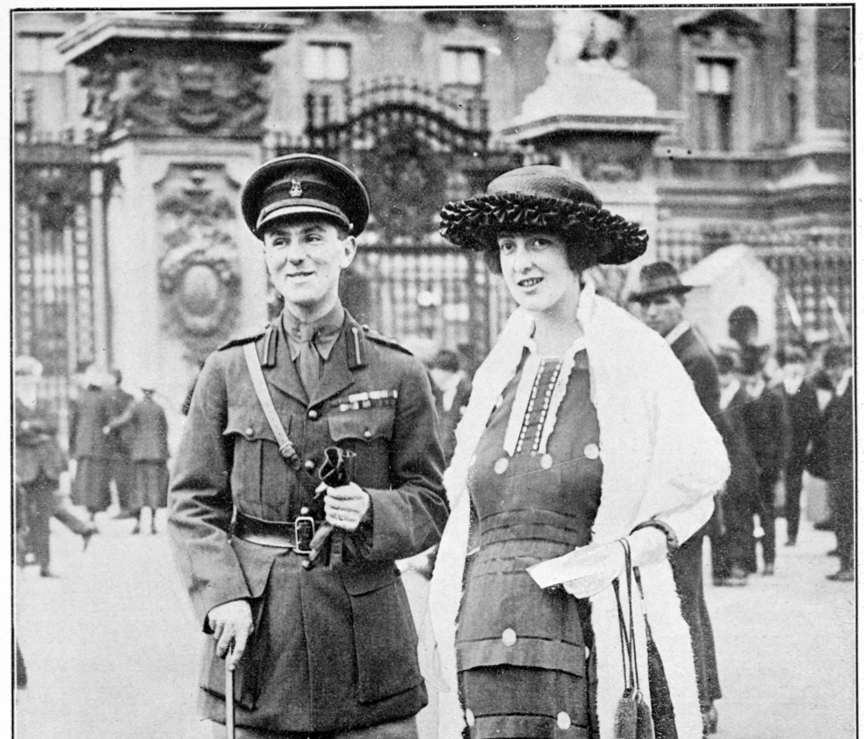
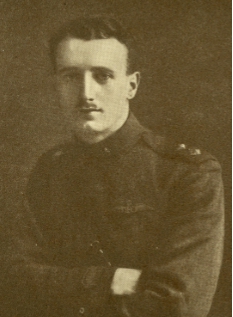
Captain JG Smyth VC, 15th Ludhiana Sikhs, 43rd Infantry Brigade and Lieutenant (Acting Captain) HEF Smyth, 1st Battalion, Ox & Bucks Light Infantry were summoned to Buckingham Palace to receive decorations won in action in Waziristan and Russia (where the 1st Ox and Bucks were part of the Allied force that intervened in the Russian Civil War to assist the ‘White Russians’ in their fight against the Bolsheviks) respectively.

We understand that it was the first occasion on which two brothers had been decorated with the same decoration at the same investiture, and they marched up together to receive Military Crosses from the Duke of York, who was deputising for the first time for the King (who was unwell).

I gather both brothers were rather nervous – as was His Royal Highness, and the citations were never read out. We can at least rectify this here in Jack’s case:

“At Khajuri (Tohei Valley) on October 22nd, 1919, this officer’s gallantry and initiative under fire contributed largely towards the saving of a valuable convoy which was attacked by the enemy. Sent forward from Idak with reinforcements to clear up the situation he most ably appreciated a very critical situation which, but for his so doing, must have resulted in serious disaster. He displayed staff ability of a high order in co-ordination and reporting the situation, rallying personnel who were in a state of apathy, due to the casualties amongst their officers. He was subjected throughout this period to heavy and accurate enemy fire, which in no way deterred him from moving from place to place. His courage was an example to all, and resulted in the convoy being brought safely to Idak.”

Jack Smyth pictured after the ceremony with his fiancée, Miss Dundas.

Today we bring the Summer Term to an end with sports, a concert and prize-giving, and Jack’s busy week continues as he is with us to make the presentations.

July 13th 1920

In the recent General Paper set by Mr Vassall, the boys were invited to write a rhymed epitaph on their form-master or mistress. It  produced a number of amusing efforts.

One, by S. Keen, was dedicated to Hon. Captain WJL Wallace, Ox & Bucks Light Infantry:

Here lies a mighty man
Who talked of bombs all day;
He fell out of a window once,
But couldn't die that way.

Another, on Mr & Mrs Hum, entitled ‘In Memoriam, AEL, MAL is by J Betjemann:

Hum and May went out one day
On a motor-bike painted vermillion; 
Hum was the nut of the latest cut
And May was the girl on the pillion.

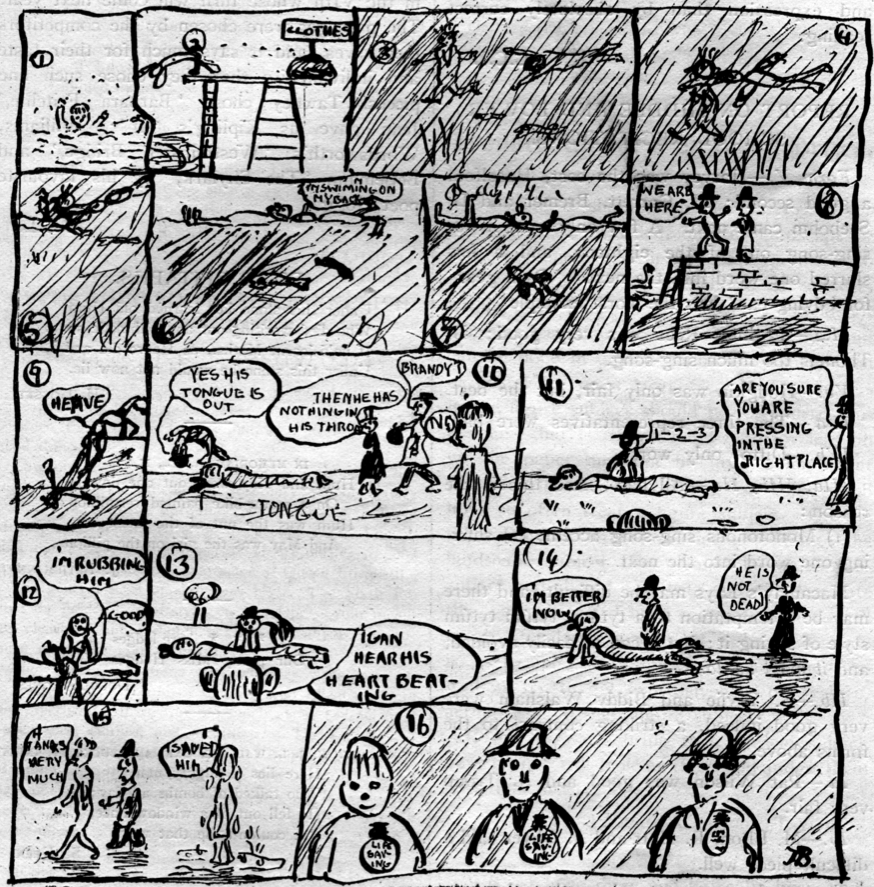
In the same General Paper, question 9 required candidates to “Explain fully and illustrate by drawings how you would rescue and revive a drowning man.”

This splendid effort was the work of J. Betjemann:

John Betjemann leaves at the end of this term to go to Marlborough College. Although he was not successful in winning a scholarship there, he acquitted himself well enough to be excused taking the entrance examination.

He has again excelled in English and has a number of pieces of work in the next edition of the ‘Draconian’, of which this is one:

A STAINED-GLASS WINDOW. 
The sun was sinking in an almost cloudless sky, as the old man, 
with his head reverently bowed, passed up the sombre nave of 
the lofty cathedral. Before him in all its magnificence stood 
the high altar, the candles already lit for evening service. He 
turned and faced the west window, through which the parting 
rays of the sun were shining. Seen from the choir, the colours 
melted into one another like clouds gathering in the sky. Among 
beautiful foliage and soft green grass sprinkled with daisies, 
stood the figure of Saint Francis with his cowl of poverty. 
There was Saint George with uplifted sword aiming a great blow 
at the dragon, which writhed at his feet spitting fire and 
clouds of inky smoke. Above these two panels were emblazoned 
the coats of arms of rich benefactors, in gold and red, with 
Latin inscriptions and strange proverbs. In the centre, on a 
lonely hill with the turrets of Jerusalem in the distance, the 
Crucifixion... The sun disappeared behind the house-tops and 
the pictures faded. The bells echoed down the aisles, and the 
old man took his accustomed seat. 
                                       J. Betjemann, age 13.6

Meanwhile, we await the results of the English Literature Paper set by Frank Sidgwick, which we hope to publish shortly.

July 1st 1920

It is at this time of year that we invite Old Dragons to set examination papers for us. The General Papers will be provided by Jack Haldane and his sister Naomi MItchison, together with Mr Vassall.

The English Literature paper for the top forms has been set by Frank Sidgwick and you are now invited to see how you would do!

English Literature Paper, July 1920.

1. Who wrote:
   (a) Westward Ho!
   (b) The Riddle of the Sands
   (c) Puck of Pook's Hill
   (d) In Memoriam
   (e) Old Mortality
   (f) Dombey and Son
   (g) a poem about a tiger
   (h) a long poem about fox-hunting
   (i) who translated Omar Khayyam into English verse
   (j) who translated Homer into English verse

2. In what work, by what author, do the following characters 
   appear?
   (a) Sam Weller
   (b) David Balfour
   (c) Captain Hook
   (d) General Stanley
   (e) Minnehaha

3. Write not more than one page on either 
   (a) the difference between prose and verse, or 
   (b) the difference between poetry and verse.

4. What are the first six questions you would ask William 
   Shakespeare if you met him in the Elysian Fields?

5. Write a short essay on the Choruses in Henry V. Why do you 
   think Shakespeare put them in? Why were they called Choruses? 
   Mention any parallels you can think of.

6. Continue for not more than three lines, giving author and work:
   (a) Should auld acquaintance be forgot...
   (b) He prayeth best, who loveth best...
   (c) The tumult and the shouting dies...
   (d) A wandering minstrel I...

When Frank Sidgwick has marked the papers and submitted his report, you shall know the answers and can see if you did better than our young Dragons!


June 18th 1920

O.D. Dinner – June 12th 1920.

The Old Dragons have had their say on our reunion, now it is my turn!

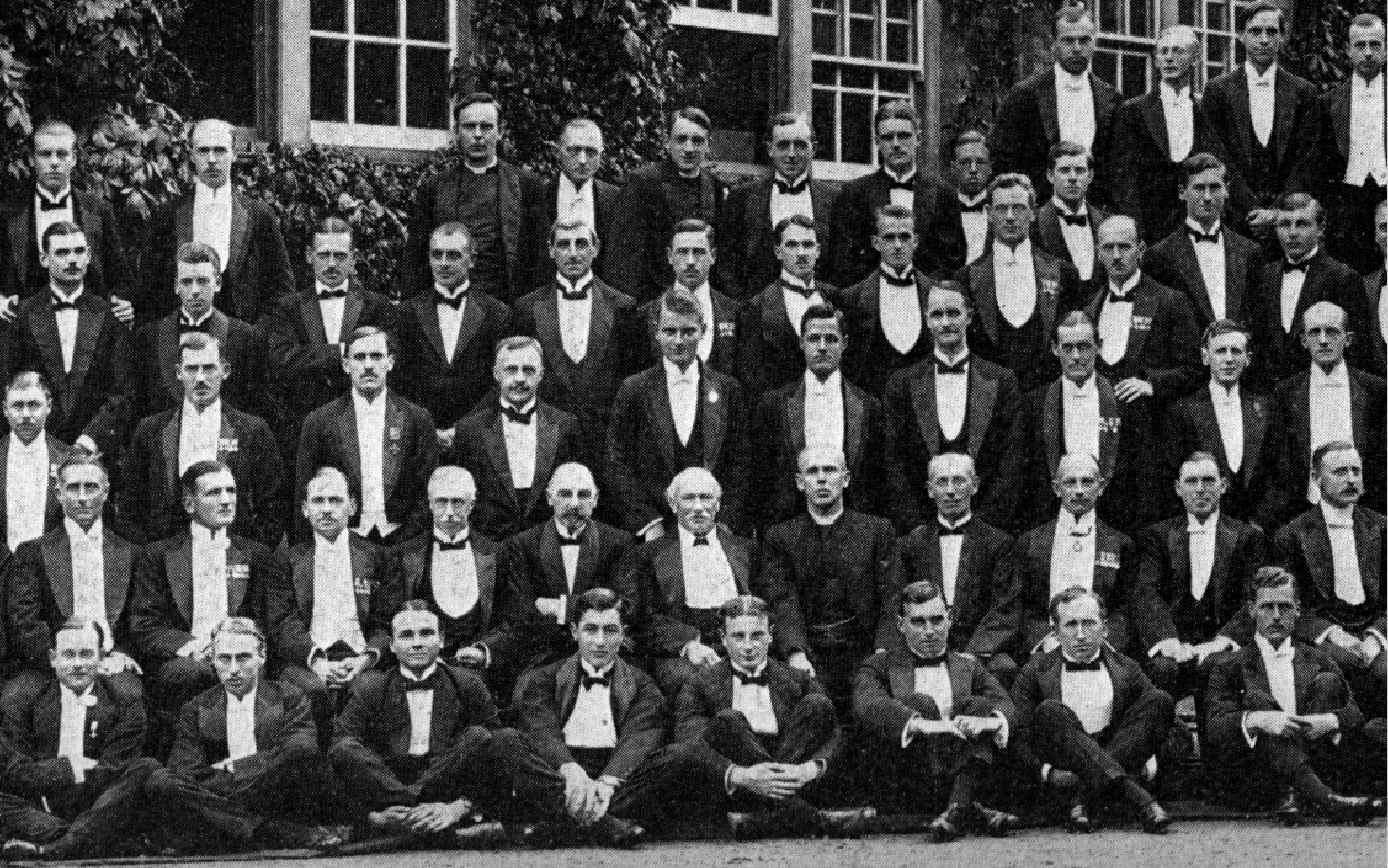
It was the greatest pleasure to meet 115 of my Old Boys and the staff at dinner in the School Hall on Saturday. I am rather proud of having only in one case made a mistake in identification. If I failed to have a yarn with each individual it was for lack of time and not for lack of will. It was strange and delightful to feel that I am the one link between them all – that in the whole wide world there is no-one else who has known them all personally from their boyhood.

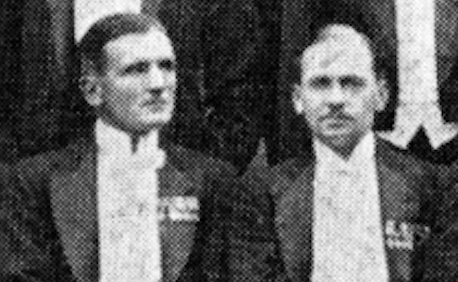
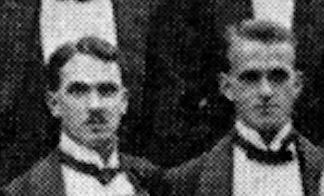
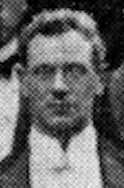
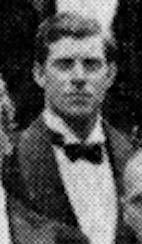
Walter Moberly (left) was one of our most distinguished Old Boys in the War, being twice mentioned in dispatches and winning the D.S.O in an action that sadly cost the lives of two other Old Dragons, Will Scott and Gifford Turrell. He has now returned to Lincoln College, where he is a Fellow, lecturing in philosophy.  Frank Sidgwick (right) continues to prosper with his publishing company Sidgwick & Jackson, having had particular success with the works of the war poet, Rupert Brooke.
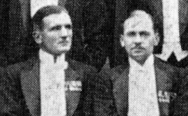
Geoffrey Freyberg (left), having survived the battle at Jutland and witnessed the surrender of the German High Seas fleet in November 1918 on HMS Valiant, is now the King’s Harbour Master at Plymouth.  Geoffrey Rose (right) is in the process of writing up the history of the 2/4th Oxfordshire & Buckinghamshire Light Infantry in the War, to be published later this year. Having been called to the Bar in 1912, he is returning to a legal career.

Philip Frere (left) provided the ‘Draconian’ with an account of the retreat enforced by the Germans’ Spring Offensive of March 1918 and Nevil Norway (right) having as a 17-year-old witnessed the events in Dublin of Easter 1917, served the final months of the War as a private soldier in the Suffolk Regiment.  He is now up at Balliol College, reading Engineering Science.

Maurice Campbell (left)  ended the war with typhus and malaria and was invalided home. Last year he was awarded the OBE for his services with a field ambulance and has now returned to Guy’s Hospital as a medical registrar. Pat Campbell (right) having gone straight into the Army from Winchester in 1917, has now returned to Oxford to study for a degree at Brasenose College.

Roger Mott, it may be recalled wrote to us back in 1915 of his “Balkan Find” – a memorial tablet from the time of the Emperor Hadrian, and I understand that it is now the proud possession of the new Imperial War Museum, officially opened on June 9th by King George V at the Crystal Palace.

Geoffrey Carpenter spent the War with the Uganda Medical Service and wrote to us following the Battle of Tanga, known as the Battle of the Bees. He has now returned to Oxford and is working as a Specialist Officer for the control of sleeping sickness in Uganda. He is bringing out a book later this year, ‘A Naturalist on Lake Victoria, with an account of Sleeping Sickness and the Tse-Tse Fly’, about his time there (1911-14), the introduction written by his friend an mentor Prof. EB Poulton (father of Ronnie Poulton).
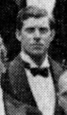
Sydney Carline, whose experience of being shot down over the Somme in 1916 was reported to us by his brother George,  enjoyed the final months of the conflict as a war artist. Having returned from his tour of the Middle East for the Imperial War Museum with his brother Richard last year, they have both enjoyed a successful exhibition of their work in the Goupil Gallery in March.

Jack Gamlen was one of the most prolific of our ‘war correspondents.’ A regular guest critic of our school plays before the War, he was particularly missed here when we were putting on ‘A Midsummer Night’s Dream’ in 1915 and he sent the boys a most witty verse.  We were delighted to have him back to review last term’s production of ‘Henry V’, even if his judgments were not always generous!

Noel Sergent, who sent us many descriptions of his time on the Gallipoli peninsula, together with a graphic account as to how he managed to escape drowning when his ship was torpedoed, we are delighted now to have on our staff, teaching French (of course) and mathematics. He is also a great asset on the river where he has been coaching diving.

Jack Smyth – whose array of medals impressed us all – was a regular correspondent in the War years. Who will ever forget the day to returned to the School with his VC? He has a busy time ahead – he is due to receive the MC on July 20th and be married on July 22nd,  but has kindly agreed to attend our Prizegiving on the 21st to give away the prizes!

There were many who were under Mr Clarke, my predecessor, and who had suffered from my mistakes and inexperience as a young teacher; and perhaps that meeting with an early generation of Dragons was of the greatest interest to me. They have had time to distinguish themselves, and many have done so…

And then, alas! there are so many whom we shall not see again at these gatherings, those who have so nobly given their lives for us.

(Of those mentioned above, a number had lost an Old Dragon brother in the War: Frank Sidgwick (Hugh), Geoffrey Freyberg (Lance), Maurice & Pat Campbell (Percy), for whom the day must have brought on very mixed emotions).


June 15th 1920

O.D. Dinner – June 12th 1920.

On Saturday, it was a great pleasure to be able to welcome back to the School a great gathering of Old Dragons. I am delighted to say that the events of the day have been recorded by one of our company,  who prefers to remain anonymous!

“The Senior Old Boys’ Dinner (‘the first since 1914’ as the carte d’invite said) took place in the School Hall on Saturday June 12, 1920, according to plan, at 7.30.

Photo at 7.15, according to plan; showers, noon to 7.00 p.m.; downpour, 7.16 p.m.; the interval, no doubt, pre-arranged by the School authorities…

It was a magnificent gathering of 116 or 160, or perhaps 1,600 Old Boys, including representatives of all the First Families such as Tyrwhitt, Townsend, Johnson, Holland, Mayhew, Taylor, Spurling etc. – even men who were boys before the Skipper knew the difference between a centreboard and a centrebit, or between Capri and Chianti. ‘Fancy that!’ as Ibsen’s characters always remark when a divorce or murder in the family is announced.

Orders and decorations were worn, mostly on the left pap, where the heart doth hop; but some Old Boys preferred to tie them round their necks. These, we noted, were chiefly those who had lived in India and other light-fingered countries, so no doubt the precaution was instinctive. Be that as it may, the room glowed and gleamed with polychromatic ribbon and tinkling symbols of valour and prowess. 

The menu was well chosen, the courses numerous and costly, the liquor generous, and the conversation consequently consecutive, but not subsequently inconsequent.

After the loyal toast, and the reading by the Skipper of the School’s Roll of Honour, he was again on his feet to give the health of his Old Boys in one of those magnificent characteristic speeches where spasmodic recollection of disjointed portions of the prepared speech (when the note happens to be decipherable) is periodically annihilated by a spontaneous heart-felt outpouring of the Skipper’s own colloquial, breezy, generous speech. He threw in, of course, as an afterthought, the usual time-worn plea that he should not be referred to in subsequent speeches…

But what, may we ask, is Home without a Mother? What Hamlet without the Prince of Denmark? ‘Quelle idee!’ as a naval officer sitting near me remarked under his breath, when he heard this request enunciated by the man he had come  – we had all come – to see and hear and talk about.

Walter Moberly was in very good form, and having said a few nice things about the School, turned frankly to the subject closest to our hearts and spoke at length and in detail about the Skipper, whose health really got drunk at the end instead of the School’s. The general opinion was that the School was quite able to look after its own health…

It was a great occasion, medicine for the spirit of the middle-aged pessimist and a vast stimulus to the wiser optimist. It is good to come home and find a welcome there, and go away humbled with the lesson that even the worst of us must have been good once.”

May 26th 1920

The most recent issue of ‘The Draconian’ contains no fewer than 26 pages of letters from the Carline brothers, recording their time as war artists gathering material on their grand tour of 1919.  It is now six months since the Imperial War Museum packed them off on this mission and from Mesopotamia, where Sydney Carline‘s last letter was posted, they have moved on to Persia, which they reached at the end of July 1919.

“Kuretu (Persia) July 31st 1919.

If you look on the map you will see that on the borders of Persia and Mespot there are endless successions of mountain ranges. My sketch shows the craggy peaks of the first series as seen from the camp in which we are quartered till tomorrow, when we continue by car to Kirmanshah, Hamadan and Kazvin

We are blessed with a servant in the form of a little Arab boy about 13 to 14. He puts our beds out, fetches water, polishes our boots and so forth. It is very nice to have someone to attend to us on a journey of this sort, as there are no conveniences anywhere, no hot and cold water laid on etc. But already we are faced with a counterbalance of extra worry about what he is to eat, where it is to be got from, where to sleep and so forth…

Though he made my dressing easy by having everything ready, in return it took me most of the morning to arrange for his boiling of his mid-day rice. You see everything has its proper place; one caste of Indians use this fire, another that, and so on, and to find the one where our boy is to boil his is quite a job…

To understand the country one must understand the heat, as it produces problems that are exactly opposite to all the conditions that one is accustomed to and looks upon as proper…

After I have washed in our one and only basin, should Dick want to do so also, what does he do to get rid of my dirty water? Does he call a servant, have it tipped in a bucket and carried in search of a drain down which to pour it..? Oh, dear no. He may chuck it out the window, in which case it may allay the dust on the lane for a brief moment. But water is precious, evaporating water produces a coolness in the air, our room is hot, the brick floor is hot to touch and dusty; taking the basin Dick therefore pours the contents on our bedroom floor. The bricks are porous, they drink up the water; there is a dark patch for a few moments, the room is perhaps slightly cooler, and, as Dick finishes his wash, all is as it was before.”

May 19th 1920

Capt. JG Smyth VC

Capt. W Leefe Robinson VC


V  C    D  A  Y

We are proud to honour two Old Dragons, Jack Smyth and William Leefe Robinson,  who were awarded the Victoria Cross in the War. May 18th was the day on which Jack won his VC in 1915 and we mark it at the school as our VC Day with a school holiday.

The weather was not kind to us, as Hum reports:

“A party of 135 took boats at Port Meadow and struggled against a violent gale and a high-running stream to the old spot at the foot of Wytham Wood, near Swinford Bridge. Here we were joined by Mrs (Harry) Smyth and the maids, who came by caravan, which had previously brought a mighty lunch and tea. Rain and wind did its futile best to depress the merry party; some got soaked, no one wanted to bathe.

It was with a sense of relief that we found all were safely home, with only one boat seriously damaged and sundry minor casualties.”

This was preceded by VC Sunday (May 16th) which was marked by a special service in commemoration of Old Dragons killed in the War. This will, we hope, be an annual observance. Mr CRL Fletcher, father of Regie and George Fletcher, both of whom laid down their lives in the War, gave the address.

Whilst recalling the exploits of our two VCs and mentioning the 20 DSOs and 48 MCs won by our Old Boys, he quoted Mr EW Hornung‘s famous words:

The brightest gems of valour in the Army's diadem
Are the VC and the DSO, MC and DCM,
But those who live to wear them will tell you they are dross
Beside the Final Honour of a simple wooden cross.

The text he took was from Thucydides: ‘To you who are the sons and brothers of the departed I see that the struggle to emulate them will be an arduous one’ and he ended his address observing,

“However great your own valour and virtue may grow to be, the world will hardly ever think you capable of equalling them, or even of approaching them. But, courage! and do, each one of you, your best to come as near as you can to them.”

This is the second address Mr Fletcher has given to the boys – the first was back in June 1917.

May 15th 1920

Sydney Carline and his brother Richard have moved on since their last letter from Cairo in May 1919, and this one is from Mesopotamia:

“Mespot, 12th July 1919.

I am sorry I have not written a proper letter, but it is very difficult to find time for writing in this country. The early morning is sacred for work, as the afternoon is silent and universally given up to sleep. One complies with this not from indulgence, but because one’s eyes will not keep open. After tea one can again work and by dinner one is quite exhausted, and by reason of our getting up at sunrise, I, like a boy after the jam in the cupboard, slink off early to bed on the roof-top.

Everyone sleeps on the roof-top in order to get the cool breeze. Towards dusk there is quite a chatter, as all the many wives of each household are busy putting the beds out on their roofs, which are of course flat, and in the better class houses have low walls separating them from the neighbours…

Occasionally the silence of the night is perturbed by a wife who has still some household work to perform for her lord and master, who is probably reclining and smoking on his wooden bed…

It is now 7 and breakfast time. I must get to work on my picture of dropping bread on Kut, after which I have only one more to do to finish my work here.”


May 3rd 1920

The Carlines have moved on into Egypt on their journey and it is the turn of Richard Carline to write, this time from the Hotel Continental in Cairo on May 20th 1919.

“A day was spent in riding along the edge of the desert on camels, from the Gizah Great Pyramids to the old Step Pyramids and the necropolis of Sakkara about ten miles south, and from there on to the site of Memphis, where we saw the colossal statue of Rameses. But all the journeys were so long and took so much time that not much was left for seeing the most interesting things of all, namely, the tombs of Sakkara.  We ended by doing much of the ride in the dark…

We were accompanied by our dragoman, and two small Arab boys ran the whole way with sticks to drive the camels, in order to keep a good speed up and in order to take care of them while we are enjoying ourselves; neither of these boys could have been more than twelve, and we did more than thirty-two miles during the whole of the day – running all the way. I remember my young days, when I walked to Windermere once, a matter of about eighteen miles in all, and I was practically dead at the end of it.”

Richard also includes this delightful little sketch (and explanation):

Picture by Sydney giving an impression as he saw it of our journey to Sakkara. In the distance to left is the Step Pyramid, and all about under the sand are the tombs. The further figure is the dragoman; the nearer is myself.


April 23rd 1920

This is the third of the letters from the Carline brothers on their travels last year and appropriate for today, which is St George’s Day.

Arriving in the Middle East in January 1919, the brothers followed the suggestion of General Salmond (General in Command) to travel round Palestine and Syria by train or car before making flights over the areas of interest. Thus Sydney had made preliminary sketches in February before he wrote this letter from Damascus, dated April 24th 1919.

“Dick has mentioned the picture he is painting of the town from the air, and I am painting another of my aeroplane pictures, depicting the attack on the Turkish Army trying to escape along the pass between the mountains leading from the town along which the famous and beautiful Baroda flows. I have got to take another flight tomorrow if the weather is good in order to finish it…

The only news one ever gets here is of the troubles in Egypt, expecting massacres of Jews in Palestine on account of the Zionist movement, and odd bits about the Peace Conference, so that we are really quite ignorant as to the state of affairs at home or in Europe.

Tomorrow is St. George‘s Day. Curiously he is supposed to be buried at Ludd near Ramleh, where there is a church to him. The story of Perseus and Andromeda is also supposed to have been enacted at Jaffa, in the same neighbourhood, and the rocks out to sea from Jaffa (which I have painted) are supposed to be the dragon turned into stone…

St. George and the dragon was, I believe, a local story that the crusaders brought back with them.”