November 12th 1916

It is always a pleasure to welcome back our old boys and this week we were delighted to receive a visit from Lieut. Henry Tyndale (KRRC). He was on excellent form, although still lame from the wound he received last year in Flanders.

Harry has given us an account of how this came about for publication in this term’s ‘Draconian.’

tyndale“Away to our right, on high ground rising in the middle of a large wood, was a strong German redoubt, apparently untouched by our guns. From this redoubt machine-guns were keeping the edge of the wood under fire so that those parties who emerged soon lost their leaders and many of their men. My own men were held up by those in front, who could not move, and while finding out the exact situation, I was hit.  

Very fortunately I fell down into a shallow shell-crater. One of my men, who was beside me, straightened out my broken leg and bound up my wound, placing the broken part in a rough splint by tying it against a spade-handle. Once this was done I had very little pain, provided that I kept quite still,  and when the attempted counter-attack was over and the men had reformed in the original support trench, I was alone with one other wounded man.

As we were so near the open ground and probably under view of the enemy, I knew that there would be no prospect of a stretcher until dusk. I sent back a reassuring message to my Company Commander, who would know where I was lying. The afternoon was beautifully warm and I could watch the sun gradually getting lower in the heavens. There was little firing.

Towards dusk a party of volunteer stretcher-bearers came across me, but they had no means for carrying me in. I waited a long time for their return with the necessary stretcher, but night fell and flares went up along the line and I began to wonder whether they had forgotten me.

An hour after sunset I heard men moving in the undergrowth near me. It was with considerable difficulty that I could guide them to my shell-hole, so thick was the wood. They had no stretcher, but someone produced an overcoat, and with rifles run up the sleeves, this provided a fair stretcher. With difficulty they got me under way, but soon I was behind a small barrier of sandbags on a track through the wood, and a wide floor board proved an excellent substitute for a stretcher.

At the dressing station I met my Company Commander, who had been searching for me in vain and was greatly relieved to see me in safe hands; before dawn I was under chloroform, having my leg set, and in the early sunlight the ambulance took me to the train.”

Harry is a Winchester man through and through. Having won a scholarship there in 1900 and subsequently another one to New College (where he got a First in Classical Moderations and Literae Humaniores) he returned to teach at Winchester.

Being unfit for active service, Harry is now working in the Intelligence Department at the War Office.

November 6th 1916

Although France is currently the centre of attention in this war, the North-West Frontier continues to require policing, in order to thwart German efforts to threaten British power in India.

north-west-frontier

Lieut. Jack Smyth VC (15th Sikhs), who wrote to us in June about the signalling course he was sent on, has written to say that he is back on active service there:

Jack Smyth28/10/16 “Here we are on the frontier, once more on active service and I am writing this in the Mess tent, well dug down below ground to escape stray bullets…

I arrived at Peshawar to find the regiment had marched out the day before and orders awaiting me to command the Depot.

A newly joined subaltern came up and reported that he had been left as Adjutant and handed over piles of correspondence, which we had to get down to at once…

We had two or three very strenuous days with the usual notes from everyone who had gone out with the regiment asking for various things they had left behind. This sort of thing:

‘Please get the keys of my bungalow from my gardener and on the bunch you will find a brass key, which opens the third drawer of my writing table. At the back of the drawer you will find my despatch case and in it my cheque book. Please send this out by the milk lorry tomorrow. Awfully sorry to bother you, as I know how busy you must be,’  but this is part of the Depot commander’s job…

Three days ago I was relieved and sent out to join the regiment. The Mohmands with whom we are fighting, or supposed to be fighting, have so far left us severely alone, but come down at night and snipe and hurl abuse at us…

We can’t attack them because they would only retire to their hills and we should need a large force and a long line of communication to follow them, and they won’t attack us because they think barbed wire and mountain guns an unfair advantage.”

Before this, Jack had been on leave in Kashmir, where he reports that he met up with fellow Old Dragon, 2nd Lieut. Edward Sheepshanks (Indian Army) at a dinner party,

“…and thereupon had an OD dinner on our own and drank to the Skipper and the OPS, which astonished the rest of the party…”

Knowing how lively an affair an OD dinner can be, I am not surprised they were astonished!

(At least there were no Wykehamists present to sing a joyous chorus in praise of the present subjunctive – and they did not have to suffer my recitation of the Banjo Song!)

* * * * * * *

Roderick HaighToday is the second anniversary of the death of Lieut. Roderick Haigh (Queen’s Royal West Surreys). Thanks to his bequest, which paid for our shooting range, the boys will be competing for the Roderick Haigh Cup at the end of this term.

He was a noble man, who saw it as a privilege to die for his country.

November 6th 1916

Although France is currently the centre of attention in this war, the North-West Frontier continues to require policing, in order to thwart German efforts to threaten British power in India.

north-west-frontier

Lieut. Jack Smyth VC (15th Sikhs), who wrote to us in June about the signalling course he was sent on, has written to say that he is back on active service there:

Jack Smyth28/10/16 “Here we are on the frontier, once more on active service and I am writing this in the Mess tent, well dug down below ground to escape stray bullets…

I arrived at Peshawar to find the regiment had marched out the day before and orders awaiting me to command the Depot.

A newly joined subaltern came up and reported that he had been left as Adjutant and handed over piles of correspondence, which we had to get down to at once…

We had two or three very strenuous days with the usual notes from everyone who had gone out with the regiment asking for various things they had left behind. This sort of thing:

‘Please get the keys of my bungalow from my gardener and on the bunch you will find a brass key, which opens the third drawer of my writing table. At the back of the drawer you will find my despatch case and in it my cheque book. Please send this out by the milk lorry tomorrow. Awfully sorry to bother you, as I know how busy you must be,’  but this is part of the Depot commander’s job…

Three days ago I was relieved and sent out to join the regiment. The Mohmands with whom we are fighting, or supposed to be fighting, have so far left us severely alone, but come down at night and snipe and hurl abuse at us…

We can’t attack them because they would only retire to their hills and we should need a large force and a long line of communication to follow them, and they won’t attack us because they think barbed wire and mountain guns an unfair advantage.”

Before this, Jack had been on leave in Kashmir, where he reports that he met up with fellow Old Dragon, 2nd Lieut. Edward Sheepshanks (Indian Army) at a dinner party,

“…and thereupon had an OD dinner on our own and drank to the Skipper and the OPS, which astonished the rest of the party…”

Knowing how lively an affair an OD dinner can be, I am not surprised they were astonished!

(At least there were no Wykehamists present to sing a joyous chorus in praise of the present subjunctive – and they did not have to suffer my recitation of the Banjo Song!)

* * * * * * *

Roderick HaighToday is the second anniversary of the death of Lieut. Roderick Haigh (Queen’s Royal West Surreys). Thanks to his bequest, which paid for our shooting range, the boys will be competing for the Roderick Haigh Cup at the end of this term.

He was a noble man, who saw it as a privilege to die for his country.

November 1st 1916

Our old friend ‘Fluff,’ Lieut. – Col. Stuart Taylor (West Yorks) has recovered from his wounds. He returned to command his battalion on September 16th and, although he cannot say as much, I think it highly likely he is somewhere in the region of the Somme.

We are most grateful that he has found the time to write to the boys:

Stuart Taylor 2“We are living in stirring times now and there is much doing. I wish I could tell you all about it, but the censor rules are very strict.

There are one or two things I hate in the trenches worse than the Boches – rats and cats.

The rats are enormous grey shiny looking things with great fat tails, and they come out in swarms at night and eat up all the horrid things they can.

You would think the cats would eat the rats, but they do not, I regret to say. They are kittens which have been born since the war, in the desolated and ruined villages and towns of Northern France, and they are rapidly forming a new species of wild cat, living in old disused trenches or holes in the ground and coming out at night.

There is so much to eat lying about that they do not kill the rats or mice.”


This is not the way of nature, but it is to be supposed that war is bound to have some sort of effect on all who partake in it – even cats and rats, it now seems.


October 23rd 1916

Lieut. Geoff Buck (RFC) has completed his training and has now been let loose on the Boche!

Amongst the danger and excitement of war, these latest entries from his journal show an interesting range of emotions – who would have thought war could be a laughing matter?

Buck, Geoff27/9/16. “I took a machine and eight bombs and went off with 16 other machines to raid Bocheland. Flying close together with 16 others is ‘anellofajob’. But anyhow we all came back, and it was quite pleasant – no Hun machines and very few ‘Archies’. You can’t think how queer a big battle looks from upstairs – frightfully interesting, but I simply hate to think of the poor blighters on the ground..”

2/10/16. “Flying high in formation we got slightly ‘Archied’ over the lines (I disliked this because a little bit of iron on one of my eight bombs means that I go simply to swell the Roll of Honour). We dropped our bombs, and they all fell on their objective, and probably strafed some French peasants, mice and woodpeckers. But I hope we killed more Boches.

Then the fun began, pop-pop, bang, fizz-whizz, hiss, pop, bang, little black puffs all around us, and each explosion shook our little machines as if they had been kicked. This was most dangerous and unpleasant (so I thought), and after waving to my nearest fellow-sufferer to keep clear, I performed a memorable series of switchback vertical turns at an average speed of 150 mph. This upset Archibald’s calculations some, I guess, and anyhow I lost control and was much too frightened trying to get control of the machine again to be frightened about Archie.

It really is a sporting kind of life, and I laughed till I could hardly see the instruments.”


As a young Dragon, Geoff always enjoyed a good scrap. I recall a bike expedition to North Cerney in the summer of 1910.  Having gone by train to Fairford we bicycled to North Cerney. There followed a cricket match against a local team of boy scouts. The match was conveniently tied before the real fun started. Paddy Burton’s brother Phil wrote up the events that followed:

“…someone bagged one of the Boy Scouts’ caps, and this lead to a battle; after about ten minutes ragging they collected their troops and sounded the charge. They were much older than we were for the most part, and they outnumbered us, but we were not going to be beaten. Keyworth had a tremendous fight with the ‘Samsonian Beefer’ (aged 19) and everyone did his best to sit on the scout he had got hold of. Geoff Buck held down a writhing mass of three scouts, and Flea Carr White and Henry Way wrought frightful havoc.

When we were told to go to bed, the lawn (of the Rectory) was covered with Dragons sitting on scouts, and I may quite fairly say that we absolutely licked them. Then we cheered them and trooped off to bed.”

The next morning we started for home, stopping to lunch in Burford. Clearly it was a good one, as Billy Smyth recorded in the hotel’s visitors’ book:

Four cyclists arrived at the Inn of the Bull;
They came very empty and went away full;
Their names were the Skipper and Billy and Flea,
And Geoffrey; a hungrier four ne’er did you see.

The fare was roast beef with potatoes and peas,
And raspberry tart, and some excellent cheese;
A fair maiden served us with all of the best;
But who wrote this poem will never be guessed.

With so much to depress us in today’s world, it is good to have these memories of happier days to buck us up!


October 19th 1916

raikes-jf-2

2nd Lieut. John Raikes (Essex Regiment)

One cannot guess at the number of shells that daily pour down on our troops on the Somme. I am very sorry to have to relate that John has been killed near Flers by one such shell on 10th October 1916.

Rev. Raikes, John’s father, has shared with us a letter he received from a brother officer, who witnessed the event:

“We had just come up by night to the support line and I had just started up with a working party. John had gone to his dug-out to get some rest; we were being heavily bombarded, and a high explosive shell burst right on the top, destroying the place and killing him instantaneously.

We buried him where he fell and have erected a temporary cross over his grave. ‘In memory of Lieut. Raikes, killed in action, Oct. 10th. 1916. RIP’”

John’s servant, also aged 20, was killed by the same shell. This lad, writing home to his mother a few days before, had said, ‘You needn’t worry about me. I am with a proper gentleman.’                                 

I remember Johnnie as a good-hearted, merry little fellow with a keen sense of humour. We went on several bicycle expeditions with the boys to his home and he always enjoyed showing us around the Zoological Gardens in the neighbourhood.

Although he failed to impress Winchester quite enough for them to offer him a place, he won a scholarship to Radley and thereafter a Mathematical Exhibition to Corpus Christi College Oxford – the first Radleian to have won a Mathematical distinction at the University for many years.


October 15th 1916

blencowe-oc

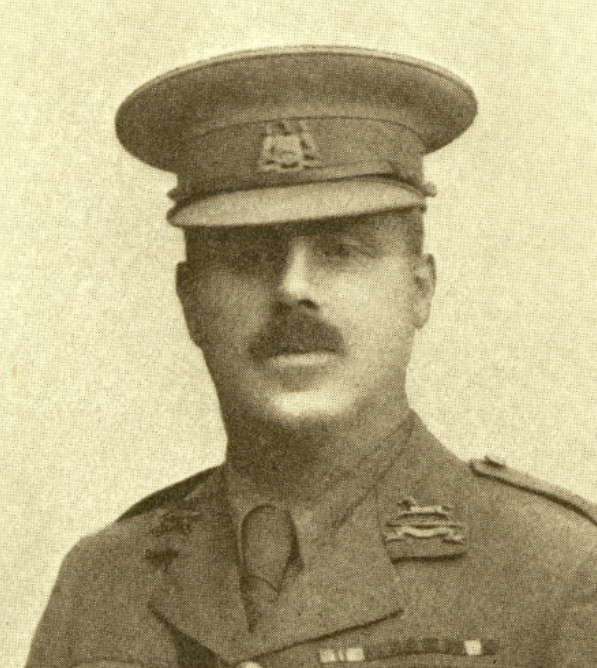
2nd Lieut. Oswald Blencowe (Oxford & Bucks Light Infantry)

An eighth Old Dragon has laid down his life in the battle that has been raging on the Somme since July 1st. Oswald was killed on 7th October 1916 when temporarily attached to the Rifle Brigade.

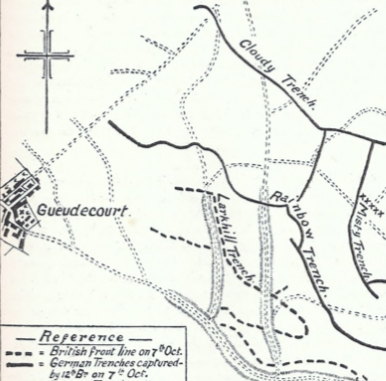
It was the Brigade’s task to capture Rainbow and Cloudy Trenches, near Guedecourt. As soon as our barrage lifted the Riflemen (some of whom had been lying down in the open awaiting this moment) rose bravely to make the attack.  On reaching the crest of a hill about twenty yards from the German line they met with heavy machine-gun fire. All five officers of the two leading companies went down – four (including Oswald) were killed and a fifth severely wounded.

guedecourt-map

It is of some small consolation that the reserve troops coming up behind them were able to take Rainbow Trench.

A brother officer recalls Oswald most fondly:

“In the line he was of immense value to us, and in the most trying hours, when things were as bad as shells and foul weather could make them, he showed that rare kind of cheerfulness which does not offend nor depress by its artificiality. He set a high value on music and poetry. He sang well, and was strongly heard in a dug-out – carols, songs, and choruses, old English songs, and Gilbert and Sullivan. One day he pulled out the books he always carried with him – Omar Khayyam, and two volumes of the hundred best poems and three of us lay awake reading aloud to one another…

He was hit by a shell in the head in front of his men about ten yards from the enemy’s line, but such details are needless and unsatisfying; we know what he was when alive and in what manner and with what spirit he must have died. The circumstantial details are useless trappings.” 

We are thankful for information from the Colonel, confirming Oswald was given a proper burial:

“He had been temporarily attached to this battalion and had only been with us three days. He went into action alongside his battalion and was killed during a successful attack in which he was with the leading company.

He was buried by our Chaplain near the place where he fell, between our and the old German line.”

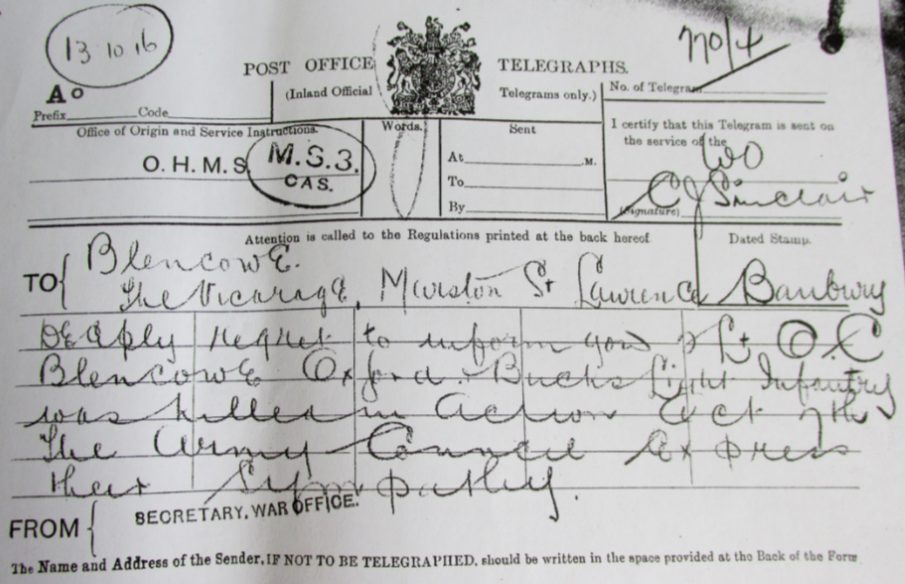
The news of Oswald’s death did not reach his parents until October 13th, six days after the event.

blencowe-telegram


October 11th 1916

AG Clarke

Lieut. Geoff Clarke (Rifle Brigade) was killed on the first day of the battle on the Somme. Further to what we were able to post at the time, a Sergeant P. Blunt has most kindly written to the family with further details:

28/9/16 “Well, as you know, on July 1st our Battalion was told off to attack a certain  part of the German line.

Lieut. Clarke, who was then our Battalion Bombing Officer, had rather a tough job and it was while going over towards the 3rd German line that I came across him. He was then slightly wounded, but refused all assistance and would insist on keeping going. He was again wounded, rather badly this time, but still refused all help and insisted on us to get along.

That was the last I ever saw of him; he was then lying in a trench hole. During the fighting and excitement that followed, I lost touch with him, but was told by a man who has since been killed that he saw a shell pitch into the hole that Lieut. Clarke lay in and he saw a body blown into the air.

When we returned from the third line, I went and looked for him, but could not see him anywhere…”

This is most painful reading for all those of us who knew him so well.


October 8th 1916

Lieut. Hugh Sidgwick (RGA) is proving a prolific correspondent.  Being currently under-employed behind the lines on the Somme, he apparently has plenty of time for both reading and writing.

sidgwick-ah-226/9/16. “I was in the most forward of our batteries the other day just at ‘zero’ time – i.e. the prearranged moment when the final bombardment begins. The noise was really appalling. Our own howitzers were comparatively mild members of the orchestra: the high velocity guns easily out-topped them: now and then came the roar of the really big guns far behind: while the rumble of field guns was practically continuous. If you don’t stop to think, it is something of an experience: if you do, you want to sit down and cry.

Generally, I feel a complete fraud and quite unworthy of print in the ‘Draconian’.  I have only been a combatant for about six weeks and am now a petty clerk. So this is my last contribution to the war columns. Veni, vidi, Vick-E: I came, I saw a little of it and it was all over. Any telephonist will explain the joke to you. It is the first I have made since 1902.

The modern Pepys and Shane Leslie book are much appreciated here. Leslie is quite interesting, but what right has he to be compiling memoirs and summing up an epoch at his age (31)?

Besides, I am not at all so certain that the epoch is over yet. Everyone I meet out here appears to wish to live after the war pretty much as he did before, though all agree that other people ought to reform their ways and show signs of spiritual uplift.

I hope all goes well with the OPS.”

October 3rd 1916

No regular reader of the newspapers and their lists of casualties can be in any doubt that the fighting on the Somme continues to be fierce and costly. (How grateful we are that we have suffered no fatalities since August).

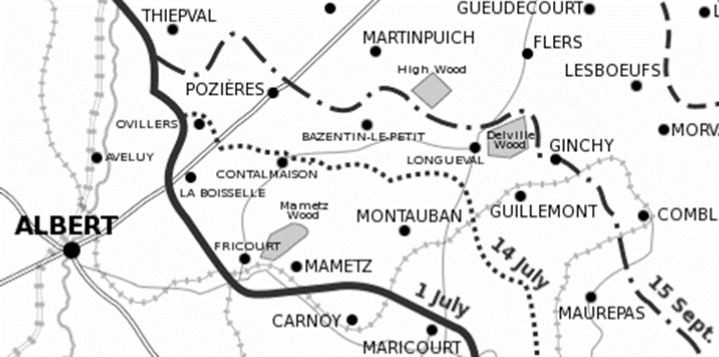
Lieut. Jack Gamlen (OBLI), who joined the Push on August 13th, tells me that he “has no great tale to tell.” I beg to disagree, as his description of the advances made from Ovillers towards Thiepval is most illuminating.

somme-map-2

“We struck north for Ovillers… it was my first sight of the front and I shall never forget it. Less than three hours march had carried us from corn-fields and unruined villages to an obscure desert which looked like nothing but the surface of the moon. We marched through Ovillers, passing streams of wounded and weary men who were returning from the front line.

Then we turned sharp to the left up a narrow, freshly dug, communications trench. In it I felt quite safe, though enemy 5.9 shells began to fall pretty thickly round us. We went on and on very slowly, and with many halts for half-an-hour, and then at last turned into the third line trench, which we were to occupy as company in reserve.”

Here Jack and his men had to endure some fairly heavy shelling, but were pulled back the following day for a brief period.

“We returned three days afterwards, and this time my Company took over the front line. We were heavily shelled from the first. One man in my platoon was killed by a shell, within three yards of me, just as we had taken up our position.”

Again, the shelling was constant but there were no infantry attacks and Jack returned safely.

“A week later we were back again, further to the left, and in full sight of Thiepval, which looks so harmless and so near in the strong sunlight of a hot morning.

In all this part of the line, the trenches were really not trenches at all. They had been blown to bits weeks before and gave scarcely any shelter to my men, several of whom were under fire for the first time.

On the afternoon of our first day up (August 23rd), an attack was to be made by the Bucks battalion on our left against the enemy line some 200 yards in front. I was in charge of a bombing section, with orders to push on to the enemy trench at Point ***  as soon as the Bucks went over, and to join up with them.

From a shell-hole I watched our wonderful preliminary bombardment of the enemy’s lines. It was terrifying, but extraordinarily interesting. I say ‘terrifying,’ because some of our shells burst very close to us; far too close to be pleasant. Then the barrage suddenly stopped, and the Bucks went over, alas, only to come back (what was left of them) in a very few minutes, for they were mown down by machine-gun fire which started the moment our own barrage lifted.

I now sent back for further orders, and was told to push on to Point ***  if I could. So I organised my bombing party, and sent two men up the communicator, where I already held a ‘bomb-stop,’ (a barricade in the trench dividing Br/Ger troops) to see how near the enemy was. They came back at once and reported about 20 of the enemy behind the next traverse but one. I didn’t believe them, so went myself, and found about 10 of them behind the next traverse but two. We looked at each other and I came back quickly. The attitude of the enemy was expectant, but not very menacing.

I waited for about half an hour, in order to allow the Huns to recover from the sight of me, and then advanced with my whole party. We all expected death, but there was no time to think about it.

When we reached the point at which I had sighted the enemy, I found a German, three yards in front of me, who was just about to descend into a dug-out. His head was already out of sight. I had a beautiful revolver shot at him, and his body and legs followed his head. It was a good moment.

Immediately afterwards the enemy woke up, and there was bombing at close quarters. We conjugated the verb “to bomb” in all its moods and tenses, and my party had wonderful escapes and only two slight casualties. The enemy then retired round the corner of the communicator into their own trench, and as I did not feel equal to attacking their whole first line with one section, I ‘consolidated my position,’ and remained where I was until I was relieved…

This is all I will tell you this time. The Somme trenches are very horrible; shells are very horrible; and fighting is tiring beyond anything which can be conceived at home.

What most impresses me is the speed with which one forgets the horrors as soon as one leaves them behind.”