May 18th 1917

Young Dickie Wallace (aged 8 and in Form 1a) has shown me a letter he has just received from his uncle, Sous-Lieut. Noel Sergent (French Artillery), describing how he survived a torpedo attack on his way back to France.

13/5/17 “I left Salonika on Easter Sunday at 5 in the evening on a rotten old barge of 8000 tons, which could only go about 12 miles an hour. We called at Athens and Milos and on April 16th, while we were all having a snooze after lunch, we were torpedoed; we all went up on deck to see what was happening and we were told to put the boats and rafts out as soon as possible, as the ship would go down rapidly. So I went to my raft, which was forward, and found there was no time to spare, so we got her into the water.

In the meanwhile, the ship was sinking rapidly by the bows and when the bows went under, our raft was chucked up on to the deck and we all let go for fear of being crushed against some part, as the raft was bowled over and over by the waves.

I was washed down into the hold of the sinking ship by a big wave and drank and drank and drank, and all became dark round me. I thought it was the end and I remember saying to myself, ‘I’ve wondered how my end would come and this is it.’

In the meantime I did what I could to get to the surface and, as I got a glimmer of light, I made an effort and reached the surface and clutched at some boards that were floating about, and managed to keep up with one of these under each arm till I got my breath…

…The raft, which had presumably been wandering about on the deck, came near me and I gave two or three good strokes between waves and hung on to one of the ropes. But the backside of the old ship seemed to be right over the top of us and we couldn’t get the raft off the deck, as the waves kept shoving us back again…

As luck would have it, the ship sank down gradually, the funnel just missed us and the wash of the ship swept everything off the deck and the ship glided down just in front of us. There was no suction to speak of, so I was helped on to the raft where I was sick twice, and 3½ hours later we were picked up by a French torpedo boat…

There were 45 men drowned, chiefly owing to rough seas, too much clothing and tummy aches – as you know you mustn’t bathe (if you can help it) directly after a meal.

I was seriously handicapped by having on at the time a pair of heavy English football boots, which I had specially had out from England, and also a large artilleryman’s ‘Capote’ (a heavy coat with large cape attached to it).

Thank God I had learnt to swim under water, or you would never have had this letter…

Your loving uncle,

Noles.”

May 13th 1917

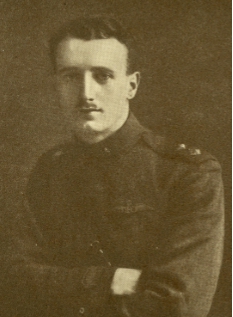
Lieut. Morice Thompson (Shropshire Light Infantry & MGC)

I am sorry to report that a second Old Dragon has been killed at Arras.

We have learnt from the Thompsons that Morice was killed by machine gun fire in the Scarpe Valley, whilst leading his section over the top in the big attack on May 3rd. At the time he was hit, it is reported, he was attending to a man in his section who was severely wounded.

Circumstances did not allow for the recovery of Morice’s body for burial.

The battle at Arras, which started on April 9th, has cost many lives.  The length of the lists in the newspapers seems almost as long as those from the Somme battle last year, when we lost nine of our Old Boys.

I remember Morice as a rather silent and reserved boy, but, as such boys often are, exceedingly popular and beloved by all who knew him at all intimately.

He played in many Old Dragon football matches and was always a most loyal Dragon.


May 9th 1917

No-one went off to war with a heavier heart than our own Pug – Lieut. Lindsay Wallace (OBLI) – being a Dragon, man and boy.

Since he left our Staff he has managed a number of visits, much to the delight of the boys. Last term he talked to them on the subject “With the troops in training” and they were intrigued by his description of the workings of the Mills bomb.

Pug has now returned to active service and even if, dare I say it, the OPS is not always the tidiest of places, the contrast between home and the Front is a stark one.

28/4/17 “We started off yesterday from the base and were told we would take about two days to reach our division.

Three of us had a first-class compartment to ourselves. We managed to get some tea and cake before leaving the station and then started on our journey very slowly indeed at about 4 p.m.

I have never seen such a sight as the sides of the line, in some places they are layers deep in tins of all descriptions thrown out of the carriages. This doesn’t apply to one particular spot but all along the line: without exaggeration there must have been millions of tins.

Also all along the line were kids who kept shouting ‘bisceet,’ and they generally got one. In many places there were German prisoners, who got cigarettes thrown to them…

After quite a good meal, which was helped on very much by heating up a meat tin over my cooker, we all settled down to sleep and I was very glad to have quite a good night.

Then all of a sudden we were woken up, about 5.30, and all told to get out. We got up and packed our various belongings and turned out, and there we were, right in it: almost every house is blown to bits, some have the walls standing and a few have the roof left in places.

It was a bit of a shock getting out of the train into a sort of shattered world.”


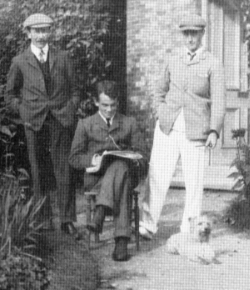
I have picked out this picture to remind us all of happier times.

It was taken by our VC hero, Jack Smyth outside The Lodge a few years before the war, and shows three stalwarts of my Staff: my brother Hum (AE Lynam), Pug (WJL Wallace) and Cheese (GC Vassall).

It seems a long time ago and from a different world now.


May 5th 1917

The battle at Arras continues unabated. Indeed, a couple of nights ago (around 1 a.m) many in Oxford were awoken by the sounds of the artillery bombardment – or so it was believed to be. I did not hear it myself.

* * * * * * *

We now have more encouraging news of William Leefe Robinson. His sister has been told that a captured German airman has revealed that William is alive and is now a prisoner of war.

We still do not know the fate of Peter Warren, who has been missing since April 2nd.

The casualties suffered by our airman last month must be a matter of great concern to our leaders. The Daily Telegraph of April 27th reported a significant increase in our losses (killed, wounded and missing):  January – 56, February – 119, March – 152, April –  319.

Of the twenty or so Old Dragons serving with the RFC, William and Peter are the first to have been declared “missing” and the news of William renews our hope that Peter is also a prisoner.

* * * * * * *

It is good to have the boys back and on the very first day of term our cricket team enjoyed a match against a team of young Old Dragons who are still on holiday. We scored a creditable 63 to the ODs’ 93.

The new boys are settling in well, although there have been some tears. Indeed, I found young Betjemann crying outside the Lodge. We walked up and down the road whilst I tried to comfort him.  He does know Ralph Adams from their holidays in Cornwall, so we have put them both in Form II. Let’s hope Ralph can help buck him up.

My brother Hum got to know the Betjemanns on holiday in Trebetherick a few years ago, and hearing that John was not having a good time of it at Highgate School (where his German-sounding name led to some unpleasantness), suggested he came to board here at the OPS.


May 2nd 1917

Summer Term 1917

Today we open the gates to a new term and we welcome 18 new boys into the school: G Naish (aged 12.9), E Webb (11.1), D Seebohm (10.3), G Page (11.10), C de Bunsen (11.6), T Anson (13.3), J Betjemann (10.8), M Garrett (7.11), C Neep (9.0), C John (8.10), W Haselfoot (9.0), Joan Gibson (9.4), B Gibson (8.1), Marguerite Leplae (9.7), M Edginton (9.2), A Onions (9.1), Joan Stenning (8.8), B Thomas (9.8).

A special mention should also be made of young Stephen Field, who joined us midway through last term. He is the son of the late Captain Stephen Field, who died so heroically whilst tending his fellow prisoners at the Wittenberg Camp.

Stephen has received a War Exhibition at Wellington College and has passed the necessary examination. He is only ten years old and will, I hope, be with us for two or three years before going to Wellington.


April 28th 1917

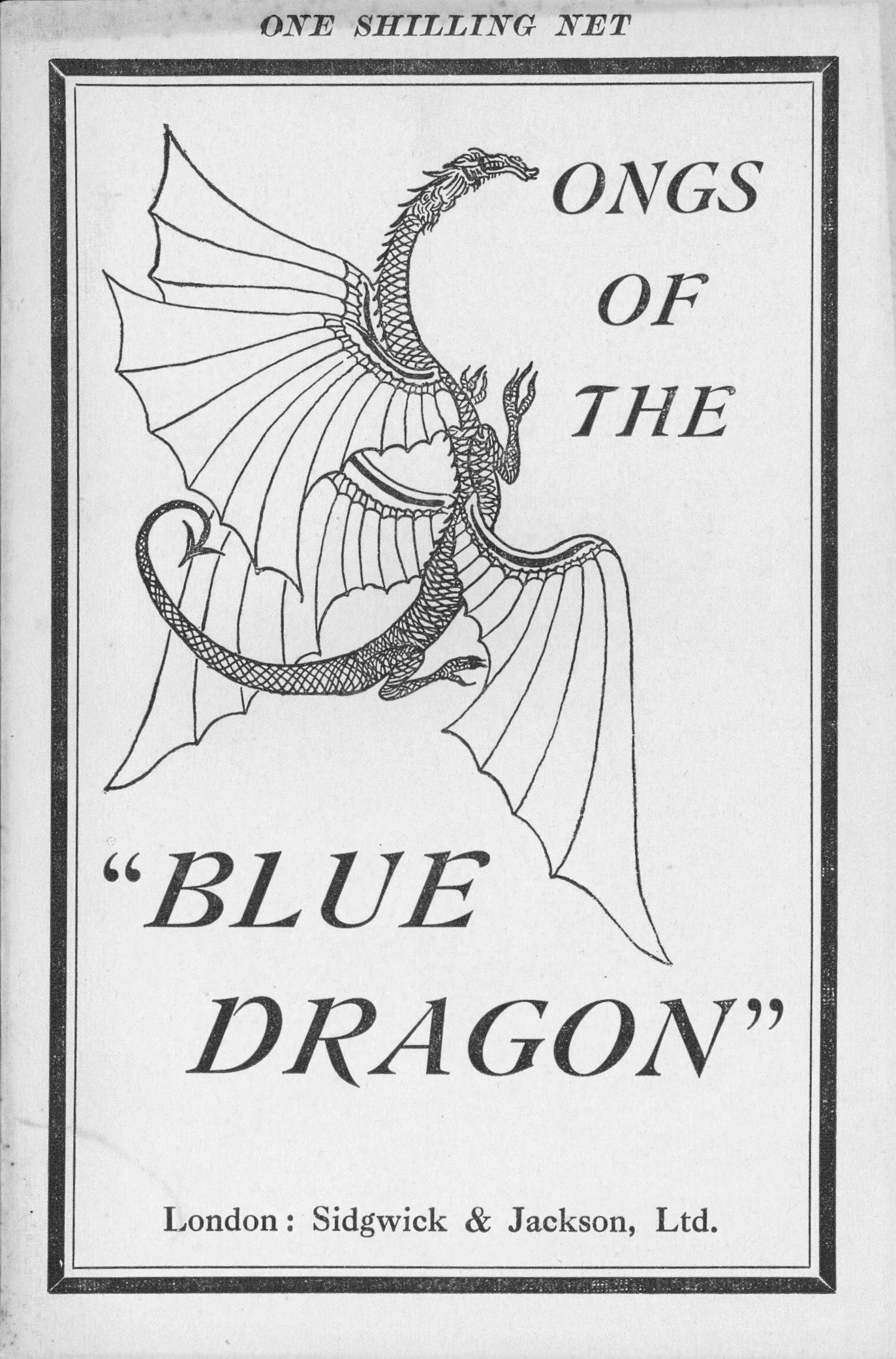
The holidays are a time to enjoy some light reading and I am delighted to say that Sidgwick & Jackson have just published a collection of songs and poems from the previously published ‘Logs of the Blue Dragon.’ It is now on sale for the princely sum of one shilling!

Both Frank and Hugh Sidgwick have contributed to this volume and here, by way of example, is one of Hugh’s contributions:

Nimium ne Crede Experto                               

“This narrow strait,” (the Sailing Directions said)
   “Is full of rocks and difficult to enter;
Whirlpools are common here at every tide;
There are uncharted reefs on every side
   And currents (twenty knots) along the centre.”
“Come,” said the Skipper, “we will go in there.”
            (We went in there.)

“There is no sand” (the Sailing Directions said),
   “The anchorage is thoroughly unsafe.
There is no shelter from the frequent squalls,
Save on the west, among the overfalls.
   Boats should go on to Loch MacInchmaquaif.”
“Come,” said the Skipper, “We will anchor here.”
            (We anchored here.)

                                  Hugh Sidgwick

In my humble opinion, this rather overrates my nautical abilities!

Mr SPB Mais, who came to teach at the OPS for the Summer Term of 1909 (on the recommendation of his tutor at Christ Church, our own Charles Fisher), has written enthusiastically about our new book. He is now at Sherborne School and he describes the arrival of the book there through the post as giving rise to high excitement in the Mais household:

“I forgot my bath, my shaving water, even my breakfast. I was late for chapel and nearly turned my lecture on Range-Finding into a reading on Voyages of a five and a twelve ton yawl. I managed to restrain myself until the English hour for Army candidates. Then for three-quarters of an hour I gave myself up to delirious pleasure…

It is enough to say that no past or present Dragon will feel satisfied until he has learnt by heart all the cheerful, witty, honest poetry which is here presented all for his delight.”


April 21st 1917

Lieut. John Pratt (Yorkshire Regiment)

Announced in The Times yesterday was the death, on April 11th at St. Martin sur Caquel, of Jack Pratt, the second Old Dragon to die in the battle at Arras.

His regiment was involved in an attack on the Hindenburg Line. The artillery having failed to destroy the barbed wire defences, Jack went ahead with a machine gun to find a gap in the wire entanglement through which he might take his Company.  He was picked off by a sniper.

His Commanding Officer has commended him for his gallantry and devotion to duty.

During his time at the OPS Jack was a promising athlete and a merry youngster around the school, with plenty of pluck and nerve. He distinguished himself at Blundell’s School, which he entered in 1908, by getting his cricket and rugger colours whilst still aged 15.

April 19th 1917

2nd Lieut. Rafe Griffith (Royal West Kents) only left us five years ago, in August 1912 (with an Exhibition to St. Bees College, where Harold and William Leefe Robinson also went).

We presume that this description is of the Battle of Arras, which has featured in our newspapers of late and opened up on the morning of April 9th:

14/4/17. “Here we are absolutely untouched. We ‘went over’ at 5.30 a.m., and of course it was raining. Never shall I forget ‘zero.’ There are two outstanding things, barrage and the company going over. Every gun massed at A______ went off together, as though worked by a spring, in one great crash.

The company went over as though starting a 100 yard race, never a man late. The whole way through I can’t say enough for the men. They were magnificent throughout, laughing and joking all the time. There aren’t any duds in the British Army; they are all as plucky as anything and full of the fighting spirit.

We took old Fritz by surprise, entirely; we were over his first lines before he had realised anything. Some of them were in bed with their boots off. I had two lucky escapes. Before we reached our front line, my haversack was shot away; we were finally held up by a strong party of Germans at the end of a communication trench. Three bombing raids were led against them, but their snipers were too hot for us. Then a bullet went through my steel helmet. We finally rushed them over the open and bagged the lot. We then went on to our objective and found Fritz had cleared off.

We stayed there that night and the next day had to go on to the furthest point our troops reached. It snowed hard all the time, and we were all soaked to the skin and a bitter wind was blowing.

On arriving at our destination, we found the Boche on three sides of us and had quite a nasty time from his shelling…

The line nowadays is a very funny place. Both sides sit in shell holes and little bits of trenches a few feet deep, with gaps here and there in the line, so when we take over a bit of the front, we don’t know whether we are hanging by a thread, so to speak, or strongly supported on the flanks. Fritz doesn’t give us much opportunity to find out either, as his snipers are always on the watch and it is more than one’s life is worth to show oneself…

The general feeling out here now is that the war may be over by the Autumn, but that we shall have to fight very hard.”

This is encouraging to hear.

April 16th 1917

clunet-jean

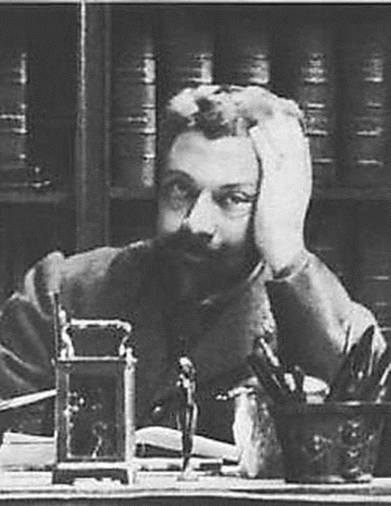
Dr. Jean Clunet

News has reached us that Jean succumbed to the typhus fever on April 3rd.

He joined the French Army as a surgeon at the beginning of the war and had many escapades, which we reported last April.

Following an eventful time in France and Gallipoli, Jean was part of the French military mission sent to Romania to provide assistance. There he was chief doctor of the Infectious Diseases Hospital in Bucharest.

In December, Jean set up a field hospital in the village of Bucium to care for typhus sufferers and this has not only cost him his life, but the lives of several of his staff.

Jean was one of the ten French Old Dragons serving with the French Army.

April 13th 1917

The Times and the Daily Telegraph have announced that our VC winner, Capt. William Leefe Robinson (RFC) is “missing.” Yesterday’s Telegraph added that “he was believed to have been killed.”

He is the second Old Dragon airman to have suffered this fate since the start of the month.  News has reached us that 2nd Lieut. Peter Warren (RFC) is also missing. He has been at the Front barely a month.

Peter was up at Magdalen in 1914 (where his uncle, Sir Herbert Warren, is President) and being only 17 yrs old was not then eligible for service, although he did join the University OTC.

He received his commission last July and trained as an Observer with 57 Squadron. He transferred to 34 Squadron in November to train as a pilot, graduating in early February. At the end of the month he was sent to the front to join 43 Squadron.

The Warrens have close connections with the OPS. Peter’s grandmother, Mrs Morrell, lives at Black Hall (No 21, St Giles) doors away from where the OPS started.

Peter’s uncle is Philip Morrell, who was a Dragon under Mr Clarke from 1878 until 1880, when the school consisted of a few rooms at No 26 St Giles. He now lives at Garsington Manor with his wife, Lady Ottoline, and is the Liberal MP for Burnley.


Both the Leefe Robinson and Warren families and friends will be enduring a period of great strain until further news is received about their loved ones. Certainly it is perfectly possible that, if they came down over enemy held territory, they are prisoners of war. We will live in hope that this is the case.